










 AMLR Solutions
  AMLR Consultation
 EUDI Wallet
 Onboarding
 Ongoing Monitoring
 FRAML
FRAML KYC
KYC KYB
KYB KYI
KYI Age Assurance
 Workforce IAM
 Candidate Verification
 Account Takeover
 Bonus/ Promotion Abuse
 Chargeback Fraud
 Deepfake
 Document Fraud
 Fraud Networks
 Impersonation Fraud
 Money Mule Activity
 Multi-Accounting
 Party Fraud
 Regulatory & Compliance Risks
 Synthetic Identity Fraud
 Adult Content
 Banking
 Crypto
 Fintech
 Forex
Forex Compliance
 Fraud prevention
 Trust & safety
 Global expansion
 Compliance Officers
 Developers
 Fraud Analysts
 Product Managers
 Journey Builder
  Global Trust Platform
 Customer Profiles
 Vendor Comparison
 IDV Case Management
 AML Case Management
 Regulatory Reporting
 Agentic Rule Builder
  AI Compliance Co-Pilot
  Fraud Analytics
 Fraud Hub
  OCR
OCR Shufti AI
 Bank Account Verification
  Biometric Duplication
 Database Checks
 Document Intelligence
 Government ID
 Mobile Driver's License
 NFC
NFC Selfie Liveness
 Brand Personalisation
 Deployment Options
 Identity Methods
 IDV Modes
 Multi-tenancy
 On-Premise IDV
 Secure Capture
 Shufti MCP


E-Commerce and Marketplaces
Ecommerce Identity Verification That Protects Buyers, Verifies Sellers, and Kills Fraud
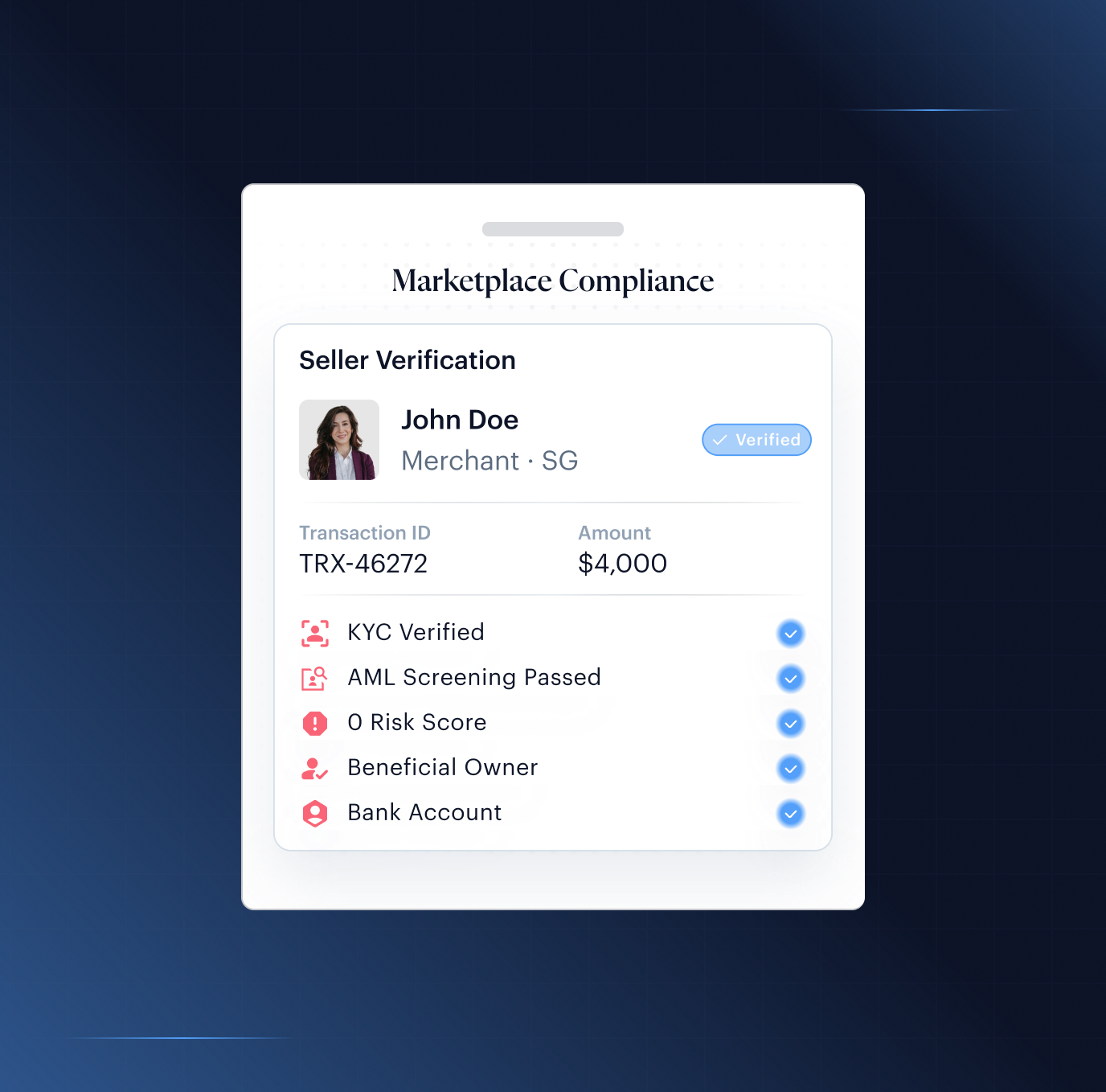
Verify sellers, screen buyers, monitor transactions and meet DSA compliance obligations across 240+ regions actively processed. All from a single integration. One audit trail your legal team can export in under five minutes.
Proven Performance
Our impact, by the numbers
- <30sMedian Time-to-Decision
- 4,000+Watchlists Screened
- 240+Regions Actively Processed
Trusted by Leading Digital Enterprises Worldwide






Compliance Without Compromise
Why MarketPlaces Choose Shufti
-
Stay Ahead of DSA Enforcement
DSA Articles 30-31 require every professional trader to be verified before listing. Fines reach 6% of global annual revenue. Shufti's jurisdiction coverage and AML rule sets update continuously, so compliance posture adjusts as enforcement expands without an engineering sprint.
-
Stop Fraud Before It Lists
Deloitte projects generative AI fraud losses could reach $40 billion by 2027. Shufti's iBETA Level 3 liveness detection and device intelligence intercept sophisticated fraud at first contact, before a fraudulent account ever reaches the listing stage.
-
One Integration Across the Full Journey
From seller KYB to buyer checkout to ongoing AML monitoring, Shufti connects every verification and transaction signal into a single exportable audit trail across 240+ regions actively processed. One DPA. One integration.



Secure Every Stage of the MarketPlaces User Journey

Sign Up
Bot Account Farming
Bot operators spin up thousands of seller and buyer accounts to farm welcome vouchers, inflate ratings, or seed fake storefronts. Proprietary Device Fingerprinting identifies shared emulator stacks and proxy infrastructure across every registration. Behavioural Biometrics stops the campaign at registration. Machine-speed form fills and identical interaction patterns have no human equivalent. The Fraud Hub links every account in the ring before a single listing goes live.
Synthetic Identity Registration
A fraudster stitches stolen PII with fabricated details to create a seller or buyer account that passes basic format checks but has never existed. eIDV independently cross-references the submission against government records and credit-bureau data in real time. A synthetic identity leaves no electronic footprint and fails immediately.
Stolen Identity Registration
A criminal uses a real victim's credentials from a data breach to open a buyer or seller account, leaving the victim unaware. Shufti's eIDV checks the submitted contact details against the identity's known data footprint and flags mismatches the victim would never have created. The biometric step then requires a live selfie, confirming that the person registering is present and matches the claimed identity. An attacker holding only stolen credentials cannot pass both checks.
Multi-Account / Duplicate Sign-Up
A buyer or seller registers multiple accounts under family names or slight ID variations to stack welcome discounts or evade per-account selling limits. Face Verification continuously runs a 1:N deduplication check across all enrolled accounts. The same face cannot open a second one.
Referral Exploit
A single fraudster generates fake referral chains across multiple seller or buyer accounts to drain referral bonus budgets before any genuine platform activity. Device Fingerprinting ties every account back to the same hardware fingerprint. The Fraud Hub intelligently flags the abnormal referral velocity and blocks payouts before the ring completes.
Affiliate / Install Fraud
Click farms generate fake marketplace sign-ups or app installs to drain seller affiliate and marketing budgets, with no real buyer intent. Behavioural Biometrics flags the scripted, uniform interaction patterns. Device Fingerprinting identifies farm devices cycling multiple identities. The Fraud Hub suppresses payouts to fraudulent sources.

Seller Onboarding (KYB)
Business Identity Theft
A fraudster registers as a marketplace seller using a legitimate company's registration number, collects buyer payments, then vanishes. Business Verification checks the entity against authoritative registry data, confirming legal status, directorship, and registered address. Due Diligence cross-references operating history against the declared profile. Discrepancies halt onboarding before the first listing is approved.
Shell Company Registration
A company with no genuine operations registers as a marketplace seller to collect payments, launder funds, or front for a sanctioned individual. Shufti's Business Verification flags entities with no trading history, recent incorporation dates, and nominal capital that does not match the declared business activity. Due Diligence resolves the ownership chain to individual directors and screens each one against AML and sanctions databases. Shell structures with no verifiable commercial substance do not pass.
UBO Concealment
A sanctioned individual hides behind nominee directors and layered corporate structures so their name never appears on a standard company search. Shufti's Due Diligence maps every ownership layer until it reaches the ultimate beneficial owner, regardless of how many entities sit in between. That individual is then screened against 4,000+ watchlists and 215+ sanctions regimes in real time. A match is flagged before a single listing goes live.
Document Forgery
A fraudulent seller submits tampered or fabricated business registration documents to clear the onboarding check and gain access to the platform. Shufti's Document Verification applies forensic analysis across any government-issued document, detecting edited fields, reprinted security features, and MRZ inconsistencies. Where the document has an NFC chip, Shufti reads it directly, bypassing any surface-level image manipulation. A forged document cannot produce a valid chip response.
Deepfake / AI Face Attack
An attacker presents an AI-generated face video during the selfie step to impersonate a legitimate business representative and clear biometric KYB. Shufti's Face Verification applies iBETA Level 3 certified presentation-attack detection, using 3D depth mapping and micro-movement analysis to distinguish a live face from synthetic video. Injection Detection identifies virtual camera drivers at OS level before biometric capture even begins. The attack is blocked before the identity check completes.
Identity Pack Fraud
Dark-web kits pairing a forged document with a matched synthetic selfie are used to clear onboarding checks that rely on visual matching alone. Shufti's NFC Verification reads the cryptographic chip embedded in the identity document, a step no purchased kit can replicate. Document Verification simultaneously checks the physical document for tampering indicators that surface scans miss. Without a valid chip response, the kit fails at the first verification step.
Fake Professional Licences
A seller submits counterfeit regulatory certificates to list in restricted or age-gated product categories that require verified credentials. Shufti's Document Verification checks licence authenticity against known document templates and issuing-body formatting standards. Business Verification cross-checks the declared category permissions against the verified entity profile from registry data. Licences that do not match the issuing body's records block category access.

Buyer KYC
Document Forgery
A buyer submits a tampered or forged ID to establish a verified identity for high-value or age-restricted purchases. Shufti's Document Verification applies forensic checks to identify edited fields, reprinted photos, and MRZ inconsistencies across any government-issued document. Where the document carries an NFC chip, Shufti reads it directly, removing any dependence on visual inspection. A manipulated image cannot produce a matching chip response.
Deepfake / AI Face Attack
An attacker presents a synthetic face video during the buyer selfie step to impersonate a real person and pass biometric KYC. Shufti's Face Verification, certified at iBETA Level 3 under ISO/IEC 30107-3, applies 3D depth analysis and micro-movement detection to reject synthetic video. Injection Detection identifies virtual camera drivers before capture begins, catching attacks that bypass the camera entirely. Both the physical and injection attack vectors are covered in the same flow.
Identity Theft and Impersonation
A criminal uses a victim's stolen identity to open a buyer account and make high-value purchases or access credit-backed checkout. Shufti's eIDV cross-references the submitted details against government and credit-bureau records, flagging contact-detail mismatches the victim would never have created. The biometric step then confirms that the person completing the check is present and matches the claimed identity. Stolen credentials alone cannot clear both layers.
Address Fraud
A buyer submits a fabricated address to unlock regional pricing tiers or bypass geo-restricted product categories. Shufti's Address Verification cross-references the declared address against independent utility, postal, and credit data sources. A fabricated address has no matching electronic footprint in any of those sources. Document Verification confirms that the address on the ID matches what the buyer has declared.
Age Bypass for Restricted Goods
A minor submits a borrowed or forged ID to purchase age-restricted products where only a document check stands between them and the sale. Shufti's Age Verification combines document analysis with a biometric age estimation check, catching mismatches between the face and the declared date of birth. Face Verification confirms the person completing the check is the same individual on the submitted document. A borrowed ID from an adult relative does not pass the biometric match.
Camera Injection Attack
An attacker runs virtual camera software to feed a pre-recorded or synthetic image in place of the live camera during the buyer selfie step. Shufti's Injection Detection identifies virtual camera drivers and emulator signatures at OS level before biometric capture begins. Device Fingerprinting flags the compromised device environment and escalates the session for review. The attack is detected before any biometric data is captured.

Log In
Credential Stuffing
An attacker runs credential-stuffing tools against marketplace login endpoints, targeting seller accounts holding live inventory and stored payout routes. Shufti's Biometric Face Authentication requires a live biometric step alongside credentials, making stolen passwords alone insufficient to access the account. Device Fingerprinting flags login attempts from devices with no history on the platform and triggers MFA step-up before access is granted. The account remains protected even when the password has been compromised.
SIM Swap / 2FA Bypass
An attacker social-engineers a mobile carrier to hijack a seller's phone number, intercepting SMS 2FA codes and gaining full account access to redirect payouts or delist inventory. Shufti's MFA uses TOTP authenticator apps bound to the device, not the phone number, so a SIM swap produces nothing of value to the attacker. Biometric Face Authentication then confirms the live biometric before any sensitive action is permitted. Intercepting the SMS code is not enough to proceed.
Session Hijacking
A stolen session token gives an attacker silent access to a live marketplace account, letting them redirect payouts, alter listings, or drain stored value without triggering a new login. Shufti's Behavioural Biometrics continuously analyses interaction patterns during the live session and detects when the behaviour shifts mid-session. Device Fingerprinting identifies when the session moves to a new, unrecognised device environment. A mismatch triggers automatic re-authentication before any action can proceed.
Phishing / Adversary-in-the-Middle
A fake site mirrors the real marketplace in real time, capturing credentials and 2FA codes from a genuine user who believes they are logging in normally. Shufti's Biometric Face Authentication is bound to the genuine SDK flow and cannot be replicated or proxied on a spoofed site. Fast ID confirms the returning user's biometric without requiring credentials that could be intercepted. The attack fails at the authentication layer.
MFA Fatigue Attack
An attacker spams push-notification 2FA prompts until an exhausted user approves one, granting access without knowing they have done so. Shufti's TOTP-based MFA replaces push notifications entirely, requiring a time-limited code from an authenticator app the attacker cannot access. Behavioural Biometrics flags the abnormal login velocity that precedes a fatigue attack and triggers additional friction before any approval is possible. Approving a push prompt is not an option in this flow.
RAT Scam-in-Progress
A genuine seller or buyer is covertly remote-controlled during a live session, authorising high-value purchases, payout changes, or listing modifications they never initiated. Shufti's Behavioural Biometrics detects the scripted, non-human interaction patterns that remote-access tools produce, even when the session belongs to the legitimate account holder. Consent Verification requires an explicit, unprompted confirmation from the user before any high-value action completes. A coerced or remote-controlled confirmation does not satisfy this check.

Browse and List
Counterfeit and Fake Listings
A fraudulent seller lists goods they do not own or intend to ship, collecting payment from buyers before the account disappears. Shufti's Business Verification ties every active listing to a verified seller identity, so unverified accounts cannot reach active listing status. Document Verification confirms that the trading credentials match the product categories the seller is attempting to list in. Listings without a verified identity behind them are blocked before going live.
Inventory Hoarding Bots
Automated scripts hold high-demand items in carts at scale, locking out genuine buyers until the bot operator resells access at a premium. Shufti's Device Fingerprinting identifies emulator and automation signatures that cart-hoarding scripts produce. Behavioural Biometrics flags the inhuman precision and speed of scripted add-to-cart sequences that no real shopper replicates. The Fraud Hub aggregates the signals and blocks the bot cluster before inventory is locked.
VPN / Proxy Geolocation Spoofing
A seller or buyer uses a VPN or residential proxy to misrepresent their location and gain access to geo-restricted categories or pricing tiers. Shufti's Device Fingerprinting detects proxy and VPN routing patterns that do not match the declared account location. Address Verification cross-references the declared address against independent utility and postal data, flagging the location mismatch. Accounts where the IP, device, and address signals do not align are escalated.
Click Farm Engagement Fraud
Human-operated click farms generate fake reviews and listing engagements to manipulate search visibility and build artificial social proof. Shufti's Behavioural Biometrics analyses session-level interaction patterns and identifies farm-like engagement signatures distinct from genuine browsing. Device Fingerprinting links the farm devices operating multiple accounts in sequence. The Fraud Hub surfaces the coordinated activity across accounts regardless of how many identities are in the ring.
Emulator / Headless Browser Attack
An attacker generates listing and browsing activity from device emulators or headless browsers designed to look like real user sessions. Shufti's Device Fingerprinting detects emulator signatures, virtual device environments, and headless browser patterns at OS and hardware level. The Fraud Hub cross-references these signals against known attack infrastructure and flags the sessions before any platform interaction is recorded as genuine.
Price Scraping Bots
Headless browser scripts harvest platform pricing at scale, enabling automated undercutting or market-rate manipulation across categories. Shufti's Device Fingerprinting distinguishes scraping infrastructure from genuine buyer devices by hardware and environment signature. Behavioural Biometrics identifies the uniform, rapid browsing cadence that scraping bots produce compared to real shoppers. Sessions identified as automated scrapers are rate-limited or blocked.

Purchase and Checkout
Stolen Card / CNP Fraud
A fraudster uses stolen card details to fund a high-value marketplace order, covering electronics, luxury goods, or bulk inventory, before the legitimate cardholder notices and raises a dispute. Shufti's Device Fingerprinting scores the device at checkout and flags hardware previously associated with card fraud. Transaction Monitoring detects the velocity and value patterns that distinguish card-testing sequences from normal purchasing behaviour. High-risk checkout sessions trigger biometric step-up before the order is confirmed.
BNPL Synthetic Identity Fraud
A fictitious identity clears buy-now-pay-later onboarding to acquire marketplace goods on credit, including high-ticket electronics, appliances, or fashion, with no intention of repaying. Shufti's eIDV cross-references the applicant against credit-bureau and government data, catching identities with no legitimate financial footprint. Face Verification confirms that a live person is present and matches the submitted identity, blocking fabricated applications. The Fraud Hub links the attempt to other synthetic registrations from the same device or network.
Triangulation Fraud
A fraudster operates a fake storefront, collecting real card data from buyers and fulfilling orders using stolen cards at legitimate merchants. Shufti's Business Verification requires every seller to have a verified identity and trading credentials before their storefront goes live. Transaction Monitoring detects the payout patterns and order structures that triangulation schemes produce. Unverified storefronts cannot reach active status.
Friendly Fraud / Chargeback Abuse
A genuine cardholder completes a legitimate purchase, receives the goods, and then disputes the transaction to recover the payment. Shufti's Consent Verification captures a cryptographic record that the verified account holder authorised the specific transaction. That record is non-repudiable under card-scheme dispute rules, giving the platform defensible evidence before the chargeback is raised. Transaction Monitoring flags accounts with elevated dispute rates for enhanced review.
Test-Card Carding Attack
High-velocity small-value transactions probe a platform's payment stack to validate stolen card numbers before full exploitation begins. Shufti's Transaction Monitoring detects micro-transaction velocity sequences that no genuine purchase pattern produces. Device Fingerprinting links the probing activity to known fraud infrastructure. The Fraud Hub suppresses the card-testing sequence and escalates the device cluster for investigation.
Account Takeover at Checkout
An attacker exploits a compromised account with a stored card to execute high-value purchases the moment they gain access. Shufti's Biometric Face Authentication requires a live biometric match before any transaction above the configured threshold can proceed. Behavioural Biometrics detects interaction pattern changes mid-session that indicate a different person is now controlling the account. Device Fingerprinting flags unrecognised environments and triggers re-authentication before checkout completes.

Payment and Payout
Money Mule Deposit
A seller account receives funds from a third party on behalf of criminals, then converts them into a legitimate-looking payout and forwards the proceeds. Shufti's Transaction Monitoring detects third-party funding patterns and rapid deposit-to-payout sequences that genuine seller revenue does not produce. AML Screening screens the funding source against 4,000+ watchlists in real time. The Fraud Hub surfaces the mule-network structure across linked accounts and escalates before payout clears.
Structuring / Smurfing
High-value illicit payments are broken into multiple sub-threshold transactions across accounts to avoid triggering AML reporting rules. Shufti's Transaction Monitoring analyses payment patterns over time, not just individual transactions, detecting consistent sub-threshold amounts that do not match declared business volumes. AML Screening cross-references the accounts involved against sanctions and adverse media sources. Coordinated ring behaviour across accounts is surfaced in the Fraud Hub.
Sanctioned Seller Payout
A payout is sent to a seller whose ultimate beneficial owner appears on a global sanctions list, creating regulatory exposure for the platform. Shufti's AML Screening re-screens every active seller on a 15-minute cycle against 4,000+ watchlists and 215+ sanctions regimes, including OFAC SDN, EU consolidated, and UK HMT lists. Due Diligence maintains the UBO record so a re-designation surfaces at the beneficial-owner level, not just the company name. A matched seller is flagged and their payout is held before funds transfer.
Invoice Redirection / Vendor Fraud
Payout banking details are intercepted and replaced with the fraudster's account information, redirecting legitimate seller payments. Shufti's Biometric Face Authentication requires a live biometric confirmation before any payout destination can be added or changed. Consent Verification provides a timestamped, cryptographic record that the verified account holder authorised the specific change. An attacker with temporary account access cannot produce either.
APP Scam at Payout
A seller is socially engineered into authorising a payment to a fraudster posing as a platform representative or logistics contact. Shufti's Consent Verification ties every authorised payment to the verified account holder, providing evidence the action was taken by them. Behavioural Biometrics flags coercion indicators in the session, including unusually long pauses, copy-paste behaviour, and scripted navigation. Transaction Monitoring escalates payment events that deviate from the seller's established payout patterns.
Chargeback Fraud at Settlement
A buyer disputes a legitimate purchase immediately after delivery to recover the payment while keeping the goods. Shufti's Consent Verification creates a timestamped record of the verified buyer authorising the specific transaction at checkout. That record anchors the purchase to the verified identity and provides defensible evidence in the card-scheme dispute process. Transaction Monitoring flags accounts with repeat dispute patterns for enhanced review and limit adjustment.

Dispute and Refund
False INR Claim
A buyer claims goods never arrived to obtain a full refund while keeping the product, with no genuine delivery failure involved. Shufti's Consent Verification ties the original purchase to the verified buyer identity with a timestamped authorisation record. Transaction Monitoring cross-references the dispute claim against the account's full purchase and dispute history. Accounts with repeated INR patterns across multiple orders are escalated automatically before refunds are approved.
Return Abuse
A buyer returns a damaged, used, or counterfeit item while keeping the genuine product, exploiting lenient return policies at scale. Shufti's Biometric Face Authentication ties the return confirmation to the verified account holder, ensuring the same person who made the purchase is initiating the return. Face Verification confirms live presence during high-value return requests, blocking returns submitted by someone other than the verified buyer. Consent Verification records the return authorisation as a non-repudiable event.
Refund-as-a-Service Ring
Organised groups coach buyers through repeated INR or not-as-described claims in exchange for a percentage of the refund value. Shufti's Fraud Hub cross-references dispute patterns across accounts, surfacing coordinated claim timing and shared device infrastructure that individual account review cannot see. Device Fingerprinting links coached buyers operating from the same environment as the orchestrating party. The ring structure is identified and flagged before the next claim cycle.
Return Request Velocity Attack
Rapid refund requests are submitted in sequence to exhaust manual review capacity before the pattern is identified and the account is restricted. Shufti's Transaction Monitoring detects abnormal return-request velocity at the account and device level in real time. The Fraud Hub aggregates signals and automatically escalates high-risk cases before the refund queue becomes unmanageable. High-velocity accounts are restricted pending review without manual intervention.
First-Party Refund Fraud
A genuine account holder systematically exploits refund policies using their own verified identity, staying below per-incident thresholds that would normally trigger a flag. Shufti's Transaction Monitoring tracks lifetime dispute and refund rates per verified identity across the full account history. The Fraud Hub detects the cumulative pattern that per-transaction checks miss and triggers enhanced review when the threshold is crossed. Future purchases by the account are automatically placed under elevated scrutiny.
Friendly Fraud Recidivism
The same buyer repeatedly disputes legitimate transactions across multiple order cycles, knowing that each individual dispute looks insufficient to trigger action on its own. Shufti's Fraud Hub maintains a cross-transaction dispute history tied to the verified identity, not just the most recent order. Transaction Monitoring detects the repeat pattern and automatically adjusts the account's risk score. Threshold breach restricts purchasing and payout limits without requiring a manual review decision.

Account Maintenance
Password Reset Account Takeover
An attacker uses a SIM swap or email compromise to intercept the password reset link, gaining full account access without the legitimate user's knowledge. Shufti's Biometric Face Authentication requires a live selfie matched to the enrolled KYC biometric before any password reset can complete. Email or phone compromise alone cannot produce that match. Device Fingerprinting flags the reset attempt from an unrecognised environment and adds friction before the reset is processed.
Fraudulent Bank Account Addition
An attacker with partial account access adds their own bank account as a payout or withdrawal destination, redirecting future payments. Shufti's Biometric Face Authentication requires biometric re-verification before any new payout destination can be saved to the account. Device Fingerprinting flags the addition attempt from an environment not associated with the account holder's normal sessions. Partial account access is not sufficient to pass either check.
Identity Detail Change to Evade Screening
After receiving an AML or fraud flag, a user attempts to alter their registered name, date of birth, or address to clear their profile and re-enter good standing. Shufti's AML Screening triggers an automatic re-screen whenever a core identity field is changed. Document Verification and eIDV re-verify the updated details against authoritative data sources before the change is accepted. The original flagged record is retained regardless of what the user updates.
Continuous Session Takeover
A stolen session token is used to access an authenticated account mid-session, allowing settings changes and data extraction without a visible new login event. Shufti's Behavioural Biometrics continuously monitors interaction patterns during the live session and detects when they shift in a way that indicates a different person is in control. Device Fingerprinting identifies movement of the session to an unrecognised environment. Either signal triggers automatic re-authentication before any change is saved.
Support Channel Social Engineering
An attacker impersonates the account holder in a support interaction, using PII knowledge to convince a support agent to change account settings or escalate permissions. Shufti's Biometric Face Authentication requires biometric re-verification for any support-initiated account change, regardless of how much PII the caller can provide. Fast ID enables a frictionless re-verification step the legitimate user completes in seconds. No amount of PII knowledge substitutes for the enrolled face.
New MFA Device Addition Attack
An attacker with temporary account access registers a new MFA device, then locks out the legitimate account holder by controlling future authentication prompts. Shufti's Biometric Face Authentication requires a biometric confirmation matching the enrolled KYC record before any new MFA device can be registered. Device Fingerprinting flags the registration attempt from an unrecognised environment and triggers an alert to the account holder. Temporary access cannot complete the biometric step.

Re-Verification
Fake Documents for Higher Tier
user submits a forged ID or fabricated utility bill in an attempt to unlock higher purchase or payout limits beyond what their verified tier permits. Shufti applies the same forensic document checks at the upgrade stage as at initial onboarding, with no reduced scrutiny for returning users. NFC Verification reads the chip on the submitted document, blocking any forgery that passes visual inspection. The face on the upgrade document must also match the originally enrolled biometric.
Address Fraud for Regional Tier Change
A user submits a fabricated utility bill to move into a lower-restriction jurisdiction tier with higher limits or fewer compliance checks. Shufti's Address Verification cross-references the submitted address against independent utility, postal, and credit data from that jurisdiction. A fabricated document has no matching electronic footprint in any of those sources. Document Verification confirms the physical document has not been edited to match a target location.
KYC Recycling
An attacker reuses a previously verified identity package across multiple upgrade attempts or separate accounts to avoid submitting new documents that might fail checks. Shufti's Face Verification runs the upgrade selfie against all enrolled identities on the platform, not just the current account. A recycled identity package produces a biometric match to an account other than the one requesting the upgrade. The attempt is flagged and both accounts are escalated for review.
Identity Swap at Re-VerificationI
A user claims their original ID was lost and submits different documents at re-KYC, effectively trying to replace their verified identity with a new one. Shufti's Biometric Face Authentication requires the current selfie to match the originally enrolled biometric, regardless of what new documents are presented. Face Verification at iBETA Level 3 confirms the match under the strictest presentation-attack detection tier. New documents alone cannot change the identity on record.
Support Social Engineering for Limit Increase
An attacker calls support to argue for a manual limit override, claiming identity or account issues to bypass the standard upgrade process. Shufti's Biometric Face Authentication requires biometric re-verification for any limit change, whether initiated by the user or by a support agent. Fast ID provides the legitimate user a frictionless way to complete this check in seconds. Knowledge-based authentication has no role in the limit decision.

Account Deactivation
Pre-Investigation Closure
An account holder requests closure and a GDPR erasure simultaneously, attempting to destroy transaction and identity evidence before a compliance review or investigation begins. Shufti's Transaction Monitoring runs a final history review and AML check before any closure request is processed. Regulatory retention obligations override the erasure request, preserving the legally required evidence chain. The account is deactivated but the compliance record remains intact.
Balance Extraction Before Closure
Immediately after receiving a compliance communication, an account holder withdraws the full balance and then submits a closure request to prevent further investigation. Shufti's Transaction Monitoring flags full-balance withdrawal events that follow compliance triggers as a high-risk signal. Biometric Face Authentication confirms the account holder is present for the withdrawal, and the event is logged with a regulatory hold flag. The closure request is queued for compliance review before processing.
Re-Application Under New Identity
An offboarded account holder re-applies using different documents or a close associate's identity, expecting the deactivated record to create no barrier. Shufti's Face Verification compares every new applicant's selfie against all previous accounts, including deactivated ones. The same face cannot clear onboarding under a different name. AML Screening also runs on the new application to catch any new watchlist entries since the original account was closed.
GDPR Erasure to Destroy Evidence
A deactivating user submits a GDPR Article 17 erasure request timed to remove AML decision records or transaction evidence supporting an ongoing investigation. Shufti separates personal data subject to erasure rights from legally retained compliance records, which are governed by AML and regulatory retention obligations. AML Screening and Transaction Monitoring records are preserved independently of the personal data erasure. The erasure request is processed for eligible personal data while the compliance record remains untouched.
Coordinated Ring Offboarding
Multiple accounts within a fraud ring close simultaneously after executing a scheme, aiming to prevent the cross-account pattern analysis that would expose the full network. Shufti's Fraud Hub captures cross-account signal connections at the point of closure, not only during active account operation. Linked accounts trigger coordinated investigation flags regardless of individual closure requests. Face Verification and AML Screening run on every account in the linked cluster before any closure is confirmed.
Built For Every Role That Owns The Onboarding Decision
Combine products across identity, compliance, and fraud defence to build a verification stack that meets your regulatory requirements; without rebuilding the integration each time the rulebook changes.
Compliance Officer
Stop manually reconciling vendor data. Shufti delivers a unified, jurisdiction-specific evidence package for every buyer and seller decision, updated in real time. DSA Article 30 queries are answered from one log.
Head of Product
Configure risk-tiered verification flows that match your seller categories and buyer risk levels. Localised pass-rate data from 240+ regions actively processed means the user experience can be optimised before going live in a new market.
Head of Engineering
One REST API covers the full user lifecycle: seller KYB, buyer KYC, AML screening, and transaction monitoring. Mobile and web SDKs included. Enterprise-grade SLAs with a sandbox available immediately.
Fraud Analyst
Reduce manual review time with a unified Fraud Hub that connects buyer, seller, and device signals into a single case view. The reason behind every flag is visible before the case is even opened.
Don’t just take our word for it, hear from our customers
The Confidence Our Clients Share

The future of digital identity is defined by trust, interoperability, and regulatory alignment, so our partnership with Shufti reinforces DevCode Identity’s commitment to supporting our global customers with the most secure, best-in-class, compliant identity verification solutions available today.
Combining our Conversion Driven Compliance Orchestration Platform with Shufti’s global KYC and IDV capabilities allows our customers not only to navigate complex regulatory demands but also to maintain a seamless customer onboarding experience with the highest achievable conversion rates.
We’re proud to continue our partnership with Shufti as we expand into new jurisdictions.
Shufti’s verification technology not only strengthens our compliance framework but also ensures our players enjoy a smooth, secure onboarding experience.
We aim to offer our clients and their traders the very best tools with which to do their jobs, we’re excited to be able to work with Shufti.
They’re a leading company, and we’re looking forward to offering their solutions to our clients through our CRM.
The relationship with Shufti was born out of frustration with an existing provider, so we started our discussion with Shufti.
The response time was excellent, from the start of speaking to sales to getting up and running with the demo.
Everything you need to know in one place
Frequently Asked Questions
DSA Articles 30 and 31 require marketplace platforms to collect and verify the identity, address, and contact details of every professional trader before they can list products. Platforms must also make reasonable efforts to confirm that information is accurate. Fines reach 6% of global annual revenue. Shufti's compliance rule sets cover DSA trader verification, AMLD6, OFAC, and INFORM Consumers Act requirements from a single integration.
ISO/IEC 30107-3 PAD Level 3 is the highest independent certification tier for presentation attack detection. iBETA tested Shufti's liveness system against physical artefacts, video replay attacks, and deepfake injection vectors. Level 3 certification confirms the system passed at the most demanding attack tier in the standard, covering both seller onboarding and buyer verification flows.
A single REST API covers document verification, biometric liveness, KYB business-registry checks, UBO resolution, AML screening, address verification, and transaction monitoring. Risk-tiered workflows apply different verification depths to buyers, casual sellers, and professional traders without a separate vendor integration for each.
Watchlist refresh runs on a 15-minute cycle across 4,000+ lists, 50,000+ adverse media sources, and four PEP tiers. The 215+ sanctions regimes covered include OFAC SDN, EU consolidated, UN Security Council, UK HMT, and national-level lists. Each match generates a cryptographic hash so the screening decision can be re-verified in audit.
A sandbox is available immediately for integration testing. A standard production setup covering seller verification, buyer KYC, AML screening, and address checks for a single market typically goes live within two to eight weeks, depending on internal QA cycles. Mobile and web SDKs are included. Compliance teams can update rules and add countries through no-code workflow tools without engineering support.
Evaluate Shufti Against Your Current Marketplace Stack
DSA Articles 30-31, AMLD6, and the INFORM Consumers Act require a verification architecture that connects seller onboarding to ongoing transaction monitoring. Point-solution stacks cannot share identity records, produce consistent audit trails, or update compliance rules from a single source. Evaluate whether your current stack meets that standard.
Your Go-To for KYC/AML & Fraud
Resources

10 September, 2026
Misterb&b Strengthened Trust and Safety Across Global Travel
How misterb&b cut chargebacks by 50% and lifted verification pass rates from 77% to 88%, with country rules and fraud checks set up for each travel market it serves.
Case Study