








 AMLR Solutions
  AMLR Consultation
 EUDI Wallet
 Onboarding
 Ongoing Monitoring
 FRAML
FRAML KYC
KYC KYB
KYB KYI
KYI Age Assurance
 Workforce IAM
 Candidate Verification
 Account Takeover
 Bonus/ Promotion Abuse
 Chargeback Fraud
 Deepfake
 Document Fraud
 Fraud Networks
 Impersonation Fraud
 Money Mule Activity
 Multi-Accounting
 Party Fraud
 Regulatory & Compliance Risks
 Synthetic Identity Fraud
 Adult Content
 Banking
 Crypto
 Fintech
 Forex
Forex Compliance
 Fraud prevention
 Trust & safety
 Global expansion
 Compliance Officers
 Developers
 Fraud Analysts
 Product Managers
 Journey Builder
  Global Trust Platform
 Customer Profiles
 Vendor Comparison
 IDV Case Management
 AML Case Management
 Regulatory Reporting
 Agentic Rule Builder
  AI Compliance Co-Pilot
  Fraud Analytics
 Fraud Hub
  OCR
OCR Shufti AI
 Bank Account Verification
  Biometric Duplication
 Database Checks
 Document Intelligence
 Government ID
 Mobile Driver's License
 NFC
NFC Selfie Liveness
 Brand Personalisation
 Deployment Options
 Identity Methods
 IDV Modes
 Multi-tenancy
 On-Premise IDV
 Secure Capture
 Shufti MCP


Social Networks
Stop fake accounts, protect minors and stay compliant with one platform
Verify users, protect communities and stay ahead of the Online Safety Act, DSA, COPPA and Australia's under-16 mandate; all from one platform, one API and one audit trail.
Proven Performance
Our impact, by the numbers
- <30sMedian Time-to-Decision
- 4,000+Watchlists Screened
- 240+Regions Actively Processed
Trusted by Leading Digital Enterprises Worldwide






Compliance Without Compromise
Why Social Platforms Choose Shufti
-
Stay Ahead of Regulation
The UK Online Safety Act is in force. The EU Digital Services Act applies to every platform with 45 million or more EU users. Australia's under-16 mandate carries fines up to $32 million per non-compliance. Shufti's jurisdiction coverage and AML rule sets update continuously; your compliance posture moves with the regulation, not behind it.
-
Stop Fraud Before It Onboards
Generative AI has cut the cost of fabricating identity documents and synthetic faces to near zero. Shufti's iBETA Level 3-certified liveness detection and device intelligence intercept deepfakes, bot farms and stolen-identity registrations at first contact; before a fraudulent account reaches your community.
-
Onboard Without Losing Users
A median decision time under 30 seconds across 240+ regions actively processed means real users clear verification before they abandon. Risk-tier configuration routes low-risk users through frictionless electronic checks and reserves document-plus-liveness for high-risk segments.



Secure Every Stage of the Social User Lifecycle

Sign Up
Bot Account Farming
An automated script attempts to register thousands of accounts in minutes, cycling through proxy IPs and pre-filled form data to harvest sign-up bonuses or seed spam networks. Device Fingerprinting identifies the emulator environment, scripted input patterns and proxy rotation before the first account is created. Behavioural Biometrics detects the inhuman speed and uniformity of form completion that no real user produces. Fraud Hub cross-references the device signature against known bot infrastructure and blocks the entire campaign at source.
Synthetic Identity Registration
A fraudster assembles a fictitious person from fragments of real stolen PII and fabricated details, then submits the identity expecting format checks alone to pass. eIDV cross-references the declared identity against government, telco and credit bureau records simultaneously; a synthetic combination produces contradictions that a real person's data footprint would not contain. Device Fingerprinting links the registration attempt to previously flagged fraud infrastructure if the same hardware has been used before. The identity is rejected before an account is created.
Underage Sign-Up Circumvention
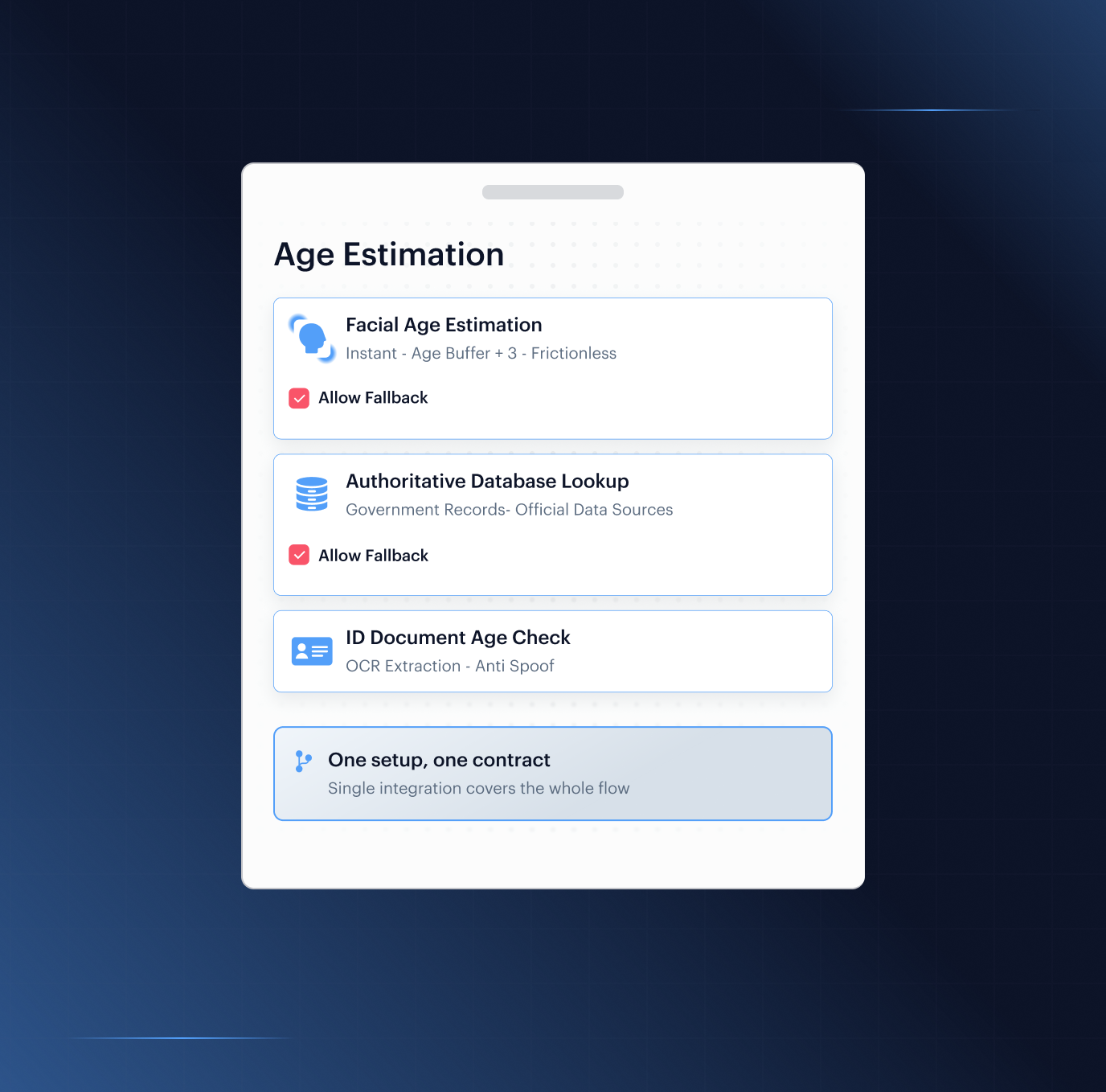
A minor enters a false date of birth to appear old enough to register, knowing that date-of-birth fields are the only check on most platforms. Age Estimation analyses the selfie taken at registration and returns an estimated age with a confidence score; a child's facial characteristics produce an estimate inconsistent with the declared adult age. Where the confidence threshold is not met, Age Verification escalates to an electronic identity check or document step to confirm the declared date of birth against independent records. The account creation is blocked before the minor reaches the platform.
Multi-Accounting
A single person registers a second or third account using name variations or a family member's details to exploit per-user limits or evade a previous ban. 1:N Facial Deduplication runs the new account selfie against every enrolled face on the platform and returns a match to the existing account within seconds. Device Fingerprinting links the new registration to the same hardware or network used for the original account, providing a second independent confirmation. Fraud Hub surfaces the full pattern, matched face, shared device, correlated registration timing, and flags the account before it activates.
Stolen Identity Registration
A fraudster uses real PII sourced from a data breach to register on behalf of a victim who has no idea their identity is being used. eIDV checks the submitted details against independent contact records and flags mismatches; the fraudster's device location and contact details rarely align with the victim's genuine data footprint. The biometric step then requires a live selfie, and the fraudster's face does not match any identity document tied to the stolen PII. The registration fails without the victim ever being contacted.
Disposable Identity Sign-Up
A bad actor uses a temporary email address and a VOIP number to register an account with no traceable real identity, typically at scale across multiple platforms. Device Fingerprinting checks the registration device against known patterns of mass-registration infrastructure and flags disposable contact credentials at the point of submission. eIDV finds no matching electronic footprint for the identity submitted alongside the temporary contact details. Fraud Hub cross-references the device against previous disposable-identity registrations and blocks the attempt before it completes.
VPN-Masked Geo-Evasion
A user in a sanctioned or restricted jurisdiction installs a VPN to appear in a permitted country during registration, then declares an address that matches their VPN exit node rather than their actual location. Device Fingerprinting detects the VPN or proxy signature and flags the mismatch between the claimed location and the true network origin. eIDV cross-references the declared address against independent data sources and finds no matching record in the stated jurisdiction. AML Screening then checks the registration against sanctions regimes applicable to the user's actual geographic origin before the account activates.

Age Verification
Document Forgery
A user submits a tampered or fabricated ID to pass an age check, using a kit purchased for under $50 on a dark-web market. Document Verification applies forensic analysis across any government-issued document, checking font consistency, security feature placement and micro-print against known-genuine specimens, and flags the fabricated document within seconds. NFC Verification reads the cryptographic chip embedded in a genuine e-passport or national ID, producing a chip-level authentication that a printed or digitally altered document cannot replicate. A purchased forgery has no working chip, so the attempt fails at that step.
Deepfake / AI Face Attack
A fraudster generates an AI-produced video of an adult face and presents it during the selfie capture step to impersonate a real person and pass the age check. Face Verification uses 3D depth mapping and micro-movement analysis to distinguish a live human face from a synthetic or replayed video; characteristics that AI-generated footage cannot reliably reproduce. Injection Detection checks at OS level for virtual camera drivers or application spoofing software before biometric capture begins, preventing the substituted feed from ever reaching the liveness engine. The system is iBETA Level 3 certified, validated against the most demanding synthetic-face attack scenarios.
Camera Injection Attack
A fraudster uses virtual camera software to feed a pre-recorded video or synthetic image to the verification system instead of the device's live camera. Injection Detection identifies virtual camera drivers and emulator signatures at OS level before the biometric capture session opens. Device Fingerprinting confirms the device environment is consistent with a genuine mobile or desktop device rather than an emulated or rooted environment. Any session where these signals are present is terminated before a biometric result is produced.
Identity Pack Fraud
A fraudster purchases a dark-web kit containing a forged document and a matched synthetic selfie for $50 to $500, and uses it to attempt to pass both document and biometric verification steps. NFC Verification attempts to read the cryptographic chip on the submitted document; a forged or printed document contains no working chip, and the attempt fails immediately. Document Verification independently flags the physical and digital inconsistencies in the forged document. eIDV cross-references the identity details against independent records and finds no matching electronic footprint for the fabricated combination.
Parental ID Borrowing
A child uses a parent's or older sibling's genuine ID document to attempt to pass an age verification check, knowing the document itself is real and would pass forensic inspection. Face Verification requires the live selfie submitted at verification to match the portrait on the document; a child's face does not match an adult's, and the biometric comparison returns a non-match regardless of whether the document is genuine. Biometric Face Authentication at subsequent sessions confirms the same enrolled face is present, preventing access even if a different family member holds the account credentials. A genuine document and correct password are not enough without the matching face.
Age Estimation Bypass via Disguise
A minor applies makeup or physical disguise to appear older during a selfie-based age estimation check, hoping the model returns an adult-range estimate. Age Estimation applies multiple model outputs and returns a confidence score alongside the estimated age; borderline or high-uncertainty results do not automatically produce a pass. Where confidence falls below the configured threshold, the flow escalates automatically to a document verification step that confirms the declared date of birth against an independent record. Face Verification validates liveness throughout, ensuring the submitted selfie is from a live person and not a static image.
Repeated Verification Retry
A minor who fails age verification attempts to retry multiple times with different images, documents or selfie angles, hoping that enough attempts will eventually produce a pass. Device Fingerprinting ties every retry to the same device session, so each failure is linked to the same hardware regardless of what image or identity is submitted next. Fraud Hub detects the pattern of repeated failures from the same device, applies an increasing retry penalty and escalates the session to manual review or a hard block after a configurable number of attempts. No combination of retried images can produce a pass once the session is flagged.

Profile Setup
Impersonation / Fake Celebrity Profile
A fraudster creates a profile using stolen photos of a public figure, intending to scam followers or conduct fraud under borrowed authority. 1:N Facial Deduplication compares the profile selfie submitted at verification against every enrolled face on the platform; if the same face is already registered under a different identity, the mismatch is flagged before the account goes live. Fraud Hub cross-references the account against known impersonation patterns, including name combinations and profile photo sources associated with previous attempts. An account whose verified face matches a known identity but whose profile claims a different one is surfaced for Trust and Safety review.
Catfishing
A fraudster steals photographs of a real person from another platform and uses them to build a convincing false persona for romance scams, grooming or targeted harassment. Face Verification at profile setup requires the submitted profile selfie to match the face captured during identity verification; a stolen photograph of someone else will not match the fraudster's verified biometric. 1:N Facial Deduplication checks whether the verification face has previously been enrolled under a different identity, flagging fraudsters who cycle between personas. Fraud Hub surfaces accounts where the verification face and profile image diverge, or where the device is associated with previous catfishing flags.
Coordinated Fake Network Setup
A group creates dozens of fake profiles simultaneously using shared device infrastructure, intending to seed an inauthentic community or carry out coordinated influence operations. Device Fingerprinting links each profile creation event to the underlying hardware and network; accounts created in rapid succession from the same device or network block are flagged as a coordinated cluster rather than treated as independent registrations. 1:N Facial Deduplication confirms whether any of the new profiles share a verified biometric identity, exposing a single operator behind multiple personas. Fraud Hub surfaces the full cluster pattern and enables a single enforcement action to deactivate all linked accounts simultaneously.
Bot Profile for Follower Farming
Automated accounts are created at scale to sell fake followers, manufacture engagement metrics or amplify disinformation, each going through a scripted profile-completion flow. Behavioural Biometrics analyses the interaction patterns during profile setup; scripted flows produce timing, field-completion order and input velocity that no real user replicates, and flags the session before the profile is published. Device Fingerprinting links the account to infrastructure used in previous mass-registration events on the platform. Fraud Hub cross-references the device signature against known follower-farm infrastructure and applies a block before the account becomes active.
Harassment Account Setup
A user who has been banned for targeted harassment creates a new account immediately after, using variations of their previous identity details to re-establish contact with their target. 1:N Facial Deduplication checks the new account selfie against all previously enrolled faces including deactivated and banned accounts, and returns a match to the original banned identity within seconds. Device Fingerprinting links the new registration to the same hardware or network used by the banned account, providing a second independent confirmation signal. Fraud Hub surfaces both signals together and enables the platform to block the account before it sends its first message
Underage Profile Misrepresentation
A minor who passed the initial age gate at registration sets up a profile declaring an adult age to access age-gated content categories restricted to over-18 users. Age Verification at onboarding creates a verified age record tied to the account; any profile field declaring a different age is checked against the verified record and flagged automatically. Ongoing Monitoring tracks post-onboarding behaviour signals, including content interactions and feature usage, that are inconsistent with the verified age profile and triggers a step-up re-verification where the divergence is significant. Fraud Hub maintains the full history of the account's behaviour signals to support compliance review decisions.

Log In
Credential Stuffing
An attacker runs a credential stuffing tool against the platform's login endpoint, testing billions of leaked username-password combinations sourced from previous data breaches on other platforms. Biometric Face Authentication requires a live biometric match at login; even a correct password is insufficient to access the account without the enrolled account holder's face. Device Fingerprinting flags login attempts from devices or IP ranges not associated with the account's history, adding friction for anomalous access attempts. MFA with TOTP provides an additional locally generated factor that credential dumps cannot supply, ensuring three independent signals must align before access is granted.
SIM Swap / 2FA Bypass
An attacker convinces the account holder's mobile carrier to transfer their phone number to a new SIM card, then uses SMS-based 2FA codes to access accounts while the victim is locked out. MFA using TOTP authenticator apps generates codes locally on the user's enrolled device and is entirely phone-number independent; a SIM swap gives the attacker no access to TOTP codes regardless of which number they now control. Biometric Face Authentication adds a biometric layer that the attacker cannot satisfy even with the correct TOTP code, requiring the enrolled account holder's live face before access is granted. The combination makes SIM swap attacks ineffective against accounts using both factors.
Session Hijacking
An attacker steals a valid session token through malware or network interception and uses it to access an authenticated account without triggering a new login event. Behavioural Biometrics runs continuously throughout the session, building a real-time model of the account holder's interaction patterns, typing cadence, navigation behaviour and device movement, and detects when those patterns shift mid-session to indicate a different person is in control. Device Fingerprinting confirms whether the device environment has changed since the session was authenticated, adding a hardware-level signal alongside the behavioural one. When both signals diverge from the enrolled baseline, the session is terminated and re-authentication is required.
Account Takeover via Phishing
A fraudster builds a fake login page that proxies the real platform in real time, capturing the user's credentials and 2FA codes as they type and immediately replaying them to gain access. Biometric Face Authentication is bound to the genuine Shufti SDK flow; the biometric capture cannot be proxied, replicated or satisfied through a spoofed interface because the liveness check runs within a cryptographically attested session. Fast ID provides frictionless re-authentication tied to the enrolled device, removing the credential input that phishing attacks depend on. An attacker who captures a password gets no closer to account access without the enrolled face.
Geographic Anomaly Login
An account that regularly logs in from one country suddenly receives an access attempt from a device in a completely different region, indicating credential theft or a commercial account-sharing arrangement that violates platform terms. Device Fingerprinting flags the new device and geographic anomaly as a high-risk signal against the account's established login history, triggering an elevated-risk session rather than automatic access. Biometric Face Authentication requires a live biometric match before the anomalous session is granted access, ensuring only the enrolled account holder can proceed. Fraud Hub maintains the full login-history profile and surfaces a risk summary for the Trust and Safety team if the pattern repeats.
Account Sharing / Credential Resale
A verified account is sold on a secondary market or shared with individuals who have not completed identity or age verification, giving them access to age-gated content or features they would not otherwise be permitted to use. Biometric Face Authentication at each high-risk session requires a live selfie matched to the enrolled biometric; credentials alone cannot grant access, so the purchaser of a shared account cannot pass the authentication step. Behavioural Biometrics detects shifts in interaction style between sessions that indicate different individuals are using the same account, triggering a step-up verification event. A single account cannot practically be shared when biometric re-authentication is required at each sensitive session.

Connect and Engage
Romance Scam Initiation
A fraudster creates a convincing persona and begins building a romantic relationship with multiple targets simultaneously, using scripted messaging designed to establish trust before pivoting to financial requests. 1:N Facial Deduplication checks the fraudster's profile photo against all enrolled accounts and flags any face previously associated with a blocked or flagged account on the platform. Fraud Hub surfaces known romance-scam account signatures, including device associations, rapid connection-building behaviour and repeated outreach to new users, and flags the account for review before significant harm occurs. Behavioural Biometrics detects the scripted, high-volume nature of the outreach pattern that distinguishes a fraud operation from genuine social engagement.
Grooming of Minors
An adult deliberately targets younger users through platform connection features, using gradual trust-building to develop an exploitative relationship that the victim may not initially recognise as harmful. Age Verification at onboarding creates a verified age record for every account, enabling the platform to identify when adult accounts are establishing disproportionate engagement with verified-minor accounts. Ongoing Monitoring tracks interaction patterns between accounts with different verified age profiles and flags escalating contact intensity between adult and minor accounts for Trust and Safety review. The combination of verified age data and behavioural monitoring gives the platform the evidence it needs to intervene before harm escalates.
Coordinated Inauthentic Behaviour
A network of fake or operator-controlled accounts amplifies specific content, drives trending topics artificially or suppresses legitimate voices through coordinated mass engagement, with each account appearing independent. Device Fingerprinting links accounts operating from shared infrastructure, the same device, the same network range or the same emulation environment, exposing the coordination that nominally independent accounts are designed to conceal. 1:N Facial Deduplication confirms whether accounts sharing device infrastructure also share a verified biometric identity, identifying a single operator behind multiple personas. Fraud Hub correlates registration timing, device signals and engagement patterns across the cluster and surfaces the coordination map for platform enforcement.
Investment Scam Initiation
A fraudster builds a credible investor persona over days or weeks before directing targets to a fraudulent trading platform or requesting direct wallet transfers, exploiting the trust built through normal-seeming social interaction. Behavioural Biometrics detects the scripted progression from initial contact to financial topic introduction; a pattern that repeats at the same cadence across multiple simultaneous targets and diverges measurably from organic conversation. Fraud Hub cross-references the account's messaging patterns and device signatures against known investment-scam operator profiles, flagging the account before the financial ask is made. AML Screening checks any payment activity associated with the account against sanctions lists and known fraud-linked entities.
Fake Brand / Influencer Scam
A fraudster clones a recognised brand's or influencer's profile, name, imagery, follower count styling, and uses the impersonated account to run fake giveaways, promote fraudulent products or distribute phishing links to trusting followers. 1:N Facial Deduplication detects whether the profile photo submitted at verification matches an existing enrolled account and flags the identity divergence between the fraudster's verified face and the identity they are impersonating. Device Fingerprinting links the impersonation account to previously flagged infrastructure associated with other fake brand accounts, surfacing a repeat operator rather than an isolated incident. Fraud Hub maintains the brand-impersonation pattern library and triggers an alert when name, imagery and account behaviour match a known impersonation template.
Fake Follower Farm
A commercial operation creates thousands of accounts that exist solely to be sold as followers, artificially inflating the perceived credibility of paying clients and distorting platform engagement metrics. Device Fingerprinting identifies accounts created from the same hardware or network infrastructure, grouping them into clusters that expose the farm's operational footprint rather than treating each account as independent. 1:N Facial Deduplication confirms whether farm accounts are backed by real verified identities or are synthetic creations without a genuine biometric record, directly identifying accounts that bypassed the identity step. Behavioural Biometrics detects the scripted, repetitive engagement patterns of follower-farm accounts; the inhuman uniformity that distinguishes purchased engagement from organic interaction.

Direct Messaging
Child Grooming via DMs
An adult uses the private messaging feature to build a covert relationship with a minor, using flattery and secrecy to isolate the child from other trusted contacts before escalating to harmful requests. Age Verification at registration assigns every account a verified age record; the platform can identify and monitor interactions between adult and verified-minor accounts that would not be visible without age data attached to both sides of the conversation. Ongoing Monitoring flags communication patterns between accounts where the verified age gap and escalating message frequency match known grooming signatures, enabling Trust and Safety to intervene before harm escalates. The verified age record also provides the regulatory-grade evidence that an Online Safety Act audit or law enforcement request would require.
Sextortion
A fraudster builds a trust relationship through private messaging before requesting or manipulating the target into sharing intimate imagery, which is then used as leverage in an extortion demand. Behavioural Biometrics detects the escalating manipulation pattern in the communication sequence; the transition from normal social engagement to increasingly personal territory follows a scripted progression that differs measurably from organic conversation. Fraud Hub cross-references the account's behaviour signatures against known sextortion operator profiles, including device associations and message-sequence patterns from previously identified cases. An account flagged by both signals is surfaced for Trust and Safety review before the extortion demand is made.
Pig Butchering / Investment Fraud
A fraudster cultivates a relationship over weeks through private messages, presenting as a romantic interest or a successful trader, before introducing an investment opportunity on a fraudulent platform that initially shows artificial profits to encourage larger deposits. Behavioural Biometrics tracks the conversation pattern and detects the structured progression from relationship-building to financial topic introduction that repeats identically across multiple simultaneous targets. Fraud Hub surfaces the account's device and message-pattern signatures against known pig-butchering operator profiles, flagging the account at the relationship-building stage rather than waiting for a financial transaction to occur. AML Screening checks any payment flows associated with the account against sanctions lists and known fraud-linked financial entities.
Phishing Link Distribution
A fraudster sends malicious links at high volume through private messages, leading recipients to credential-theft pages or malware downloads, often using accounts that appear legitimate because they passed basic registration checks. Behavioural Biometrics detects the inhuman dispatch velocity and uniform message structure of a mass-phishing campaign; a real user cannot send hundreds of near-identical messages per minute, and the behavioural model flags this within the first few dozen sends. Device Fingerprinting links the sending account to infrastructure associated with previous phishing campaigns, enabling a network-level block rather than individual message review. Fraud Hub applies the combined signals to identify the campaign before the majority of recipients have received a link.
Impersonation via DMs
A fraudster sends messages claiming to be platform support, a bank representative or a trusted contact, using social engineering to extract account credentials or one-time codes from unsuspecting users. Biometric Face Authentication is required for any account action triggered by a DM instruction; a user who receives a message asking them to verify their account must complete a live biometric check before any sensitive action executes, making the social engineering payload ineffective even if the user is convinced by it. Fraud Hub cross-references the sending account against known impersonation operator patterns, including platform-staff impersonation profiles, and flags the account before significant damage is done. A platform that routes all credential and payment actions through biometric authentication removes the attack surface that impersonation via DMs depends on entirely.
CSAM Distribution
Accounts that evaded or bypassed identity and age verification are used to distribute child sexual abuse material through private messaging channels where content moderation is more limited than in public feeds. Age Verification at registration creates a verified identity record for every account, providing the audit evidence that law enforcement and regulators require when investigating distribution cases discovered on the platform. Ongoing Monitoring tracks account-level behaviour signals, including message volume, recipient patterns and session characteristics, inconsistent with the declared identity and flags anomalous accounts for Trust and Safety review. Fraud Hub maintains the cross-account pattern history that enables the platform to identify distribution networks rather than treating each flagged account as isolated.

Content Creation and Posting
Deepfake / Non-Consensual Intimate Imagery
A bad actor uses generative AI tools to superimpose a real person's verified face onto explicit or defamatory video content and uploads it to the platform, causing severe harm to the depicted individual without their knowledge or consent. Face Verification at upload applies iBETA Level 3-certified deepfake detection to identify AI-generated or composited face content; the system detects the artefacts that synthetic face insertion produces even in high-quality outputs that evade casual review. Fraud Hub cross-references the uploading account against known NCII operator profiles and flags accounts with a history of synthetic content uploads for immediate Trust and Safety escalation. The combination of deepfake detection at upload and account-level history review enables intervention before the content reaches other users.
Coordinated Disinformation
A network of accounts publishes coordinated false narratives across the platform simultaneously, each appearing independent while actually operating from shared infrastructure under centralised direction. Device Fingerprinting links accounts that publish correlated content from the same hardware or network range, exposing the coordination infrastructure that makes the campaign appear organic. 1:N Facial Deduplication confirms whether accounts sharing device signals also share a verified biometric identity, identifying the operator behind multiple seemingly independent personas. Fraud Hub correlates publication timing, content similarity and account registration patterns to surface the full campaign scope rather than flagging individual posts in isolation.
CSAM Upload
An account that reached the content-publishing stage without completing proper identity verification uses the upload feature to distribute child sexual abuse material, exploiting the reduced friction of content posting versus account registration. Age Verification and Document Verification at onboarding create a verified identity record that law enforcement and regulators can access during a CSAM investigation; platforms with robust identity records are significantly better positioned to support investigations and comply with reporting obligations. Ongoing Monitoring tracks upload behaviour signals, session timing, content-category patterns and account history, inconsistent with normal platform usage and flags accounts for immediate review. The verified identity record means every upload on the platform is attached to a verified person, not an anonymous handle.
Influencer Fraud / Fake Engagement
A creator or brand purchases fake engagement, likes, shares, comments, generated by bot accounts to inflate their metrics and misrepresent their reach to advertisers or brand partners. Behavioural Biometrics applied to the engaging accounts detects the inhuman uniformity of bot-generated interaction patterns; the timing, duration and click sequences of automated engagement differ measurably from genuine user behaviour. 1:N Facial Deduplication confirms whether the engaging accounts are backed by unique verified identities or are clustered synthetic accounts without distinct biometric records. Fraud Hub surfaces the full engagement fraud network, enabling the platform to apply enforcement across all participating accounts rather than removing individual fake likes.
Ban Evasion via New Account
A user who received a content-policy ban creates a new account to resume the same behaviour that triggered the original ban, using different registration details to avoid the name-matching checks the platform already applies. 1:N Facial Deduplication screens the new account selfie against all previously enrolled faces including banned accounts; the returning user's face is the one consistent signal that no registration-detail change can disguise. Device Fingerprinting links the new registration to the same hardware used by the banned account, providing a second independent signal that confirms the connection even if the user registered from a different email address or phone number. The account is blocked before it publishes its first piece of content.
IP Theft via Bot Scraping
An automated bot systematically harvests copyrighted images, videos or written content from the platform to resell, republish or use as training data without the creators' consent or the platform's authorisation. Behavioural Biometrics detects the non-human content access pattern of a scraping bot; the request volume, navigation sequence and session characteristics diverge sharply from the behaviour profile of any real user exploring content on the platform. Device Fingerprinting identifies the infrastructure behind the scraping operation and links it to known bot networks, enabling a network-level block rather than session-by-session detection. Fraud Hub cross-references the device and behaviour signals against known scraping operator profiles and enables the platform to block the operator's full infrastructure range rather than individual sessions

Monetisation and Payments
Stolen Card / CNP Fraud
A fraudster uses a stolen credit card to fund creator tips, subscriptions or in-app purchases, knowing the card will be disputed after the value has been extracted from the platform. Device Fingerprinting checks the device making the purchase against known fraud-associated hardware and network profiles, flagging high-risk devices before the payment is authorised. Transaction Monitoring analyses the velocity, value and pattern of the purchase against the account's established behaviour; a first-time user making an unusually large purchase immediately after registration is a risk signal that triggers a hold before funds move. The card owner's chargeback dispute is prevented from succeeding where Transaction Monitoring has already held the funds.
Money Mule Activity via Creator Payments
A creator account receives payments from multiple unrelated sources in rapid succession and immediately forwards the consolidated funds, functioning as a money mule layer in a larger laundering operation. Transaction Monitoring detects the third-party funding pattern and the velocity of outbound transfers, flagging accounts where the inflow-to-outflow ratio and timing are inconsistent with legitimate creator income behaviour. AML Screening checks each payment counterparty against 4,000-plus watchlists and 215-plus sanctions regimes, identifying if any funding sources are linked to known financial crime. Perpetual KYC updates the account's risk score dynamically as each transaction occurs, triggering enhanced due diligence without waiting for the next scheduled review cycle.
Chargeback Fraud
A user purchases a platform subscription or virtual goods, extracts the full value, access to content, creator features or in-platform currency, and then disputes the charge with their card issuer as unauthorised, effectively stealing the service. Transaction Monitoring flags the purchase-to-dispute pattern, particularly where the dispute follows the consumption of all purchased value, and builds a risk history for the account that informs how future transactions are handled. Fraud Hub cross-references the account against known chargeback fraud profiles, including repeat disputants who cycle through platforms using this method, and applies risk-based holds on future purchases before they complete. The platform's chargeback rate falls as Transaction Monitoring identifies the behaviour before the dispute window closes.
Sanctions Violation via Platform Payments
A platform payment flow, creator tipping, subscription revenue or virtual goods purchase, sends or receives funds involving a sanctioned individual, entity or jurisdiction without the platform's awareness, creating a regulatory compliance exposure. AML Screening checks every payment counterparty against 215-plus active sanctions regimes and 4,000-plus watchlists before the transaction is processed, identifying sanctioned individuals or entities at the point of attempted transfer rather than in a post-transaction audit. Transaction Monitoring flags payment flows with geographic or counterparty characteristics indicating sanctions exposure, providing a second independent check for high-value or high-risk payment events. The platform's sanctions compliance audit trail is maintained automatically across every transaction.
Account Takeover for Payment Extraction
A fraudster gains access to a creator account and immediately attempts to redirect stored payment balances or subscription revenue to an attacker-controlled external account before the legitimate owner notices. Biometric Face Authentication is required for any payment method addition or withdrawal request; the fraudster cannot satisfy the biometric step without the enrolled account holder's live face, regardless of how they gained access to the credentials. Device Fingerprinting flags the new device making the payment request as inconsistent with the account's established device history, adding a second high-risk signal before any funds move. Transaction Monitoring detects the rapid full-balance withdrawal pattern following an anomalous login event and applies an automatic hold before the funds clear.
Fake Donation / Tip Fraud
A fraudster creates a creator profile with a fabricated charitable or creative story and uses the platform's tipping or donation feature to solicit funds from genuine users who believe they are supporting a real cause. 1:N Facial Deduplication confirms that the creator account is backed by a unique verified identity and flags accounts where the same face is registered under multiple creator profiles, exposing a serial fraudster cycling through donation campaigns. AML Screening checks the creator account and its payment counterparties against known fraud-linked entities, catching cases where funds are flowing toward known financial crime networks. Fraud Hub cross-references the campaign's messaging patterns and account history against known donation fraud profiles and flags the campaign before significant funds are collected.
Structuring / Payment Smurfing
A creator or monetisation account deliberately splits income or payments across multiple smaller transactions timed to stay below the reporting thresholds that would trigger automatic AML review. Transaction Monitoring aggregates payment activity across time windows and identifies the consistent sub-threshold pattern; individual payments that appear unremarkable combine into a structuring signature when viewed across the account's full history. AML Screening cross-references the payment counterparties and geographic patterns against known structuring and smurfing profiles, adding a customer-identity dimension to the transaction-pattern analysis. Perpetual KYC updates the account risk score with each transaction event, ensuring that structuring behaviour triggers enhanced due diligence without waiting for a scheduled review.

Age-Restricted Content Access
Minor Accessing Adult Content
A minor navigates to an age-restricted content section and enters a false date of birth in the age-gate field, relying on the fact that most platforms treat self-declaration as sufficient verification without any further check. Age Estimation analyses a selfie at the content access point and returns an estimated age; a child's facial characteristics produce an estimate inconsistent with the claimed adult age, triggering an escalation before any restricted content is served. Where Age Estimation returns a borderline result, Age Verification escalates to an electronic identity check or Document Verification against a government-issued ID to confirm the declared age against an independent record. No single step can be bypassed without failing another, and self-declaration alone is never treated as sufficient on any restricted content flow.
Parental ID Borrowing for Content Access
A minor uses a parent's verified account credentials to reach the age-restricted content gate, knowing the parent's account has already passed verification and assuming the credential check is the only barrier. Face Verification at the content access step requires a live selfie that matches the enrolled account holder's biometric; a child's face does not match the parent's enrolled face, and the content access is denied regardless of which credentials were used to reach that screen. Biometric Face Authentication ensures that the person physically present at every high-risk session is the verified account holder, not a family member who has borrowed the login. A genuine document and correct password are not enough without the matching enrolled face.
Age Gate Bypass via VPN
A minor uses a VPN to appear to be connecting from a jurisdiction with less restrictive age verification requirements, hoping that a geo-based content filter will serve restricted material without triggering a verification step. Device Fingerprinting detects the VPN or proxy signature at the content access attempt and flags the location mismatch, ensuring the verification requirement is applied based on the platform's configured age-assurance policy rather than the spoofed geographic signal. Age Estimation from a selfie applies regardless of what location the device appears to connect from; the physical characteristics of the person requesting access are the verification, not their declared or geo-located jurisdiction. A VPN changes the IP address but cannot change the face presented to the camera.
Deepfake Age Bypass
A minor sources an AI-generated image or video of an adult face and presents it during the age verification selfie step, attempting to pass biometric age checks with a synthetic face rather than their own. Face Verification applies iBETA Level 3-certified liveness detection, validated against the most demanding synthetic face attack scenarios, including hyper-realistic AI-generated video, and rejects faces that lack the depth, micro-movement and texture of a live human being. Injection Detection checks at OS level for virtual camera software or application spoofing before the biometric capture session opens, preventing a synthetic video from ever reaching the liveness engine. A minor cannot pass both an OS-level injection check and a Level 3 liveness check with a generated image.
Repeated Verification Retry
A minor who fails the selfie-based age check at a content access gate attempts to retry the step multiple times, trying different lighting, expressions or image sources in the hope that enough attempts will eventually produce an acceptable result. Device Fingerprinting ties every retry to the same device session, so each failed attempt is linked and counted regardless of what image or selfie is submitted; the cumulative failure pattern is visible as a single event rather than a series of independent checks. Fraud Hub detects the repeated-failure pattern and applies an escalating penalty, reducing the number of remaining attempts, increasing the time lock between attempts and eventually escalating to manual review or a hard block. A minor cannot retry their way through a gate designed to detect exactly this pattern.
Shared Account for Content Access
A verified adult shares their account credentials with a minor, often a younger sibling or friend, so that the minor can access age-gated content without going through the verification step themselves. Biometric Face Authentication at each age-gated content session requires a live biometric match to the enrolled account holder's face; credentials shared with a minor are unusable for content access because the minor's face will not match the adult's enrolled biometric. Behavioural Biometrics detects interaction style shifts between sessions that indicate different individuals are using the same account, different typing patterns, navigation behaviour and session timing that diverge from the enrolled account holder's baseline. When both signals indicate a different user is present, the session is stepped up to biometric re-authentication before restricted content is served.

Account Recovery
Password Reset Account Takeover
An attacker who has gained access to the account holder's email address or phone number uses the platform's password reset flow to take over the account, intercepting the reset link before the legitimate owner can act. Biometric Face Authentication requires a live selfie matched to the enrolled biometric as part of the recovery flow; an attacker who controls the email address or phone number cannot produce the enrolled account holder's face and the recovery fails. MFA using TOTP adds a locally generated code that is not delivered via email or SMS and cannot be intercepted even if the attacker controls both communication channels. Device Fingerprinting flags the recovery attempt originating from an unknown device and applies additional friction before any account access is restored.
Support Social Engineering
An attacker calls or messages platform support claiming to be the account holder, provides enough correct PII to sound convincing and requests account access restored through a manual exception to the standard recovery flow. Biometric Face Authentication is required for any account recovery action; no support agent can bypass the biometric step on behalf of a user, because the check is automated and cannot be waived by manual override. Fast ID provides the legitimate account holder with a frictionless biometric recovery path on their enrolled device, removing the incentive to seek manual support exceptions that an attacker could exploit. An attacker who knows the account holder's name, address and date of birth still cannot produce a matching live face.
Identity Swap at Re-Verification
Someone claiming to be the account holder submits different documents at re-verification during recovery, claiming the original ID was lost, stolen or expired, and hoping the platform will accept new documents without checking against the original enrolled biometric. Face Verification requires the selfie submitted during recovery to match the biometric enrolled at original onboarding; a different person submitting different documents will fail the comparison regardless of how genuine the new documents are. Document Verification applies forensic checks to the newly submitted documents independently, confirming they have not been tampered with, and cross-references the identity details against the original account record. Biometric Face Authentication ensures the biometric check is live and cannot be satisfied with a photograph of the original account holder.
Fraudulent Ownership Claim
A third party claims to be the rightful owner of an account, submits fabricated supporting evidence such as a forged ID or a fake confirmation email, and requests full access restoration through the platform's dispute process. Document Verification applies forensic analysis to the submitted ID, checking template consistency, security features and micro-print against known-genuine specimens; a fabricated document fails multiple independent checks. Face Verification requires the claimant's live selfie to match the face enrolled at the account's original creation; a third party's face does not match the original account holder's biometric, regardless of what documents they submit. Fraud Hub surfaces patterns of fraudulent ownership claims from the same device or across linked accounts.
Recovery Phishing Link
A fraudster sends a fake account recovery email that mimics the platform's genuine recovery flow, directing the user to a spoofed page that captures their credentials and any recovery codes they enter. Biometric Face Authentication is bound to the genuine Shufti SDK flow; a spoofed recovery page cannot replicate the biometric capture step because the liveness check runs within a cryptographically attested session that cannot be proxied. Device Fingerprinting flags the device accessing the platform after a recovery email event as either consistent or inconsistent with the account's established hardware profile, providing a signal that anomalous device access has occurred. Fraud Hub surfaces recovery phishing campaigns targeting the platform's users by detecting clusters of recovery-link clicks followed by failed authentication attempts from new devices.
Pre-Deactivation Balance Extraction
A fraudster who has gained account access through a recovery exploit immediately attempts to extract the stored payment balance or redirect creator revenue before the legitimate account holder realises their account has been compromised. Transaction Monitoring flags the rapid full-balance payment or withdrawal request occurring immediately after a recovery event as a high-risk pattern and applies an automatic hold before the funds clear from the platform. Biometric Face Authentication is required for any payment action post-recovery; the fraudster cannot satisfy the biometric step without the enrolled account holder's live face, preventing the extraction attempt from completing even if account access was granted through the recovery flow. The combination of automatic transaction hold and biometric payment gate means the fraudster reaches a dead end even if the account recovery itself succeeded.

Account Settings and Re-Verification
Identity Detail Change to Evade Screening
A user who has received an AML flag or compliance alert attempts to alter their registered name, date of birth or address to create a clean identity record that will pass re-screening without the flag. Any change submitted to core identity fields triggers an automatic re-verification event; the user must submit fresh documents and complete a new eIDV check against the updated details before the change is applied. Document Verification applies the same forensic checks to the newly submitted documents as at original onboarding, catching document substitutions that attempt to introduce a different identity rather than update an existing one. AML Screening runs automatically against the new identity details the moment re-verification completes, ensuring the flag that prompted the change attempt is reapplied if the underlying risk remains.
Fraudulent Payment Method Addition
An attacker who has gained partial access to an account, through credential theft or a session exploit, attempts to add their own bank account or payment card as a withdrawal destination, planning to drain the stored balance as soon as the new method is confirmed. Biometric Face Authentication is required for any new payment destination addition; the attacker cannot produce the enrolled account holder's live face, so the addition request is rejected before the new payment method is registered. Device Fingerprinting flags the request as originating from a device not associated with the account's established hardware history, adding a second independent signal that the action is being taken by an unauthorised party. The platform's payment settings cannot be modified without both the enrolled biometric and a recognised device.
Sanctions Re-Listing Not Caught by Ongoing AML Screening
An account holder who was clean at onboarding is subsequently added to a global sanctions list, a designation that occurs without any notification to the platforms where they hold accounts and without triggering any action under an annual review model. Ongoing AML Screening re-screens every account continuously against 4,000-plus watchlists and 215-plus sanctions regimes, generating an immediate alert the moment a re-designation occurs rather than waiting for the next scheduled review. Perpetual KYC dynamically updates the account's risk score the moment the re-designation is detected, triggering automatic escalation to enhanced due diligence without waiting for a compliance officer to manually initiate the process. A re-designated account is restricted within hours, not months.
Risk Profile Drift
An account's behaviour gradually shifts toward high-risk patterns, increasing transaction velocity, new payment counterparties in higher-risk jurisdictions, changing usage hours, in ways that a static annual review cycle would not detect until significant exposure had accumulated. Transaction Monitoring evaluates every payment event against the account's established baseline and updates the risk profile dynamically, ensuring that drift is identified as it develops rather than in retrospect. Perpetual KYC aggregates the accumulated signals and triggers an enhanced due diligence step when the risk score crosses a configurable threshold, bringing the account back into active review without requiring a scheduled audit date. Behavioural Biometrics adds the session-level behaviour dimension; changes in how the account holder interacts with the platform are factored into the risk profile alongside the transactional signals.
Profile Hijack for Settings Changes
An attacker who has obtained a valid session token navigates to account settings and attempts to change the registered email address, phone number or linked payment method, planning to use the new contact details to complete a full account takeover. Behavioural Biometrics detects the shift in interaction style mid-session; the attacker's navigation patterns, input timing and session behaviour diverge from the enrolled account holder's baseline and trigger a step-up authentication event before settings changes are processed. Device Fingerprinting confirms whether the device environment matches the account's established hardware profile, providing a second independent signal that the session has been transferred to a different operator. Biometric Face Authentication is required for any critical settings modification, ensuring the enrolled account holder's live face must be present before email, phone or payment details can be changed.
Privacy Setting Manipulation for Evasion
A user engaged in prohibited behaviour reduces their account's public visibility to minimum settings, believing that a lower profile will limit detection by content moderation and compliance teams. Ongoing Monitoring operates on account-level behaviour signals, interaction patterns, transaction events and session characteristics, rather than on publicly visible profile content, so reducing account visibility has no effect on the monitoring outputs. Fraud Hub maintains the account's full behavioural history regardless of privacy settings, ensuring that a pattern building before the privacy change is not reset by it. Perpetual KYC dynamically updates the risk score based on what the account does, not how visible it chooses to be; risk assessment is behaviour-driven, not appearance-driven.

Deactivate / Delete Account
Pre-Investigation Closure
A user who is aware that a compliance review is imminent submits an account closure request alongside a GDPR data erasure request, attempting to destroy the transaction history and identity records before the review can be completed. Regulatory retention obligations override erasure requests for accounts under active compliance review; Shufti's retention configuration maps to the minimum periods required under OSA, DSA, COPPA and applicable AML legislation, ensuring the evidence chain is preserved regardless of the closure request. Transaction Monitoring runs a final full-history review at the point the closure request is received, generating a consolidated risk record and triggering a SAR evaluation if the transaction history meets reporting thresholds. Ongoing AML Screening continues to run against the account's identity record for the mandatory post-closure retention period.
Pre-SAR Balance Extraction
A user who has received a compliance communication attempts to withdraw their full balance immediately before the platform has the opportunity to apply a hold, then submits a closure request to make the account inactive. Transaction Monitoring flags the rapid full-balance withdrawal occurring within a short window of a compliance event as a high-risk pattern and applies an automatic hold before the funds clear; the withdrawal is detained rather than processed. Biometric Face Authentication is required for any withdrawal above the platform's configured threshold, ensuring the account holder's live biometric must be present even for the attempted extraction. The combination of automatic hold and biometric gate means the funds are secured before the closure request is processed.
Re-Application Under New Identity
A user whose account was deactivated for compliance reasons applies for a new account using different identity documents or a close associate's identity, intending to resume activity as if the previous account had never existed. 1:N Facial Deduplication screens the new application selfie against all previously enrolled faces including deactivated and banned accounts; the returning user's face is the one signal that no identity change can alter, and the match is returned within seconds of the new selfie being submitted. AML Screening applies to the new application and returns the same risk signals as the closed account if the underlying financial crime pattern is unchanged; a new name does not produce a clean result if the behaviour history is consistent. The new account is blocked before it reaches the active state.
GDPR Erasure Abuse for Evasion
A user submits a GDPR data erasure request timed to coincide with a compliance investigation or an imminent SAR filing, using privacy legislation as a mechanism to destroy the evidence the investigation requires. AML and regulatory compliance obligations take legal precedence over personal data erasure rights where the data is being held to meet a statutory requirement; Shufti's retention configuration enforces this hierarchy automatically without requiring a manual compliance decision for each request. Transaction Monitoring generates a consolidated risk record at the point the erasure request is received, preserving the transaction history in the compliance-retention partition before any standard data lifecycle processes apply. Ongoing AML Screening continues against the retained identity record for the full mandatory retention period, regardless of the erasure request status.
Deactivation to Evade Content Moderation
A user with active content policy violations pending review deactivates their account to escape the consequences of an enforcement action, intending to immediately re-register under a new identity and resume the same behaviour from a clean account. 1:N Facial Deduplication screens the re-registration selfie against all previously enrolled faces including recently deactivated accounts; the user's face is the consistent signal that connects the new application to the deactivated account and the pending enforcement action. Device Fingerprinting links the new registration to the same hardware used by the deactivated account, providing a second independent confirmation signal even if the user registered with different contact details. Fraud Hub surfaces both signals together and applies the original enforcement action to the new account before it becomes active.
Identity Laundering via Closure
A user with an account flagged for financial crime or compliance violations closes it voluntarily and immediately opens a new account using a different identity, intending to launder the risk profile associated with the previous account by starting fresh under a clean name. 1:N Facial Deduplication checks every new application selfie against all previously enrolled accounts including recently closed ones, identifying the same face behind the new application within seconds of the selfie being submitted. AML Screening applies to the new application and returns the same risk signals as the closed account if the underlying financial crime pattern is unchanged; a new identity does not produce a clean result if the behaviour history is consistent. Fraud Hub maintains the cross-account intelligence that connects the new application to the closed flagged account, ensuring the platform's enforcement history follows the person rather than the account.
Built For Every Role That Owns The Compliance Decision
Combine products across identity, compliance and fraud defence, Build a verification stack that meets your regulatory requirements; without rebuilding the integration each time the rulebook changes.
Compliance Officer
Stop reconciling vendor data. Shufti delivers a unified, jurisdiction-specific evidence package for every user; updated in real time, exportable on demand. 215-plus sanctions regimes screened continuously. One audit trail for every decision.
Head of Product
Eliminate market-specific friction with a configurable engine that scales to 240+ regions actively processed, using localised pass-rate data to optimise your UX before you even go live.
Head of Engineering
Single REST API. Mobile and web SDKs with sandbox access in under five minutes. Signed webhook assertions. 99.95% delivered uptime. One integration covers every verification flow across every jurisdiction Shufti supports.
Fraud Analyst
Tamper-evident audit trail across every verification decision. Configurable retention mapped to OSA, DSA, COPPA and Arcom timelines. Examiner-ready evidence exports in PDF and JSON in under five minutes. Single Article 28 DPA covers all in-scope products.
Don’t just take our word for it, hear from our customers
The Confidence Our Clients Share

The future of digital identity is defined by trust, interoperability, and regulatory alignment, so our partnership with Shufti reinforces DevCode Identity’s commitment to supporting our global customers with the most secure, best-in-class, compliant identity verification solutions available today.
Combining our Conversion Driven Compliance Orchestration Platform with Shufti’s global KYC and IDV capabilities allows our customers not only to navigate complex regulatory demands but also to maintain a seamless customer onboarding experience with the highest achievable conversion rates.
We’re proud to continue our partnership with Shufti as we expand into new jurisdictions.
Shufti’s verification technology not only strengthens our compliance framework but also ensures our players enjoy a smooth, secure onboarding experience.
We aim to offer our clients and their traders the very best tools with which to do their jobs, we’re excited to be able to work with Shufti.
They’re a leading company, and we’re looking forward to offering their solutions to our clients through our CRM.
The relationship with Shufti was born out of frustration with an existing provider, so we started our discussion with Shufti.
The response time was excellent, from the start of speaking to sales to getting up and running with the demo.
Everything you need to know in one place
Frequently Asked Questions
Ofcom's codes of practice require age assurance that is robust enough that children cannot easily circumvent it. Self-declaration does not meet that standard. Shufti uses a risk-tiered approach: electronic identity verification for low-risk flows, escalating to document verification plus iBETA Level 3-certified liveness for high-risk or primary-priority content. Every decision produces a structured evidence record exportable for Ofcom review.
DSA Article 28 requires proportionate measures to ensure a high level of privacy, safety and security of minors. Shufti's risk-based orchestration applies verification depth appropriate to the content risk level. Per-user age decision records with method, confidence score and timestamp are retained and exportable for European Commission review. One integration covers all VLOP obligations.
Yes. Where COPPA or equivalent legislation requires verifiable parental consent, Shufti's consent verification captures and evidences consent through a jurisdiction-specific flow. Parental consent records are retained per the updated FTC COPPA Rule (effective June 2025) and exportable for FTC review.
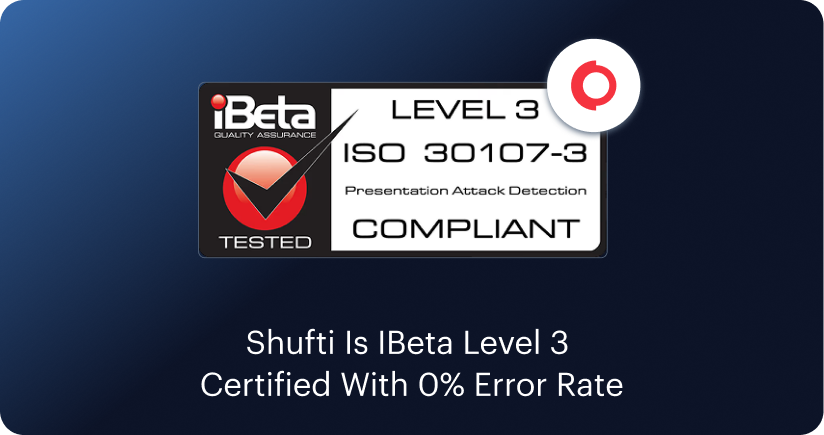
ISO/IEC 30107-3 PAD Level 3 is the most demanding independent certification for presentation attack detection. iBETA tested Shufti's system against hyper-realistic 3D silicone and resin masks, AI-generated face video and camera injection attacks. Shufti passed with 0% APCER and 0% BPCER on both iOS and Android; the result that matters when a regulator asks how you prevented a deepfake from passing your age check.
Yes. 1:N Facial Deduplication checks every new account selfie against all enrolled accounts on the platform. Device Fingerprinting links accounts sharing hardware or network infrastructure. Fraud Hub surfaces cross-account coordination signals including shared devices, correlated registration timing and synchronised activity patterns; the signals that individual account checks miss entirely.
Sandbox access is available immediately for integration testing. The single REST API covers age verification, document verification, biometric liveness, AML screening and fraud detection; removing the multi-vendor integration cycle that typically extends deployment timelines. Production integration typically runs two to eight weeks depending on platform complexity and the number of jurisdictional flows configured.
Evaluate Shufti Against Your Current Social Platform Stack
The Online Safety Act, DSA, COPPA and Australia's under-16 mandate require a verification architecture that connects onboarding identity to ongoing monitoring. Point-solution stacks cannot share identity records, produce a consistent audit trail or update compliance rules from a single source. Evaluate whether your current stack meets that standard
Your Go-To for KYC/AML & Fraud
Resources

23 September, 2025
AML Screening for Social Media
AML screening for social platforms, covering the obligations that now reach them, the risk they carry, and how screening fits into their existing sign-up flows.
Brochure