









 AMLR Solutions
  AMLR Consultation
 EUDI Wallet
 Onboarding
 Ongoing Monitoring
 FRAML
FRAML KYC
KYC KYB
KYB KYI
KYI Age Assurance
 Workforce IAM
 Candidate Verification
 Account Takeover
 Bonus/ Promotion Abuse
 Chargeback Fraud
 Deepfake
 Document Fraud
 Fraud Networks
 Impersonation Fraud
 Money Mule Activity
 Multi-Accounting
 Party Fraud
 Regulatory & Compliance Risks
 Synthetic Identity Fraud
 Adult Content
 Banking
 Crypto
 Fintech
 Forex
Forex Compliance
 Fraud prevention
 Trust & safety
 Global expansion
 Compliance Officers
 Developers
 Fraud Analysts
 Product Managers
 Journey Builder
  Global Trust Platform
 Customer Profiles
 Vendor Comparison
 IDV Case Management
 AML Case Management
 Regulatory Reporting
 Agentic Rule Builder
  AI Compliance Co-Pilot
  Fraud Analytics
 Fraud Hub
  OCR
OCR Shufti AI
 Bank Account Verification
  Biometric Duplication
 Database Checks
 Document Intelligence
 Government ID
 Mobile Driver's License
 NFC
NFC Selfie Liveness
 Brand Personalisation
 Deployment Options
 Identity Methods
 IDV Modes
 Multi-tenancy
 On-Premise IDV
 Secure Capture
 Shufti MCP


BUSINESS VERIFICATION
Full-Spectrum Business Verification Services for Confident Decisions
Assess businesses with verified registry data, ownership intelligence, document-backed evidence, and audit-ready records: all in one business verification framework.

Verification at Global Scale







A Business Verification Solution for Every Layer of the Company
The Difference Is in the Depth
Registry-sourced company data, fetched company registry reports, document authenticity, ownership structure, and UBO verification outcomes consolidate into a single report per entity. One contract, one audit trail, one evidence chain, defensible across 240+ regions actively processed.
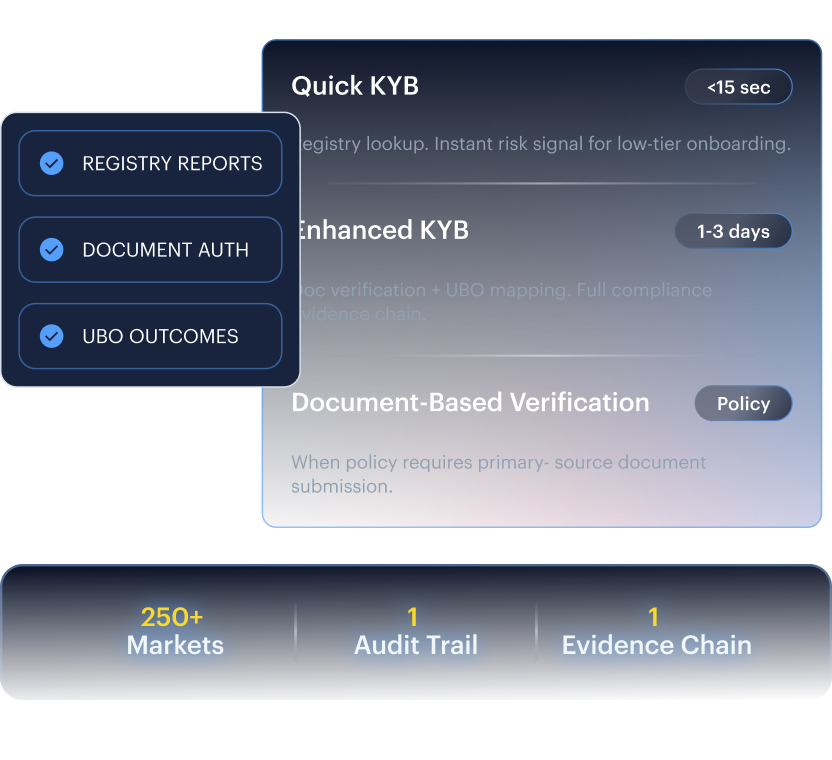
Intelligently configure verification depth per risk tier on one platform. Quick KYB in under 15 seconds. Enhanced KYB in 1–3 business days. Document-based verification when policy requires.
Verify the company, identify UBOs from official business registries or business documents, surface ownership structure, and verify the people behind the business on the same platform. Multi-person invites consolidate outcomes into one company-level record.
Accuracy and Quality
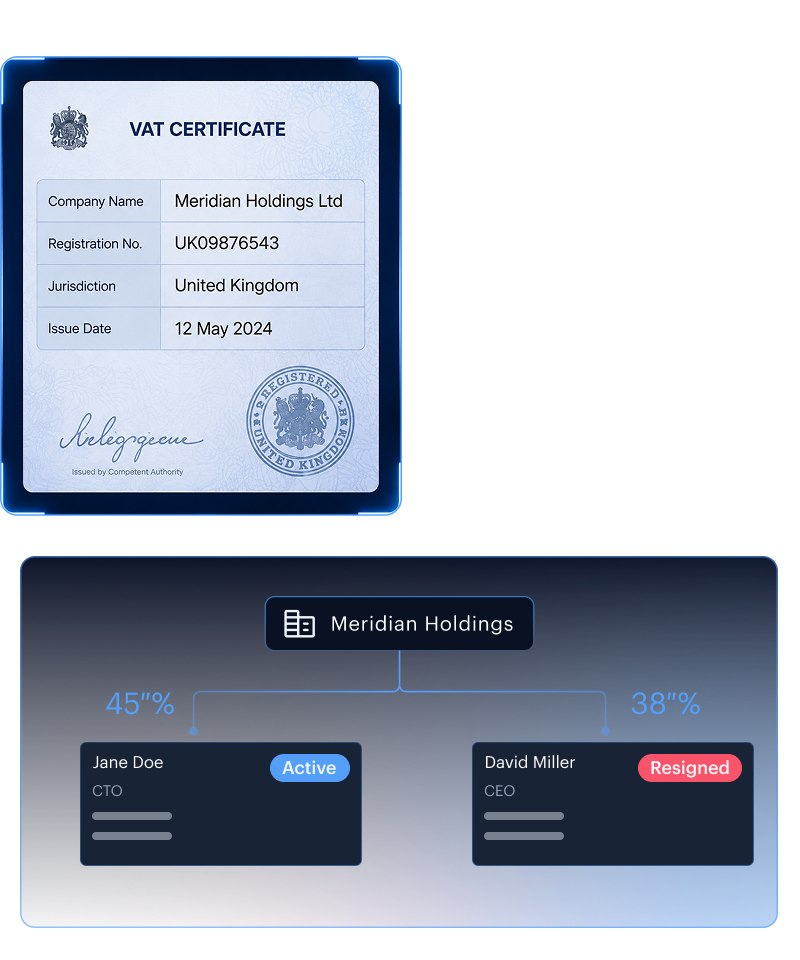
Processes VAT Certificates, Commercial Registration Certificates, Trade Licences, Australian company extracts, Singapore Business Profiles, People Profiles, Register of Members, and jurisdiction-specific extras.
Validates extracted document data against official business registries.
Identifies UBOs from official registries and business documents, intelligently traverses multiple holding-company layers, and surfaces beneficial owners against the threshold percentage configured per jurisdiction.
Oversight and Control
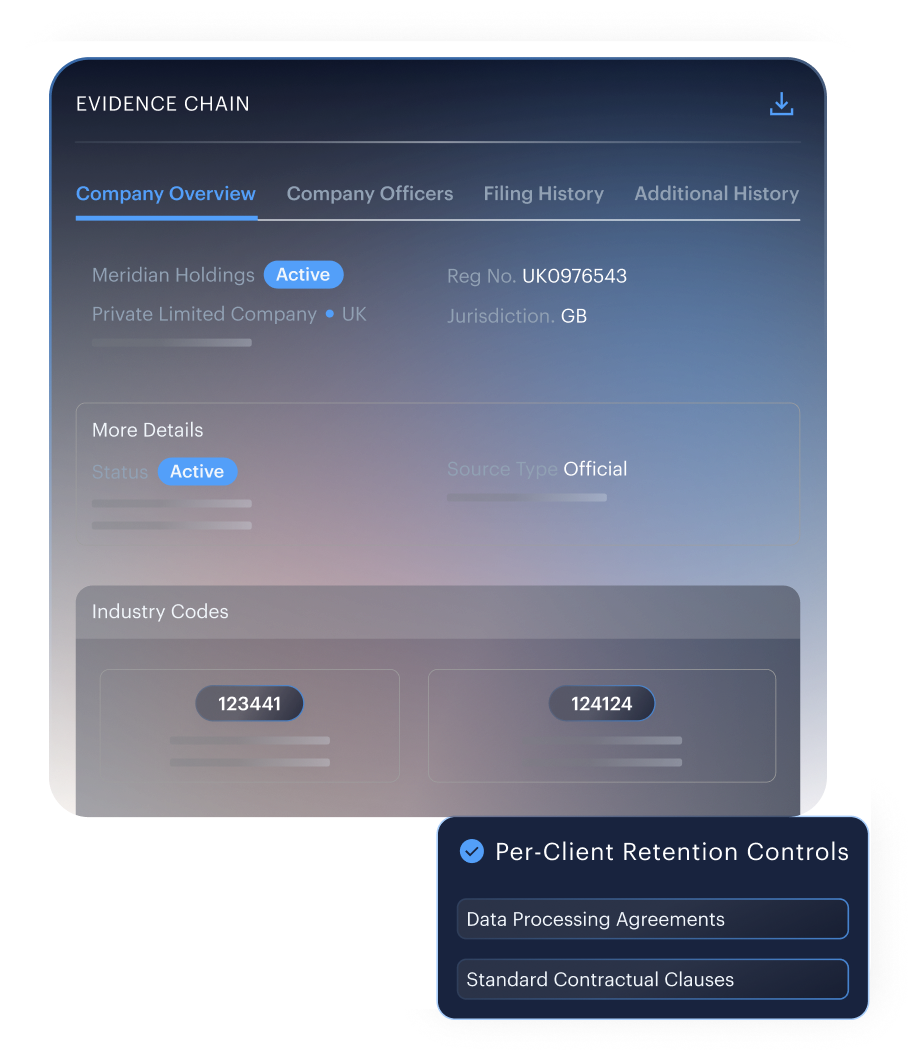
Full consolidated evidence chain available for review, download, audit-trail export, and role-based access.
Per-client retention controls, supported by Data Processing Agreements and Standard Contractual Clauses for regulated environments.
Re-checks trigger on configurable cadence and on jurisdictional, ownership, address, or threshold-breach events. The KYI Questionnaire captures role and ownership context directly from UBOs and directors as part of the flow.
Single API, Seamless Integration
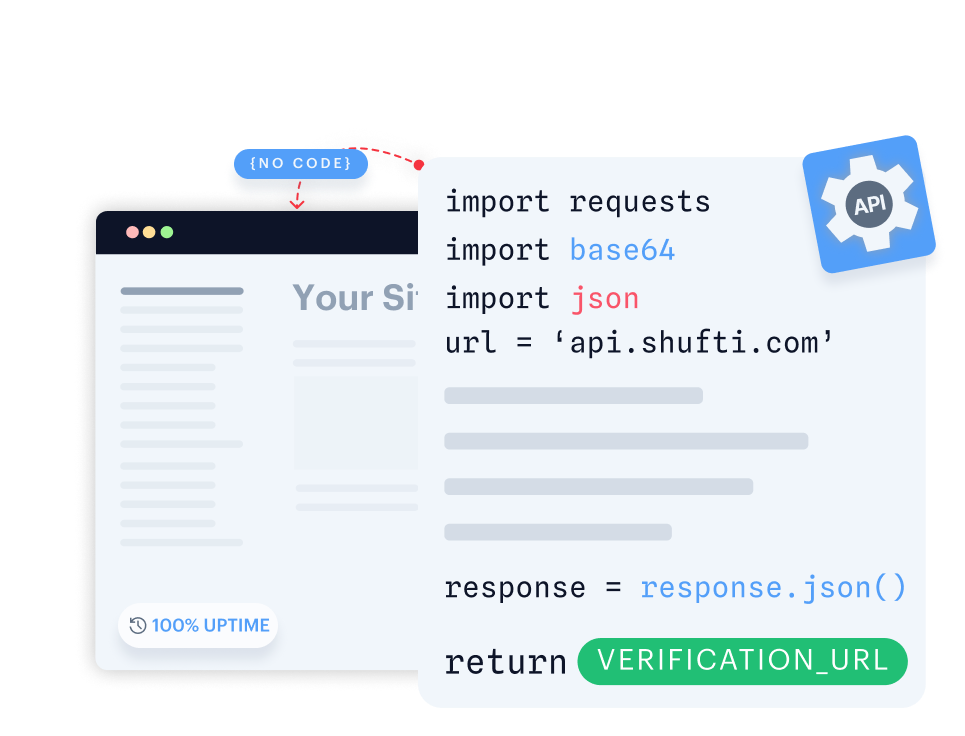
Build fully customisable verification flows with seamless backend integration.
- Gain full control by customising verification flows end-to-end.
- Integrate seamlessly with your backend for quick implementation.
- Design flexible verification journeys tailored to your users.
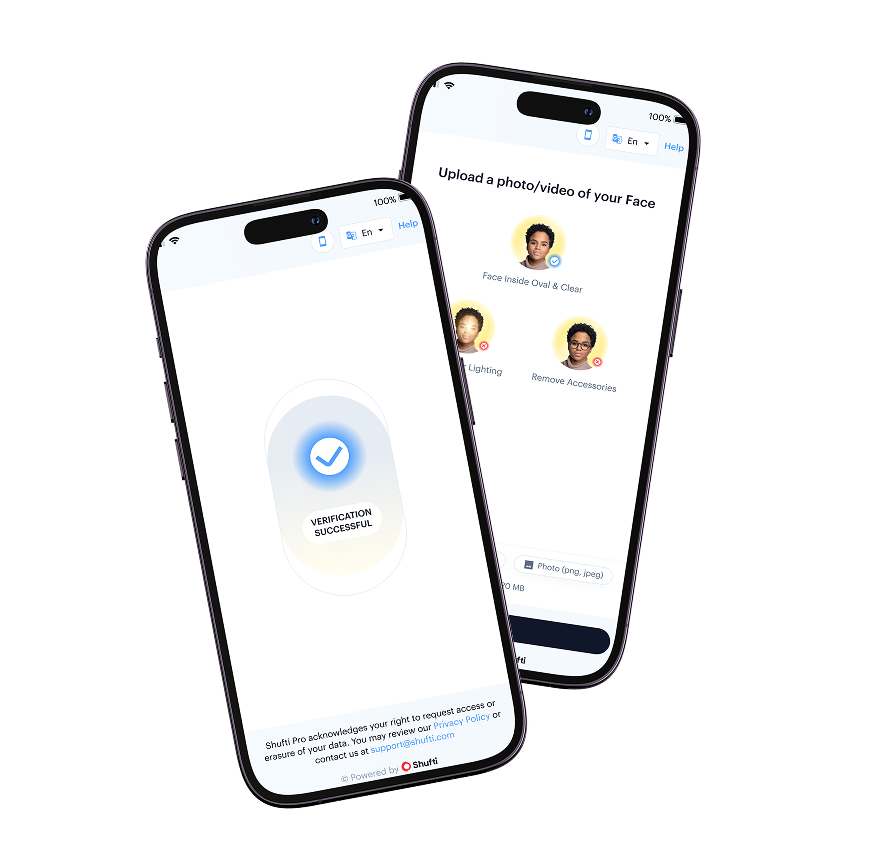
Launch a native verification experience in your mobile app within minutes.
- Launch native verification within minutes on iOS or Android.
- Use ready-made UI with camera, capture, and real-time feedback.
- Customise flows to fit seamlessly into your mobile app.
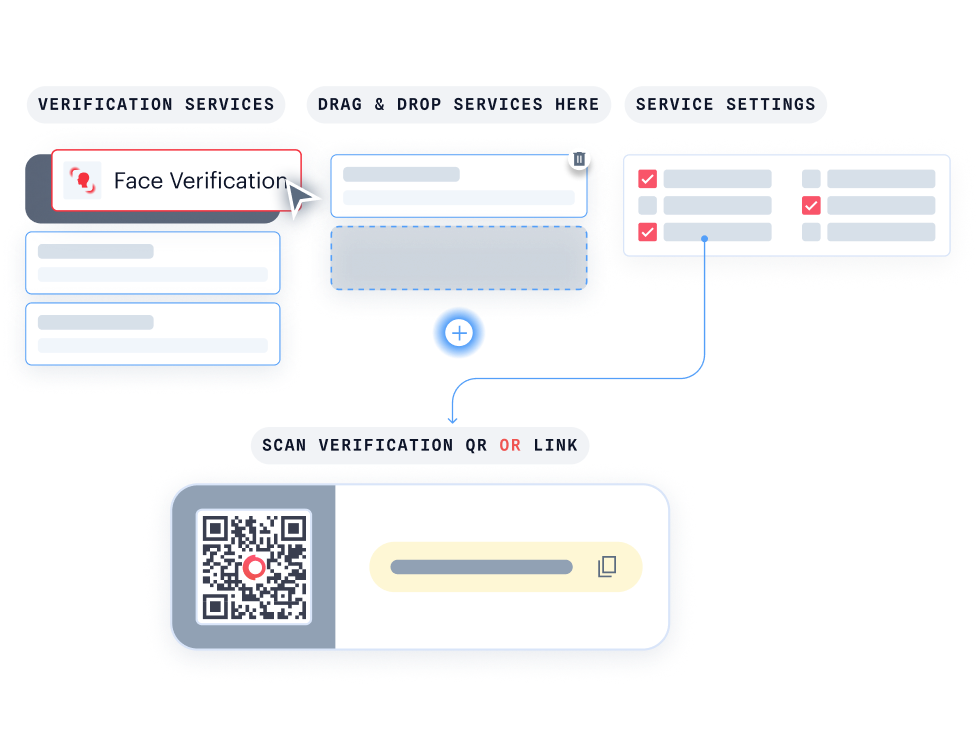
With KYC Journey Builder, create personalised verification journeys without writing a single line of code.
- Customise your journey effortlessly with drag-and-drop functionality.
- Instantly see how your verification flow looks for your users.
- Easily connect with Hosted Verification for a consistent, branded experience.
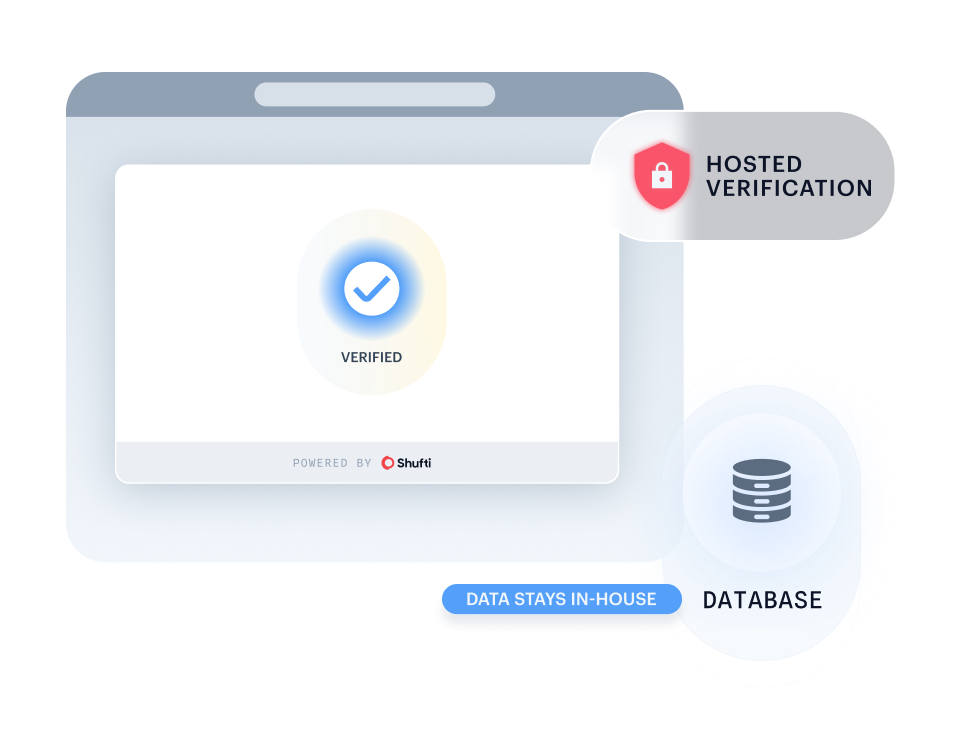
Run Shufti within your own identical-capability infrastructure for maximum data control and privacy.
- Keep all sensitive information in-house to meet strict governance and data residency requirements.
- Keep sensitive information fully private and secure in-house.
- Deploy in highly regulated sectors without compromising compliance.
Where It Fits
Built for Different Business Needs
Sellers Verified, Listings Cleared
Enabling seller signups, raising listing limits, and approving payouts without business verification invites fraud and disputes. Shufti Business Verification runs Quick KYB on the bulk of low-risk volume and Enhanced KYB on higher-value listings and cross-border sellers.

Don’t just take our word for it, hear from our customers
The Confidence Our Clients Share

The future of digital identity is defined by trust, interoperability, and regulatory alignment, so our partnership with Shufti reinforces DevCode Identity’s commitment to supporting our global customers with the most secure, best-in-class, compliant identity verification solutions available today.
Combining our Conversion Driven Compliance Orchestration Platform with Shufti’s global KYC and IDV capabilities allows our customers not only to navigate complex regulatory demands but also to maintain a seamless customer onboarding experience with the highest achievable conversion rates.
We’re proud to continue our partnership with Shufti as we expand into new jurisdictions.
Shufti’s verification technology not only strengthens our compliance framework but also ensures our players enjoy a smooth, secure onboarding experience.
We aim to offer our clients and their traders the very best tools with which to do their jobs, we’re excited to be able to work with Shufti.
They’re a leading company, and we’re looking forward to offering their solutions to our clients through our CRM.
The relationship with Shufti was born out of frustration with an existing provider, so we started our discussion with Shufti.
The response time was excellent, from the start of speaking to sales to getting up and running with the demo.
EVERYTHING YOU NEED TO KNOW IN ONE PLACE
Frequently Asked Questions
What is business verification, and how is it different from KYC?
Business verification, confirms that a company is legitimate by checking its registration status, directors, and ultimate beneficial owners. KYC verifies individual people, while KYB verifies the business entity and the people behind it. Shufti brings both into one platform, creating a consolidated company record for faster onboarding, compliance review, and audit readiness.
What happens in markets where registries are limited or absent?
Shufti runs authoritative registry verification where supported and falls back to document-led verification plus UBO identity verification where registry data is limited, partial, or absent. The fallback mechanism is part of the platform, not a separate product. Onboarding stays live in markets across the long tail.
How does Shufti calculate the 99% match accuracy figure?
The figure reflects the rate at which Quick KYB returns a confirmed entity match against the authoritative registry source for the submitted business identifier within the supported coverage set. Methodology, sample size, and bias-mitigation programme are documented in the methodology note available on request.
How often is registry data refreshed and how is upstream integrity maintained?
Registry data is sourced through real-time calls to authoritative business registries at the moment of each verification request. The verification result reflects the registry state at lookup time. For periodic re-verification, configurable cadence is supported with trigger conditions including jurisdictional change, ownership change, and threshold breach.
How does regional accuracy vary, and how is bias mitigated?
Match accuracy varies by registry quality, completeness, and jurisdictional coverage. Markets with mature centralised registries (EU, UK, US states, Singapore, Australia, Hong Kong) carry higher first-pass match rates than markets with paid-only or partial registry access. Where authoritative registry verification is limited, the fallback mechanism (document-led plus UBO identity) compensates. Demographic and regional bias mitigation is part of the published verification methodology.
Can Business Verification run on-premises or in a private cloud?
Registry-bound verification (Quick KYB and the registry-lookup leg of Enhanced KYB) runs through regional cloud processing across EU, UK, US, APAC, and MENA, because the verification depends on real-time calls to external authoritative registries. First-party modules (document authenticity, OCR, UBO biometric verification, journey orchestration) support private-cloud deployment for regulated environments where required, scoped to those modules. The deployment posture is documented per module rather than per product.
How does Shufti align with AMLD6 and the UK ECCTA?
AMLD6 takes effect through national transposition with a deadline of July 2027 and strengthens ultimate-beneficial-ownership transparency obligations. The UK Economic Crime and Corporate Transparency Act 2023 carries equivalent UBO identity-verification reforms through Companies House from 2024–25. Shufti supports authoritative registry verification, document-backed evidence retention, and UBO identity verification at the substantial-assurance threshold both regimes expect for remote onboarding. Customer firms attain the assurance level when the configuration matches the regulatory requirement; Shufti supports that configuration.
How does Shufti handle multi-vendor consolidation?
Compliance teams running registry verification, document authentication, and UBO identity verification through three vendors carry three contracts, three audit trails, and three failure surfaces. Shufti runs all three on one platform with one contract, one API surface, one Backoffice, and one consolidated report per company. Migration support and parallel-run windows are available for teams switching from a multi-vendor stack.
How does Shufti support UBO verification and business ownership verification?
Shufti supports UBO and business ownership verification by identifying directors and beneficial owners, mapping ownership chains across holding-company layers, and applying jurisdiction-specific ownership thresholds.
See How Far Your Coverage Really Goes
Shufti helps you assess registry coverage, document fallback, and UBO verification across 240+ regions actively processed.
Your Go-To for KYC/AML & Fraud
Resources

10 September, 2026
Enabling Scalable, Multi-Market Compliance for Macropay
How Macropay brought KYC, KYB and AML onto one layer across EEA and international markets, building an audit-ready compliance setup it can expand without a redesign.
Case Study