









 AMLR Solutions
  AMLR Consultation
 EUDI Wallet
 Onboarding
 Ongoing Monitoring
 FRAML
FRAML KYC
KYC KYB
KYB KYI
KYI Age Assurance
 Workforce IAM
 Candidate Verification
 Account Takeover
 Bonus/ Promotion Abuse
 Chargeback Fraud
 Deepfake
 Document Fraud
 Fraud Networks
 Impersonation Fraud
 Money Mule Activity
 Multi-Accounting
 Party Fraud
 Regulatory & Compliance Risks
 Synthetic Identity Fraud
 Adult Content
 Banking
 Crypto
 Fintech
 Forex
Forex Compliance
 Fraud prevention
 Trust & safety
 Global expansion
 Compliance Officers
 Developers
 Fraud Analysts
 Product Managers
 Journey Builder
  Global Trust Platform
 Customer Profiles
 Vendor Comparison
 IDV Case Management
 AML Case Management
 Regulatory Reporting
 Agentic Rule Builder
  AI Compliance Co-Pilot
  Fraud Analytics
 Fraud Hub
  OCR
OCR Shufti AI
 Bank Account Verification
  Biometric Duplication
 Database Checks
 Document Intelligence
 Government ID
 Mobile Driver's License
 NFC
NFC Selfie Liveness
 Brand Personalisation
 Deployment Options
 Identity Methods
 IDV Modes
 Multi-tenancy
 On-Premise IDV
 Secure Capture
 Shufti MCP


CUSTOMER DUE DILIGENCE
Every due diligence check is complete under one session
From customer due diligence at onboarding through enhanced due diligence, every check runs inside one form. One session. One case record. No gaps in the audit trail.

Every Source that matters, verified in one session







One Platform. Every Check. Across the Full Customer Lifecycle
One Platform Handles It All
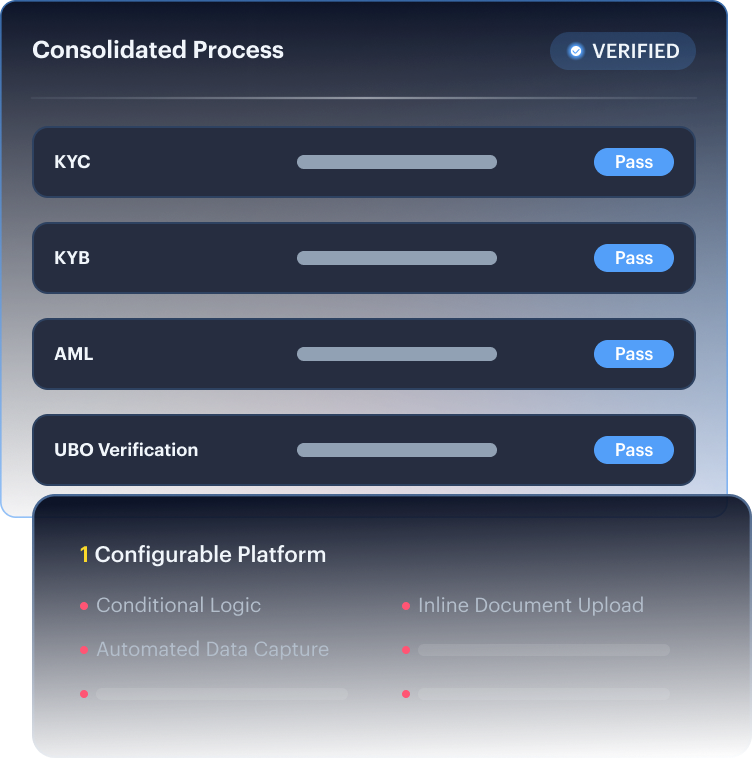
Compliance teams collect due diligence across Google Forms, shared inboxes, and document folders before spending hours stitching it together. Shufti consolidates the entire kyc due diligence process into one proprietary configurable platform with conditional logic, inline document upload, and automated data capture. Forms complete 40% faster with no manual entry.
Verification Lives Inside the Form
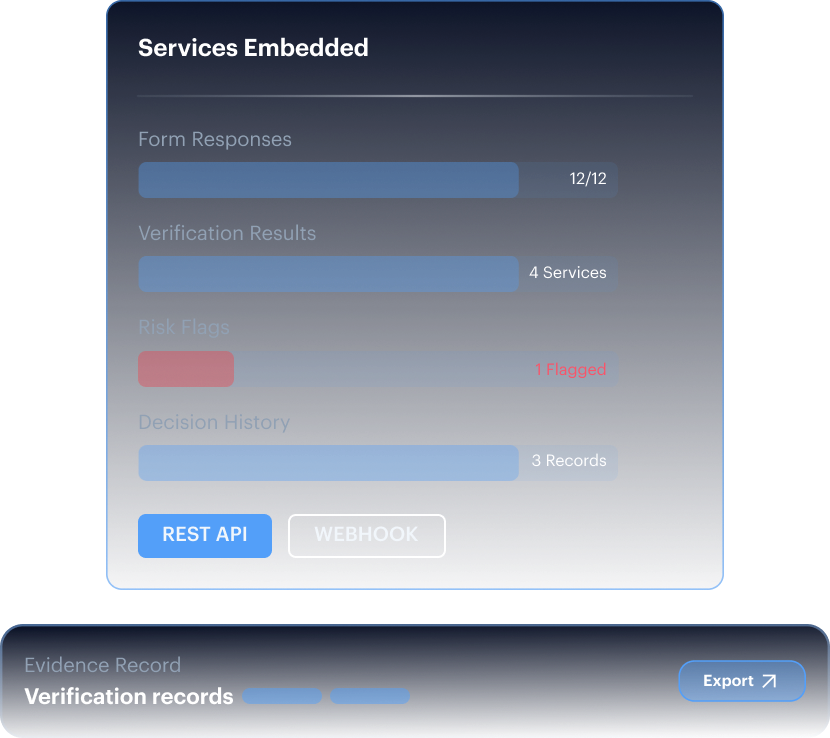
Most organisations run identity verification, UBO checks, and questionnaires as three separate steps with no data correlation between them. Shufti embeds Aml due diligence checks and identity verification directly into the form so customers complete every requirement in a single flow with a consolidated correlated evidence record built automatically.
Full Context at Every MLRO Review
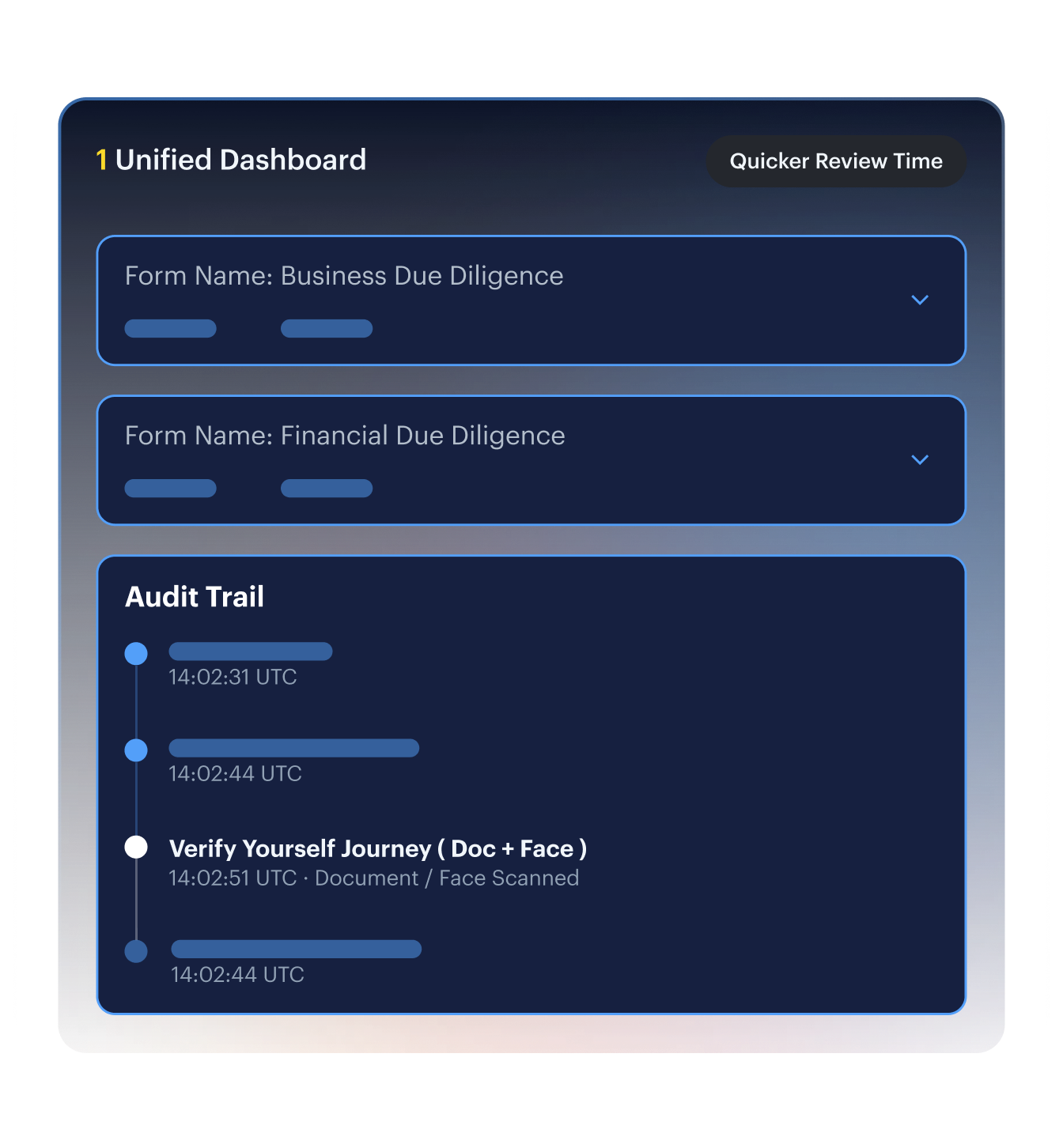
MLROs switch between six tabs including questionnaire responses, documents, KYC results, risk flags, and email, losing context at every step. Shufti brings business due diligence, vendor due diligence, and financial due diligence checks into one unified dashboard so reviews drop from 45 minutes to 10, with a complete defensible audit trail built in.
Forms That Build, Branch, and Adapt
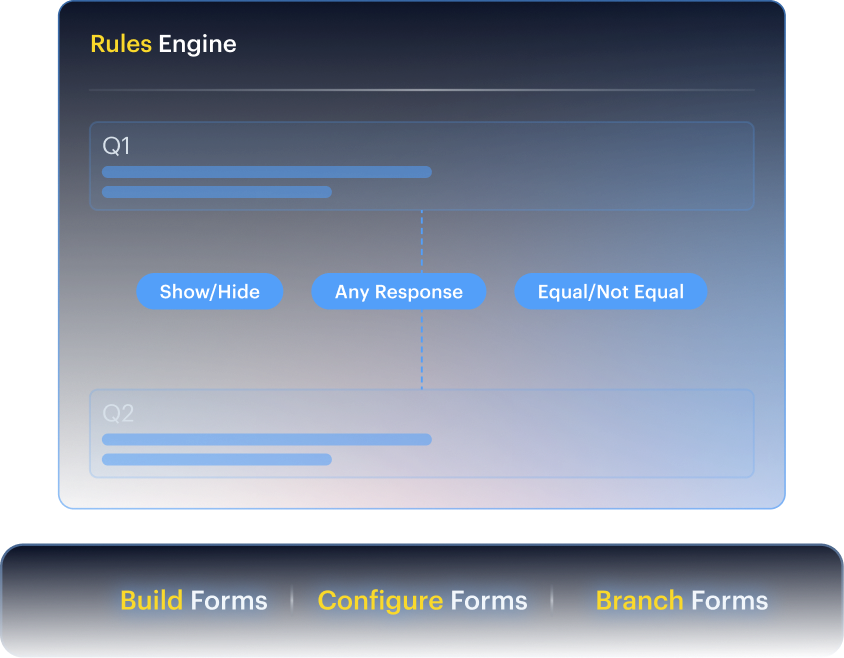
Compliance forms built across multiple tools produce inconsistent data, broken validation, and no shared logic layer. Shufti's due diligence platform lets compliance teams build, configure, and branch forms entirely from the back office.
A proprietary built-in Rules engine shows, hides, jumps, and skips questions based on any response, so the kyc due diligence process adapts in real time without any code.
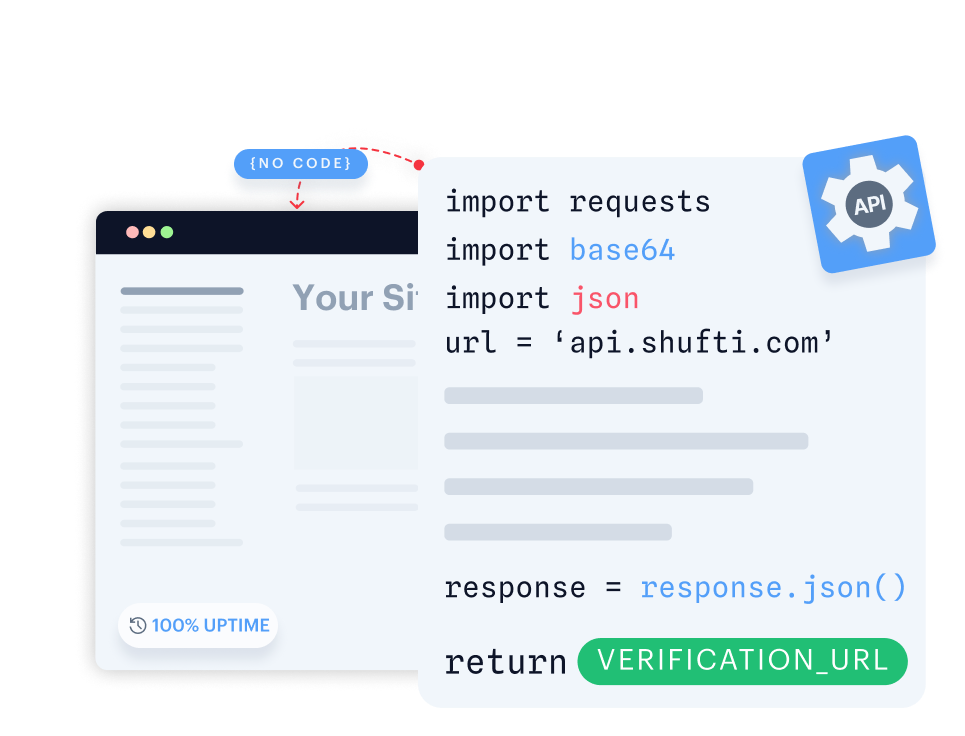
Single API, Seamless Integration
Build fully customisable verification flows with seamless backend integration.
- Gain full control by customising verification flows end-to-end.
- Integrate seamlessly with your backend for quick implementation.
- Design flexible verification journeys tailored to your users.
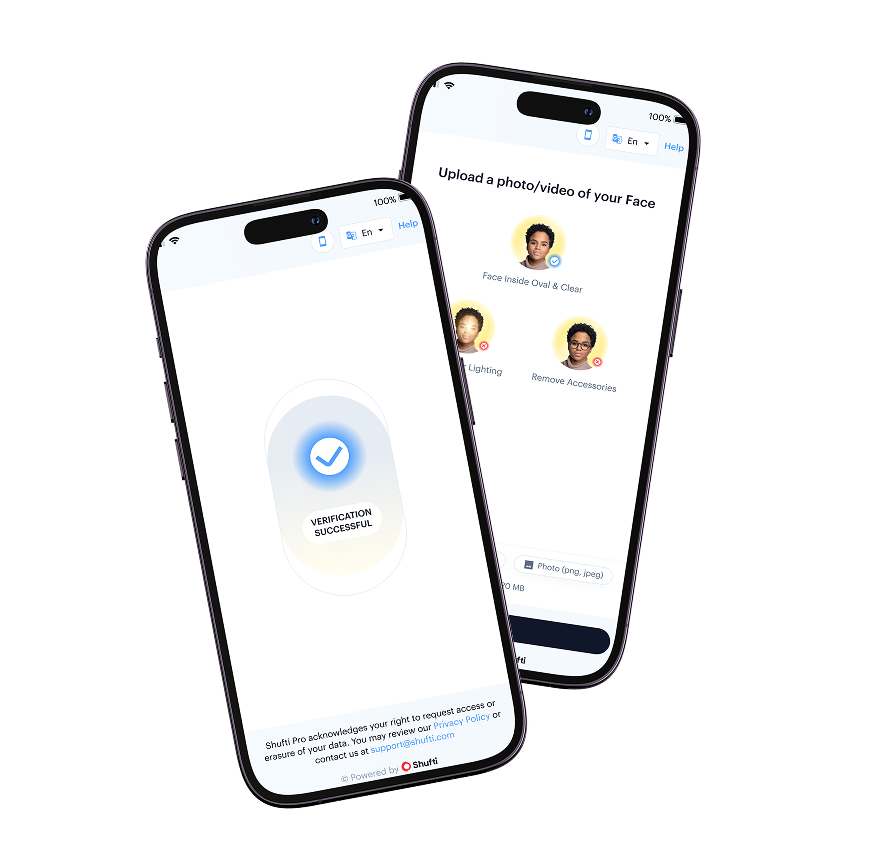
Launch a native verification experience in your mobile app within minutes.
- Launch native verification within minutes on iOS or Android.
- Use ready-made UI with camera, capture, and real-time feedback.
- Customise flows to fit seamlessly into your mobile app.
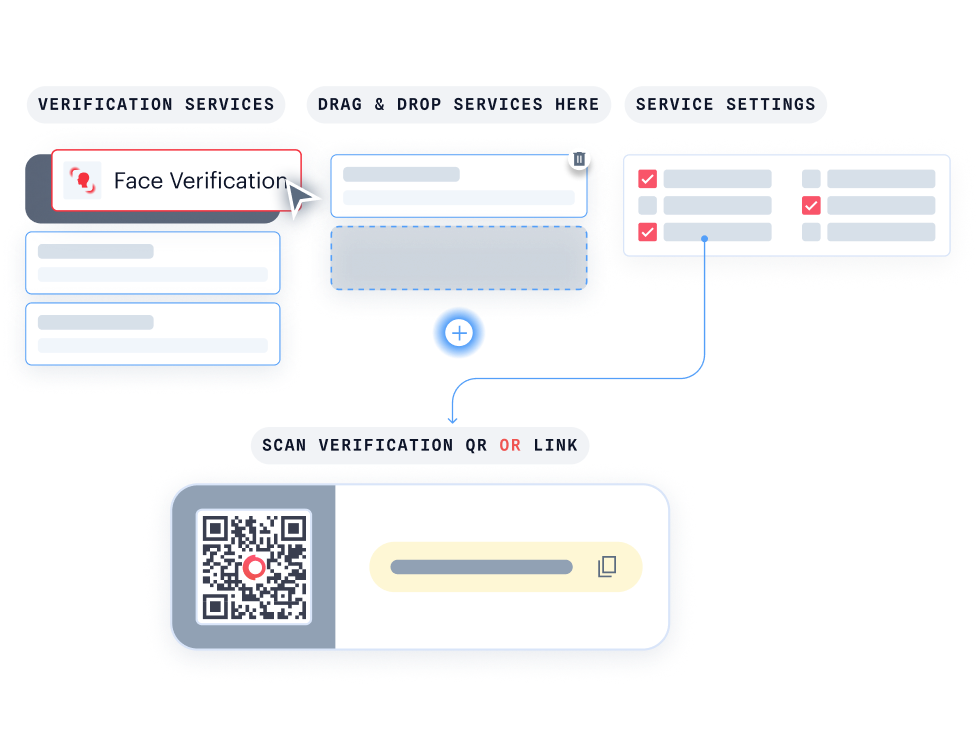
With KYC Journey Builder, create personalised verification journeys without writing a single line of code.
- Customise your journey effortlessly with drag-and-drop functionality.
- Instantly see how your verification flow looks for your users.
- Easily connect with Hosted Verification for a consistent, branded experience.
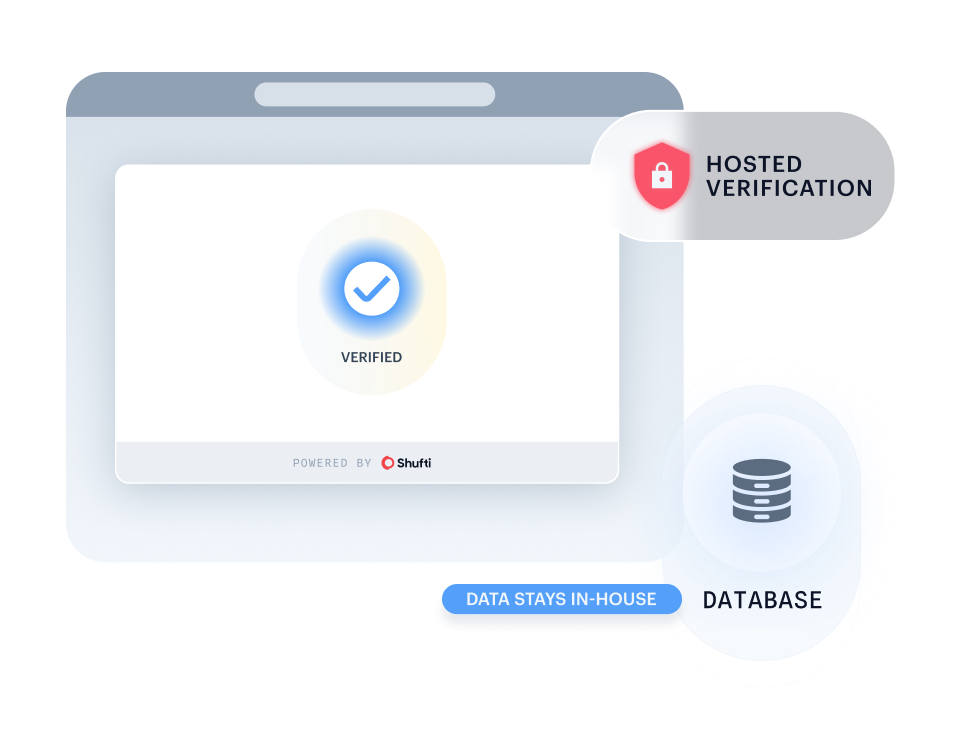
Run Shufti within your own identical-capability infrastructure for maximum data control and privacy.
- Keep all sensitive information in-house to meet strict governance and data residency requirements.
- Keep sensitive information fully private and secure in-house.
- Deploy in highly regulated sectors without compromising compliance.
WHERE SHUFTI DUE DILIGENCE FITS BEST
Built for Regulated and High-Stakes Compliance Workflows
One Audit Trail, No Fragmented Vendors
Separate KYC and due diligence tools produce fragmented audit trails across client onboarding and ongoing monitoring. Shufti Due Diligence consolidates KYC, UBO, AML, and Source of Wealth in a single case record, with MLRO review time down from 45 minutes to 10.

Don’t just take our word for it, hear from our customers
The Confidence Our Clients Share

The future of digital identity is defined by trust, interoperability, and regulatory alignment, so our partnership with Shufti reinforces DevCode Identity’s commitment to supporting our global customers with the most secure, best-in-class, compliant identity verification solutions available today.
Combining our Conversion Driven Compliance Orchestration Platform with Shufti’s global KYC and IDV capabilities allows our customers not only to navigate complex regulatory demands but also to maintain a seamless customer onboarding experience with the highest achievable conversion rates.
We’re proud to continue our partnership with Shufti as we expand into new jurisdictions.
Shufti’s verification technology not only strengthens our compliance framework but also ensures our players enjoy a smooth, secure onboarding experience.
We aim to offer our clients and their traders the very best tools with which to do their jobs, we’re excited to be able to work with Shufti.
They’re a leading company, and we’re looking forward to offering their solutions to our clients through our CRM.
The relationship with Shufti was born out of frustration with an existing provider, so we started our discussion with Shufti.
The response time was excellent, from the start of speaking to sales to getting up and running with the demo.
Everything you need to know in one place
Frequently Asked Questions
What is the difference between Customer Due Diligence and Enhanced Due Diligence?
Customer Due Diligence (CDD) establishes a baseline risk assessment on every customer: identity confirmation, background context, and activity expectations. Enhanced Due Diligence (EDD) applies when the risk profile crosses a threshold: politically exposed persons, high-value accounts, sensitive jurisdictions, or confirmed adverse-media signals.
What happens when a customer becomes high-risk after onboarding?
The due diligence form re-fires automatically when a transaction monitoring alert, behavioural change signal, sanctions re-screen, or scheduled review window trips. The reviewer receives the re-verified case on the identical MLRO dashboard used at onboarding, with the original questionnaire data, the new risk signal, updated verification results, and the complete decision history on one screen.
How does Shufti consolidate KYC, KYB, AML, and UBO into one workflow?
The entire due diligence process runs from inside the questionnaire itself, not from a parallel workflow. The customer answers, verifies identity, screens against AML watchlists, and completes vendor due diligence and business due diligence checks, including UBO verification links dispatched to directors and beneficial owners, in a single customer session. There is no manual due diligence checklist to manage across systems. Every result stitches to the parent case in real time. One REST API and one webhook contract drive every state change into downstream systems, and one audit record captures every action.
How does the real-time risk scoring engine reduce false positives?
Weighted answers roll into a composite risk score per submission. Scoring rules are client-configurable per policy, so the threshold that separates Standard DD from Enhanced DD reflects the operator's own risk appetite rather than a fixed vendor default. Low and Medium tier cases route to straight-through CDD. High tier cases open EDD sections automatically. Critical tier cases escalate for four-eyes approval. Reviewer time concentrates on the cases that actually require judgement, not on the routine ones.
How often does Shufti refresh AML watchlists, sanctions lists, and PEP profiles?
Watchlist, sanctions, and PEP data refresh continuously from upstream authoritative sources. Sanctions updates propagate to live screening and to scheduled re-screens on a sub-daily cadence. Scheduled Lifecycle DD reviews and ad-hoc re-screens pull from the current dataset at the moment of execution, so a case re-verified on Tuesday reflects the Tuesday data, not last month's snapshot.
What is the typical implementation timeline for a mid-market deployment?
Shufti's due diligence services complete mid-market deployments in 10 to 14 days end-to-end. Questionnaire customisation runs in parallel with API integration and sandbox provisioning during the first working week. SDK embedding and initial MLRO team training complete in the second week. Go-live follows training sign-off. Phased rollouts across multiple verticals extend the timeline proportionally; the 10 to 14 day benchmark applies to a single-vertical mid-market launch.
What happens to due diligence data when a customer is offboarded?
Retention windows are client-configurable per data category. Upon customer offboarding or scheduled retention expiry, the platform archives the decision record to an immutable log for regulator-reach purposes and purges operational copies according to the retention policy. Data Processing Agreements in the enterprise contract specify the erasure mechanism. A one-click audit report remains retrievable for the full regulatory retention window even after operational data purges.
Evaluate Your Due Diligence Against the Full Lifecycle
Most compliance stacks stop at onboarding. Shufti protects every user throughout their full lifecycle, with continuous monitoring and re-verification that fires when risk changes. Book a review call and see the scoring engine and MLRO dashboard in action.
Your Go-To for KYC/AML & Fraud
Resources

4 August, 2026
EU AMLR Guide 2027: Requirements, Scope, Deadlines
Regulation (EU) 2024/1624 applies from 10 July 2027. Covers which firms fall in scope, what CDD and ownership checks demand, and how AMLR differs from AMLD6 today.
Guide