AMLR Solutions
  AMLR Consultation
 EUDI Wallet
 Onboarding
 Ongoing Monitoring
 FRAML
FRAML KYC
KYC KYB
KYB KYI
KYI Age Assurance
 Workforce IAM
 Candidate Verification
 Account Takeover
 Bonus/ Promotion Abuse
 Chargeback Fraud
 Deepfake
 Document Fraud
 Fraud Networks
 Impersonation Fraud
 Money Mule Activity
 Multi-Accounting
 Party Fraud
 Regulatory & Compliance Risks
 Synthetic Identity Fraud
 Adult Content
 Banking
 Crypto
 Fintech
 Forex
Forex Compliance
 Fraud prevention
 Trust & safety
 Global expansion
 Compliance Officers
 Developers
 Fraud Analysts
 Product Managers
 Journey Builder
  Global Trust Platform
 Customer Profiles
 Vendor Comparison
 IDV Case Management
 AML Case Management
 Regulatory Reporting
 Agentic Rule Builder
  AI Compliance Co-Pilot
  Fraud Analytics
 Fraud Hub
  OCR
OCR Shufti AI
 Bank Account Verification
  Biometric Duplication
 Database Checks
 Document Intelligence
 Government ID
 Mobile Driver's License
 NFC
NFC Selfie Liveness
 Brand Personalisation
 Deployment Options
 Identity Methods
 IDV Modes
 Multi-tenancy
 On-Premise IDV
 Secure Capture
 Shufti MCP













TL;DR
- A digital identity is the set of attributes representing a person or organisation online.
- It includes credentials, biometric data, device signals, and identity documents.
- The main types are government-issued, federated, biometric, and self-sovereign identity.
- The EUDI Wallet under eIDAS 2.0 reshapes how digital identity works across the EU from 2026.
- Verifying digital identity is now a legal obligation across most regulated sectors.
A digital identity is what stands in for a person when there is no counter, no clerk, and no physical document to inspect. As services moved online, that representation became the thing businesses have to trust, and the thing fraudsters work hardest to fake. This page defines digital identity, sets out its main types, explains how it is verified online, and covers the change that matters most right now, the rollout of the European Digital Identity Wallet under eIDAS 2.0. It is written for the teams who have to verify digital identities and stay compliant while they do it.
What is digital identity?
A digital identity is the collection of attributes and credentials that represent a person or organisation in online environments. Those attributes include a name and date of birth, biometric data such as a face template, identity documents, device and behavioural signals, and the login credentials tied to an account. Together they form the profile a business uses to recognise and trust a user remotely.
A digital identity is not the same as a physical ID. A passport is a single credential. A digital identity is the broader, living set of data points that can include that passport alongside a biometric, a device fingerprint, and a verified email or phone. It also changes over time, as credentials are added, devices change, and behaviour builds a pattern, which makes digital identity management an ongoing discipline rather than a one-time setup. That breadth is why verifying a digital identity takes more than checking one document, and why it sits at the centre of any complete guide to identity verification.
Types of digital identity
Digital identity comes in four main types, and most people hold more than one. They differ in who issues the identity, who controls it, and how it is verified. The table compares them.
| Type | What it is | Example |
| Government-issued digital ID | A state-backed digital identity credential | Aadhaar, BankID, MitID, the EUDI Wallet |
| Federated identity | One login reused across many services via an identity provider | Signing in to apps with a single provider account |
| Biometric identity | Identity anchored to a physical trait such as a face or fingerprint | Face match at onboarding or device unlock |
| Self-sovereign identity (SSI) | Identity the user holds and controls directly, sharing only what is needed | A wallet-held credential the user presents selectively |
The trend across all four is toward user-controlled, reusable credentials, which is exactly what the EUDI Wallet formalises. Understanding the types matters because each is verified differently, a point explored further in digital user verification flows.
How digital identity is verified online
Digital identity is verified online by confirming the user’s attributes against trusted sources through a combination of document, biometric, and database checks. No single check is enough on its own, because each one proves a different part of the identity.
Document verification authenticates a government-issued ID by reading its security features and machine-readable zone. Biometric verification matches a live face to the document and runs liveness detection to confirm a real, present person. Electronic identity verification (eIDV) checks the claimed attributes against authoritative databases and national digital identity schemes. Run together, these steps confirm that the digital identity is real, belongs to the person presenting it, and is not a synthetic or stolen profile. This layered approach is what makes remote digital identity verification as reliable as an in-person check.
The EUDI Wallet and eIDAS 2.0: what businesses need to know
The European Digital Identity Wallet (EUDI Wallet) is a government-backed digital identity credential that every EU member state must offer, and it is the single biggest change to digital identity in Europe. Under the revised eIDAS 2.0 regulation, each member state must provide citizens with at least one certified EUDI Wallet by November 2026, and obliged entities such as banks, telecoms, and large platforms must accept it as a means of identification by December 2027 (European Commission).
For businesses, the practical implications are concrete. Any regulated organisation operating in the EU will need its verification stack to accept wallet credentials alongside traditional documents before the 2027 deadline. The wallet also shifts onboarding toward reusable, user-controlled identity, which reduces friction for users who already hold a verified credential. Preparing early turns a 2027 acceptance deadline into a competitive advantage rather than a last-minute integration scramble, and the wider forces behind it are covered in the digital identity verification trends shaping the market.
Digital identity fraud: the risks businesses face
Digital identity fraud is the use of fake, stolen, or synthetic identities to pass verification and open fraudulent accounts, and generative AI has made it sharply more dangerous. The risk is no longer a stolen password. It is a complete, convincing identity assembled to defeat onboarding.
Three attack types dominate. Synthetic identity fraud combines real and fabricated data into an identity that has no single victim to report it, which is why it often goes undetected for months. Deepfakes and face swaps use AI-generated media to defeat biometric checks that lack strong liveness detection. Credential stuffing reuses leaked username and password pairs to take over existing accounts at scale. Defending against all three is why digital identity verification has moved from a compliance task to a fraud-prevention priority, a shift detailed in how Shufti approaches AI identity verification. The AML dimension of that defence sits within AML identity verification.
How Shufti verifies digital identities
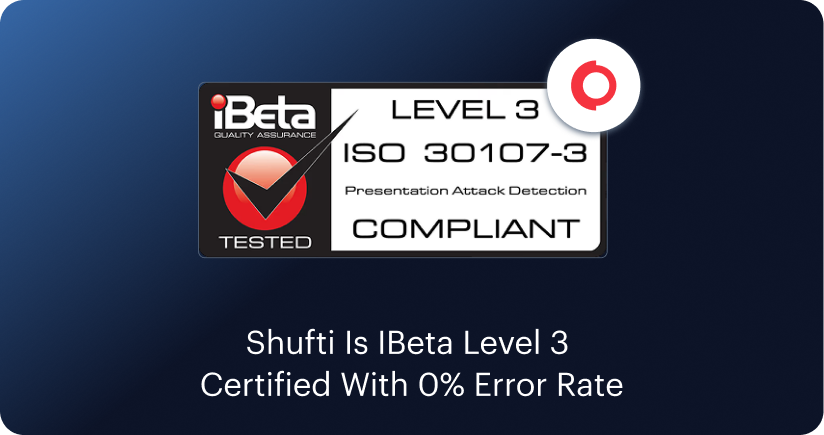
If you are preparing for reusable credentials like the EUDI Wallet while defending against AI-driven fraud, the challenge is doing both through one integration rather than bolting on a new vendor for each. Shufti built and owns its full stack, verifying physical IDs, Digital IDs, EUDI Wallets, and NFC chip credentials through a single API, with document intelligence trained on 10,000+ document types across 240+ countries and territories. Its liveness engine holds iBeta Level 3 conformance under ISO/IEC 30107-3, the highest published standard for detecting deepfakes and presentation attacks, so the same flow that accepts a wallet credential also resists the synthetic identities trying to game it.
See how Shufti verifies digital identities across documents, biometrics, and digital ID wallets in one platform — explore the solution.
Frequently Asked Questions
What is digital identity?
A digital identity is the set of attributes and credentials that represent a person or organisation online, including name, date of birth, biometric data, identity documents, device signals, and login credentials. Businesses use it to recognise and trust users remotely, and verifying it is a legal requirement across most regulated sectors.
What is the difference between digital identity and digital identity verification?
Digital identity is the data that represents a person online. Digital identity verification is the process of confirming that the data is real and belongs to the person presenting it, using document, biometric, and database checks. The identity is the subject, and verification is the action that establishes trust in it.
What is the EU Digital Identity Wallet (EUDI Wallet)?
The EUDI Wallet is a government-backed digital identity credential under the eIDAS 2.0 regulation. Every EU member state must offer citizens a certified wallet by November 2026, and obliged entities must accept it as identification by December 2027. It lets users store and selectively share verified identity attributes.
How do businesses verify a customer's digital identity?
Businesses verify a customer's digital identity by combining document authentication, biometric matching with liveness detection, and electronic checks against authoritative databases or digital ID schemes. Running these together confirms the identity is real, belongs to the person presenting it, and is not synthetic or stolen, all within a single onboarding session.