AMLR Solutions
 AMLR Consultation
 Onboarding
 Ongoing Monitoring
 FRAML
FRAML KYC
KYC KYB
KYB KYI
KYI Age Assurance
 Workforce IAM
 Candidate Verification
 Account Takeover
 Bonus/ Promotion Abuse
 Chargeback Fraud
 Deepfake
 Document Fraud
 Fraud Networks
 Impersonation Fraud
 Money Mule Activity
 Multi-Accounting
 Party Fraud
 Regulatory & Compliance Risks
 Synthetic Identity Fraud
 Adult Content
 Banking
 Crypto
 Fintech
 Forex
Forex Compliance
 Fraud prevention
 Trust & safety
 Global expansion
 Compliance Officers
 Developers
 Fraud Analysts
 Product Managers
 Advanced Journey Builder (AJB)
 Global Trust Platform
 Customer Profiles
 Vendor Comparison
 IDV Case Management
 AML Case Management
 Regulatory Reporting
 Travel Rule Protocols
 Agentic Rule Builder
 AI Compliance Co-Pilot
 Fraud Analytics
 Fraud Hub
 OCR
OCR Shufti AI
 Bank Account Verification
 Biometric Duplication
 Database Checks
 Document Intelligence
 Government ID
 Mobile Driver's License
 NFC
NFC Selfie Liveness
 Brand Personalisation
 Deployment Options
 Identity Methods
 IDV Modes
 Multi-tenancy
 On-Premise IDV
 Secure Capture









- An identity verification solution automates customer ID checks using documents, biometrics, and database lookups.
- The core components are document verification, face biometrics, liveness, eIDV, AML screening, and an audit trail.
- Evaluate providers on global coverage, independent accuracy validation, compliance certs, integration, and rejection rates.
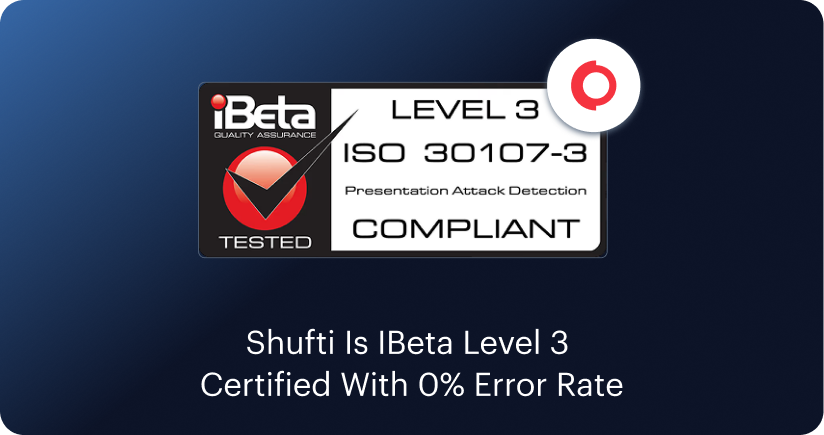
- iBeta Level 3 conformance under ISO/IEC 30107-3 is the benchmark for liveness attack detection.
- A solution that fails in your growth markets quietly caps expansion, so test coverage where it matters.
An identity verification solution is the difference between onboarding a customer in seconds and losing them to a manual review queue. As fraud grows more automated and regulators tighten their rules, businesses are replacing point tools and manual checks with a single platform that handles the whole verification decision. This page explains what an identity verification solution is, the components it should include, how it works, and the criteria that separate a solution that performs from one that only demos well. It is written for the teams who have to evaluate, buy, and integrate one.
What is an identity verification solution?
An identity verification solution is a platform that automates the confirmation of a customer’s identity using document checks, biometric matching, and authoritative database lookups, returning an accept, reject, or refer decision. It replaces the fragmented mix of manual review, single-function identity verification tools, and disconnected vendors that many businesses still run, consolidating the verification decision into one auditable workflow. Some teams buy this as an identity verification service from a specialist provider rather than building and maintaining the checks in-house.
The key distinction is between a platform and a point tool. A point tool does one job, such as reading a document or matching a face. A solution orchestrates all the checks together and returns a single decision your systems can act on. That difference matters for both accuracy and compliance, because a verification chain split across vendors produces inconsistent logic and a broken audit trail. The full context for this sits in the complete guide to identity verification, while this page focuses on the platform itself.
Core components of an identity verification solution
A complete identity verification solution brings six components together under one decision engine. Evaluating a provider starts with confirming all six are present and owned, rather than stitched in from third parties. The table below lists each component and what it does.
| Component | What it does |
| Document verification | Authenticates government IDs by reading MRZ, NFC chip, and security features |
| Face biometrics | Matches a live selfie to the document photo |
| Liveness detection | Confirms a real, present person and resists deepfakes and replay attacks |
| Electronic IDV (eIDV) | Checks identity data against authoritative databases and digital ID schemes |
| AML screening | Screens the identity against sanctions, PEP, and watchlist sources |
| Audit trail | Logs every check and decision into a record you can produce on demand |
When these components share one decision engine, the logic stays consistent and the audit trail stays intact. When they are stitched together from separate vendors, each handoff is a point where the trail can break. This is also where ID verification at the document layer connects to the wider screening and decision stack.
How identity verification solutions work
An identity verification solution works as a five-step automated workflow that runs in seconds and produces a logged decision. Automated identity verification removes the hours of delay that manual review introduces, while keeping a complete record for compliance.
- First, the customer captures their identity evidence, usually a document image plus a live selfie or video.
- Second, the solution authenticates the document through forensic checks.
- Third, it matches the biometric and runs liveness detection to confirm a real person is present.
- Fourth, it cross-checks the identity against authoritative databases and AML sources.
- Fifth, it returns an accept, reject, or refer decision and writes the full check history into an audit record.
The same workflow scales from a handful of verifications to millions, which is what separates a true solution from a tool that needs manual oversight at volume.
What to evaluate when choosing an identity verification solution
Choosing among identity verification providers comes down to five criteria, weighted to where your customers actually are. The common mistake is evaluating on the easy markets in a pilot, then discovering the pass rate collapses in the regions that matter for growth.
- The first criterion is global document coverage, the core of international identity verification. Confirm the solution reads the document types and languages in your hardest markets, not just the headline country count.
- The second is independent accuracy validation. iBeta Level 3 conformance under ISO/IEC 30107-3 is the highest published standard for liveness attack detection, so treat it as the benchmark rather than a vendor’s own accuracy claim.
- The third is compliance certifications such as SOC 2, ISO 27001, GDPR, and PCI DSS, which decide whether you can deploy in regulated environments at all.
- The fourth is integration method, since a single clean API reduces the dependency risk that fragmented multi-vendor stacks carry.
- The fifth is the false rejection rate, because a solution that turns away genuine customers costs revenue every day it runs.
Comparing shortlisted identity verification companies against all five, rather than price alone, is what protects the decision. For the platform category as a whole, see how to assess identity verification software.
Compliance standards your solution should meet
An identity verification solution should meet the compliance standards your regulators require, and the strongest providers hold independent validation rather than self-attesting. The standards below are the ones that matter most for regulated onboarding.
- The first is liveness validation. ISO/IEC 30107-3 is the standard for presentation attack detection, and iBeta Level 3 conformance against it is the highest published bar, introduced specifically in response to AI-driven deepfakes.
- The second is data protection, where GDPR and equivalent regional regimes govern how identity data is captured, stored, and processed.
- The third is the anti-money-laundering baseline set by the Financial Action Task Force, whose Recommendation 10 requires identity verification from reliable, independent sources.
- The fourth is information security, evidenced by SOC 2 and ISO 27001.
A solution that holds these gives compliance teams defensible, auditable decisions rather than claims they cannot stand behind.
How Shufti’s identity verification solution is built
If you are evaluating providers, the gap that surfaces fastest is coverage in the markets you most want to grow. Most solutions trained their models on Western documents and retrofitted the rest, so pass rates drop in exactly the regions where you are expanding. Shufti built and owns its full verification stack, with document intelligence trained on 10,000+ document types across 240+ countries and territories, proprietary OCR in 150+ languages, and a liveness engine holding iBeta Level 3 conformance under ISO/IEC 30107-3. Document, biometric, eIDV, and AML checks run through one API with cloud, on-premises, and hybrid deployment, so the audit trail stays intact and data residency can sit where the regulator requires.
See how Shufti’s identity verification solution handles document, biometric, and AML checks in one integration — request a demo.
Frequently Asked Questions
What is an identity verification solution?
An identity verification solution is a platform that automates customer identity checks using document verification, biometric matching, liveness detection, and database lookups, returning an accept, reject, or refer decision. It consolidates checks that would otherwise be split across manual review or single-function tools into one auditable workflow.
How do I know if an identity verification solution is compliant?
Look for independent validation rather than self-attested claims. Key markers include iBeta Level 3 conformance under ISO/IEC 30107-3 for liveness, SOC 2 and ISO 27001 for information security, GDPR for data protection, and alignment with FATF Recommendation 10 for AML. These give compliance teams defensible, auditable decisions.
What is the difference between an identity verification solution and KYC software?
An identity verification solution confirms who a customer is at onboarding. KYC software covers the wider compliance programme, adding risk assessment, ongoing AML screening, and continuous monitoring. Verification is the first step, and many full solutions include the KYC screening and monitoring layers around it.
How fast can an identity verification solution verify a customer?
A modern identity verification solution returns a decision in seconds. Document authentication, biometric matching, liveness, and database checks run in real time within a single session. Cases routed to a human reviewer take longer, which is why strong automation and image-capture quality matter for both speed and conversion.