Frame-2085666935

Blind Spot Audit

Spot Fraud in your approved Customers

Runs On Your CloudRuns On Your Cloud

No Data SharingNo Data Sharing

No Contract RequiredNo Contract Required

Frame-2085666935

Deepfake Detector

Check where deepfake IDs slipped
through your stack.

Runs On Your CloudRuns On Your Cloud

No Data SharingNo Data Sharing

No Contract RequiredNo Contract Required

Frame-2085666935

Liveness Detection

Find the replay gaps in your passed
liveness checks.

Runs On Your CloudRuns On Your Cloud

No Data SharingNo Data Sharing

No Contract RequiredNo Contract Required

Frame-2085666935

Document Deepfake Detection

Spot synthetic documents hiding in
verified users.

Runs On Your CloudRuns On Your Cloud

No Data SharingNo Data Sharing

No Contract RequiredNo Contract Required

Frame-2085666935

Document Originality Detection

Stop fake documents before they pass.

Runs On Your CloudRuns On Your Cloud

No Data SharingNo Data Sharing

No Contract RequiredNo Contract Required

.

Introducing Blind Spot Audit. Spot AI-generated forgeries with advanced document analysis. Teg-1 Run Now on AWS right-arrow-2

Introducing Blind Spot Audit Teg-1

Spot AI-generated forgeries with advanced document analysis.

Run Now right-arrow-2
.

Introducing Deepfake Detector. Detect deepfakes with precision your stack has missed. Teg-1 Run Now on AWS right-arrow-2

Introducing Deepfake DetectorTeg-1

Detect deepfakes with precision your stack has missed.

Run Now right-arrow-2
.

Introducing Liveness Detection. Detect spoofs with technology built for sophisticated fraud. Teg-1 Run Now on AWS right-arrow-2

Introducing Liveness DetectionTeg-1

Detect spoofs with technology built for sophisticated fraud.

Run Now right-arrow-2
.

Introducing Document Deepfake Detection. Spot AI-generated forgeries with advanced document analysis. Teg-1 Run Now on AWS right-arrow-2

Introducing Document Deepfake DetectionTeg-1

Spot AI-generated forgeries with advanced document analysis.

Run Now right-arrow-2
.

Introducing Document Originality Detection. Verify document authenticity before your next audit. Teg-1 Run Now on AWS right-arrow-2

Introducing Document Originality DetectionTeg-1

Verify document authenticity before your next audit.

Run Now right-arrow-2

us

216.73.217.148

Effective Sanctions Screening | A Guide for Compliance Professionals 2026

Sanctions are crucial in combating financial crimes and maintaining national and international security. Firms doing business with sanctioned entities face substantial fines. The US Federal Reserve and Treasury charged Wells Fargo bank $97.8M for breaching US sanctions regulations. After two months, crypto firm Poloniex agreed to pay $7.6 million for violating 66k sanctions. Financial consequences are not only the concern, but global investors avoid doing business with firms that do not fulfil their corporate social responsibility. This highlights how important it is to deploy Anti-Money Laundering (AML) screening solutions to maintain sanctions compliance in 2026 and avoid heavy penalties.

What is Sanctions Screening?

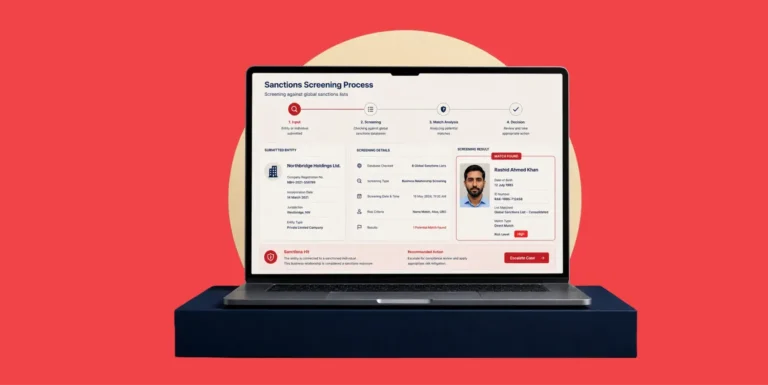
Sanctions screening is the process of checking whether an entity or individual appears on a sanctions list or watchlist. Such lists are compiled by governments and approved by international organisations to identify entities or individuals on sanctions lists due to the illicit activities they are involved in. Screening against these lists (commonly referred to as watchlist screening) mitigates the risk of financial crimes and protects a business’s reputation in this age of widespread digitisation. Businesses of all sizes rely on sanctions screening services to meet their AML sanctions screening obligations and avoid exposure to sanctions evasion risk.

Major Sanctions Lists Across the Globe

  • The Office of Foreign Assets Control (OFAC) Sanction List: It is maintained by the US Department of Treasury and includes individuals, organisations, and countries subject to various US sanctions, primarily through the Specially Designated Nationals (SDN) list. OFAC also maintains non-SDN lists with more targeted restrictions.
  • The United Nations (UN) Sanction List: The list is maintained by the United Nations and includes individuals, firms, and countries subject to sanctions under the UN Security Council Charter.
  • The European Union (EU) Sanction List: The European Union maintains a list of individuals, businesses, and countries subject to different sanctions under EU laws.
  • The UK Sanction List: Administered by the Office of Financial Sanctions Implementation (OFSI), this list covers individuals, firms, and countries subject to several sanctions under UK regulations. Since Brexit, OFSI maintains an autonomous UK sanctions list that can diverge from EU measures.
  • The Australian Sanction List: The government of Australia maintains this list, which includes individuals, companies, and countries subject to different sanctions under Australian law.
  • The Swiss Sanction List: The list is maintained by the Swiss government and includes individuals, firms, and countries subject to sanctions under Swiss regulations.

These lists are changing continuously as new sanctions are being imposed. Thus, businesses must regularly screen their clients, partners, and transactions against these lists to maintain regulatory compliance and avoid reputational damage.

Sanctions List Breakdown — OFAC vs UN vs EU vs OFSI

A practical challenge in AML sanctions screening is clear understanding when and which sanctions list apply to your business. This issue widely appears in the following primary lists due to their reach and impact:

OFAC and the SDN List

The Office of Foreign Assets Control administers US economic and trade sanctions. Its primary instrument is the Specially Designated Nationals (SDN) list is a consolidated register of individuals, entities, and countries whose assets are blocked and with whom US persons are generally prohibited from transacting. OFAC also maintains non-SDN lists (including the Non-SDN Menu-Based Sanctions List and the Non-SDN Chinese Military-Industrial Complex Companies List) that carry more targeted, sector-specific restrictions. OFAC screening is mandatory for any business with a US nexus. Civil penalties can reach up to $1.4 million per violation or twice the transaction value, whichever is greater.

UN Security Council Sanctions

The UN Security Council imposes multilateral sanctions binding on all 193 UN member states under Chapter VII of the UN Charter. These typically target countries, regimes, terrorist organisations, and arms proliferators through asset freezes, travel bans, and arms embargoes. The Consolidated UN Security Council Sanctions List is the authoritative reference for compliance teams.

EU Sanctions

The EU maintains its own autonomous sanctions regime, separate from UN measures. EU sanctions apply to all EU persons and entities, regardless of where they operate. The EU sanctions list expanded significantly after 2022, with thousands of additional entries related to Russia, Belarus, and associated circumvention networks. Businesses operating in the EU or serving EU customers must screen specifically against the EU Financial Sanctions List.

OFSI and UK Sanctions Post-Brexit

The Office of Financial Sanctions Implementation (OFSI) is HM Treasury’s body responsible for implementing and enforcing financial sanctions in the UK. Since Brexit, the UK has its own autonomous sanctions list that largely mirrors EU measures but diverges on specific Russia, Iran, and counterterrorism listings. OFSI screening is a distinct requirement for UK-regulated firms, screening against the EU list alone does not satisfy UK obligations. OFSI has increased its enforcement activity over the time and now operates under a strict liability framework for some violation types.

Why is Sanctions Screening Important?

  • Maintain Sanction Compliance: Sanctions check helps businesses comply with the ever-changing regulations and protect themselves from heavy fines.
  • Mitigate the Risk of Fraud: Individuals or organisations appearing on the sanction lists pose a great risk. Thus, businesses must perform sanction screening to mitigate the risk of financial crimes such as money laundering and sanctions evasion.
  • Support Ethical and Responsible Business Practices: Businesses have an ethical responsibility to themselves and their stakeholders to prevent criminals from using their premises to launder illegally acquired money. Thus, sanctions screening supports every business’s ethical and responsible practices.
  • Avoid Reputational Damage: Facing a sanctions penalty causes severe reputational damage to a business. Thus, financial sanctions screening is crucial to boost a company’s security, prevent it from non-compliance fines, and maintain its credibility in the market.

2025–2026 Enforcement Statistics & Penalties

Sanctions enforcement reached record levels in 2024 and 2025, with regulators signalling continued escalation into 2026. Compliance professionals need concrete benchmarks to build the business case for investment in sanctions screening software.

OFAC enforcement

OFAC imposed over $1.5 billion in civil monetary penalties during 2024, with financial institutions, cryptocurrency exchanges, and multinational corporations accounting for the majority of settlements. In one of the largest corporate resolutions in US history, Binance agreed to pay over $4.3 billion in combined penalties to the Department of Justice, FinCEN, and OFAC for systemic AML and sanctions failures. Microsoft agreed to pay $2.98 million to OFAC for apparent violations involving cloud services exported to sanctioned regions.

OFSI enforcement (UK)

The UK’s Office of Financial Sanctions Implementation has escalated its enforcement posture significantly. OFSI has moved toward a stricter liability model, meaning that inadequate screening processes (even where no wilful intent is demonstrated) can give rise to penalties. UK firms relying solely on EU sanctions list screening are exposed, as the two lists have diverged materially since Brexit.

FATF grey list 2026 pressure

 The FATF grey list, formally “jurisdictions under increased monitoring”, directly affects businesses’ customer due diligence obligations. Customers or counterparties based in grey-listed jurisdictions require enhanced due diligence (EDD) under most national AML frameworks. As of 2026, the grey list includes jurisdictions added across the 2024 and 2025 plenary cycles. Businesses should ensure their sanctions screening solutions flag grey-list jurisdiction exposure automatically.

Emerging regulatory changes

The EU’s Digital Operational Resilience Act (DORA), effective January 2025, introduces new obligations for financial entities around third-party risk management, including the resilience of sanctions screening software and data providers. In the US, the GENIUS Act (Guiding and Establishing National Innovation for US Stablecoins) extends sanctions screening obligations explicitly to stablecoin issuers and crypto service providers, building on existing FinCEN rules that already require OFAC screening for virtual asset service providers.

Challenges of Conventional Sanctions Screening

Sanctions screening was one of the top challenges many Financial Institutions (FIUs) faced in 2022. They were required to keep up with the evolving sanction screening regulations. However, the challenges are more pronounced in traditional sanction screening methods as they need manual efforts to analyse flagged alerts.

Here are the main pain points that a traditional financial crime screening solution faces:

  • False Positives: One of the significant challenges faced by conventional sanctions screening solutions is that they generate many false positives. This wrongly flags legitimate transactions as potential matches to sanctioned entities or individuals. Thus, extensive manual reviews are required that require time and effort, impacting the business’s operational efficiency. Managing false positives in sanctions screening is one of the most common burdens on compliance teams operating at scale.
  • Lack of Real-Time Updates: Another challenge traditional sanctions screening solutions face is the need for real-time updates. Legacy databases may not reflect new sanctions quickly, leading to delayed processing and greater risk whilst dealing with newly sanctioned parties.
  • Complex Entity Matching: Cross-checking entities across name variations, spelling differences, and languages accurately poses a significant challenge. Conventional screening solutions struggle to correctly detect variations of names using fuzzy matching techniques, resulting in missed matches or even false negatives.
  • Risk Assessment: Conventional screening methods do not accurately assess the risk level associated with flagged transactions. This causes “under-blocking” or “over-blocking”, where low-risk transactions are delayed, or high-risk transactions are overlooked.
  • Scalability: With the increasing volume of transactions, traditional screening systems struggle to handle the workload efficiently. Such scalability challenges can cause delays in processing and other potential compliance risks.
  • User Experience: Manual reviews and delays caused by false positives can badly impact the user experience. Clients may face transaction delays that result in frustration and loss of business.

The Benefits of Using Automated Sanctions Screening Processes

Automated sanction screening helps businesses improve their compliance efforts and minimise the risk of engaging in business relationships with sanctioned entities. The AML sanctions screening solution scans different data sources, including transaction details, client records, and watchlists maintained by government bodies and global organisations. When the system finds a potential match, it generates an alert so that the case should be further investigated by compliance professionals.

Automated sanctions screening software helps organisations:

  • Perform sanctions screening proactively
  • Simplify the firms’ compliance processes
  • Minimise manual efforts as well as operational costs
  • Ensure AML compliance
  • Enhance accuracy by reducing human errors
  • Ensure real-time sanctions screening procedures
  • Include PEP screening and adverse media screening alongside sanctions list checks in a single workflow
  • Structure data and minimise the risk of false positives using machine learning algorithms that learn to prioritise and categorise data based on relevancy to specific alert types
  • Cope with large volumes of transactions and scale as per demand

Compliance professionals can use automated sanctions screening solutions to ensure customer due diligence is performed on all associated parties and counterparties. Machine learning helps the solution learn from previous records, mitigating the risk of future errors after an accidental violation has occurred.

Risk-Based Approach to Sanctions Screening

FATF’s Recommendations require regulated entities to apply a risk-based approach (RBA) to AML compliance. In practice, this means calibrating the intensity of watchlist screening to the actual risk profile of each customer, transaction, and counterparty — rather than applying uniform checks across the board. A risk-based approach to AML does not mean screening less; it means screening smarter.

Customer risk segmentation

High-risk customers — PEPs, customers from FATF grey-list jurisdictions, high-value transaction volumes, or those flagged through adverse media screening — should undergo enhanced due diligence (EDD) and more frequent re-screening. Lower-risk customers may be subject to simplified checks at onboarding and periodic re-screening cycles.

Transaction screening thresholds

Not all transactions carry equal risk. A risk-based approach applies transaction screening more intensively to cross-border payments, correspondent banking relationships, and wire transfers to high-risk jurisdictions. Domestic, low-value transactions between established customers can be screened at a proportionate level.

Dynamic re-screening

Customer risk profiles change. A risk-based framework requires ongoing monitoring and triggered re-screening when material changes occur — such as a customer’s country of operation shifting to a newly sanctioned jurisdiction, or when a customer surfaces in adverse media screening.

Fuzzy matching calibration

Effective AML sanctions screening uses fuzzy matching AML algorithms to catch name variations, transliterations, and aliases. A risk-based approach calibrates fuzzy matching thresholds: narrower thresholds for higher-risk customer segments to maximise recall, wider thresholds for lower-risk segments to control false positive volumes. This is where automated sanctions screening software has a decisive advantage over manual or rules-based systems — the ability to tune matching sensitivity by segment without manual effort.

Things to Consider Before Investing in Automated Sanctions Screening Solutions

Businesses considering choosing the best sanctions screening solution or upgrading their existing programmes should consider the following points:

  • How easy will it integrate into the company’s existing systems?
  • Will a new training programme be required for compliance teams?
  • What are the pain points and opportunities of the previous sanctions screening processes?
  • Which areas need improvements?
  • What are the potential risks at each stage?

When choosing an automated sanctions screening solution provider, it’s advisable to inquire about case studies and endorsements. Numerous providers offer illustrations of proof of concept and employ a continuous test-and-improve methodology, closely overseeing the product to identify opportunities for performance enhancement.

How Can Shufti Help?

Shufti is a leading AML screening solution provider that helps businesses abide by regulatory requirements and minimise the risk of money laundering and other financial crimes. Our robust AML solutions use artificial intelligence that enables them to screen entities and individuals against 1700+ sanctioned lists, watchlists, and Politically Exposed Persons (PEPs) lists. We perform OFAC screening, OFSI screening, EU sanctions list checks, and UN Security Council sanctions screening, all through a single API, so compliance teams are covered across every major jurisdiction. We screen customers against global databases issued by OFAC, Financial Action Task Force (FATF), and other regulatory bodies to protect firms from non-compliance fines. Our AML screening solution stands out from other IDV solution providers because it lowers the number of false positives in sanctions screening, reducing the risk of illegitimate transactions. We ensure that our lists are updated to meet the changing regulatory landscape.

If you’re still unsure about how we can help your business fulfil sanctions screening obligations, request a demo today and talk to one of Shufti’s experts!

Frequently Asked Questions

What is sanctions screening and why is it required?

Sanctions screening is the process of checking customers, counterparties, and transactions against government-issued sanctions lists to identify prohibited entities. It is required by law in most regulated industries (financial services, fintech, crypto, insurance) under frameworks including OFAC regulations, EU sanctions regulations, and FATF Recommendations. Failure to screen exposes businesses to significant civil and criminal penalties, reputational damage, and loss of banking relationships.

What is the difference between OFAC, EU, UN, and OFSI lists?

OFAC administers US sanctions and maintains the SDN list, violations carry civil penalties up to $1.4 million per transaction. The UN Security Council issues multilateral sanctions binding on all 193 member states. The EU maintains an autonomous sanctions regime, with expanded Russia-related listings since 2022. OFSI is the UK’s sanctions enforcement body, maintaining the UK list independently since Brexit. UK-regulated firms must screen against OFSI specifically, as the UK and EU lists have diverged.

How often should businesses re-screen customers?

At minimum, businesses should re-screen existing customers whenever sanctions lists are updated because OFAC and OFSI lists can change multiple times per day. Best practice for regulated firms is continuous real-time re-screening for high-risk customers and at least monthly batch re-screening for the full customer base. Any material change in a customer’s profile (for example new jurisdiction, ownership change, or an adverse media screening hit) should trigger immediate re-screening.

What are the penalties for failing sanctions screening?

OFAC civil penalties can reach up to $1.4 million per violation or twice the transaction value, whichever is greater. Egregious violations carry criminal referrals with up to 20 years imprisonment. Binance paid over $4.3 billion in combined DOJ, FinCEN, and OFAC penalties in 2024 for systematic AML and sanctions failures. OFSI in the UK now operates under a strict liability framework for some violation types, meaning inadequate screening processes, even without wilful intent, can result in penalties.

How does automated screening reduce false positives?

Automated sanctions screening uses machine learning and fuzzy matching algorithms to score potential matches by relevance. It factors in name transliterations, aliases, dates of birth, nationalities, and entity type simultaneously. By assigning risk scores rather than binary flags, the system surfaces only the highest-probability matches for human review. Continuous learning from compliance team override decisions further refines match thresholds over time, progressively reducing false positive volumes without increasing miss rates.

Related Posts

Blog

How Deepfake Detection Secures Financial Services

How Deepfake Detection Secures Financial Services

Explore More

Blog

KYB vs KYC: What Is the Difference (and When Each Applies)?

KYB vs KYC: What Is the Difference (and When Each Applies)?

Explore More

Blog

How to Choose Deepfake Detection Software for Your Business

How to Choose Deepfake Detection Software for Your Business

Explore More

Blog

The Cost of KYC Compliance in Finance: How Digitalization Helps

The Cost of KYC Compliance in Finance: How Digitalization Helps

Explore More

Blog

How to Choose Facial Verification Software

How to Choose Facial Verification Software

Explore More

Blog

How to Spot a Fake Proof of Address

How to Spot a Fake Proof of Address

Explore More

Blog

Document Verification: Types, Methods, and Why It Matters in 2026

Document Verification: Types, Methods, and Why It Matters in 2026

Explore More

Blog

How Deepfake Detection Secures Financial Services

How Deepfake Detection Secures Financial Services

Explore More

Blog

KYB vs KYC: What Is the Difference (and When Each Applies)?

KYB vs KYC: What Is the Difference (and When Each Applies)?

Explore More

Blog

How to Choose Deepfake Detection Software for Your Business

How to Choose Deepfake Detection Software for Your Business

Explore More

Blog

The Cost of KYC Compliance in Finance: How Digitalization Helps

The Cost of KYC Compliance in Finance: How Digitalization Helps

Explore More

Blog

How to Choose Facial Verification Software

How to Choose Facial Verification Software

Explore More

Blog

How to Spot a Fake Proof of Address

How to Spot a Fake Proof of Address

Explore More

Blog

Document Verification: Types, Methods, and Why It Matters in 2026

Document Verification: Types, Methods, and Why It Matters in 2026

Explore More

Take the next steps to better security.

Contact us

Get in touch with our experts. We'll help you find the perfect solution for your compliance and security needs.

Contact us

Request demo

Get free access to our platform and try our products today.

Get started