AMLR Solutions
  AMLR Consultation
 EUDI Wallet
 Onboarding
 Ongoing Monitoring
 FRAML
FRAML KYC
KYC KYB
KYB KYI
KYI Age Assurance
 Workforce IAM
 Candidate Verification
 Account Takeover
 Bonus/ Promotion Abuse
 Chargeback Fraud
 Deepfake
 Document Fraud
 Fraud Networks
 Impersonation Fraud
 Money Mule Activity
 Multi-Accounting
 Party Fraud
 Regulatory & Compliance Risks
 Synthetic Identity Fraud
 Adult Content
 Banking
 Crypto
 Fintech
 Forex
Forex Compliance
 Fraud prevention
 Trust & safety
 Global expansion
 Compliance Officers
 Developers
 Fraud Analysts
 Product Managers
 Journey Builder
  Global Trust Platform
 Customer Profiles
 Vendor Comparison
 IDV Case Management
 AML Case Management
 Regulatory Reporting
 Agentic Rule Builder
  AI Compliance Co-Pilot
  Fraud Analytics
 Fraud Hub
  OCR
OCR Shufti AI
 Bank Account Verification
  Biometric Duplication
 Database Checks
 Document Intelligence
 Government ID
 Mobile Driver's License
 NFC
NFC Selfie Liveness
 Brand Personalisation
 Deployment Options
 Identity Methods
 IDV Modes
 Multi-tenancy
 On-Premise IDV
 Secure Capture
 Shufti MCP















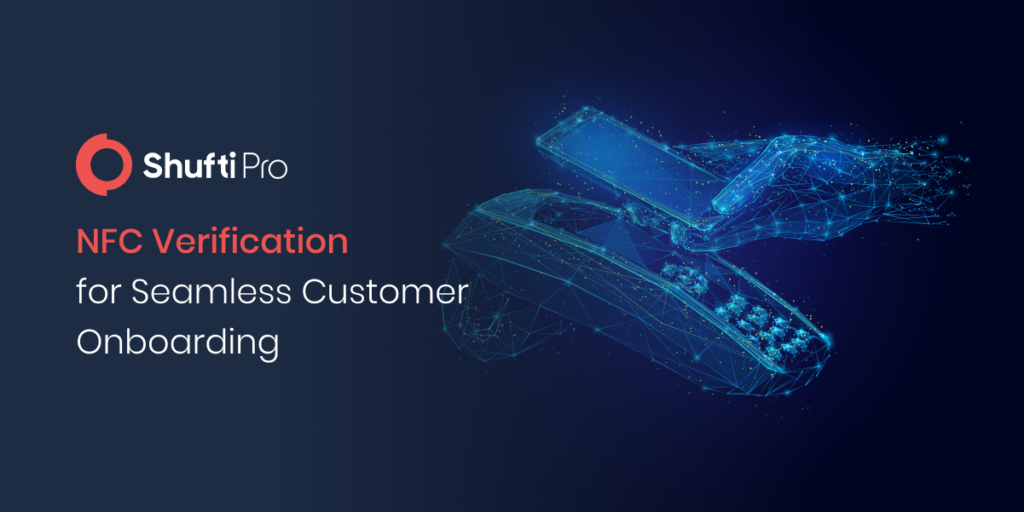
As more than 80% of today’s smartphones have NFC technology, different industries are working towards developing digital solutions that make use of the NFC chip. NFC technology is making its way into more and more daily operations, including the KYC identity verification process in banks and financial institutions.
These institutions strive to provide customers with the fastest and most secure verification processes so that they don’t change banks due to inconvenience. Today’s new identity document types are NFC chip-based and contain sensitive personal details that cannot be extracted or read without NFC-enabled devices.
NFC Verification – An Overview
Near Field Communication (NFC) is a touchless technology that allows objects to link with each other from a distance of up to 5 centimeters. The NFC-integrated circuit or chip embedded in identity cards contains the personal information specific to each individual. Then there are the devices that are NFC-enabled, meaning they are able to read the information from the NFC chip. NFC finds applications mainly in debit/credit cards provided by banks, payment terminals, and smartphones.
The NFC chip works along with an antenna to act as a functional device in itself, which is known as an NFC tag. This enables the NFC chip to communicate with the NFC reading device in a smartphone through an electromagnetic field. In this way, NFC chips are used for wireless communication of data as the NFC reader in a smartphone is allowed access to the data within the chip along with instructions on how to use it.
How NFC is Used in Identity Verification
Using this method of contactless communication, financial institutions can verify their customers’ identities quickly and accurately. ID cards issued by most world governments have Radio Frequency (RFID) chips with the personal details of the customer, including name, date of birth, address, and biometric details. NFC-enabled devices like smartphones are used to extract the RFID information from the chip on the identity document, allowing for easy and secure verification for both the customer and the institution.
Since every customer has both a smartphone and an ID document, NFC verification turns out to be the ideal way to get through the otherwise hectic process of identity verification. NFC verification proved to be quite useful during the Covid-19 pandemic as it offered a touchless mechanism to verify identities when the restrictions didn’t allow individuals to stand close to each other. With just a tap, an NFC-enabled device can read the data from the chip on an ID card, which is then extracted and verified by matching the information printed on the ID card. In this way, various industries like travel, healthcare, finance, and even the education sector benefit from NFC verification and eliminate the chances of fraud.
Is NFC the Ideal Way to Verify Identities?
Today’s easy-to-integrate APIs and SDKs allow financial institutions to install NFC enables reading systems into mobile and web applications. Banks and the payments industry have even come up with international mobile wallets known as soft cards. Major tech giants like Apple, Samsung, and Huawei are using NFC technology in smartphones to support soft cards and other NFC-enabled functionalities. Google wallets and Apple pay are among the services and products that use NFC technology to make payments convenient.
When it comes to identity verification, the systems incorporated by each business vary. This means that it’s up to the company to implement a system that can verify their customers’ identities simply by reading the NFC chip on their identity card. NFC verification by Shufti works through a few simple steps to authenticate the identities of customers. First, the customer has to submit a photo of their ID document. A condition for this type of verification to work is that the customer’s ID card and smartphone must both be NFC-enabled. If that is the case, the user simply needs to tap their smartphone’s NFC reader against the NFC chip on their ID card. Followed by that, the NFC verification system automatically receives the customers’ personal information embedded in the chip and verifies it by matching it against the previously provided image of the ID card.
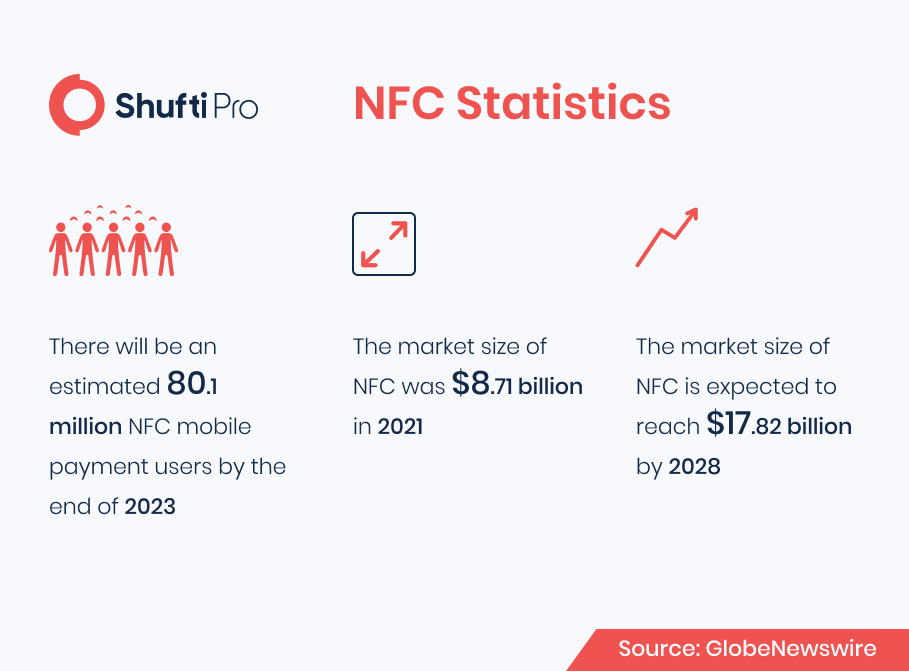
That being said, like every other technological solution, NFC verification has its good and bad qualities.
Perks of NFC Verification
- Convenience: NFC verification simply requires a tap between an NFC device and an RFID chip to extract data and verify the customers’ identity in less than a second. It is also convenient because the majority of smart devices are NFC-enabled and customers do not need to go through lengthy verification processes.
- Fraud Prevention: As NFC chips are only machine-readable, any fraudster who tries to forge the printed details on an ID document can easily be identified when the RFID data is cross-checked against it. In this way, businesses and financial institutions can eliminate fraudulent entities.
- Secure Onboarding: As data is read and extracted directly by NFC devices from RFID chips, there is no chance of a data leak or manipulation. This allows for the secure onboarding of legitimate clients within a matter of seconds.
NFC Verification and KYC Compliance
As financial regulators oversee all processes of banks and other financial institutions, NFC verification must be carried out as per the local and international data protection regulations. There are general data protection laws like the European Union’s General Data Protection Regulation (GDPR), and there are also laws that regulate the IT field. The EU’S GDPR states that the personal information of customers must be protected at all costs no matter which technology is used to verify or store the information.
Furthermore, Article 25 states, “Data protection by design and by default”, which means that the distributors or products and services and those applications that process personal data must incorporate relevant systems for data protection into their systems during the design phase itself. They are also required to implement the data protection system in such a way that the confidentiality of the data is maintained at all times. In the ideal situation where a business or financial institution is GDPR compliant, customers do not need to take extra steps to protect their personal information.
What Shufti Offers
Shufti’s robust NFC verification service is an ideal solution for banks as well as digital financial service providers. It allows businesses to verify the real identities of the customers during onboarding and also authenticates the legitimacy of the transactions. With a market-leading accuracy of 98.67%, financial institutions can ensure seamless customer experience and improved security as well.
Want to know more about NFC-based ID verification for your business?