AMLR Solutions
  AMLR Consultation
 EUDI Wallet
 Onboarding
 Ongoing Monitoring
 FRAML
FRAML KYC
KYC KYB
KYB KYI
KYI Age Assurance
 Workforce IAM
 Candidate Verification
 Account Takeover
 Bonus/ Promotion Abuse
 Chargeback Fraud
 Deepfake
 Document Fraud
 Fraud Networks
 Impersonation Fraud
 Money Mule Activity
 Multi-Accounting
 Party Fraud
 Regulatory & Compliance Risks
 Synthetic Identity Fraud
 Adult Content
 Banking
 Crypto
 Fintech
 Forex
Forex Compliance
 Fraud prevention
 Trust & safety
 Global expansion
 Compliance Officers
 Developers
 Fraud Analysts
 Product Managers
 Journey Builder
  Global Trust Platform
 Customer Profiles
 Vendor Comparison
 IDV Case Management
 AML Case Management
 Regulatory Reporting
 Agentic Rule Builder
  AI Compliance Co-Pilot
  Fraud Analytics
 Fraud Hub
  OCR
OCR Shufti AI
 Bank Account Verification
  Biometric Duplication
 Database Checks
 Document Intelligence
 Government ID
 Mobile Driver's License
 NFC
NFC Selfie Liveness
 Brand Personalisation
 Deployment Options
 Identity Methods
 IDV Modes
 Multi-tenancy
 On-Premise IDV
 Secure Capture
 Shufti MCP












The iGaming industry is expanding rapidly across the globe, and so are the laws that regulate it. However, igaming regulations differ widely between different states and regions. An online casino that can lawfully operate in one jurisdiction may face criminal exposure in another.
iGaming regulations lack uniformity because governments approach gambling through distinct public policy lenses. Some jurisdictions focus on the protection of the consumer, others implement social safeguards, while some prohibit most forms of iGaming altogether.
Consequently, iGaming operators must acquire licenses, adhere to anti-money laundering regulations, identity verification standards, and advertising restrictions.
What is iGaming?
iGaming refers to “interactive gaming” that involves internet-based gambling. These activities may include:
- Online sports betting.
- Online casino games such as slots, blackjack, and roulette.
- Online poker.
- Bingo and lottery products.
- Fantasy sports and skill-based contests in certain markets.
- Esports betting.
Some jurisdictions distinguish between games of chance and games of skill, while others regulate both under the same framework. It is the classification of an activity that determines licensing requirements for operators. Therefore, operators need to understand laws, regulations, and guidelines that govern igaming in a country when making a license application or launching an online gambling platform.
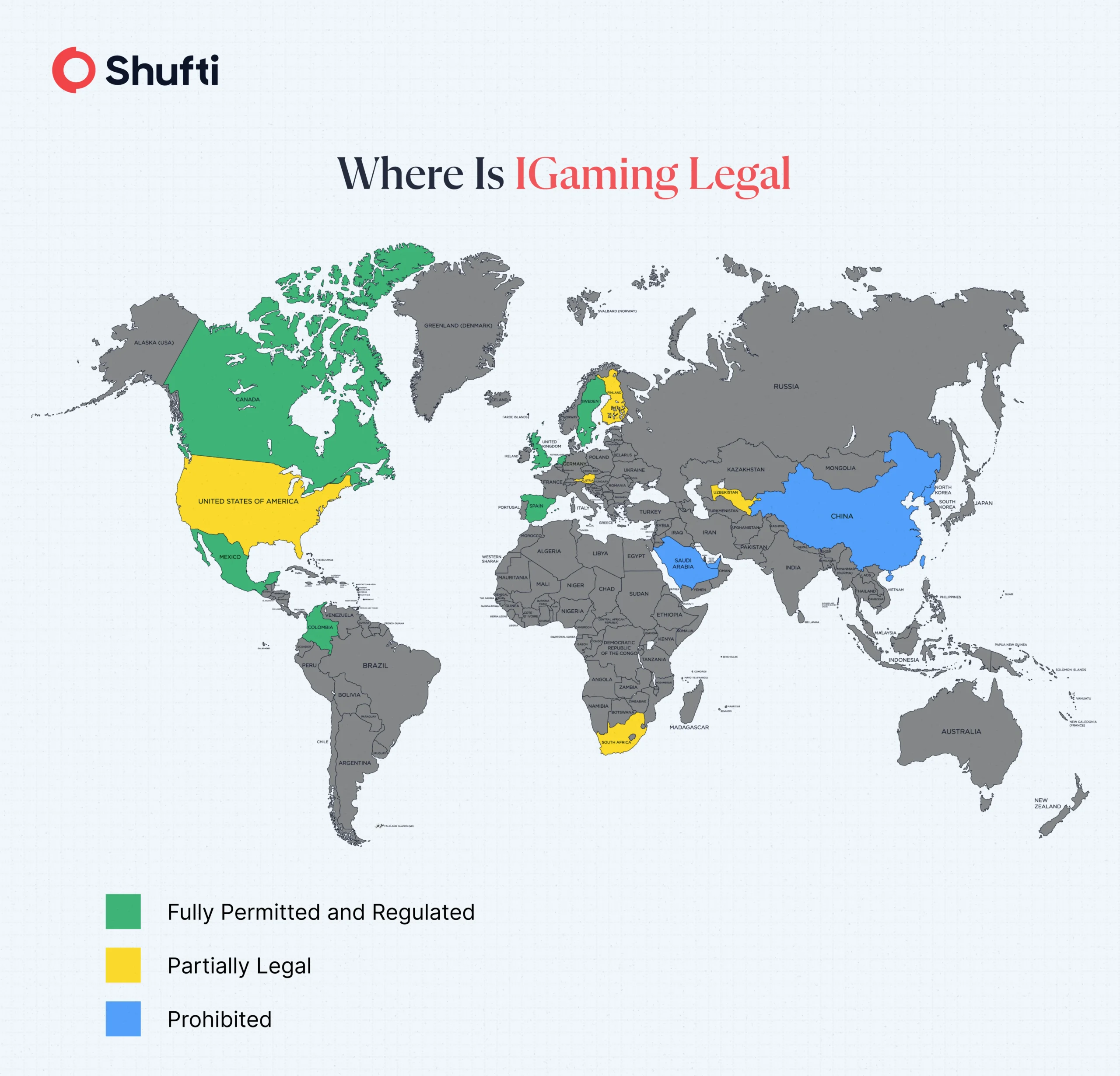
1. Markets Where iGaming is Regulated on a Country Level:
Instead of a total ban, some territories allow operators to establish online iGaming services under clear, in-depth regulations.
A. The United Kingdom:
The UK Gambling Commission (UKGC) operates one of the leading iGaming markets in the world. Gambling operators licensed by the UK Gambling Commission must comply with the UK’s Money Laundering Regulations 2017 and implement CDD, ongoing monitoring, and suspicious activity reporting obligations. In this regard, the UKGC has published AML guidance as well. The comprehensive iGaming regulations of the UKGC render the UK one of the premium iGaming markets globally.
B. Malta:
Malta is one of the most recognised licensing hubs for remote gaming, overseen by the Malta Gaming Authority. A B2C Gaming Service License is generally required for entities that want to offer remote gaming services from Malta under the MGA framework. Thus, Malta attracts foreign-oriented players through its remote services, although market access still depends on the laws of the player’s location.
C. Sweden:
Sweden operates a regulated licensing system supervised by the Swedish Gambling Authority, Spelinspektionen. The regulator positions player protection as a core priority and highlights anti-money laundering as a major focus area for online gambling.
Other regions, including the Netherlands, Isle of Man, Spain, Canada (Ontario), Colombia, and Mexico—including the offshore jurisdictions of Nevis and Anjouan—fully permit iGaming. Operators must secure the appropriate local licences and meet AML and responsible standards to operate legally.
2. Markets Where iGaming is Regulated on a State Level:
There are also jurisdictions that permit iGaming but restrict licenses by geographic location and/or other requirements:
A. The United States:
iGaming is only legal in certain U.S. states due to the country’s state-driven regulatory approach. While federal laws, including the Wire Act and the Unlawful Internet Gambling Enforcement Act (UIGEA) of 2006, set broad restrictions, it’s up to individual states to decide whether they want to legalize online casinos, poker, and sports betting.
iGambling (Online Casinos and Poker, etc.) is legal in New Jersey, Pennsylvania, Michigan, Delaware, West Virginia, Connecticut, and Rhode Island
The sports betting market, however, is more open. Following the 2018 US Supreme Court decision that decriminalized sports betting by overturning the Professional and Amateur Sports Protection Act (PASPA), states can now legalize sports betting on their own terms.
B. Germany:
The German Interstate Treaty on Gambling (Glücksspielstaatsvertrag, 2021) regulates online sports betting, poker, and other games. Operators seeking licenses for sports betting, online poker, or virtual slot games must provide a financial security guarantee. Article 4c(3) sets the minimum security at €5 million, although the amount may increase depending on the operator’s projected business volume and risk exposure.
C. South Africa:
In South Africa, online casinos and poker remain illegal under Section 11 of the National Gambling Act. However, the board allows for online sports betting, with operators able to obtain sportsbook licenses for various local sports. For interested parties, it is important to note that South African law distinguishes between sports betting and wagering.
The market for iGaming in Asia remains fragmented across the board. While India’s new regulation prohibits online gambling completely, the Philippines Amusement and Gaming Corporation (PAGCOR) permits online casino games and sports betting.
3. Jurisdictions Where iGaming Is Completely Prohibited:
Some countries ban iGaming entirely. This may be because of strong religious objections or public health issues; the Indian Promotion and Gambling of Online Gambling Act received sweeping support in parliament when government figures revealed how gambling companies collected $2.3bn annually from about 450 million individuals.
Thus, the following jurisdictions are where iGaming is completely prohibited:
A. China:
In China, online gambling is largely prohibited. However, outside mainland China, iGaming is permitted but strictly regulated. Macau, a special administrative region, is one of the world’s largest gambling destinations, home to some of Asia’s largest casinos. However, these are land-based casinos that also prohibit online gambling.
B. Saudi Arabia:
Online gambling is completely prohibited under Saudi Arabia’s penal code. The Saudi Communications and Information Technology Commission (CITC) actively blocks access to illegal iGaming websites.
C. United Arab Emirates (UAE):
iGaming has historically been banned, with Chapter VI of Federal Law No. 3 of 1987 expressly prohibiting gambling and laying out detention for up to 2 years and a maximum fine of twenty thousand dirhams.
However, the UAE’s newly established regulatory body for commercial gaming, the General Commercial Gaming Regulatory Authority (GCGRA), has, at the time of writing, issued one license to a land-based entity (Wynn Resorts) and an online gaming license to Play971.
These countries have complete bans on online gambling, and enforcement is often strict. Operators and players who attempt to subvert these restrictions are subject to hefty penalties.
Common Operational Challenges iGaming Operators Face in Regulated Markets:
Securing a license is just one of many challenges iGaming operators must manage. While acquiring an iGaming license is the first step, regulators may have additional requirements that operators must meet:
1. Underage Gambling:
In regulated markets, operators have to comply with strict age regulations to ensure that minors cannot access gambling platforms. To deny access to underage users, age verification tools are mandatory. Failure to enforce appropriate controls often results in the revocation/ban of licenses.
2. Multi-Accounting Fraud and Bonus Abuse:
Players may create multiple accounts to bypass betting limits or exploit platforms where they have been previously banned. This practice is also linked to bonus abuse, where fraudsters repeatedly claim promotional offers using different accounts/devices. Without strong identity checks and behavioural monitoring, such activities can adversely impact operator revenue.
3. AML Requirements and Cross-Border Player Verification:
Platforms must be equipped with strong AML monitoring systems that prevent the movement of illicit funds through deposits, wagers, and withdrawals. In the same line of thought, operators must identify the location (and verify their identities) of cross-border users to ensure that their gambling platform is being accessed from a jurisdiction that permits gambling.
These operational challenges shed light on how acquiring an iGaming license is just the first step.
How Shufti Supports Compliance with iGaming Regulations?
From the UKGC’s strict AML obligations to state-by-state licensing in the US, iGaming regulations vary. Whether an operator is verifying players across borders, monitoring for bonus abuse, or screening for illicit funds, their process must be able to keep up.
Shufti integrates the UAE Pass into a complete IDV suite, so businesses can verify residents through the UAE Pass in one flow. Customers move through onboarding without friction, compliance teams get consistent audit trails, and the integration overhead that has been slowing everything down goes away.
Request a demo today to explore how Shufti supports compliant iGaming operations worldwide.