








 AMLR Solutions
  AMLR Consultation
 EUDI Wallet
 Onboarding
 Ongoing Monitoring
 FRAML
FRAML KYC
KYC KYB
KYB KYI
KYI Age Assurance
 Workforce IAM
 Candidate Verification
 Account Takeover
 Bonus/ Promotion Abuse
 Chargeback Fraud
 Deepfake
 Document Fraud
 Fraud Networks
 Impersonation Fraud
 Money Mule Activity
 Multi-Accounting
 Party Fraud
 Regulatory & Compliance Risks
 Synthetic Identity Fraud
 Adult Content
 Banking
 Crypto
 Fintech
 Forex
Forex Compliance
 Fraud prevention
 Trust & safety
 Global expansion
 Compliance Officers
 Developers
 Fraud Analysts
 Product Managers
 Journey Builder
  Global Trust Platform
 Customer Profiles
 Vendor Comparison
 IDV Case Management
 AML Case Management
 Regulatory Reporting
 Agentic Rule Builder
  AI Compliance Co-Pilot
  Fraud Analytics
 Fraud Hub
  OCR
OCR Shufti AI
 Bank Account Verification
  Biometric Duplication
 Database Checks
 Document Intelligence
 Government ID
 Mobile Driver's License
 NFC
NFC Selfie Liveness
 Brand Personalisation
 Deployment Options
 Identity Methods
 IDV Modes
 Multi-tenancy
 On-Premise IDV
 Secure Capture
 Shufti MCP


Document Verification
Document verification Software that holds up across regions & scripts
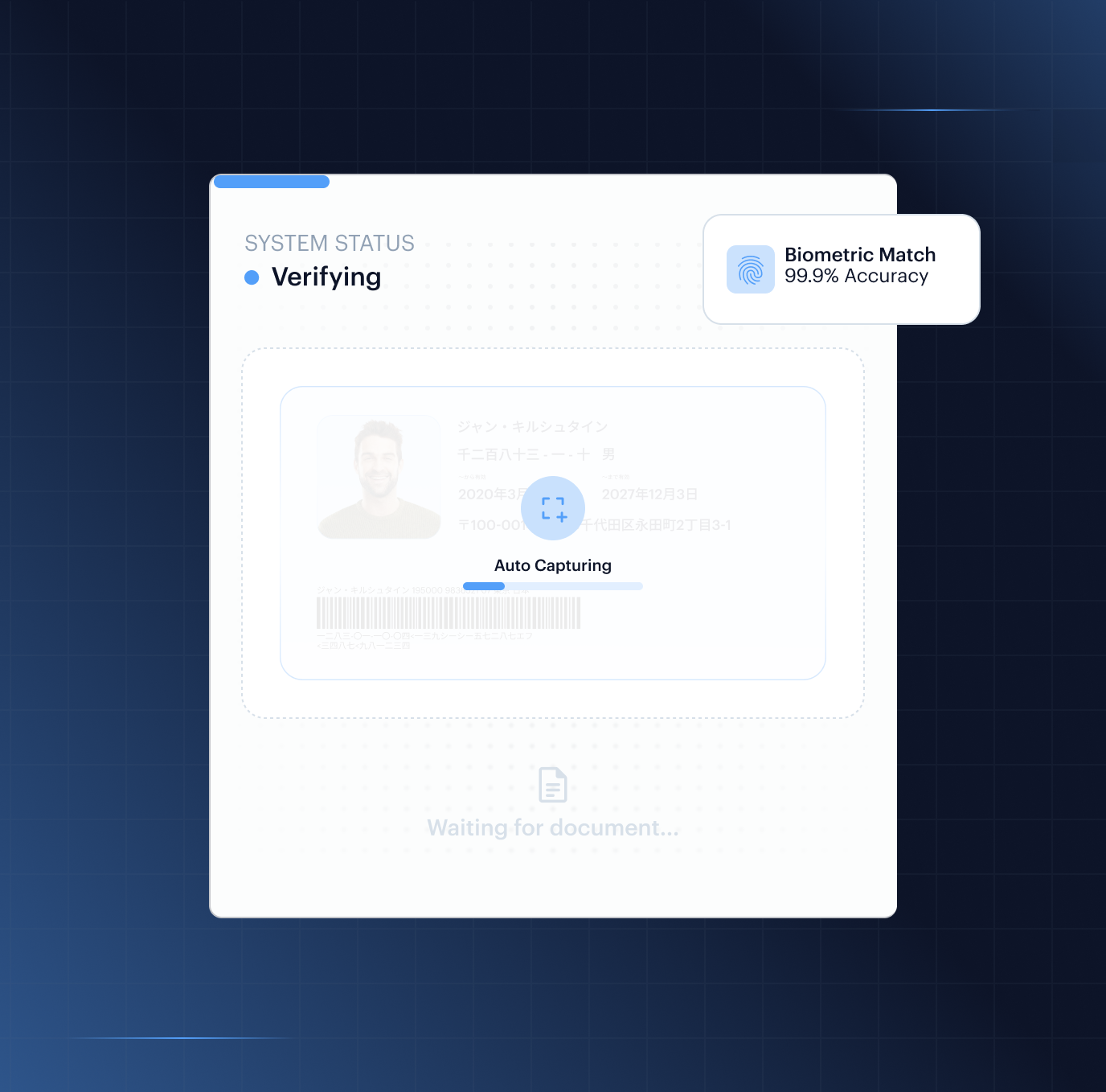
Shufti’s document verification solution lets you verify any government-issued document across 240+ regions actively processed with in-house technology and no data outsourcing. From recursive OCR for non-Latin scripts to handling cropped or worn IDs, Shufti delivers high-assurance decisions in under 15 seconds.
The World Largest Document Verification Service and Solution







The Enterprise Standard for AI Powered Document Verification
Forensic Depth That Single-Layer Systems Cannot Replicate
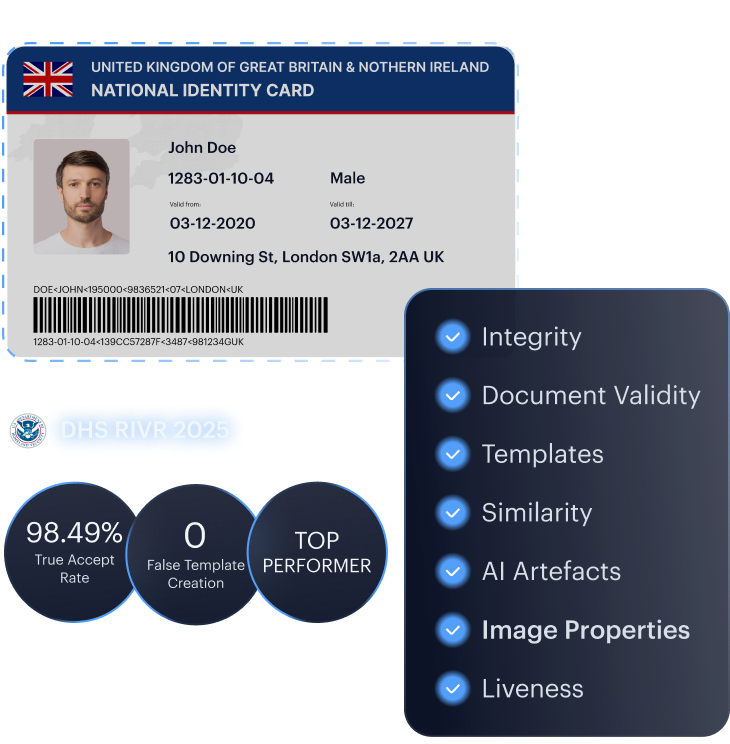
Most systems stop at template checks and OCR. Shufti document verification system runs a 9-layer AI-powered forensic pipeline across MRZ and checksum validation, metadata analysis, GenAI detection, screenshot detection, replay attack defence, PVC and synthetic document detection, hologram analysis, print-and-scan detection, and heatmap-based manipulation analysis.
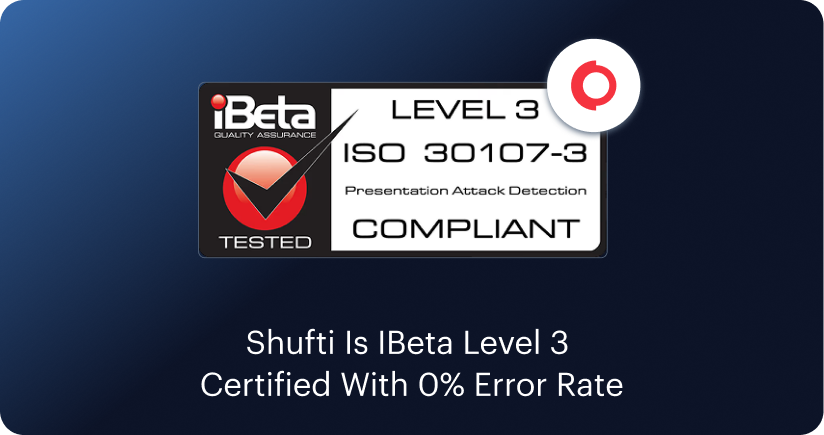
Evaluated by DHS RIVR 2025, Shufti earned Top Performer status with a 98.49% True Accept Rate and zero False Template Creation events.
ID-Optimised OCR Benchmarked Against Google
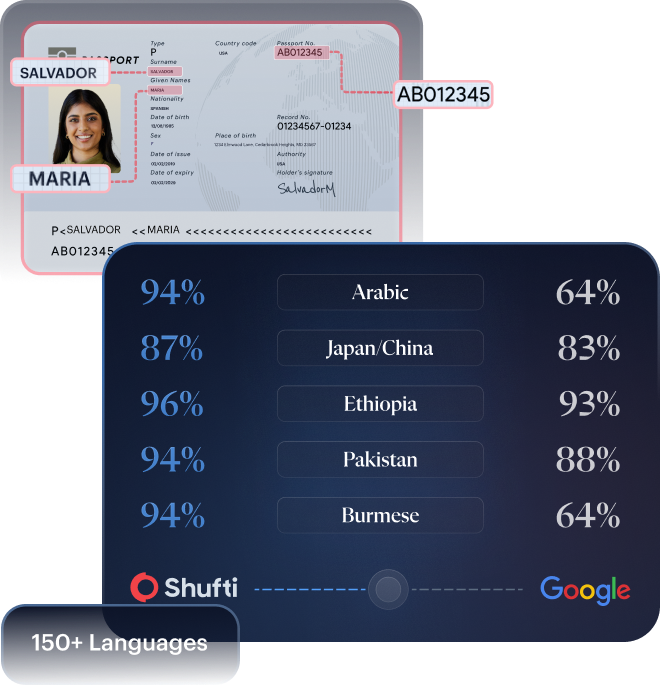
Shufti’s OCR, trained on any government-issued document, reaches 99.7% accuracy across 150+ languages and scripts, and outperforms Google Vision on Arabic, Vietnamese, and Chinese, Japanese, and Korean scripts.
Supports complex scripts including Devanagari, Ge’ez, Arabic, and Kanji, so global ID extraction works across varied issuing countries.
Verification Modes That Match Your Regulatory Requirements
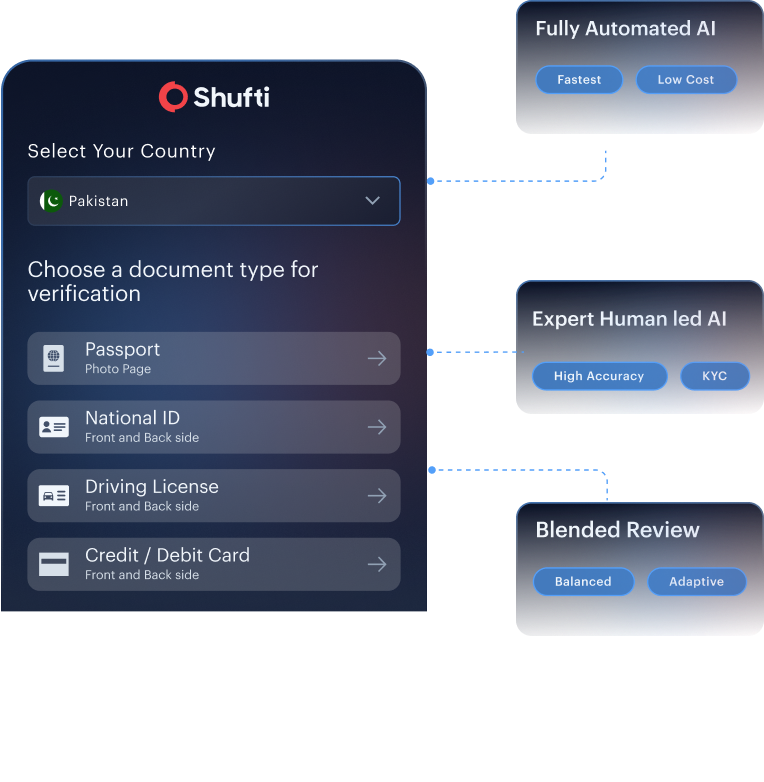
Choose fully automated AI, expert human-led AI, or blended review based on jurisdiction, risk, and compliance requirements, all in one platform.
Shufti supports both physical document checks and electronic identity credentials, mDL & EUDI Wallet ready, eIDAS 2.0 compliant digital ID acceptance, through the same API, avoiding a second vendor or integration.
VERIFICATION CAPABILITIES
Shufti’s Advanced Document Verification Capabilities
Document authentication & originality engine
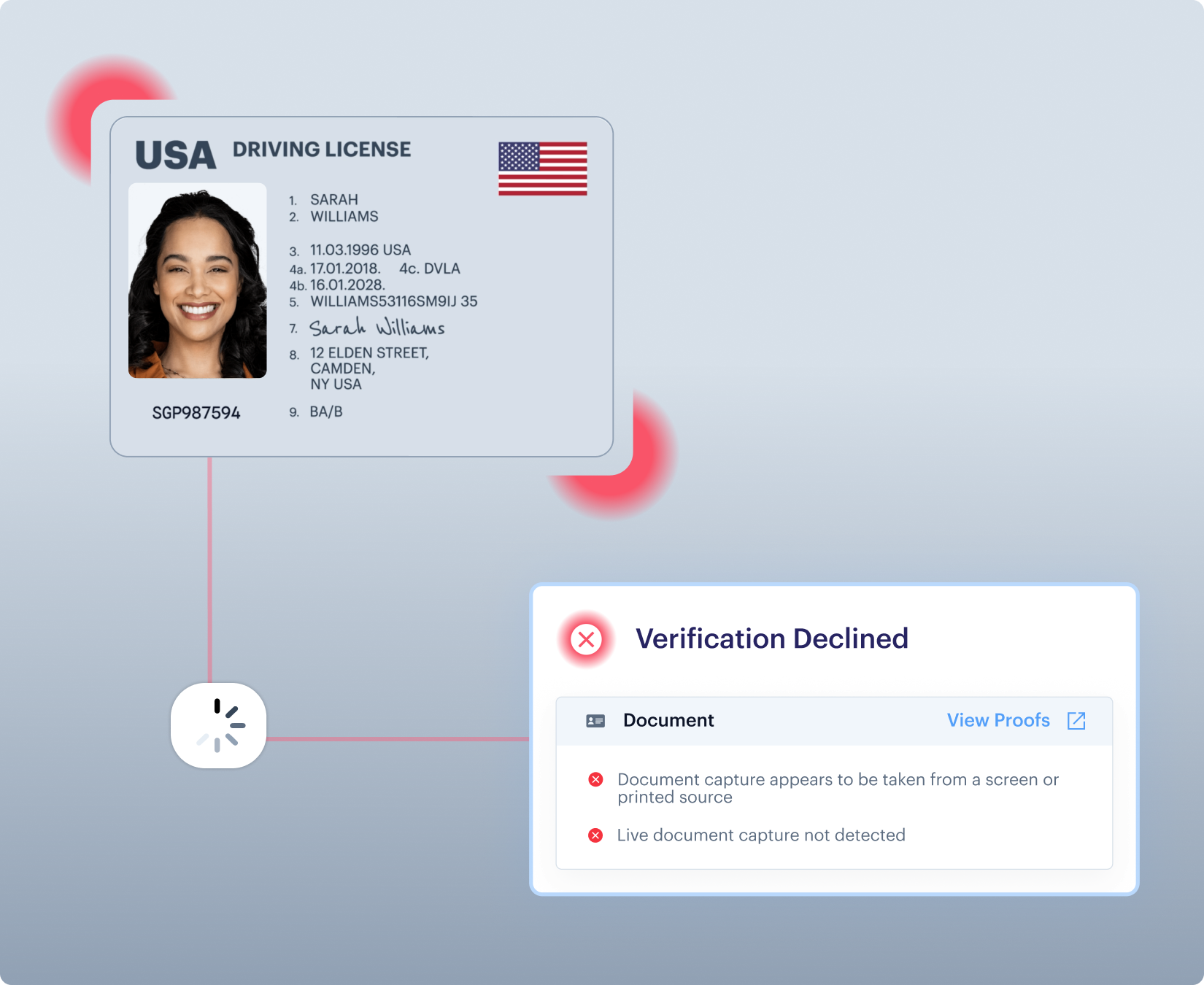
Screen Recapture and Replay Defence
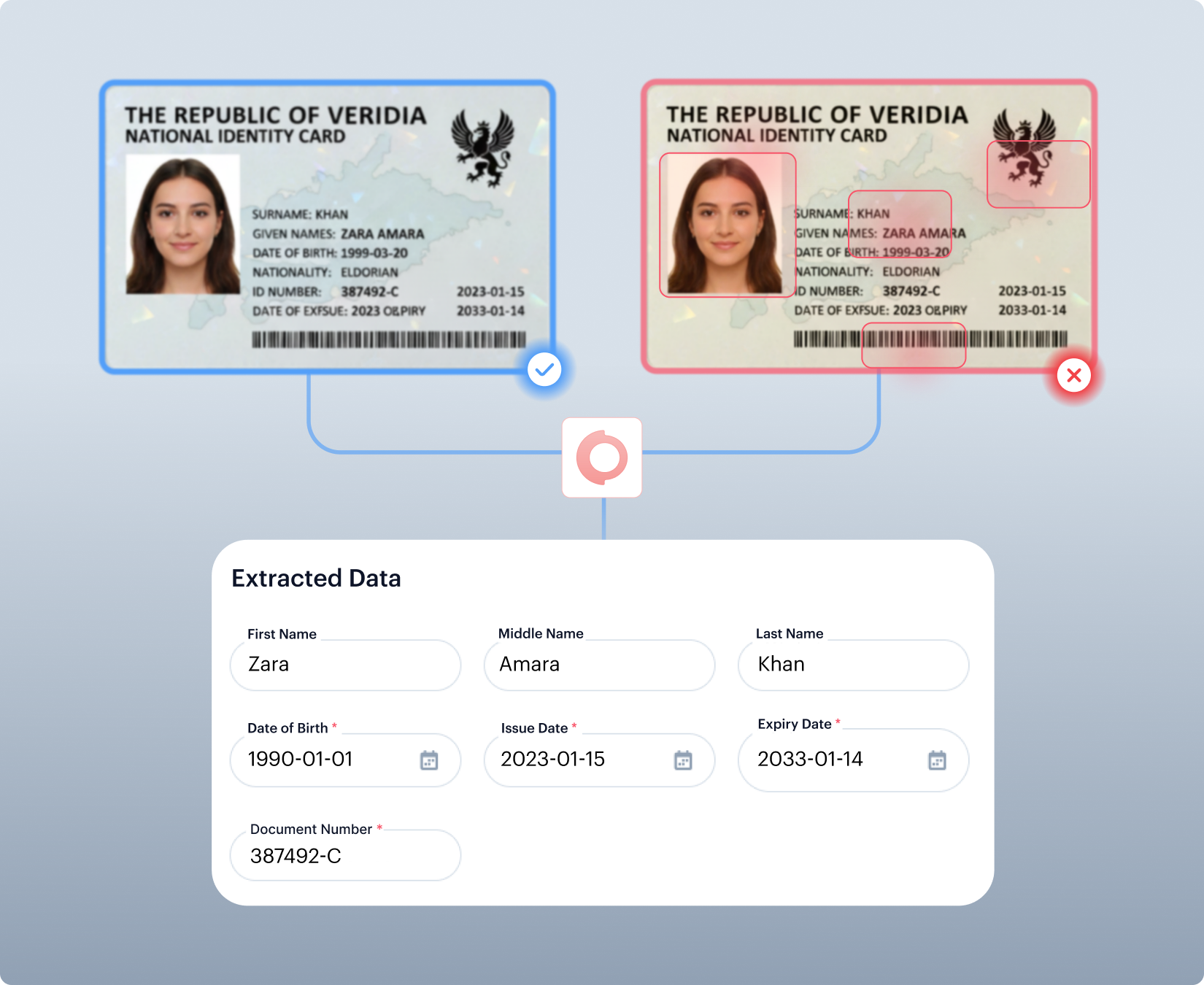
Detects documents photographed from screens, printed copies, and projected reproductions using moiré pattern analysis, reflection detection, and edge frequency analysis.
GenAI and Tamper Detection
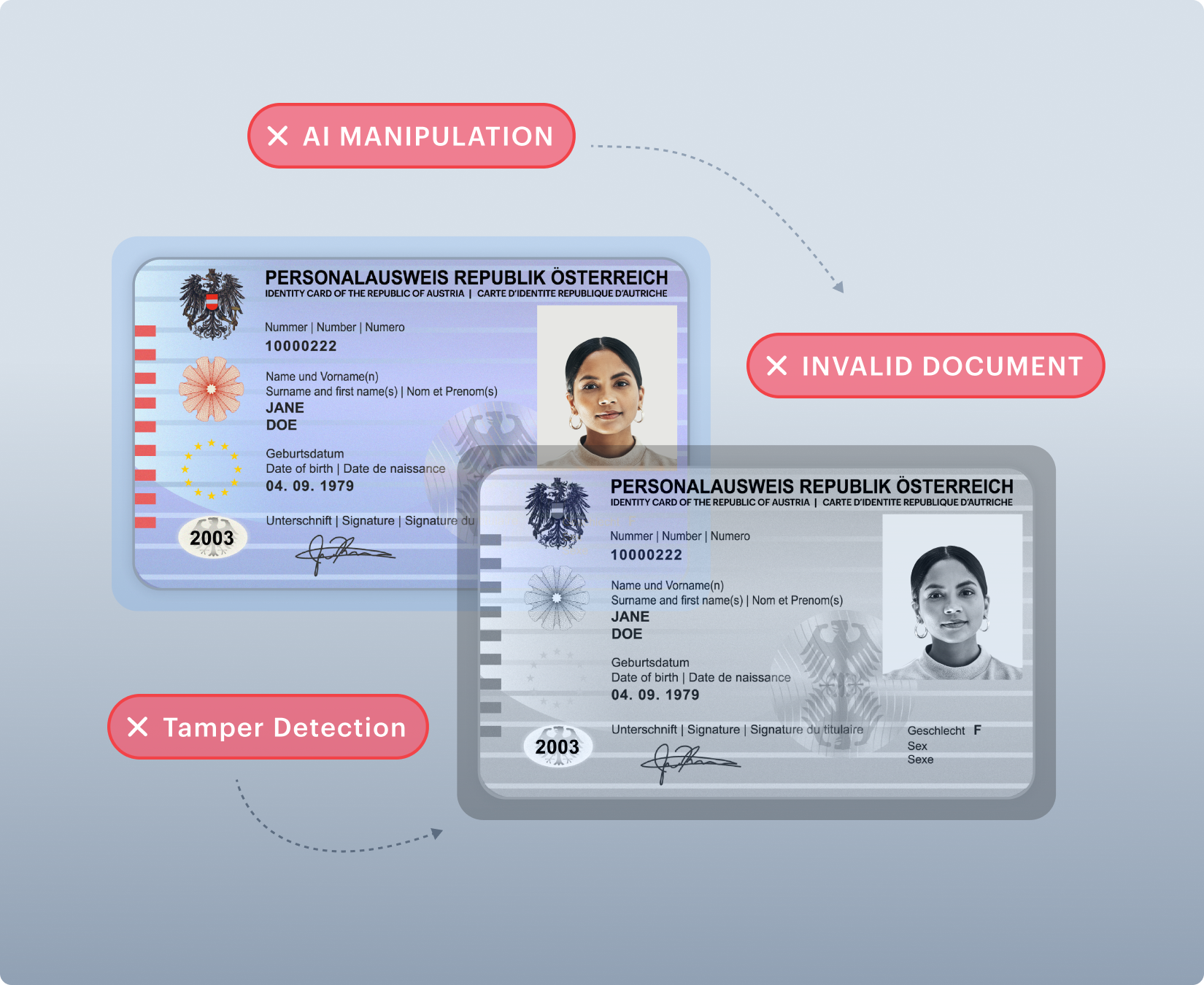
Catches AI-generated documents and synthetic security features while surfacing spliced fields, font mismatches, copy-move manipulation, and pixel-level inconsistencies.
Continuous Verification with Integrity Scoring
Re-evaluates verified documents as new fraud patterns emerge and consolidates all signals into a single configurable score teams can tune per risk level or geography.
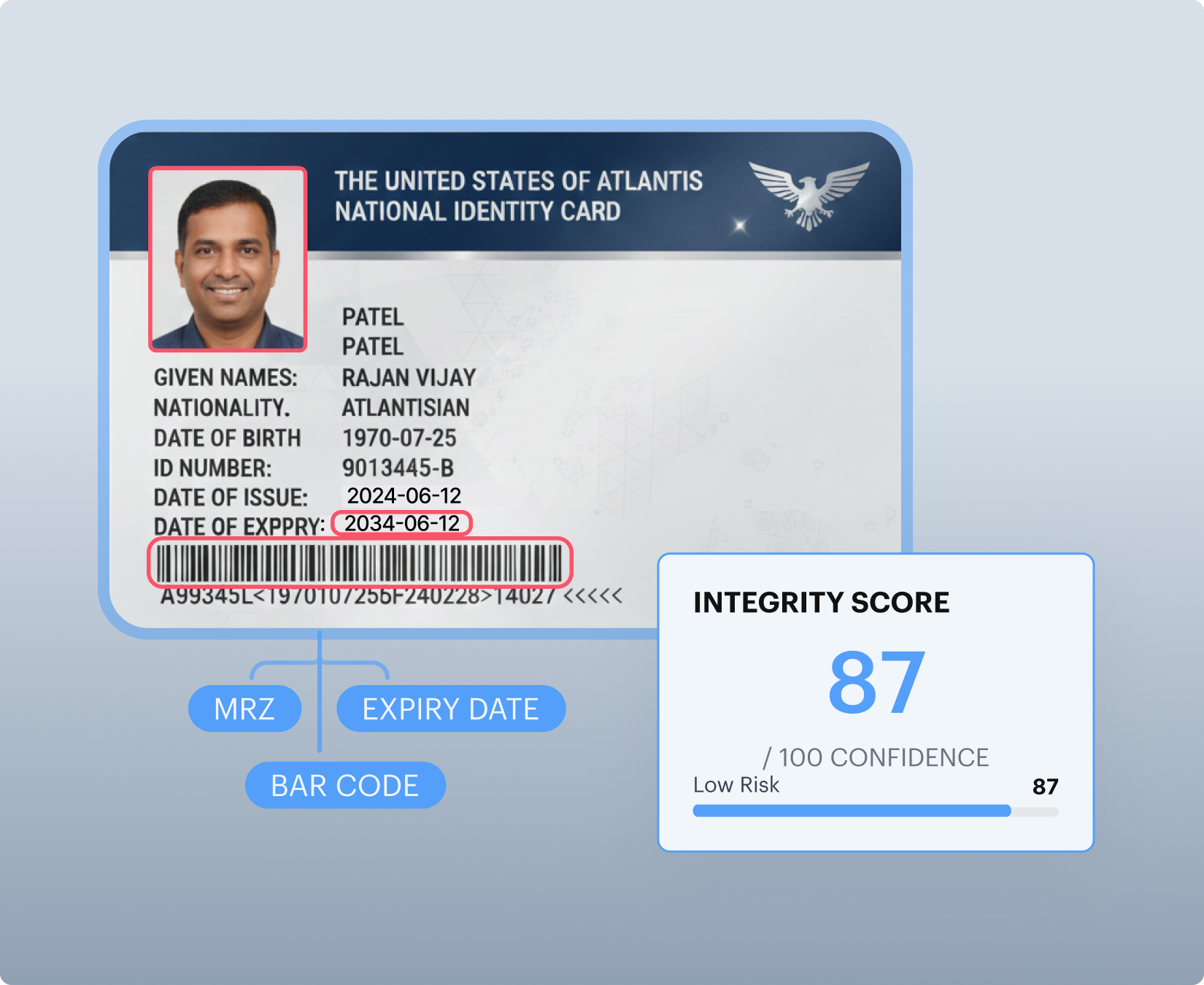
Doc360 capture resilience
Pre-Upload Quality and Submission-Type Validation
Checks sharpness, lighting, glare, and framing before the document verification process, and classifies whether the submission is a live capture, file upload, or screen grab to enforce the right policy.
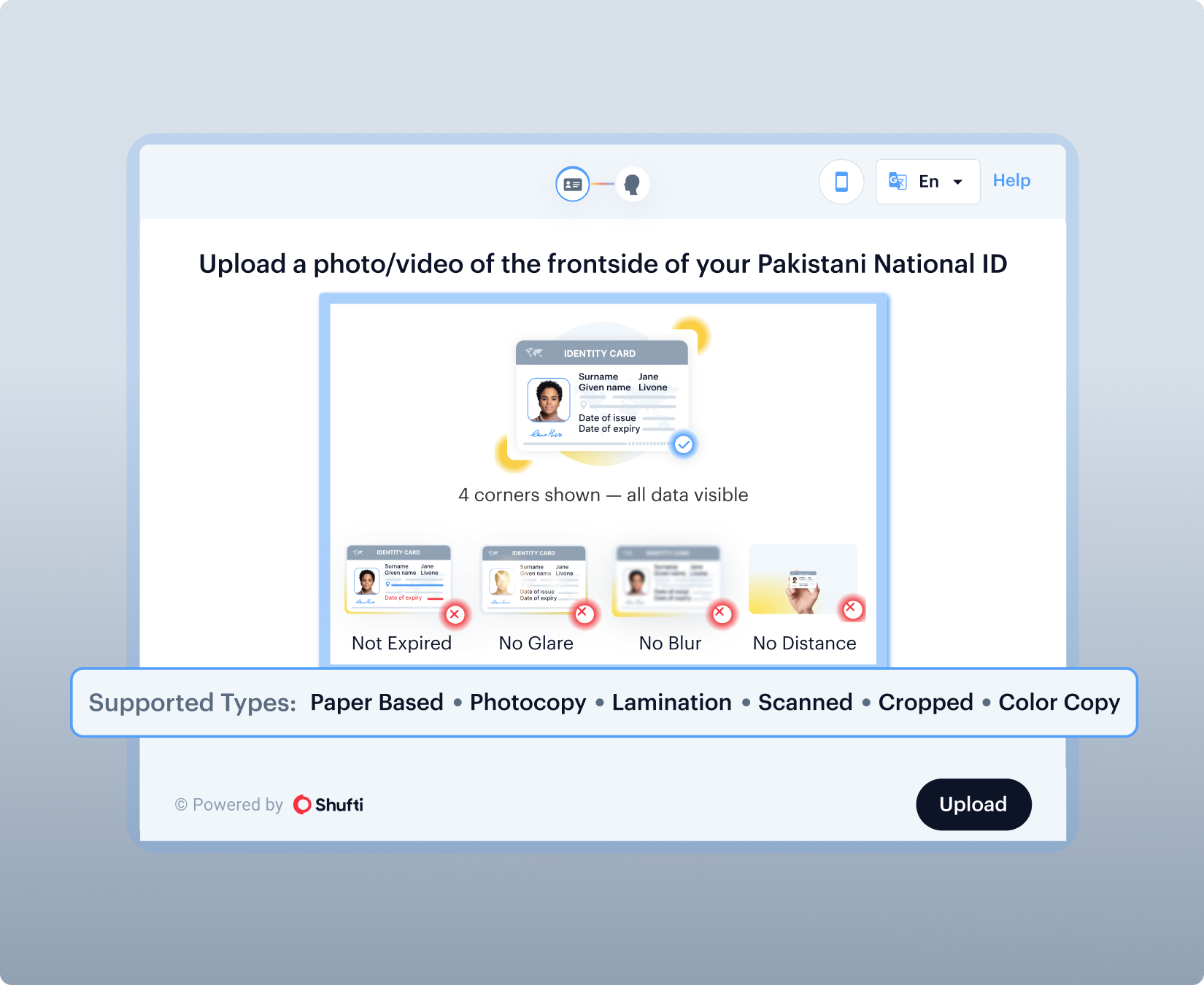
Copy, Reuse, and Low-Signal Resilience
Flags documents submitted across sessions or accounts and maintains forensic accuracy on inputs with poor lighting, occlusion, or low resolution.
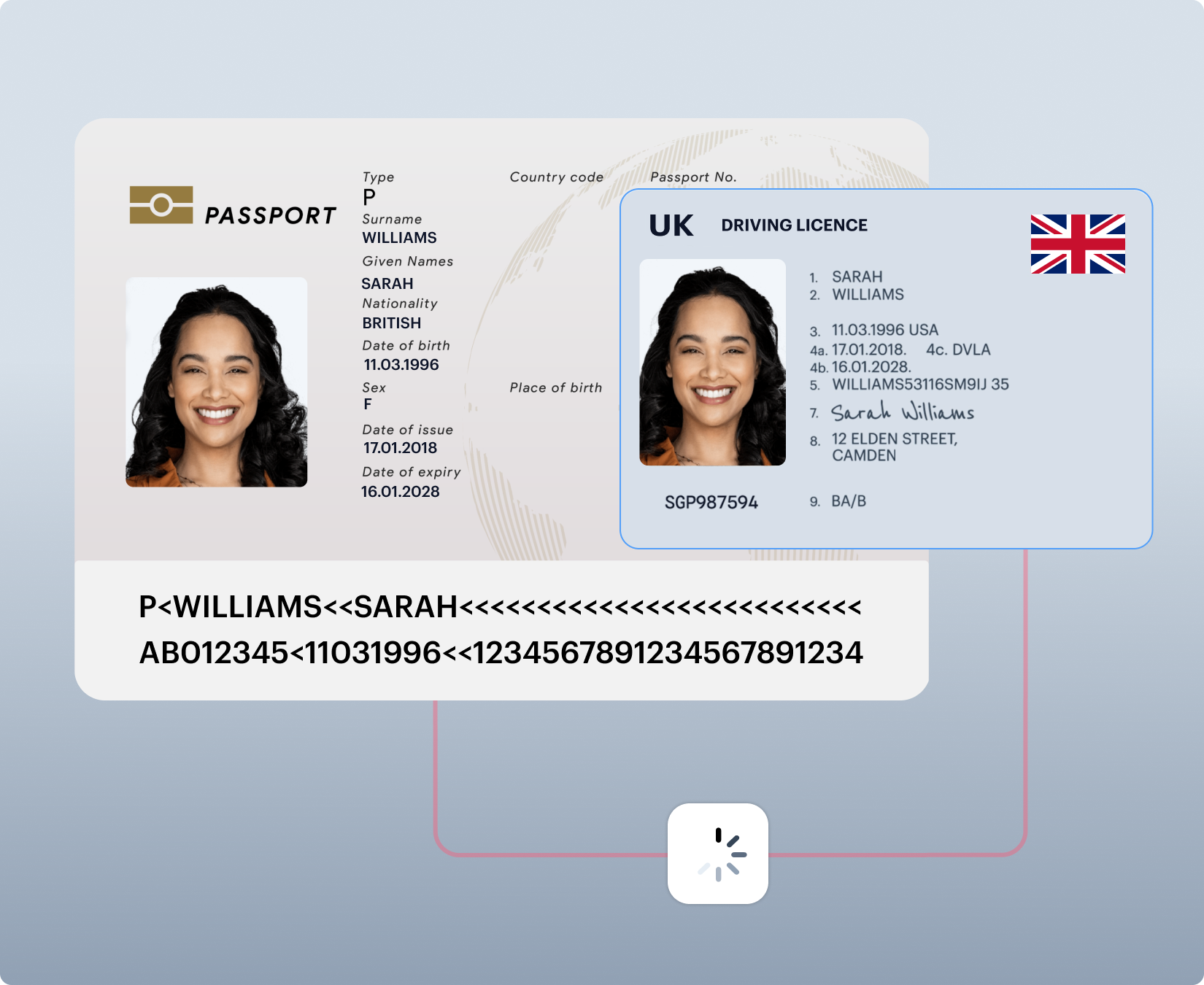
Cross-Verification & Review Outputs
Multi-Document Cross-Verification
Compares MRZ data, biographical fields, photo matching, and security features across two identity documents to catch inconsistencies single-document checks miss.
Fraud memory
Matches each submission against a database of known fraudulent documents and previously flagged cases to block repeat attempts.
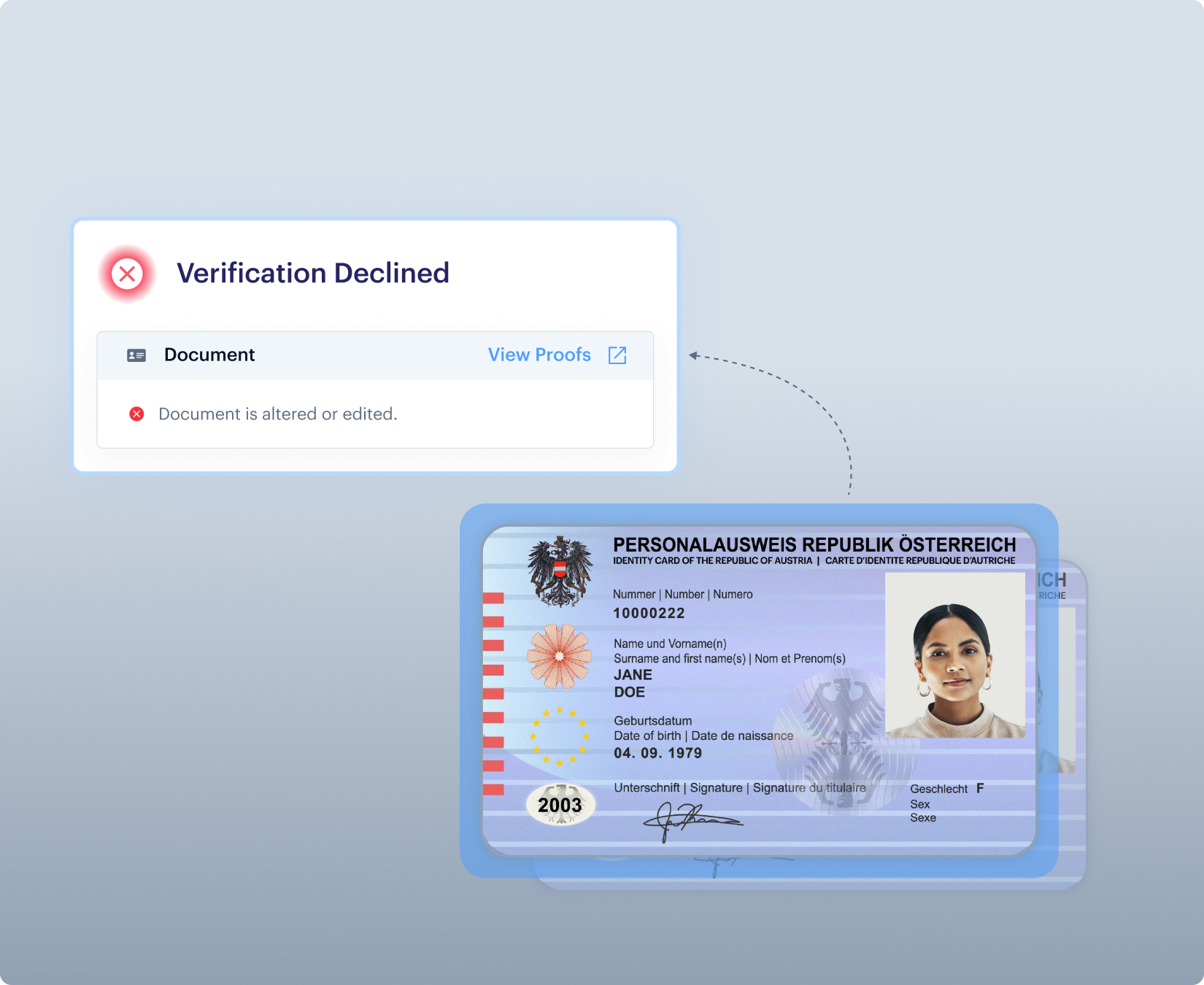
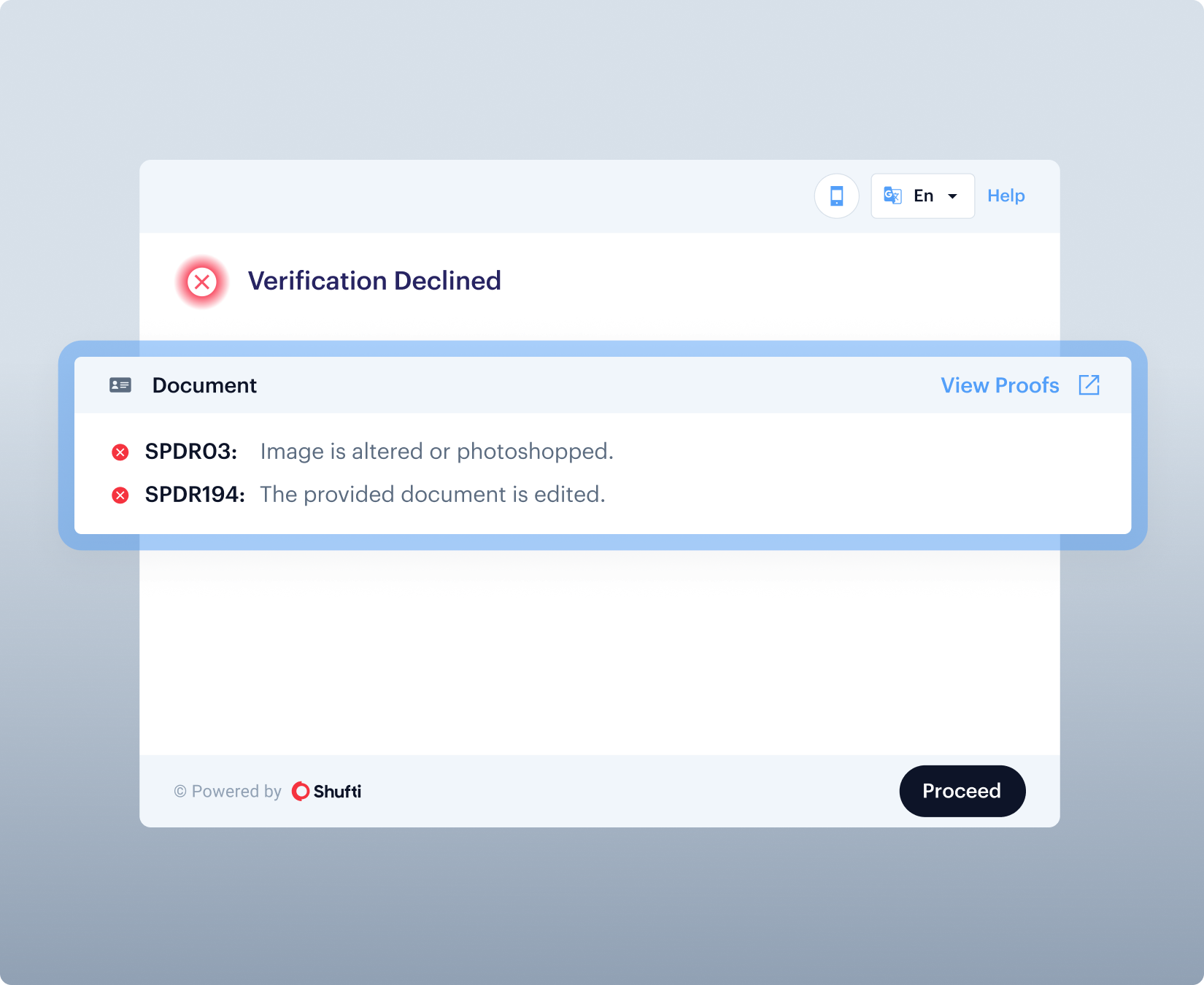
Review-Ready Outcomes
Returns structured evidence packages, extracted fields, per-layer forensic results, confidence scores, tamper-evident audit trail built to survive regulatory examination.
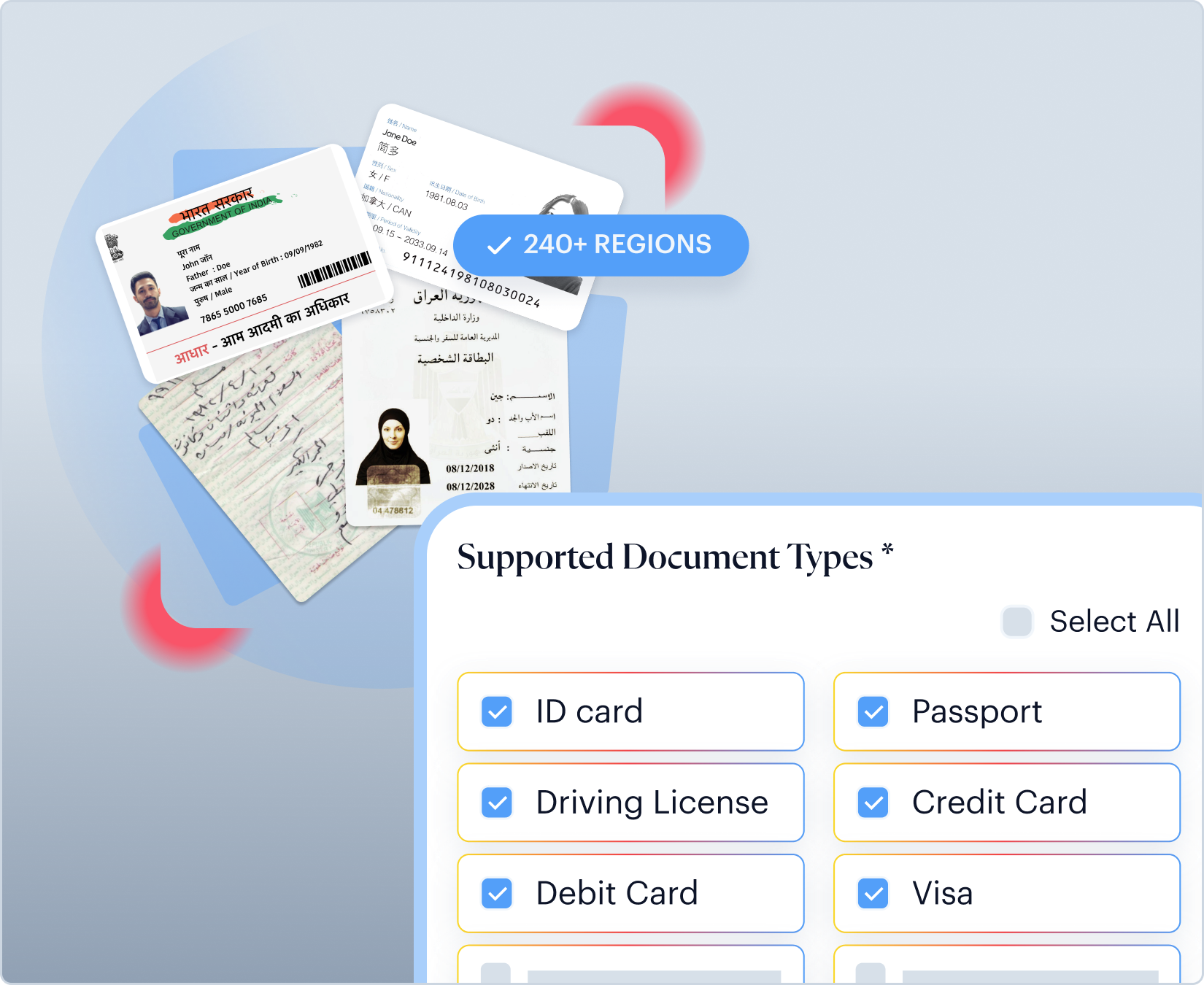
Supported document types
Any government-issued type across 240+ territories, passports, national IDs, driving licences, residence permits, visa stamps.
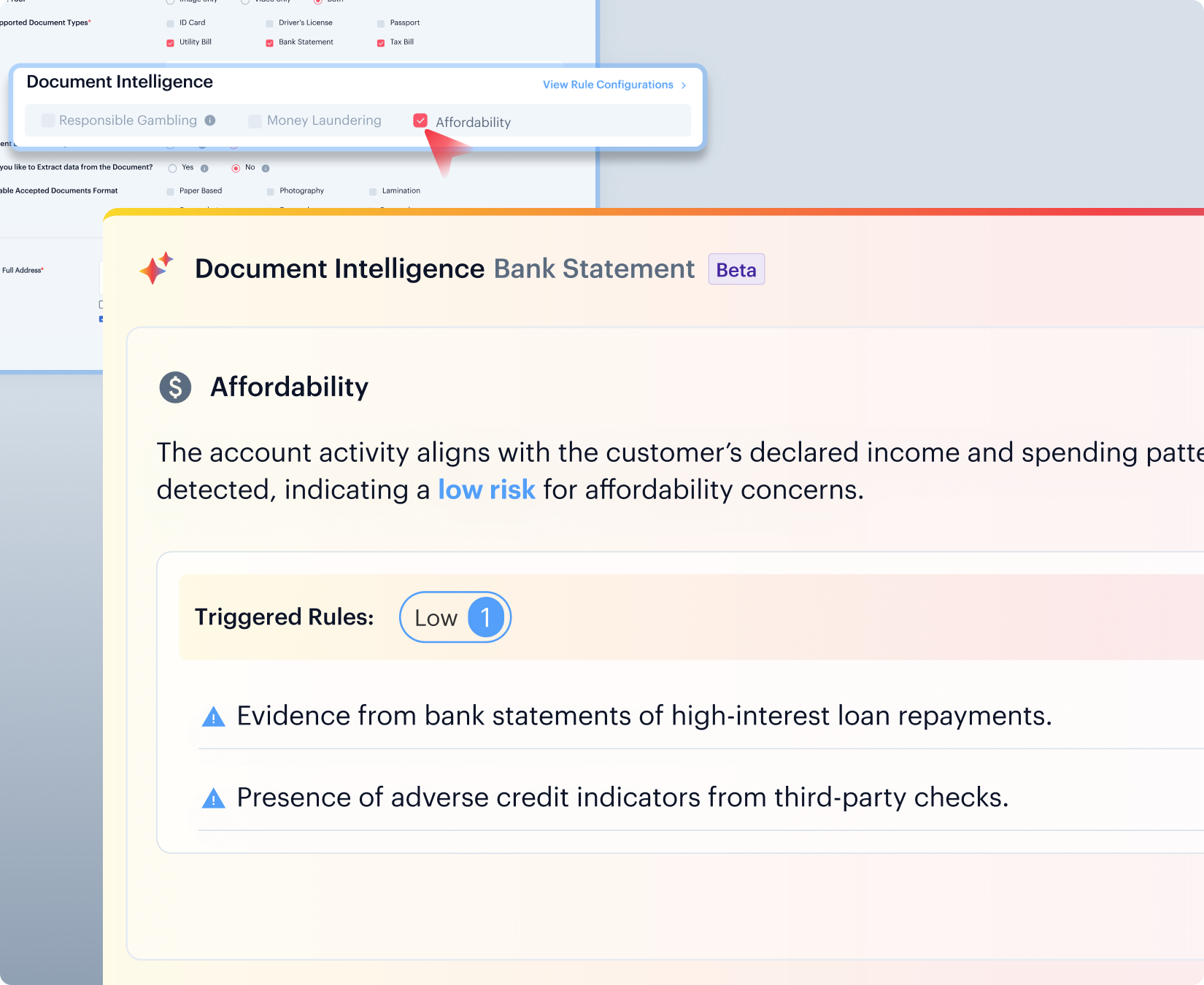
Document Intelligence
Affordability Assessment
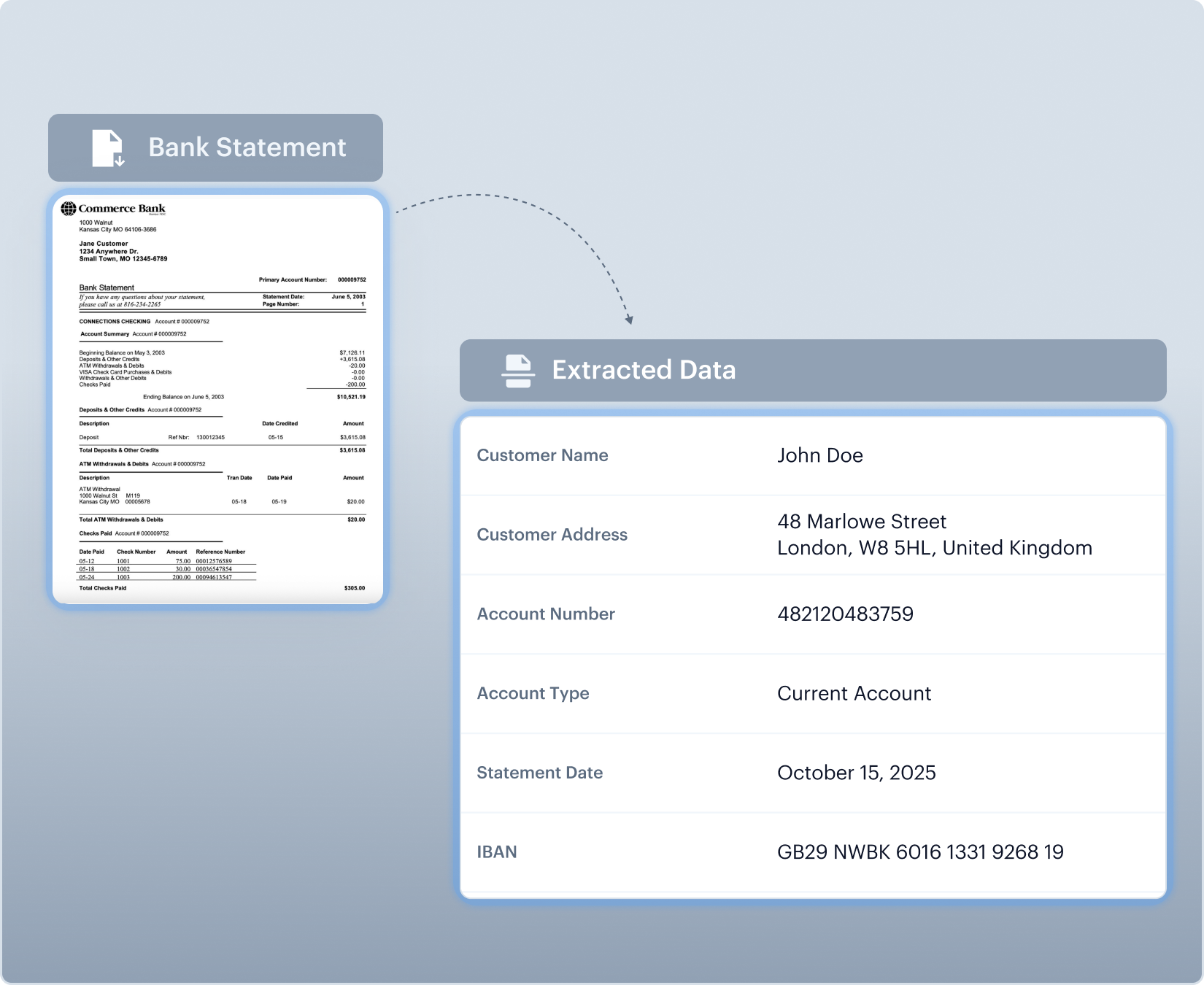
Extracts income, employment, and financial data from supporting documents to evaluate affordability and creditworthiness where proof of means is mandatory.
AI-Powered Extraction
In-house OCR at 99.7% accuracy across 150+ languages with script-to-Latin transliteration for sanctions and watchlist cross-referencing.
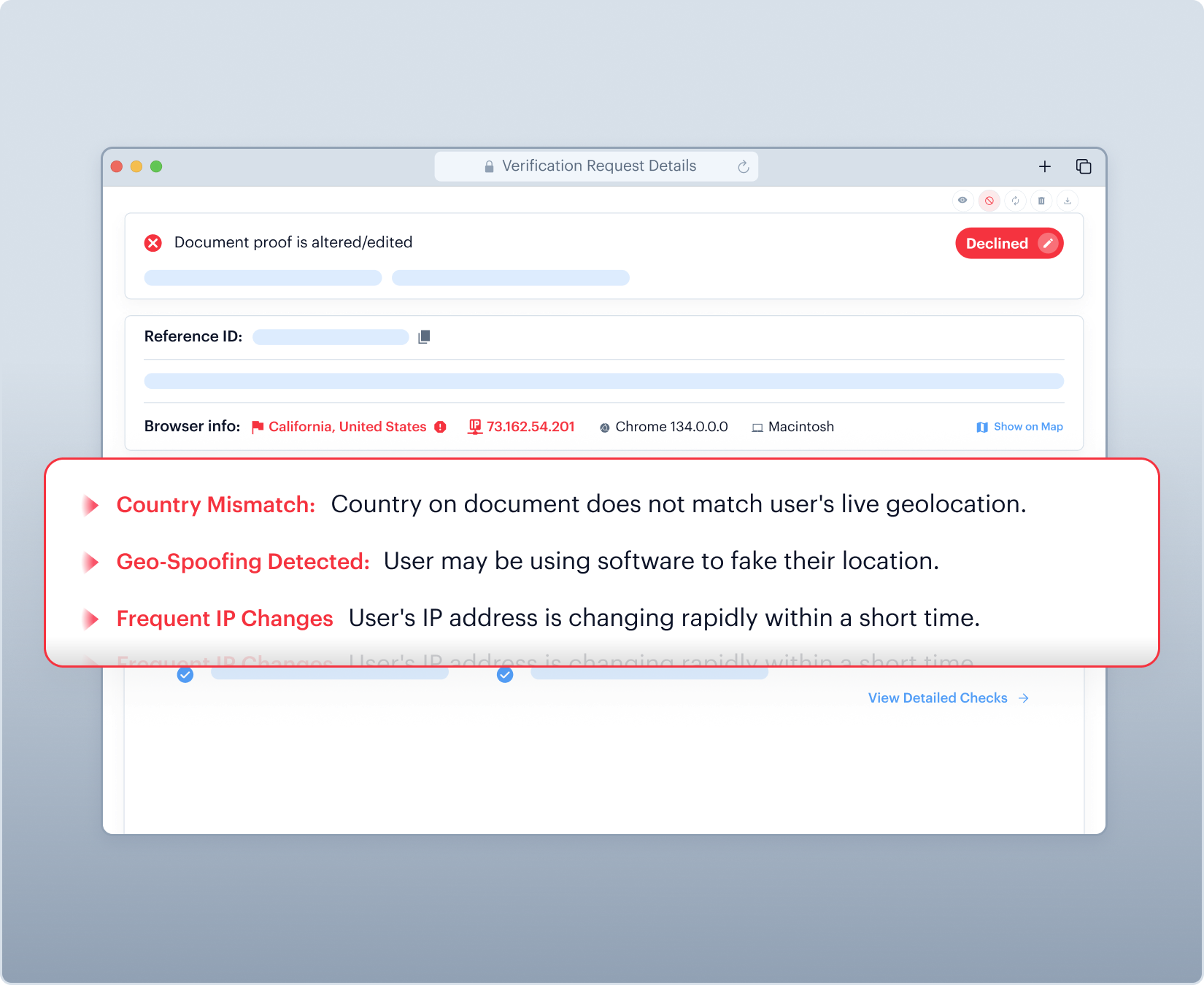
Configurable Rules and Explainable Scoring
Set verification policies per geography, risk tier, or use case. Every decision includes a full breakdown of which layers passed, which flagged, and what triggered each flag.
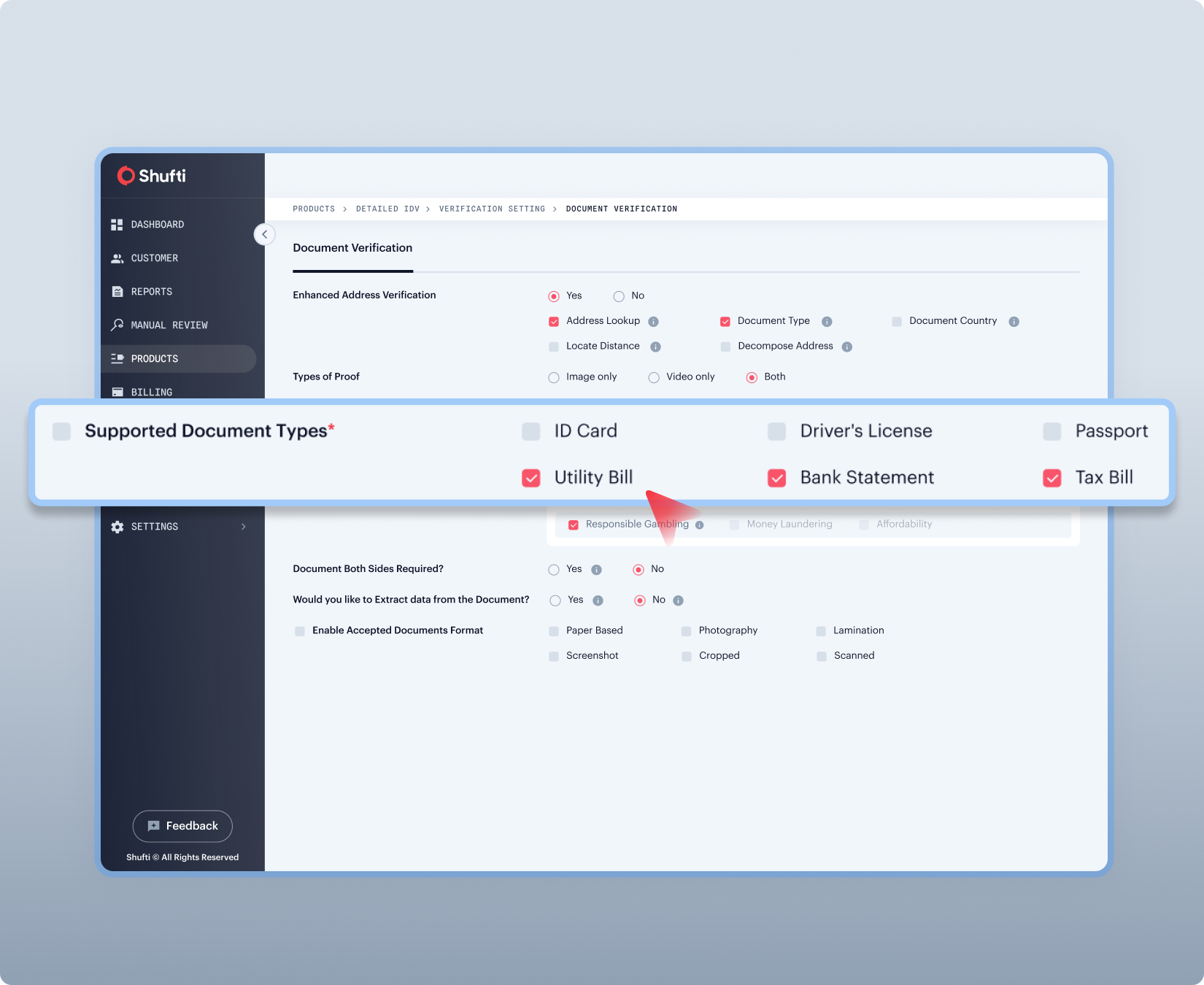
Supported Financial Document Types
Bank statements, payslips, tax returns, utility bills, and proof-of-address documents across multi-page layouts and varying formats.
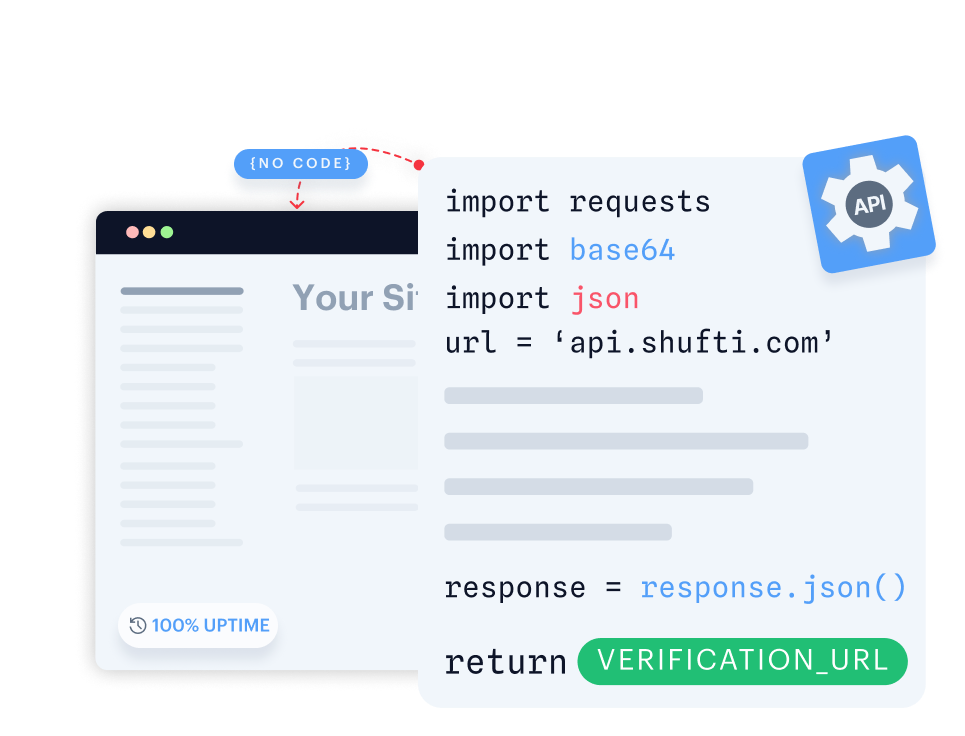
Single API, Seamless Integration
Build fully customisable verification flows with seamless backend integration.
- Gain full control by customising verification flows end-to-end.
- Integrate seamlessly with your backend for quick implementation.
- Design flexible verification journeys tailored to your users.
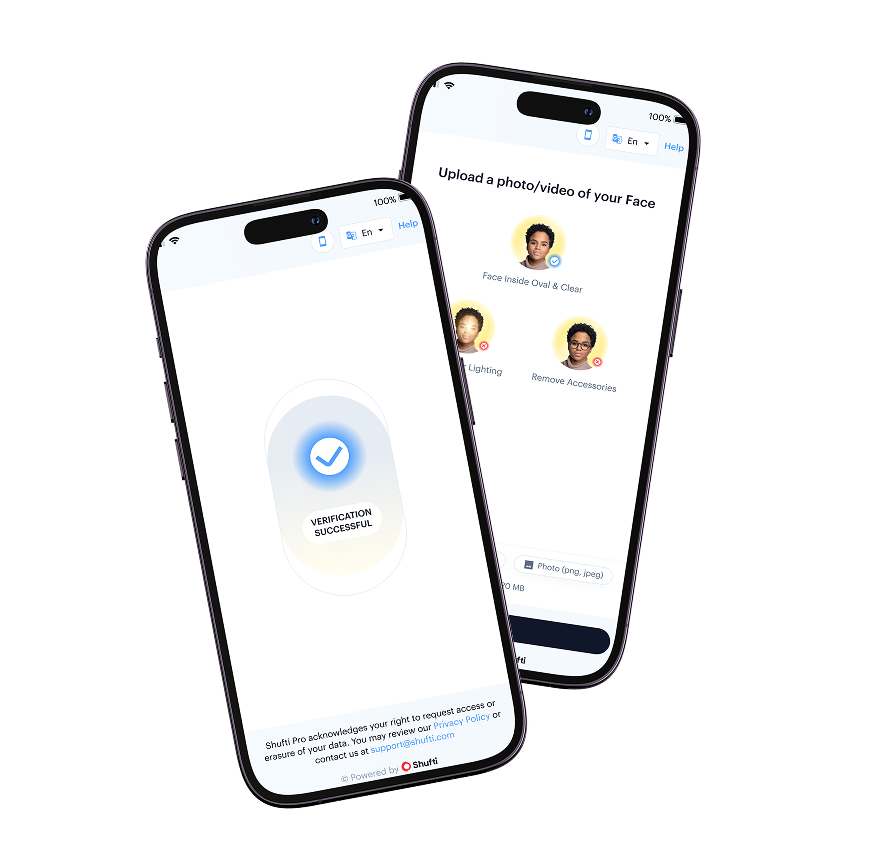
Launch a native verification experience in your mobile app within minutes.
- Launch native verification within minutes on iOS or Android.
- Use ready-made UI with camera, capture, and real-time feedback.
- Customise flows to fit seamlessly into your mobile app.
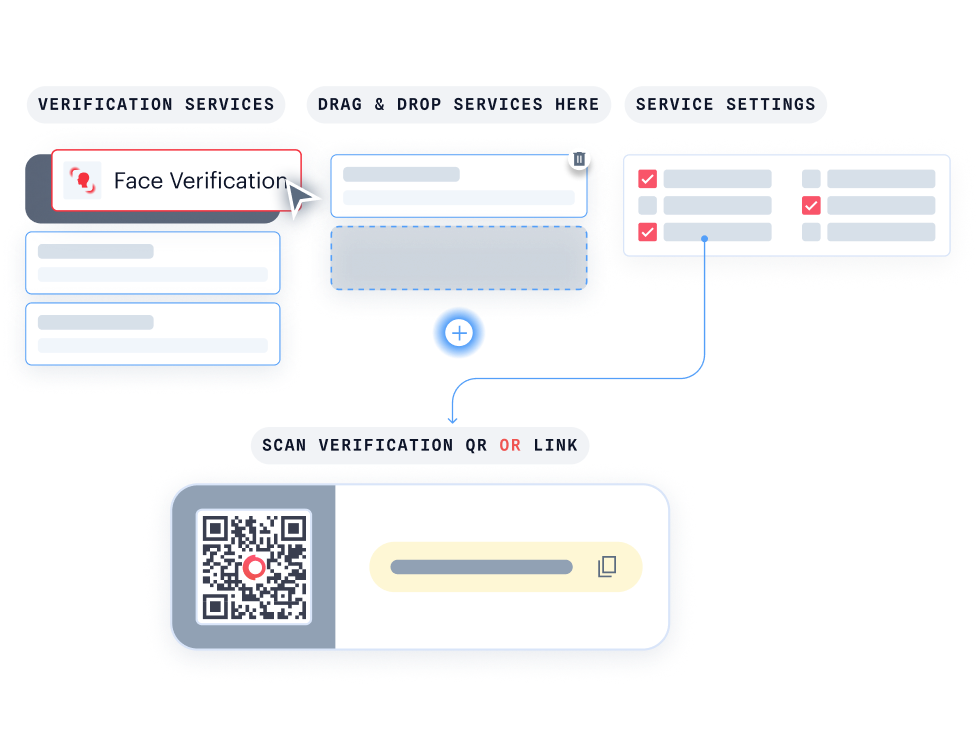
With KYC Journey Builder, create personalised verification journeys without writing a single line of code.
- Customise your journey effortlessly with drag-and-drop functionality.
- Instantly see how your verification flow looks for your users.
- Easily connect with Hosted Verification for a consistent, branded experience.
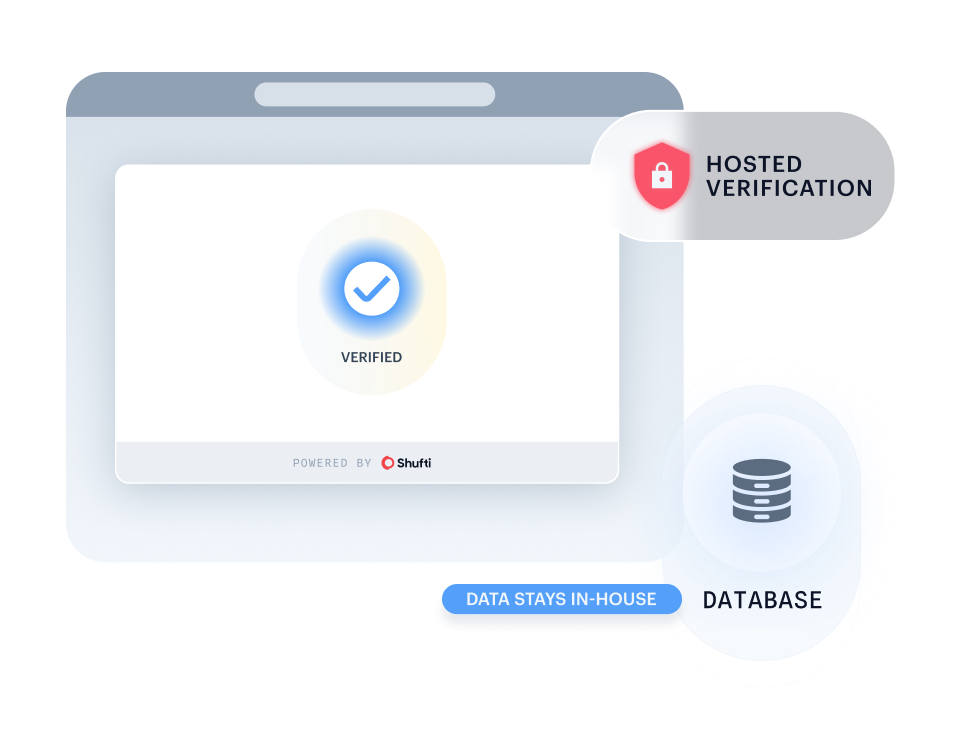
Run Shufti within your own identical-capability infrastructure for maximum data control and privacy.
- Keep all sensitive information in-house to meet strict governance and data residency requirements.
- Keep sensitive information fully private and secure in-house.
- Deploy in highly regulated sectors without compromising compliance.
Evidence-led document checks
Built for regulated and high-risk onboarding
Trustworthy sellers, less cycling
Document integrity scoring, tamper detection, and repeat-attempt signals help reduce seller fraud and re-registration loops, with exception handling that stays evidence-backed.

G2 Leader in Identity Verification, Fall 2026
Shufti has earned multiple G2 distinctions in Identity Verification this season, rated by real users and trusted by enterprises verifying across 240+ regions actively processed.





Don’t just take our word for it, hear from our customers
The Confidence Our Clients Share

The future of digital identity is defined by trust, interoperability, and regulatory alignment, so our partnership with Shufti reinforces DevCode Identity’s commitment to supporting our global customers with the most secure, best-in-class, compliant identity verification solutions available today.
Combining our Conversion Driven Compliance Orchestration Platform with Shufti’s global KYC and IDV capabilities allows our customers not only to navigate complex regulatory demands but also to maintain a seamless customer onboarding experience with the highest achievable conversion rates.
We’re proud to continue our partnership with Shufti as we expand into new jurisdictions.
Shufti’s verification technology not only strengthens our compliance framework but also ensures our players enjoy a smooth, secure onboarding experience.
We aim to offer our clients and their traders the very best tools with which to do their jobs, we’re excited to be able to work with Shufti.
They’re a leading company, and we’re looking forward to offering their solutions to our clients through our CRM.
The relationship with Shufti was born out of frustration with an existing provider, so we started our discussion with Shufti.
The response time was excellent, from the start of speaking to sales to getting up and running with the demo.
Everything you need to know in one place
Frequently Asked Questions
What is document verification?
Document verification is the process of confirming that an identity or supporting document is genuine, unaltered, and valid before it is accepted as proof. Automated systems check security features, fonts, layout templates, and machine-readable zones against known specimens, test the image for tampering, and then extract and cross-check the data fields. In customer onboarding, it is used to satisfy KYC and AML obligations. It is a separate process from I-9 employment eligibility verification.
What are the types of document verification?
There are three broad types. Identity document verification covers passports, driving licences, national ID cards and residence permits, and establishes who the customer is. Proof of address verification covers utility bills, bank statements and government correspondence, and establishes where they live. Source of funds verification covers payslips, tax records and financial statements, and establishes where their money comes from. Most regulated onboarding uses the first, adds the second for higher-risk customers, and the third for enhanced due diligence.
Can document verification software detect AI-generated or deepfake documents?
Yes, but only if the system tests for it directly. Template matching alone will not catch a well-made synthetic document, because the layout may be entirely correct. Detection depends on frequency-domain analysis, which identifies statistical artefacts that generative models leave in an image and that are invisible to the eye. Shufti applies Discrete Cosine Transform frequency analysis as one of nine independent forensic checks, alongside tests for digital manipulation, print pattern anomalies, and specimen mismatch.
Is document validation software the same as document checking software?
Yes. Document validation software, document checking software, document authentication software, and document verification software all describe the same category: tools that confirm a document is genuine, unaltered, and correctly matched to its holder. The terms are used interchangeably across the market. Where a real distinction exists, it is usually between fully automated verification, which runs checks without human involvement, and hybrid verification, which routes uncertain cases to a trained reviewer.
How long does document verification take?
Verification of documents usually returns a decision within seconds. Cases escalated to human review take longer, generally minutes rather than hours, depending on queue depth and document complexity. The main variables are image quality, how well the document type is represented in the specimen library, and whether biometric matching or address verification runs alongside. Because slow verification costs conversions as well as time, it is worth asking any provider for median rather than average decision times.
What documents are required for verification?
At minimum, most KYC programmes require a government-issued photo identity document confirming name and date of birth. A passport, driving licence, national ID card or residence permit will normally satisfy this. Higher-risk customers, or those in stricter jurisdictions, may also need proof of address such as a recent utility bill or bank statement. Some regulated sectors additionally require source of funds documentation. The exact list depends on the regulator, the sector, and the customer's risk rating.
How accurate is automated document verification?
Accuracy varies widely between providers, and self-reported figures deserve scepticism. Independent evaluation is the thing to look for. Shufti's document verification pipeline was tested in the US Department of Homeland Security RIVR 2025 evaluation, returning a True Accept Rate of 98.49% with zero False Template Creation events, and earning Top Performer status. Its in-house OCR engine achieves 99.7% aggregate accuracy across 150+ languages. When comparing providers, ask which figures are independently validated and which are internal benchmarks.
Which regulations require document verification?
The document verification pipeline maps to FATF Recommendation 10 (Customer Due Diligence), 5AMLD and 6AMLD identity verification obligations, eIDAS 2.0 document authentication standards, and UK FCA identity verification requirements. Each verification produces a structured evidence package (original image, extracted fields, per-layer forensic results, confidence scores, tamper-evident audit trail) designed to survive regulatory examination.
Talk to a document verification specialist
Share your verification volume, the products you are weighing, and the document challenges you are hitting. We will map them to the right forensic layers, OCR coverage for your scripts, and a deployment model that fits your data sovereignty requirements.
Check How It Works On Your Documents And Book A Walkthrough
Shufti verifies documents using integrity scoring, replay defence, and forensic checks, keeping genuine users moving and exceptions reviewable.
Your Go-To for KYC/AML & Fraud
Resources
27 August, 2025
Close the 1% Fraud Gap with Shufti's Adaptive AI
The 1% that your controls miss causes the largest losses of all. How a layered defence closes that blind spot, and what it changes for fraud cost and for growth.
Guide