AMLR Solutions
  AMLR Consultation
 EUDI Wallet
 Onboarding
 Ongoing Monitoring
 FRAML
FRAML KYC
KYC KYB
KYB KYI
KYI Age Assurance
 Workforce IAM
 Candidate Verification
 Account Takeover
 Bonus/ Promotion Abuse
 Chargeback Fraud
 Deepfake
 Document Fraud
 Fraud Networks
 Impersonation Fraud
 Money Mule Activity
 Multi-Accounting
 Party Fraud
 Regulatory & Compliance Risks
 Synthetic Identity Fraud
 Adult Content
 Banking
 Crypto
 Fintech
 Forex
Forex Compliance
 Fraud prevention
 Trust & safety
 Global expansion
 Compliance Officers
 Developers
 Fraud Analysts
 Product Managers
 Journey Builder
  Global Trust Platform
 Customer Profiles
 Vendor Comparison
 IDV Case Management
 AML Case Management
 Regulatory Reporting
 Agentic Rule Builder
  AI Compliance Co-Pilot
  Fraud Analytics
 Fraud Hub
  OCR
OCR Shufti AI
 Bank Account Verification
  Biometric Duplication
 Database Checks
 Document Intelligence
 Government ID
 Mobile Driver's License
 NFC
NFC Selfie Liveness
 Brand Personalisation
 Deployment Options
 Identity Methods
 IDV Modes
 Multi-tenancy
 On-Premise IDV
 Secure Capture
 Shufti MCP















As the Middle East’s financial hub, the UAE offers several enticing free trade zones that attract major enterprises and contribute significantly to the nation’s economic expansion. However, criminals use the country’s current landscape to commit crimes such as money laundering, posing a significant risk to the stability and security of the financial system. This highlights the importance of implementing Anti-Money Laundering (AML) regulations to combat this fraud in the country.
Who is the Main Regulator in the UAE?
The Central Bank of the UAE (CBUAE) established a dedicated department in August 2020 responsible for overseeing all matters related to money laundering and terrorist financing. Before this, these tasks were handled by the Banking Supervision Department. The newly established Anti-Money Laundering and Combating the Financing of Terrorism Supervision Department (AMLD) have the following primary objectives:
- Conducting checks on licenced Financial Institutions (FIs).
- Ensuring strict adherence to the UAE’s legal and regulatory framework concerning AML and CTF.
- Identifying potential risks, vulnerabilities, and emerging threats to the UAE’s financial sector.
The AMLD collaborates closely with the UAE’s National AML and Countering Terrorism Financing (CTF) Committee and the Banking Supervision Department Examination Division to fulfil its responsibilities effectively. Furthermore, the AMLD acts as a mediator between the domestic stakeholders and CBUAE.
Apart from the AMLD, other authorities involved in AML and CTF activities include:
- The Securities and Commodities Authority
- Organisations operating exclusively within special economic zones, such as Dubai International Financial Center
- Various federal and local supervisory and law enforcement authorities
What are the Principal Regulations?
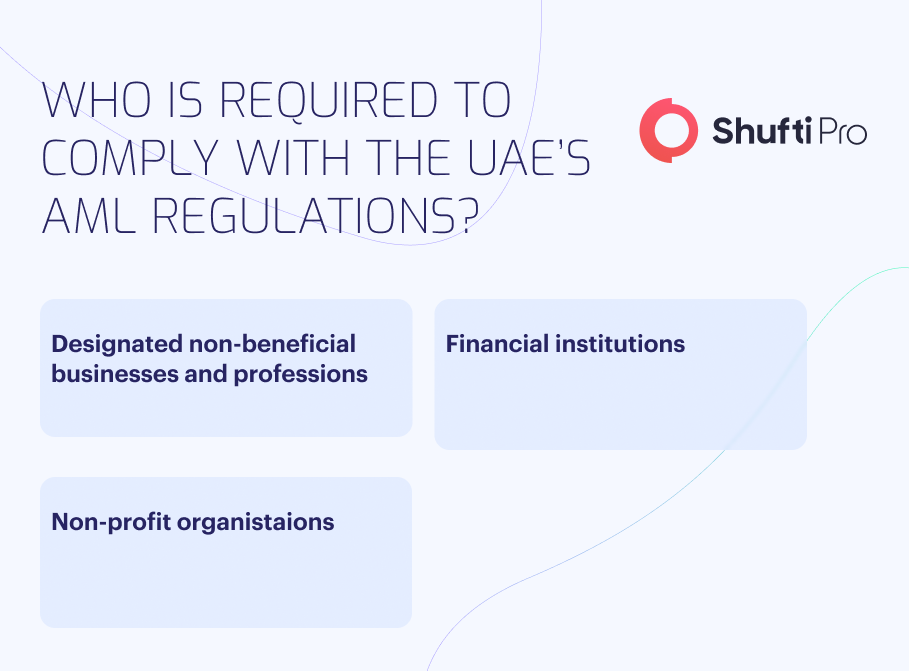
- The “AML-CTF Law” or “the Law,” officially known as Federal Decree-Law No. (20) of 2018 deals with AML, CTF, and financing of illegal organisations.
- The “AML-CTF Decision” or “the Cabinet Decision” refers to Cabinet Decision No. (10) of 2019, which concerns the Implementing Regulation of Decree-Law No. (20) of 2018 on AML and combating terrorism financing and illegal organisations.
Under the AML-CTF Law, an individual acts unlawfully when they knowingly:
- Transfer or transport proceeds of crime to conceal or disguise their illicit origin.
- Hide the true origin, nature, movement, way of disposition, or rights related to proceeds or their ownership.
- Obtain, possess, or utilise such proceeds.
- Help the perpetrator of the predicate crime in avoiding punishment.
What are the Penalties?
Failure to report suspicious activities could lead to imprisonment and fines ranging from AED 100,000 to AED 1,000,000. Violations of other AML and CTF requirements may result in companies facing imprisonment or fines between AED 10,000 and AED 100,000. Designated Non-Financial Businesses and Professions (DNFBPs) may be subject to penalties ranging from AED 50,000 to AED 200,000.
Recent Developments: UAE to Set Up AML Bodies
The UAE was on the Financial Action Task Force’s (FATF) grey list in March 2022. As a response, the country has announced the establishment of bodies to combat economic crimes. This initiative aims to build confidence among global investors and attract them to establish their businesses in the Gulf country, solidifying its position as a preferred business hub.
The decision was made during the 18th meeting of the Supreme Committee chaired by the country’s Minister of Foreign Affairs, Abdullah bin Zayed Al-Nahyan. The Director General at the Executive Office of AML and CTF, Hamid Al-Zaabi, presented the FATF action plan, the efforts undertaken by each regulatory authority, and the progress achieved.
The presentation highlighted a surge in penalties imposed by regulatory bodies, totaling more than 130 million dirhams by Q2 of 2023, reflecting the steps taken against violators. Furthermore, the number of suspicious transaction reports submitted to the Financial Information Unit (FIU) had significantly risen compared to figures from 2022. This indicates a growing understanding and awareness among the private sector due to the continuous efforts of all relevant authorities in the country.
Regarding money laundering investigations, the presentation reported an enhancement in the quality and quantity of cases handled. The meeting also included a review of the latest developments in the national plan and an overview of the outcomes of the FATF plenary session held in Paris in June 2023.
How to Stay Compliant
- Meet Customer Due Diligence (CDD) Requirements: In accordance with Article 6 of the AML-CTF Decision, both FIs and DNFBPs are obligated to implement suitable risk-based CDD measures. This means understanding the nature of the business and the reason behind the transaction.
- Report Suspicious Activity: FIs must fulfil specific obligations if they identify any suspicious activity related to Money Laundering (ML) or Terrorism Financing (TF). No minimum reporting thresholds or statute limitations exist for reporting ML and TF or suspicious transactions. FIU is the designated body responsible for handling suspicious activity reports, as mandated by federal law, irrespective of whether the unit operates in the UAE’s mainland or commercial-free zone.
- Adhere to AML and Know Your Customer (KYC) Requirements: Businesses must adhere to AML and KYC requirements when engaging with customers. They must collect documents from customers and businesses to verify their data.
How Can Shufti Help?
Shufti offers an AML screening solution that screens potential customers against 1700+ international watchlists, ensuring AML and KYC compliance. Not only does our robust ANL solution help businesses operating in the UAE and other countries avoid non-compliance fines, but it also mitigates the risk of fraud.
Here’s what makes our AML screening solution stand out:
- Validate businesses’ official registration numbers
- Conduct background checks of the Ultimate Beneficial Owners (UBOs) in real-time
- Eliminate risks of non-compliance penalties
Need help with how to stay compliant with regulations whilst operating in the UAE?