AMLR Solutions
 AMLR Consultation
 Onboarding
 Ongoing Monitoring
 FRAML
FRAML KYC
KYC KYB
KYB KYI
KYI Age Assurance
 Workforce IAM
 Candidate Verification
 Account Takeover
 Bonus/ Promotion Abuse
 Chargeback Fraud
 Deepfake
 Document Fraud
 Fraud Networks
 Impersonation Fraud
 Money Mule Activity
 Multi-Accounting
 Party Fraud
 Regulatory & Compliance Risks
 Synthetic Identity Fraud
 Adult Content
 Banking
 Crypto
 Fintech
 Forex
Forex Compliance
 Fraud prevention
 Trust & safety
 Global expansion
 Compliance Officers
 Developers
 Fraud Analysts
 Product Managers
 Advanced Journey Builder (AJB)
 Global Trust Platform
 Customer Profiles
 Vendor Comparison
 IDV Case Management
 AML Case Management
 Regulatory Reporting
 Travel Rule Protocols
 Agentic Rule Builder
 AI Compliance Co-Pilot
 Fraud Analytics
 Fraud Hub
 OCR
OCR Shufti AI
 Bank Account Verification
 Biometric Duplication
 Database Checks
 Document Intelligence
 Government ID
 Mobile Driver's License
 NFC
NFC Selfie Liveness
 Brand Personalisation
 Deployment Options
 Identity Methods
 IDV Modes
 Multi-tenancy
 On-Premise IDV
 Secure Capture











Cryptocurrencies are causing significant disruptions in the financial world. Cryptographic technology, which ensures anonymity and instant processing between users, also allows criminals to bypass traditional security controls. Almost 46,000 individuals reported losing over $1 billion to crypto-related scams since 2021.
Global regulators are intensifying their focus on the crypto industry in response to these concerns. The Securities and Exchange Commission (SEC), Financial Crimes Enforcement Network (FinCEN), and Commodity Futures Trading Commission (CFTC) categorised crypto exchanges as Money Service Businesses (MSBs), subjecting them to the Know Your Customer (KYC) rules in accordance with the Bank Secrecy Act of 1970.
As a result of these measures, individuals are now required to undergo a KYC process before they can open an account on a cryptocurrency exchange. This process involves identity verification to ensure the legitimacy of the customer’s claims.
What is KYC in Crypto Exchanges?
As the crypto sector is becoming a hotspot for money laundering and other financial crimes, conducting KYC has become necessary.
Let’s have a quick overview of the KYC process in crypto exchanges:
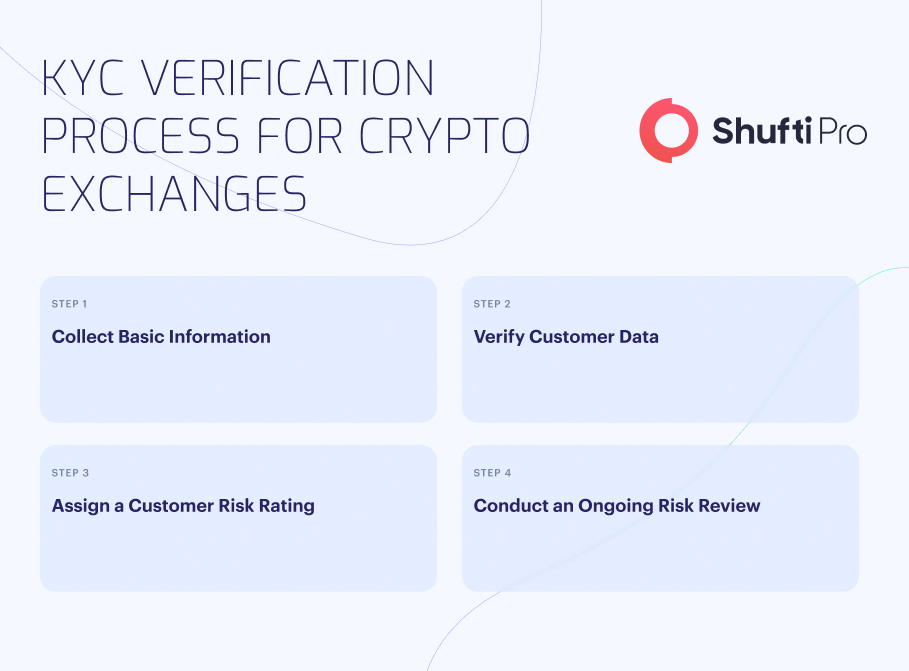
1. Collect Basic Information
Exchanges are required to gather essential identifying information during the onboarding process of a new customer. To achieve this efficiently and accurately, firms should conduct digital Customer Due Diligence (CDD), minimising the risk of human error whilst obtaining the relevant data. The fundamental customer data necessary for the KYC process includes customers’ names, dates of birth and addresses. This data collected during the initial phase of KYC crypto serves as the foundation for subsequent risk assessment and shapes the exchange’s approach to AML and Countering Terrorism Financing (CTF) compliance.
2. Verify Customer Data
Crypto exchanges must conduct verification checks to ensure the accuracy of the customer data. This involves matching the provided information with official documents such as passports, driving licences, and birth certificates. Moreover, once the identifying data is obtained, screening it against official lists is essential to determine the customer’s risk profile. These lists include global watch and sanctions lists, Politically Exposed Persons (PEPs) lists, high-risk jurisdictions, etc.
3. Assign a Customer Risk Rating
The information gathered and verified the basis for determining a client’s risk rating. This rating involves a comprehensive calculation that considers various factors, including the likelihood of the individual being involved in financial crime and the broader operational compliance risk the firm faces.
In countries where a “risk-based approach” to AML is mandated, firms must assign a KYC risk rating to each customer through a thorough risk assessment. For high-risk customers, such as national politicians or senior government officials, additional and more stringent AML/CTF measures must be implemented, such as Enhanced Due Diligence (EDD). On the other hand, customers with lower risk profiles, like those who have been long-time exchange users engaging in low-value transactions, may be subjected to more straightforward AML measures.
4. Ongoing Risk Review
It’s worth considering that KYC is not a one-time process performed just at the beginning of a client relationship. Instead, an ongoing risk review is necessary to stay updated on customer risk profile changes. Ongoing transaction monitoring is one effective method to ensure that customers’ financial behaviour aligns with the expectations set by their risk assessment.
Why Do Crypto Exchanges Need KYC?
Most crypto service providers enforce KYC checks before customers purchase cryptocurrency or withdraw funds. However, there are exceptions, with certain crypto services permitting clients to trade without undergoing KYC. Typically, such services are found in decentralised and unregulated exchanges or those operating in countries with weak AML regulations. Additionally, some exchanges may only require KYC when withdrawal limits are surpassed.
KYC crypto compliance offers the following benefits:
- Combating fraud and identity theft
- Providing transparency
- Assuring customer trust
- Gaining trust from partners
Is KYC Mandatory for Crypto Exchanges?
In most jurisdictions, KYC requirements apply to crypto businesses. However, the extent of these obligations depends on the existing AML laws and how individual countries choose to enforce them.
Over the recent years, AML laws made KYC checks mandatory across a broader range of operations in the crypto exchanges. In 2018, the EU included crypto-fiat businesses and wallet providers within its AML regulations (AMLD5), subjecting them to the same rules as financial firms.
As time passed, more virtual asset-related services have come under regulatory scrutiny to combat money laundering effectively. Certain countries, including some EU members, have started implementing services specified in the FATF Guidance 2019 and its updated version in 2021.
How Can Shufti Help?
Shufti offers an AI-powered KYC solution, helping the crypto sector verifies identities within seconds and mitigating the risk of fraud.
Here is why crypto businesses invest in our KYC solutions:
- Regulatory Compliance: With the crypto sector being subject to various global regulations, our KYC solution assists crypto businesses in fulfilling these compliance requirements. Identity verification ensures users’ legitimacy and helps prevent involvement in money laundering and other illegal activities.
- Fraud Prevention: The crypto sector is encountering security challenges and fraud issues. Our KYC verification plays a vital role in combating fraudulent activities by verifying users’ authenticity, thus minimising the risk of unauthorised access and scams.
- Trust and Credibility: Platforms that are transparent and secure attract more legitimate users. Our KYC solution verifies identities with an accuracy rate of 99.3%, helping crypto businesses establish trust with their customers and the wider community.
- Enhanced User Experience: Our robust KYC solution streamlines onboarding and verification procedures, improving the user experience smoothly and efficiently. This reduces friction for legitimate users whilst maintaining high-security standards.
- Scalability: As the crypto industry grows, platforms require scalable solutions to accommodate a more extensive user base. Our crypto KYC service can effectively meet this demand, supporting businesses at any growth stage.
Looking for a customised KYC solution for your crypto exchange?