AMLR Solutions
  AMLR Consultation
 EUDI Wallet
 Onboarding
 Ongoing Monitoring
 FRAML
FRAML KYC
KYC KYB
KYB KYI
KYI Age Assurance
 Workforce IAM
 Candidate Verification
 Account Takeover
 Bonus/ Promotion Abuse
 Chargeback Fraud
 Deepfake
 Document Fraud
 Fraud Networks
 Impersonation Fraud
 Money Mule Activity
 Multi-Accounting
 Party Fraud
 Regulatory & Compliance Risks
 Synthetic Identity Fraud
 Adult Content
 Banking
 Crypto
 Fintech
 Forex
Forex Compliance
 Fraud prevention
 Trust & safety
 Global expansion
 Compliance Officers
 Developers
 Fraud Analysts
 Product Managers
 Journey Builder
  Global Trust Platform
 Customer Profiles
 Vendor Comparison
 IDV Case Management
 AML Case Management
 Regulatory Reporting
 Agentic Rule Builder
  AI Compliance Co-Pilot
  Fraud Analytics
 Fraud Hub
  OCR
OCR Shufti AI
 Bank Account Verification
  Biometric Duplication
 Database Checks
 Document Intelligence
 Government ID
 Mobile Driver's License
 NFC
NFC Selfie Liveness
 Brand Personalisation
 Deployment Options
 Identity Methods
 IDV Modes
 Multi-tenancy
 On-Premise IDV
 Secure Capture
 Shufti MCP
















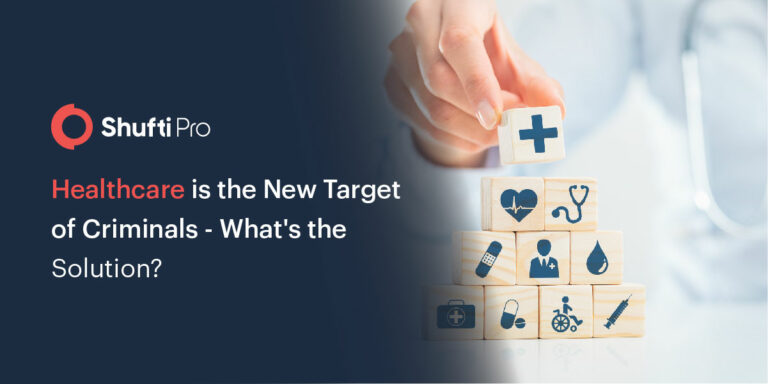
The healthcare industry faces more cyberattacks than almost any other sector. From hospitals and insurance companies to pharmacies and diagnostic labs, medical institutions handle large volumes of sensitive data. This includes personal, financial, and health-related information, all of which are valuable for cybercriminals.
Healthcare data is especially vulnerable because of its depth and permanence. Unlike a credit card number that can be changed with just a few clicks, a person’s medical history and identity information are permanent. Once stolen, this data can be exploited for identity theft, insurance fraud, and the illegal distribution of prescription drugs.
Why Healthcare Is a Prime Target for Cybercrime
Unauthorized access continues to be a major cause of healthcare data breaches. Research shows that over 34 percent of these breaches result from weak access controls. In the United States alone, between 2009 and 2019, more than 3,000 data breaches were reported, exposing over 230 million healthcare records.
The threat has only continued to grow with the rise of telehealth and remote patient care. These advances offer convenience, and were critical to the healthcare industry during the initial waves of the COVID-19 pandemic, but they also create vulnerabilities, Cybercriminals use phishing emails, ransomware, and insider access to infiltrate systems. A single breach can cost millions in penalties and cause lasting damage to an institution.
What Is Know Your Patient (KYP)?
Know Your Patient (KYP) is a process that mirrors that of Know Your Customer (KYC) practices used in financial services. Adapted for the healthcare field, KYP is designed to verify the identity of patients before granting access to services. It plays a key role in preventing medical identity theft and ensures regulatory compliance.
By verifying identities at the point of access, healthcare providers can reduce fraud, protect patient data, and maintain public trust.
Why Healthcare Providers Must Conduct KYP Checks
Identity verification is absolutely essential for healthcare entities. Regulatory bodies around the world now require providers to implement strict data protection measures. KYP plays a central role in fulfilling these obligations. Institutions that fail to verify patient information put themselves in serious risk data breaches, financial fraud, and compliance violations.
The Consequences of Non-Compliance: The Change Healthcare Attack
One of the most serious recent examples is the Change Healthcare cyberattack, which took place in February 2024. Affecting approximately 190 million individuals, this breach is considered one of the largest in the healthcare sector. Attackers infiltrated Change Healthcare’s systems by exploiting security gaps, including the absence of multifactor authentication.
Once inside, they remained undetected for over a week, stealing highly sensitive data such as insurance and billing records, medical diagnoses, lab test results, and, in some cases, Social Security numbers and financial details. This breach significantly disrupted healthcare operations across the United States, halting insurance payments and interfering with care delivery for countless providers and patients.
UnitedHealth Group, the parent company of Change Healthcare, estimated the financial damage at around $3.09 billion. This case highlights how failures in basic access management can lead to devastating consequences, both operationally and financially. It underscores the urgent need for strong identity verification protocols like KYP to protect healthcare systems and their users.
Global Regulations Supporting KYP
Healthcare provider are now legally obligated to protect patient information in many regions, Here are a few of the major frameworks that support KYP practices:
- United States: The Health Insurance Portability and Accountability Act (HIPAA) and the HITECH Act require organizations to secure protected health information. Penalties for violations can exceed millions of dollars per incident.
- United Kingdom: The NHS mandates strict data protection policies, while the General Pharmaceutical Council (GPhC) enforces identity checks for online pharmacies.
- European Union: Under the General Data Protection Regulation (GDPR), healthcare providers must obtain informed consent from patients and safeguard personal data at all times.
These laws not only mandate patient data security but also encourage the adoption of digital identity verification tools to strengthen accountability.
How Automated KYP Verification Works
Modern KYP systems use artificial intelligence, biometrics, and optical character recognition (OCR) to verify patient information quickly and securely. Here is how the KYP process typically works:
- System Integration: A healthcare provider integrates its website or app with a this-party identity verification solution.
- Document Capture: The patient uploads a government-issued ID and takes a selfie for facial comparison.
- Information Matching: AI scans the ID document and extracts key data fields. These are then matched against the information provided in the onboarding form.
- Biometric Analysis: The system conducts liveness detection and 3D facial mapping to confirm that the individual is present and real.
- Age Verification: The patient’s date of birth is cross-referenced to validate eligibility for age-restricted services.
This end-to-end process helps enhance security while simultaneously delivering a seamless user experience.
Key Benefits of Implementing KYP
Integrating KYP protocols offers measurable benefits to healthcare providers, patients, and regulators:
- Protection Against Medical Identity Theft: Only verified individuals can access medical services, which helps reduce fraud.
- Privacy Assurance: Patient information remains protected through secure digital channels.
- Age Validation for Prescriptions: Automated age checks help prevent minors from accessing restricted medication online.
- Insurance Fraud Prevention: Identity verification stops bad actors from filing false claims or using stolen identities.
- Operational Efficiency: Automating the verification process reduces manual errors and lowers the risk of internal data leaks.
Recent Developments in Healthcare Cybersecurity
Healthcare remains the most expensive industry for data breaches, according to IBM’s annual Cost of a Data Breach Report. The average cost is now in excess of $11 million per breach. In response, global health organizations and governments are calling for more rigorous cybersecurity standards and digital identity protections.
There is growing support for unified verification frameworks to ensure consistent identity checks across borders. These frameworks aim to reduce fraud in cross-border telehealth, improve access to services, and ensure legal compliance in multiple jurisdictions.
Final Thoughts
While digital transformation in healthcare offers better access, faster diagnostics, and streamlined care, it also demands stronger safeguards. As more patient interactions move online, verifying identity at every touchpoint is a necessity for protecting personal health information and maintaining institutional credibility.
KYP is more than just a compliance tool. It serves as a frontline defense against misuse, fraud, and operational disruption. When implemented effectively, it enables healthcare organizations to deliver secure, personalized services while meeting modern privacy expectations. In a sector built on trust, verifying who a patient truly is may be the most important step of all.