



 Face Verification
 Address Verification
 Document Verification
 Age Verification
 VideoIdent
 Fast ID
 Docless Verification
 Consent Verification
 NFC Verification
 Business Verification
 Due Diligence
 Investor Verification
 E-Signature

 QES
QES
 AML Screening
 Transaction Monitoring
 Adverse Media
 Business AML Screening
 PEP & RCA
 Sanctions
 Watchlist
 Behavioural Biometrics
 Device Fingerprinting
 Biometric Face Authentication
 MFA
MFA
 Fraud Hub
 Onboarding
 Ongoing Monitoring
 KYC
KYC
 KYB
KYB
 KYI
KYI
 Age Assurance
 Identity Verification
 Workforce IAM
 Candidate Verification
 Compliance
 Fraud prevention
 Trust & safety
 Global expansion
 Product Managers
 Compliance Officers
 Fraud Analysts
 Developers
 Deepfake Detection
 Bonus Abuse / Promotion Abuse
 Account Takeover
 Synthetic Identity Fraud
 Document Fraud
 Impersonation Fraud
 Multi-Accounting
 Fraud Networks
 Chargeback Fraud
 Money Mule Activity
 Party Fraud
 Regulatory & Compliance Risks
 Fintech
 Crypto
 iGaming
 Forex
Forex
 Social Network
 Marketplace
 Banking
 Gig Economy
 Payments
 Ride Hailing
 Adult Content
 Blind Spot Audit
 Deepfake Detector
 Liveness Spoofs
 Document Originality
 Document Deepfake
 Global Trust Platform
 Journey Builder
 Case Management
 Shufti AI
 Fraud Analytics
 Vendor Comparison
 Brand Personalisation
 AI Compliance Co-Pilot
 OCR
OCR
 Secure Capture
 Deployment Options
 Identity Methods
 API Documentation
 Mobile SDKs
 Service Status
 Help Center
 Contact Us
 Technical Support
 Supported Documents
 Supported Countries
 Content library
 Blogs
Blogs
 News
News
 Reports
 Insights
 Knowledgebase
 ROI calculator
 About
About
 Career
 Press Release
 Certifications
 Partnership
 Awards
 Events & Webinar
 Interactive Demo
 Podcast Studio
 Spotlight Studio
Japan’s AML/CFT Assessment – August 2021 Report
Financial crime is soaring sky high with digitisation becoming a part of our daily lives. Cyber actors not only exploit potential vulnerabilities in existing systems but make the financial system prone to even greater threats such as money laundering and terrorist financing. To cater to these increasing risks, the Paris-based global financial watchdog, Financial Action Task Force (FATF), keeps a vigilant eye on predicate offences and organised monetary crime. It regularly audits country-wide frameworks for Anti Money Laundering/Countering the Financing of Terrorism (AML/CFT) to keep financial sector safe from perpetrators.
This blog highlights the recent mutual evaluation report of Japan issued by FATF on August 30, 2021. It details Japan’s AML/CFT efforts, how well objectives are met, and what priority actions need to be put in place.
What are FATF’s Mutual Evaluations?
The FATF presents two mutual evaluation reports in the three plenary meetings it conducts each year. These assessments are aimed at analysing the overall effectiveness and execution of AML compliance measures for each member country. By conducting peer reviews, it takes into account how well the FATF’s Recommendations are implemented.
Salient Features of the Evaluation
Risks and the Current Context
According to FATF, principal money laundering risks identified by Japan include the Boryokudan members carrying out transnational organised crime, loan sharking, illegal remittances, money extortion, drug trafficking and gambling. As far as terrorist financing is concerned, foreign fighters and particular idealist extremists operating from different parts of the world pose certain TF risks. Japan’s overall assessment shows that terrorism financing risks a comparatively low.
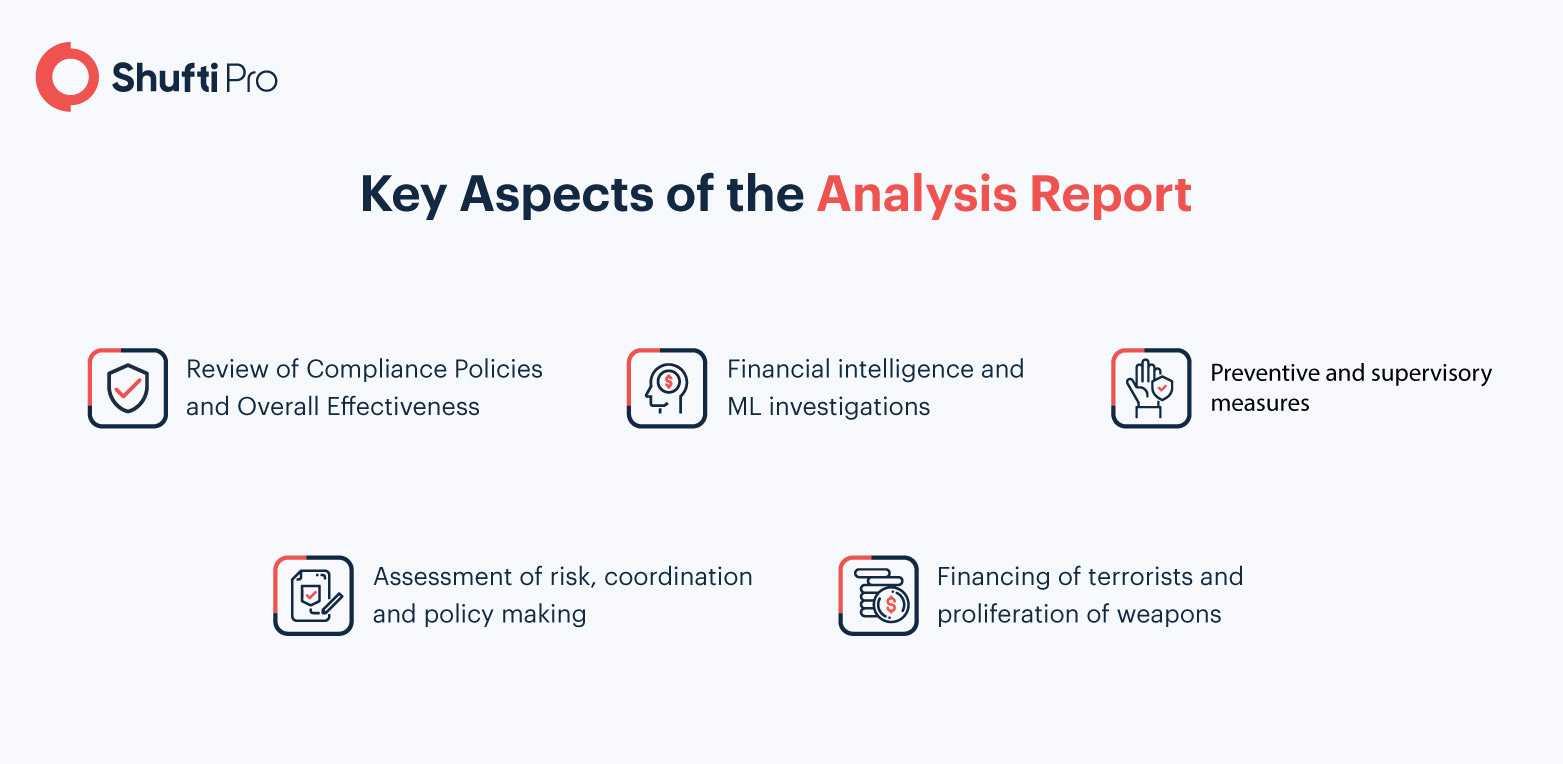
The State of Compliance and Effectiveness
Japan developed an enforceable AML/CFT framework in 2011 and 2014 that introduced beneficial ownership information and emphasized ongoing CDD and verification of Politically Exposed Person (PEPs). Banking terms and conditions with customers from high-risk countries were also revised considering ML risks. Japanese financial watchdogs in 2018 and 2019 added further ML/TF mitigation obligations for FIs and Virtual Currency Exchange Providers (VCEPs).
While compliance is effectively implemented throughout banks and other financial institutions, there exist certain technical loopholes when it comes to Designated Non-Financial Businesses and Professions (DNFBPs). Apart from that, there are inadequacies that affect implementation of sanctions for ML offences, certain physical elements to combat TF activities, and transparency regarding legal persons and subsequent arrangements.
Risk Assessment and Coordination
While Japan has a sound understanding of ML/TF risks, there are particular areas where the National Risk Assessment (NRA) and other related evaluations can be improved. Apprehension of broader risks to the Japanese economy and cross-border crimes, acquiring information from Law Enforcement Agencies (LEAs), improving requirements for suspicious transaction reporting (STR), and focusing more on potential vulnerabilities are the main objectives for Japan’s risks assessment.
Terrorism financing in Japan is well-demonstrated by experts which is why TF risks are relatively low as compared to other crime-ridden countries. But CFT compliance procedures are more focused on risks, creating gaps in prosecution policies and implementation of Targeted Financial Sanctions (TFS).
Priority Actions Recommended by FATF
Agreement with AML Obligations
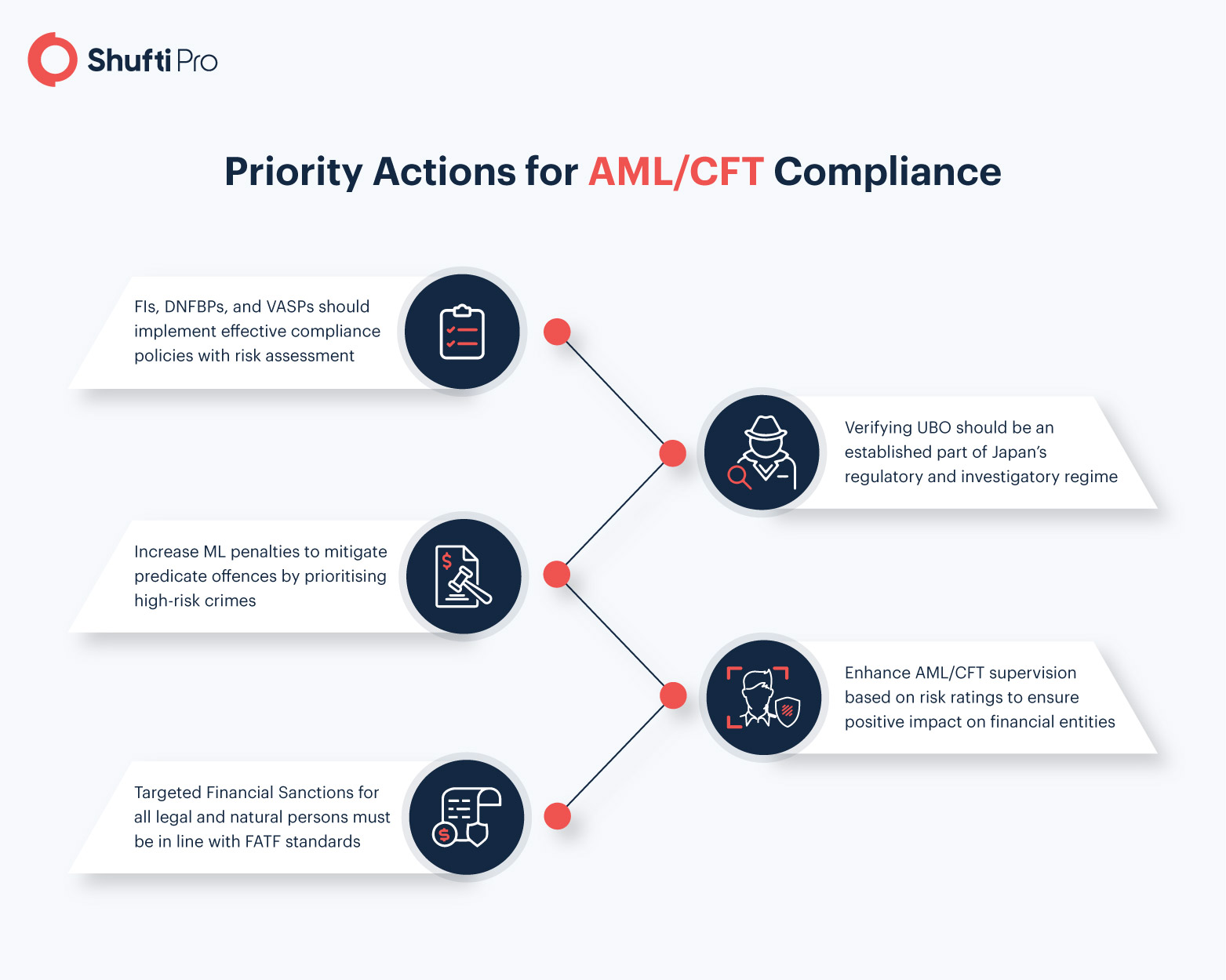
The FATF expects Financial Institutions (FIs), DNFBPs and Virtual Asset Service Providers to have a sound understanding of AML requirements. Timely implementing them through effective policies and procedures, and conducting risk-based assessments for high-risk transactions should be part of Japan’s financial action plan. Moreover, transactional monitoring, asset freezing measures, and preserving beneficial ownership (BO) information need to be in place for enhanced due diligence compliance.
Increase ML Offence Penalties
As per the FATF report, Japan needs to increase the use of ML offence to make sure serious predicate offences are properly dealt with. In this regard, Japan needs to take the following steps:
- Extensive consideration of money laundering at the initial stage of investigation
- Prioritise targeting third-party money laundering offences by incorporating a wide array of offences, especially including crimes types having a high-end profit
Streamline Information Sharing
Develop a nation-wide infrastructure to implement robust measures between the Public Prosecutors Office (PPO), Ministry of Justice (MOJ) and the National Police Agency (NPA) to establish better information sharing standards. This is important to improve the overall level of investigation and prioritisation of severe ML instances as well as the prosecution rate for cases. For instance, the PPO’s application of discretion could be reconsidered to implement policies for stringent prosecution of money laundering cases. In this regard, Japan’s financial intelligence infrastructure is of prime importance which uses high-end technology for complex financial investigations.
Read More: Japanese FSA to Beef Up AML Systems from Fiscal 2021
Strengthen AML/CFT Supervision
Japan needs to revise its supervision measures for combating financial crime across the country. An approach based on risk-basis should be developed that emphasises a combination of on-site examinations and off-site monitoring. These procedures are essential for evaluating precautions, and checking whether dissuasive penalties and remedial standards are in place, thereby ensuring compliance by FIs, VASPs and DNFBPs.
Revising the Terrorism Financing Act
FATF advised Japan to adopt binding and practical methods for CFT compliance by amending the Terrorism Financing (TF) Act. This specific recommendation ensures that funding of individually-operating terrorists and terrorist groups is outlawed, in case a link to an act of terrorism is not available. Further adding to this, Japan needs to resolve technical deficiencies in its TF Act for criminalising such cases right away. The proposals are highlighted in the Recommendation 5 analysis provided in the comprehensive evaluation report by FATF.
Summing It Up
- FATF believes that Japan is by and large cognizant of ML/TF risks given the large amount of assessment conducted
- Although CFT compliance focuses more on the risks, it needs to address concerns in prosecution procedures as well
- Financial intelligence frameworks used by LEAs are highly developed to trace assets and support targeting suspects
- FIs, VASPs and DNFBPs need to be well-aware of verifying beneficial ownership and identity information when onboarding customers
- Information sharing between national and domestic regulatory authorities needs to be improved for severe ML/TF cases
Are you a business seeking compliance with global AML/CFT laws? Try out our AML screening solution right away and decide for yourself.