AMLR Solutions
  AMLR Consultation
 EUDI Wallet
 Onboarding
 Ongoing Monitoring
 FRAML
FRAML KYC
KYC KYB
KYB KYI
KYI Age Assurance
 Workforce IAM
 Candidate Verification
 Account Takeover
 Bonus/ Promotion Abuse
 Chargeback Fraud
 Deepfake
 Document Fraud
 Fraud Networks
 Impersonation Fraud
 Money Mule Activity
 Multi-Accounting
 Party Fraud
 Regulatory & Compliance Risks
 Synthetic Identity Fraud
 Adult Content
 Banking
 Crypto
 Fintech
 Forex
Forex Compliance
 Fraud prevention
 Trust & safety
 Global expansion
 Compliance Officers
 Developers
 Fraud Analysts
 Product Managers
 Journey Builder
  Global Trust Platform
 Customer Profiles
 Vendor Comparison
 IDV Case Management
 AML Case Management
 Regulatory Reporting
 Agentic Rule Builder
  AI Compliance Co-Pilot
  Fraud Analytics
 Fraud Hub
  OCR
OCR Shufti AI
 Bank Account Verification
  Biometric Duplication
 Database Checks
 Document Intelligence
 Government ID
 Mobile Driver's License
 NFC
NFC Selfie Liveness
 Brand Personalisation
 Deployment Options
 Identity Methods
 IDV Modes
 Multi-tenancy
 On-Premise IDV
 Secure Capture
 Shufti MCP












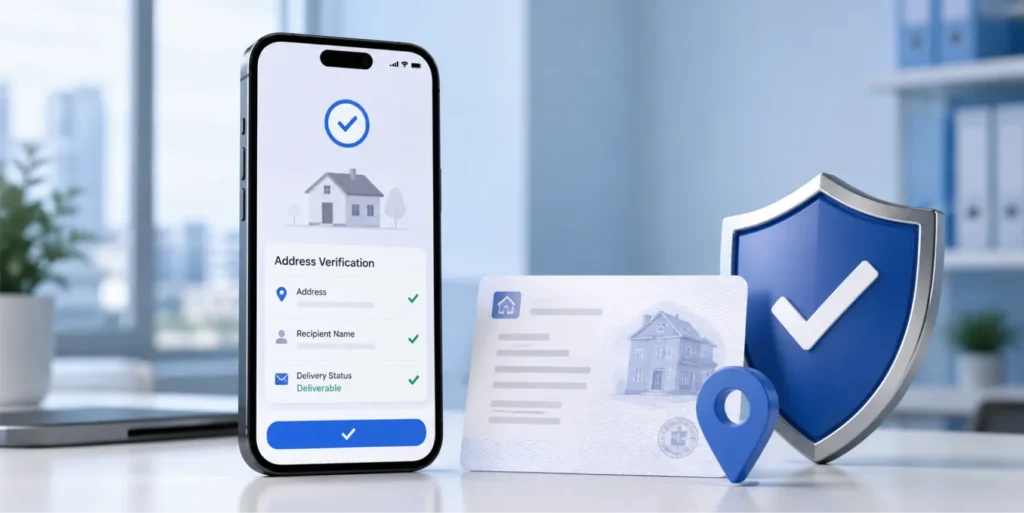
Address verification describes two very different checks that are easy to confuse. In payments, an Address Verification Service (AVS) compares the billing address entered at checkout with the address a card issuer holds on file, and returns a letter code. In compliance, address verification confirms where a customer lives using proof of address documents, and underpins KYC and AML. This guide covers both in depth, including AVS codes, AVS mismatch and rejected messages, accepted proof of address documents, and how businesses verify addresses to stop fraud. It is written for fraud teams, compliance officers, product managers and payments leaders.
This guide is about identity, fraud and compliance address checks. It is not a postal address validation or mailing list cleaning tool. Where those overlap, we make the difference clear.
Key Takeaways
- Address Verification Service (AVS) is a card network check that compares the billing address at checkout with issuer records, returning an AVS response code.
- An AVS mismatch means the address does not match issuer records; AVS rejected means the transaction was declined, often for that reason.
- Genuine customers trigger mismatches too (after moving home or mistyping), so an AVS mismatch is a risk signal, not an automatic fraud verdict.
- In KYC and AML, address verification confirms residential address using proof of address documents such as a utility bill or bank statement.
- Address verification is different from address validation (postal accuracy) and address verification software (bulk mailing data quality).
- Global card fraud reached $33.41 billion in 2024, and ecommerce fraud is forecast to grow from $56 billion in 2025 to $131 billion by 2030 (Nilson Report, 2026; Juniper Research, 2025).
What Is an Address Verification Service (AVS)?
An Address Verification Service service confirms whether an address is genuine, current, and connected to the right person or payment method. In payments, AVS matches the billing address at checkout against issuer records to reduce card fraud. In compliance, address verification confirms a residential address using official documents to satisfy KYC and AML.
The two meanings share a name but solve different problems:
- Payments AVS: A card network feature (Visa, Mastercard, American Express, Discover) that checks the billing address against the issuer’s records during authorisation. It mainly fights card not present fraud.
- Compliance address verification: A document verification process that confirms a person’s residential address using proof of address documents. It satisfies KYC, AML and Customer Due Diligence rules.
A mature verification programme uses both. Payments AVS defends the checkout, while compliance address verification defends onboarding.
What Does AVS Stand For?
AVS stands for Address Verification Service, also written as Address Verification System. Both describe the card network mechanism that matches a billing address against issuer records during payment authorisation.
Address Verification vs Address Validation vs Address Verification Software
These terms are used loosely, which confuses buyers and search engines alike. The clean distinction:
| Term | What it means |
| Address verification (payments AVS) | Matches a billing address to card issuer records to fight fraud |
| Address verification (KYC) | Confirms a residential address using official proof of address documents |
| Address validation | Checks an address is correctly formatted and deliverable against postal reference data |
| Address verification software | Bulk tools that clean and standardise mailing addresses for deliverability and data quality |
Shufti focuses on the first two, identity and fraud, not on postal list cleaning. For KYC and fraud use cases, the goal is not just a deliverable address, but proof that a specific, verified person is genuinely tied to it.
How Address Verification Works, Step by Step
Address verification works by capturing an address, comparing it against a trusted reference (issuer records, postal data, or an official document), scoring the result, and returning an approve, review or decline decision, usually in seconds.
How Payments AVS Works
- A customer enters card details and a billing address at checkout.
- The merchant’s payment processor sends an authorisation request to the issuing bank through the card network.
- During authorisation the issuer checks funds, card validity, the CVV code, and the billing address.
- The issuer compares the numeric parts of the address (street number and postal or ZIP code) with its records.
- The issuer returns an AVS response code to the merchant through the processor.
- The merchant’s fraud rules use that code, alongside other signals, to approve, hold or decline the payment.
AVS only matches numbers, not the full written address, and it is designed primarily for the United States, Canada and the United Kingdom.
How Document Based Address Verification Works (KYC and AML)
- The customer uploads a proof of address document during onboarding.
- The system classifies the document and checks it is accepted and recent enough (commonly within three months).
- Optical Character Recognition (OCR) extracts the name, address and issue date.
- Authenticity checks look for tampering, edited pixels and forged elements.
- The address and name are matched to the customer’s declared details and screened during AML screening.
- A pass, fail or manual review decision is returned, with a full audit trail.
[ Insert workflow flowchart: two lanes, Payments AVS vs Document based verification, converging on one approve / review / decline decision ]
AVS Response Codes: The Complete Reference
An AVS response code is a single letter the card issuer returns to show how closely the billing address matched. The key outcomes are a full match, a partial match (address or postal code only), no match, and address unavailable.
Codes vary slightly between Visa, Mastercard, American Express and Discover, but the meanings cluster into a few outcomes. This reference groups the most used codes by meaning and the action a fraud team should usually take.
| Code | What it means | Match level | Suggested action |
| Y | Street address and 5 digit ZIP both match | Full match | Approve (lowest risk) |
| X | Street address and 9 digit ZIP both match | Full match | Approve |
| M / D / F | Street address and postal code match (international, UK) | Full match | Approve |
| A | Street address matches, ZIP does not | Partial | Review with other signals |
| Z | ZIP matches, street address does not | Partial | Review with other signals |
| W | 9 digit ZIP matches, street address does not | Partial | Review |
| N | Neither street address nor ZIP match | No match | Decline or step up verification |
| U | Address information unavailable at issuer | Unavailable | Use other fraud signals |
| G / S | Issuer does not support AVS | Not supported | Use other fraud signals |
| R | Issuer system unavailable, retry | Retry | Retry the authorisation |
| E / B / C | AVS data invalid, incompatible or not verified | Error / unverified | Investigate before approving |
AVS Match, Partial Match, Mismatch and Rejected
- AVS match: Both the address and the postal code match issuer records. The strongest positive signal.
- AVS partial match: Either the address or postal code matches, but not both. Common for genuine customers, so most merchants review rather than auto decline.
- AVS mismatch: Neither the address nor postal code matches. This raises fraud risk and often triggers a decline.
- AVS rejected: The issuer declined to authorise the transaction, frequently because of an address mismatch.
Soft Decline vs Hard Decline
- Soft decline: A temporary refusal (for example, system unavailable). The transaction can be retried, often successfully.
- Hard decline: A permanent refusal, such as an invalid card. It should not be retried, as repeated attempts can trigger penalties.
AVS Mismatch: Causes and How to Fix It
Answer: An AVS mismatch happens when the billing address entered at checkout does not match the address the card issuer holds on file, either the street number, the postal code, or both. It raises fraud risk and often leads to a decline, but genuine customers trigger mismatches too, so it should be treated as a signal, not an automatic verdict.
Common Causes of an AVS Mismatch and How to Fix Them
| Cause | Why it happens | What to do |
| Customer moved recently | Billing address not updated with the issuer | Ask the customer to confirm or update their billing address |
| Typo at checkout | Wrong house number or postal code entered | Prompt re-entry and validate the address format |
| Old card on file | Card still registered to a previous address | Request the current billing address |
| International card | Issuer does not fully support AVS | Use other fraud signals; do not auto decline |
| Formatting differences | Address stored differently at the issuer | Normalise and re-check before declining |
| Genuine fraud | A stolen card whose true address the fraudster does not know | Decline or step up verification |
What Does AVS Rejected Mean?
Answer: AVS rejected means the card issuer declined to authorise the payment, most often because the billing address did not match its records. The message can appear to the merchant or the shopper. It is a prompt to confirm the correct billing address or apply another fraud check before retrying.
How to Reduce AVS Mismatches and False Declines
- Treat AVS as one signal among many, not an automatic decline.
- Validate and normalise the address at checkout to catch typos before authorisation.
- Let customers correct or update a billing address rather than failing silently.
- Apply risk based rules, so full matches pass and only genuine anomalies are reviewed.
- Combine AVS with identity, device and behavioural signals to separate fraud from honest mistakes.
Proof of Address: What Counts and How It Is Verified
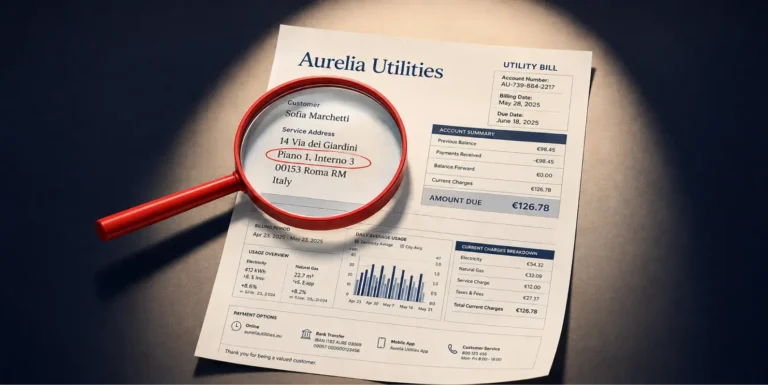
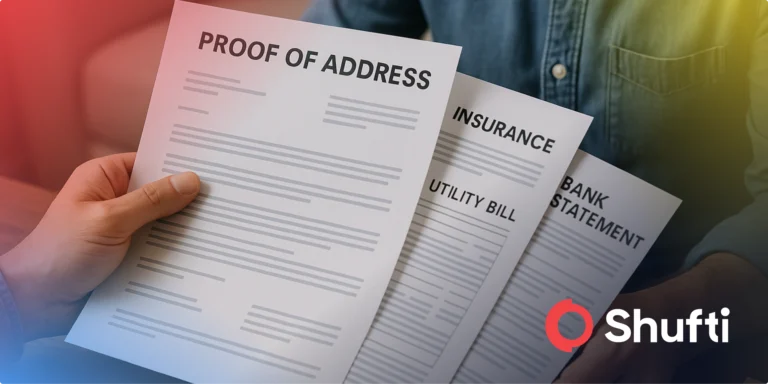
Answer: Proof of address is an official document that confirms where a person lives, used to satisfy KYC and AML requirements. Accepted documents include utility bills, bank statements, tax or council letters, tenancy agreements and government issued letters, usually issued within the last three months and showing the person’s full name and address.
Accepted Proof of Address Documents
| Document | Notes |
| Utility bill | Electricity, gas or water; usually within the last 3 months |
| Bank or card statement | Shows name and address; recent |
| Council tax or government letter | Official correspondence, strong evidence |
| Tenancy or rental agreement | Current and signed |
| Mortgage statement | Recent, issued by the lender |
| Insurance policy or letter | Shows the residential address |
| Driving licence | Where it shows the current residential address |
Documents that are expired, older than the accepted window, illegible or edited are typically declined. AI classifies the document, extracts the details with OCR, and checks for tampering and forgery. The verified address is then matched to the customer’s identity and, where required, screened during AML screening.
Proof of Address vs Payments AVS
Payments AVS is a fast, numeric match at the card issuer, used at checkout. Proof of address verification is a document based check used at onboarding, carries far more regulatory weight, and is accepted for KYC and AML. They solve different problems and are often used together across the customer journey.
Address Verification vs Related Checks
AVS vs Identity Verification
| Dimension | AVS | Identity Verification |
| Confirms | A billing address matches a card | A person is who they claim to be |
| Typical evidence | Address and postal code numbers | Government ID, biometrics, liveness |
| When it runs | At the payment moment | Mostly at onboarding |
| Fraud covered | Card not present fraud | Impersonation, synthetic identity, ATO |
For full assurance, businesses pair address checks with identity verification and, where risk is higher, face verification.
AVS vs KYC and AML
| Dimension | AVS (payments) | KYC and AML |
| Scope | One address match | Full identity and risk programme |
| Includes | Billing address check | ID, address, screening, monitoring |
| Driven by | Card networks | Regulators (FATF aligned rules) |
| Record keeping | Minimal | Auditable, retained for years |
AVS is a transaction level fraud control. AML is a broad framework covering due diligence, sanctions and PEP screening, transaction monitoring, and reporting. Verified address data feeds AML by confirming where a customer lives, but AVS does not satisfy AML on its own.
Why Address Verification Matters in 2026
- Global card fraud losses reached $33.41 billion in 2024 and are projected to climb to $41.06 billion by 2030 (Nilson Report, 2026).
- Global ecommerce fraud is forecast to rise from $56 billion in 2025 to $131 billion by 2030, driven largely by friendly fraud (Juniper Research, 2025).
- US consumers reported losing more than $12.5 billion to fraud in 2024, a 25% rise, with over 1.1 million identity theft reports (FTC Consumer Sentinel, 2025).
Benefits vs Limitations of AVS
| Benefits | Limitations |
| Fast, low friction fraud signal at checkout | Matches only address and postal numbers, not the full address |
| Reduces card not present fraud and some chargebacks | Coverage focused on the US, Canada and the UK |
| Widely supported by processors and issuers | Genuine customers who moved can trigger false declines |
| Cheap to run at scale | Not sufficient on its own for KYC or AML |
| Complements identity and document checks | Does not prove the person is who they claim to be |
Fraud Types Address Verification Helps Prevent
Card Not Present (CNP) Fraud
When a stolen card is used online, the fraudster rarely knows the true billing address, so AVS is one of the fastest ways to flag it. This is core fraud prevention at checkout.
Chargeback and Friendly Fraud
Friendly fraud, where a real customer disputes a genuine purchase, is now the fastest growing ecommerce fraud category (Juniper Research, 2025). Verified address and delivery records give merchants stronger evidence to win disputes.
Identity Theft and Synthetic Identity Fraud
Stolen and fabricated identities are often paired with a mismatched or invented address. Confirming address ownership through documents makes both harder to weaponise during onboarding.
Account Takeover (ATO)
A sudden change of address or shipping destination is a common ATO signal. Re verifying address at high risk moments helps intercept hijacked accounts.
Turn address checks into a fraud advantageShufti verifies proof of address with AI powered AI powered document verification and OCR, matches it to a verified identity, and screens customers during AML screening, across 240+ countries.
Confirm where your customers really live, cut false declines, and keep onboarding fast.
Industries That Rely on Address Verification
| Industry | Why address verification matters | Primary driver |
| Fintech | Onboard remote customers and meet KYC obligations | Compliance and fraud |
| Banking | Confirm residency for account opening and CDD | Regulation |
| Payments | Screen billing address at checkout via AVS | CNP fraud |
| Insurance | Validate policyholder address and prevent rate evasion | Fraud and pricing |
| Crypto | Meet Travel Rule and AML residency requirements | AML compliance |
| Marketplaces | Verify buyers and sellers, cut chargebacks | Trust and safety |
| Gaming | Enforce jurisdiction and age based access | Regulation |
| Government | Confirm citizen residency for services | Eligibility |
Address Verification for KYC and AML Compliance
Address is a core data point in customer due diligence. Global frameworks expect regulated firms to confirm not only who a customer is, but where they are based, because location drives sanctions exposure, tax status and money laundering risk.
- FATF: The Financial Action Task Force requires customer identification and verification, including residential information, as part of CDD.
- FinCEN: US rules enforced by FinCEN require obtaining and verifying customer address under the Customer Identification Programme.
- FCA: The UK’s Financial Conduct Authority expects proportionate address and identity checks under the Money Laundering Regulations.
- PCI DSS: The PCI Security Standards Council governs how card and billing data, including address, must be handled securely.
For higher risk customers, Enhanced Due Diligence may require additional or more recent address evidence. Verified address data also strengthens ongoing monitoring, because a change in a customer’s location can be a meaningful risk trigger. Explore Shufti’s Shufti’s business verification and compliance solutions for the full picture.
Address Verification API and Software: What to Look For
Answer: A strong address verification API should combine document verification, OCR, real time checks and fraud signals behind one integration, with global document coverage, high accuracy, and a clear audit trail.
When evaluating an address verification API or address verification software, weigh coverage, accuracy, speed, compliance alignment and flexibility:
- Coverage: Countries, document types and languages supported.
- Accuracy: Match and forgery detection rates, and false decline performance.
- Speed: Real time responses that do not stall onboarding or checkout.
- Compliance: KYC and AML alignment, data residency and secure handling.
- Flexibility: Configurable rules, risk scoring and easy integration.
Best Practices and Implementation Checklist
Best Practices
- Layer address verification with identity, document and behavioural signals.
- Treat AVS as a risk signal, not an automatic decline.
- Apply risk based rules for higher value or higher risk transactions.
- Re verify address at sensitive moments, such as a shipping change.
- Keep a complete, timestamped audit trail for every check.
Implementation Checklist
- Define which flows need AVS, document verification, or both.
- Set your accepted document list and recency window (commonly 3 months).
- Configure AVS response code handling (approve, review, decline).
- Integrate OCR and forgery detection for uploaded documents.
- Connect results to your risk scoring and case management.
- Tune thresholds using real decline and fraud data.
- Document everything for KYC and AML audits.
Common Mistakes to Avoid
- Auto declining every AVS mismatch, which rejects legitimate customers who moved house.
- Treating payments AVS as if it satisfies KYC or AML, which it does not.
- Accepting outdated or low quality proof of address documents.
- Relying on one signal instead of a layered approach.
- Ignoring international coverage gaps for cross border customers.
How AI Is Changing Address Verification
AI has moved address verification from slow, manual review to real time, high accuracy decisioning. According to the Nilson Report, AI driven models have helped push card fraud losses down as a share of total volume, even as spending grows (Nilson Report, 2026).
- Smarter OCR: Machine learning reads messy, multi language documents with far higher accuracy.
- Forgery detection: Models spot edited pixels, cloned templates and AI generated documents that humans miss.
- Risk scoring: AI weighs address signals alongside device, behaviour and identity data for a single decision.
- Lower false declines: Better models separate genuine anomalies from fraud, protecting revenue.
See how Shufti applies AI powered verification across the customer journey.
The Future of Address Verification: 2026 Trends
- Reusable and digital identity: Verified address data in digital identity wallets (such as the EUDI Wallet in Europe) will reduce repeated uploads.
- Real time data sources: More checks will draw on live utility, banking and government data rather than static documents alone.
- Agentic commerce: As AI agents transact for users, address and identity assurance becomes even more important.
- Friendly fraud defence: With first party fraud surging, verified address and delivery evidence will be central to dispute defence.
- Privacy by design: Data residency, minimisation and consent will shape how address data is stored and shared.
How Shufti Helps
Shufti provides AI powered address verification as part of a complete identity, KYC, KYB and AML platform. Businesses can confirm a customer’s address through official documents, extract details with OCR, detect forgery, and match the result against declared and screened data, within a single integration.
- Verification across 240+ countries and territories.
- Support for 10,000+ document types in 150+ languages.
- AI OCR, forgery detection and authenticity checks in real time.
- Built in KYC, AML screening and data residency options.
- A developer friendly API that unifies address, identity and document checks.
Final Thoughts
Address verification quietly sits at two of the highest leverage points in fraud and compliance. In payments, AVS gives an instant signal at checkout, and understanding AVS codes and mismatches protects revenue without punishing honest customers. In onboarding, proof of address verification confirms where customers truly live and satisfies KYC and AML.
With card fraud at $33.41 billion and ecommerce fraud on course to more than double by 2030, the businesses that win treat address verification not as a checkbox, but as a strategic, AI driven layer across the whole customer journey.
Verify addresses the smart way with ShuftiReady to reduce fraud without slowing customers down? Shufti combines address verification, identity verification, OCR and AML screening in one platform built for regulated businesses.
Confirm real addresses, satisfy KYC and AML, and protect every transaction.
Frequently Asked Questions
What is an Address Verification Service (AVS)?
An Address Verification Service (AVS) confirms whether a customer's billing or residential address is valid and associated with the correct person or payment method. It helps businesses reduce fraud, prevent chargebacks, and support KYC and AML compliance by verifying address information against trusted sources.
How does Address Verification Service work?
AVS compares the address provided by a customer with trusted data sources such as card issuer records, postal databases, or official proof of address documents. It then returns a verification result that helps businesses approve, review, or decline a transaction within seconds.
What is an AVS mismatch?
An AVS mismatch occurs when the billing address entered during checkout does not match the address stored by the card issuer. This may indicate potential fraud, although legitimate customers can also trigger mismatches if they recently changed their address.
What is the difference between Address Verification and Address Validation?
Address validation checks whether an address is correctly formatted and deliverable, while address verification confirms that the address actually belongs to a specific individual or payment method. Validation improves data quality, whereas verification helps prevent fraud.
How is Address Verification different from KYC?
Address verification is a single identity check that confirms a customer's address. Know Your Customer (KYC) is a broader compliance process that verifies identity, screens against sanctions and PEP lists, assesses risk, and may include address verification as one of its requirements.
What documents are accepted as proof of address?
Most providers accept utility bills, bank statements, tax bills, rental agreements, insurance documents, and official government letters issued within the last three months. These documents must clearly display the customer's full name and residential address.
Can Address Verification help prevent fraud and chargebacks?
Yes. Address verification helps reduce card-not-present fraud, identity theft, synthetic identity fraud, and fraudulent transactions by confirming customer address information. It also strengthens evidence when merchants dispute chargebacks.
Does AVS work for international transactions?
AVS is widely supported in the United States, Canada, and the United Kingdom. Since support varies across other countries, global businesses often combine AVS with document verification, identity verification, and additional fraud detection methods.
What is an Address Verification API?
An Address Verification API enables businesses to verify customer addresses automatically during onboarding or checkout. It can combine OCR, document verification, postal validation, and fraud detection to deliver real-time verification results through a single integration.