


 Face Verification
 Address Verification
 Document Verification
 Age Verification
 VideoIdent
 Fast ID
 Docless Verification
 Consent Verification
 NFC Verification
 Business Verification
 Due Diligence
 Investor Verification
 E-Signature

 QES
QES
 AML Screening
 Transaction Monitoring
 Adverse Media
 Business AML Screening
 PEP & RCA
 Sanctions
 Watchlist
 Behavioural Biometrics
 Device Fingerprinting
 Biometric Face Authentication
 MFA
MFA
 Fraud Hub
 Onboarding
 Ongoing Monitoring
 KYC
KYC
 KYB
KYB
 KYI
KYI
 Age Assurance
 Identity Verification
 Workforce IAM
 Candidate Verification
 Compliance
 Fraud prevention
 Trust & safety
 Global expansion
 Product Managers
 Compliance Officers
 Fraud Analysts
 Developers
 Deepfake Detection
 Bonus Abuse / Promotion Abuse
 Account Takeover
 Synthetic Identity Fraud
 Document Fraud
 Impersonation Fraud
 Multi-Accounting
 Fraud Networks
 Chargeback Fraud
 Money Mule Activity
 Party Fraud
 Regulatory & Compliance Risks
 Fintech
 Crypto
 iGaming
 Forex
Forex
 Social Network
 Marketplace
 Banking
 Gig Economy
 Payments
 Ride Hailing
 Adult Content
 Blind Spot Audit
 Deepfake Detector
 Liveness Spoofs
 Document Originality
 Document Deepfake
 Global Trust Platform
 Journey Builder
 Case Management
 Shufti AI
 Fraud Analytics
 Vendor Comparison
 Brand Personalisation
 AI Compliance Co-Pilot
 OCR
OCR
 Secure Capture
 Deployment Options
 Identity Methods
 API Documentation
 Mobile SDKs
 Service Status
 Help Center
 Contact Us
 Technical Support
 Supported Documents
 Supported Countries

 Content library
 Blogs
Blogs
 News
News
 Reports
 Insights
 Knowledgebase
 ROI calculator
 About
About
 Career
 Press Release
 Certifications
 Partnership
 Awards
 Events & Webinar
 Interactive Demo
 Podcast Studio
 Spotlight Studio
Identity Fraud in Coworking Spaces – How Shufti Pro’s Facial Biometric Authentication Helps
With more and more companies embracing remote work, the trend of coworking spaces is picking pace. Instead of working hard at home with limited facilities, employees get the opportunity to improve their communication and social skills while sitting in a coworking space having all the equipment. Not only the remote workers but many other sectors particularly real estate, and telecommunication have got a feasible option for investment and business. This latest model of business has altogether revolutionized the whole employment structure and the concept is growing around the globe.
In the US alone, the number of coworking spaces in five years, from 2017 to 2022, has increased by 55%. Although benefiting businesses a lot, shared workspaces have also raised the risks of several scams, particularly identity theft and privacy breaches, further leading to financial fraud. It is estimated by experts that the coworking concept will be highly adopted in the coming years which makes it crucial for service providers to implement stringent identity verification services, curbing cybercrime.
The Rising Need for Coworking Spaces – An Overview
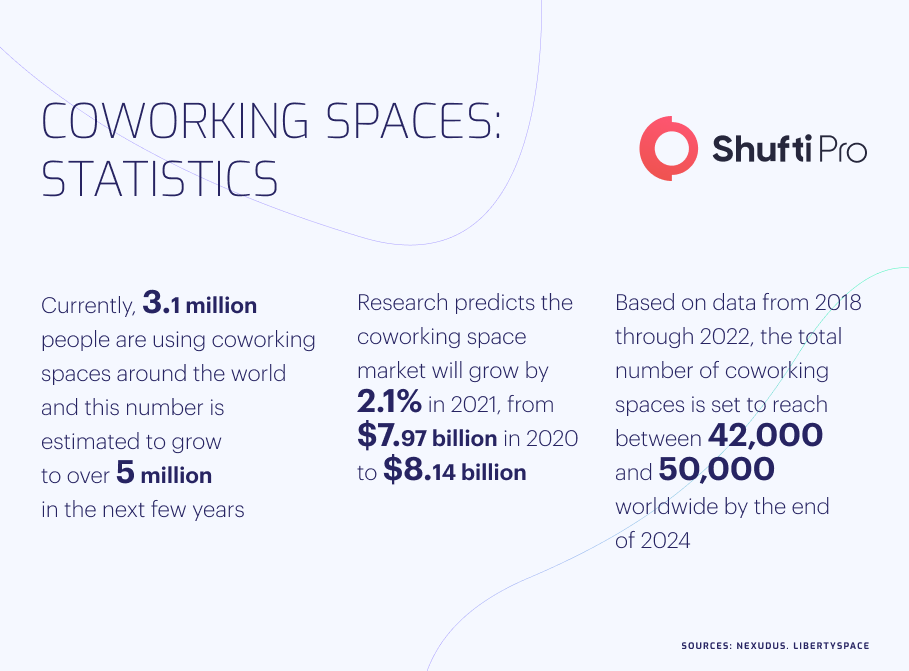
The first coworking space was established in San Fransisco in 2005 after which the concept spread to the whole world gradually. Especially during the COVID-19 pandemic, when companies had to close their on-site operations, the use of the coworking format increased substantially. A large number of surveys show that after the pandemic, a large number of workers preferred to avoid full-time office routines and even work from home, which eventually created the space for coworking setup. It is estimated that 5 million people will be working in shared spaces by 2024 – an increase of 58% compared to the current numbers.
Another crucial factor that contributed to the rising number of coworking spaces is the freelancing style of working. A large number of businesses around the globe do not have any offices; instead they hire their employees through various online platforms like Fiverr, Upwork, Freelancer, and many others. The majority of freelance workers prefer to work in coworking spaces rather than completing their projects while sitting in their homes. It is estimated that freelancers will be 50% workforce by 2025 which will eventually raise the need for more shared spaces.
Elevating Cybercrime in Coworking Spaces
Although coworking spaces are providing viable opportunities to workers, it has also encouraged cyber criminals to exploit loopholes and get involved in a myriad of scams, particularly identity theft and data breaches. Unlike financial institutions, shared spaces have not implemented stringent identity verification measures which have made them highly vulnerable to scammers. While sharing the same space, internet, computers, and other equipment, users unintentionally end up sharing sensitive personal and professional information. So it has become mandatory for coworking service providers to ensure the security of users’ data by implementing stringent solutions.
While working in a traditional job environment, all the employees know each other, but in a coworking environment, users do not have information about other people sharing the same facilities. The fraudsters can hack and steal the details of users logging in on the same devices through multiple fraud techniques, which could further result in account takeovers and identity theft.
Identity Theft – A Huge Challenge
With emerging technologies and growing digitization, identity theft has become one of the prominent issues in online businesses. In the US alone, 15 million people had their identities stolen in 2021, raising concerns for global regulatory authorities to find a solution to this menace. In the same way, coworking spaces are also posed to high risks of privacy breaches due to usage of the same wifi and other equipment. With the growing use of shared spaces, owners and developers will have to find a robust identity verification solution that can counter advanced techniques used by criminals. The most feasible solution for identity theft is presented in the form of Know Your Customer (KYC) measures which may include facial recognition, document verification, and thumb impressions.
Why Co-working Spaces Need Identity Verification Services?
The increasing trend of remote working and freelancing is compelling workers to use shared workspaces. Users have to input their confidential details while logging in, which leaves them vulnerable to several threats, particularly identity theft and privacy breaches. In order to counter criminals and make co-working spaces secure platforms, it is the need of the hour to find and implement identity verification services that can authenticate the true identities of users and report suspicious activities. Implementation of such an effective system will not only help the businesses to grow in a secure environment but also ensure a good reputation for co-working spaces.
Types of IDV Services for Coworking Spaces
There are myriad types of identity verification services that can help co-working service providers to know the true identities of their users and identify the criminals in case of any suspicious activity.
Facial Biometric Authentication
Facial recognition is the most authentic process of verifying users, which can authenticate their identities in real time. It provides the service providers
with the most secure and fastest selfie-based onboarding method where they can approve the entry of users after successful facial recognition.
Video KYC
All the documents of users including identity cards, licenses, and other details can be verified through the video feature of KYC. In order to use video KYC, users have to switch on their devices’ cameras and show proof of their identities. The verification system checks the details and compares them with the ones in records to allow/deny entry to users.
Ensuring KYC Compliance in Coworking Spaces
It is a well-established fact that all the digital businesses which incorporated strict identity verification measures, get successful in lowering the number of crimes. Similarly, the advanced KYC techniques can also help the coworking service providers ensure security on their platforms. A system efficient enough to verify the true identities of users through real-time biometric verifications and document authentication can really help business owners to counter criminal activities. The Customer Due Diligence (CDD) approach is also mandatory, which will help to authenticate every user and keep a record of their activities on the platform.
How Shufti Pro Can Help
Combating crimes, particularly identity theft and privacy breaches, is crucial for co-working spaces. It is a fact to understand that usage of co-working services will increase in the coming years, and it is the most feasible time for business owners to invest in IDV services for the platforms. Although protecting the workers from cybercrime looks like a difficult task, it can be accomplished using efficient KYC solutions.
Shufti Pro’s state-of-the-art identity verification services are the most viable solution for co-working spaces. By implementing facial recognition and document authentication services, businesses can comply with the global standards of KYC. Shufti Pro’s KYC solutions are efficient enough to verify true identities in less than a second with 98.67% accuracy.
Want to know more about the identity verification services for co-working spaces?