AMLR Solutions
  AMLR Consultation
 EUDI Wallet
 Onboarding
 Ongoing Monitoring
 FRAML
FRAML KYC
KYC KYB
KYB KYI
KYI Age Assurance
 Workforce IAM
 Candidate Verification
 Account Takeover
 Bonus/ Promotion Abuse
 Chargeback Fraud
 Deepfake
 Document Fraud
 Fraud Networks
 Impersonation Fraud
 Money Mule Activity
 Multi-Accounting
 Party Fraud
 Regulatory & Compliance Risks
 Synthetic Identity Fraud
 Adult Content
 Banking
 Crypto
 Fintech
 Forex
Forex Compliance
 Fraud prevention
 Trust & safety
 Global expansion
 Compliance Officers
 Developers
 Fraud Analysts
 Product Managers
 Journey Builder
  Global Trust Platform
 Customer Profiles
 Vendor Comparison
 IDV Case Management
 AML Case Management
 Regulatory Reporting
 Agentic Rule Builder
  AI Compliance Co-Pilot
  Fraud Analytics
 Fraud Hub
  OCR
OCR Shufti AI
 Bank Account Verification
  Biometric Duplication
 Database Checks
 Document Intelligence
 Government ID
 Mobile Driver's License
 NFC
NFC Selfie Liveness
 Brand Personalisation
 Deployment Options
 Identity Methods
 IDV Modes
 Multi-tenancy
 On-Premise IDV
 Secure Capture
 Shufti MCP















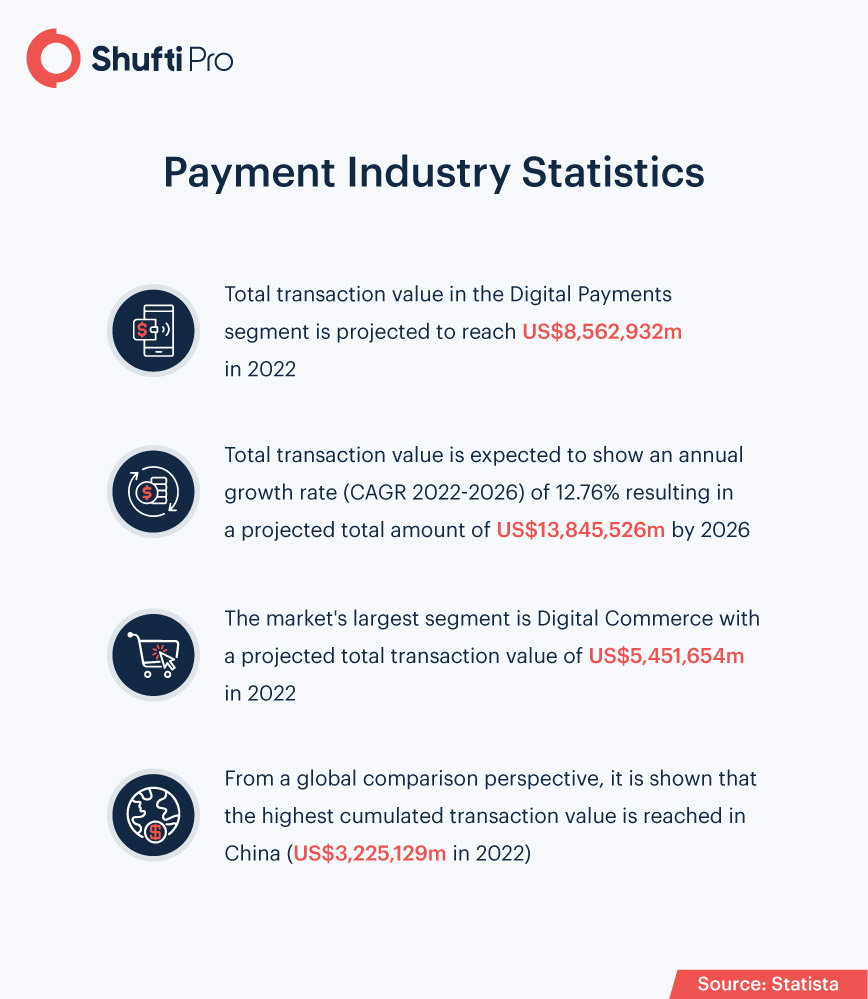
The promise of payments technologies is being realized. Consumers are executing frictionless payments in their everyday transactions. Payment service businesses are enhancing customer experiences through faster payments and richer payment data that enable value-added and robust services. Countries are updating their payments infrastructures, realizing that faster payments reduce costs and can even boost GDP growth by serving unbanked individuals. Furthermore, as alternative payment systems such as Apple Pay, Google Pay, and PayPal have risen significantly throughout the pandemic, the number of online transactions is also skyrocketing.
However, It’s quite challenging for payment service providers to detect and combat illicit financial crimes that are carried out through legit financial systems. As the use of alternative digital payments is growing, financial institutions are scrambling. There is a dire need for anti-money laundering and identity verification solutions that can ensure such suspicious activities never go undetected. While this radical digital transformation is assisting people to experience seamless payment transactions, it also poses some dirty-great problems for the financial regulators as new emerging gateways are quite vulnerable to criminal activities.
The Payment Industry’s Landscape and Financial Crime
There’s a lot of ground to cover in the payments landscape. It’s a worldwide industry with companies ranging from huge banks and IT giants to small start-ups, e-commerce facilitators to mobile wallet providers. It encompasses any business that handles payments on behalf of others, from the most recent peer-to-peer payments services to conventional Money Services Businesses (MSBs). Government organizations, multinational corporations, and even gaming firms permit the transfer of cash to tokens are among customers of the payment industry.
However, payment service providers usually charge fees against each transaction. Yet this industry also includes aggregators that manage clients’ financial transactions along with bank accounts, credit cards, loans, and various other options to provide them with a single view of their finances. Additionally, these aggregators do not initiate payments, instead, they charge subscription fees for payment services. Moreover, they also handle customers’ personal as well as financial information which makes them more vulnerable to financial crimes.
Banks and credit card issuers are among the traditional financial services organizations that offer mobile payments, often through mergers, acquisitions, or collaborations with PSPs. However, due to the high risk of crime associated with this industry some banks are focussing on their own core financial services and moving away from payment services.
Financial crimes, such as fraud, money laundering, terrorist financing, sanctions violations, and other unlawful payments, such as those related to drug and human trafficking and labor exploitation, are all risks that PSPs face. Money laundering is one of the most common financial crimes, and many governments have dedicated regulatory and law enforcement resources to combating it. Furthermore, any profit-driven illegal action, such as fraud, is a prerequisite for money laundering. That implies a PSP’s handling of those payments must be weighed against money laundering and terrorism financing concerns.
As payment service providers are subject to certain financial crimes regardless of jurisdiction, the coronavirus has also become a catalyst for similar scams around the world. However, financial crime patterns vary region-wise. Moreover, a high-level financial crime like money laundering and terrorist financing can also swiftly escalate out of control, causing financial market disruption, triggering regulatory inquiries, and adverse media coverage in several regions.
Australian Payment Network Reports 9.2% Increase in Payment Card Fraud
According to research by the Australian Payments Network (AusPayNet), with the increase in online transactions during the coronavirus epidemic, there has been a 9.2% rise in payment card fraud in the last 12 months. Credit card payments increased by 4.5% within the same time period.
The Card-Not-Present (CNP) scam is especially impacting digital transactions, with e-commerce enterprises losing $442 million at the most critical period of the coronavirus pandemic across the country. As a result, CNP was responsible for 90% of all card fraud in Australia. In addition to this, scams involving lost-and-stolen cards fell by 9.2%, while skimming scams decreased by 37.3%.
However, according to Andy White, CEO of AusPayNet, rising e-commerce trends are fueling fraudulent activity. CNP fraud occurs when legitimate card information is used to make online purchases or other online payments without the card being present at the time of the transaction. Customers will not be held liable for any financial losses incurred as a result of this scheme and will be repaid if they protect their personal data.
Deutsche Bank Pays $130M to Avoid Corrupt Payment Charges
The German investment giant Deutsche Bank has agreed to pay a $130 million fine to settle charges of concealing illicit payments and bribery. According to law enforcement authorities, the bank has been involved in such activities since 2009. Millions of dollars in bribes and additional millions were tied to business development consultants that were channeled through legit financial systems. To falsify these expenses, the bank tampered with its record-keeping. The fraud includes key bank executive members who intentionally worked to disguise the phony payments. Companies are prohibited from paying bribes overseas under a US law that prohibits corrupt foreign activities. Saudi Arabia, Abu Dhabi, Italy, and China have all been punished as a result of Deutsche Bank’s infringement of US regulations.
In addition to this, the FinCEN probe last year found that Deutsche Bank shifted millions of dollars for a Ukrainian tycoon who is now facing fraud charges. Prosecutors have also revealed that, in addition to the bribery charges, Deutsche Bank has engaged in long-term price manipulation of metals. In the settlement, the bank admitted wrongdoing and agreed to pay a fee in order to avoid charges of bribery and fraud.
Global Regulations to Secure Digital Payment Services
PSD2 & Payment Services in the E.U.
The PSD2 was enacted into national legislation to mandate payment service businesses to comply with FCA standards and guidelines. However, entities providing payment services as part of a service package or if the business receives money from a consumer before passing it to the seller, payment service providers are most likely subject to these restrictions.
The Payment Services Directive intends to promote innovation and competition in the retail payments business while also improving the security of electronic payment transactions and the protection of customer financial data. Payment service providers are required to have robust customer authentication procedures, transaction monitoring systems monitoring, and maintain high communication standards for suspicious activity reporting and security threats.
Singapore Payment Service Act
The Payment Service Act (PSA) regulates payment services in Singapore, came into effect on January 28, 2020. This law encourages the growth of FinTech by adapting to several technological advancements. One of the principal purposes of this new regulation is to maintain Singapore’s financial stability. The PSA also ensures that market participants have a level playing field. In addition to this, AML / CFT requirements must be followed by all financial institutions and businesses that have payment systems or provide payment services, according to the legislation. The Monetary Authority of Singapore (MAS) has developed a licensing structure under the Payment Service Act, which assesses whether these institutions conform with AML/CTF standards.
How Shufti Can Help
Shufti is a Payment Card Industry Data Security Standard (PCI DSS) compliant identity verification service provider based in the UK. Powered by thousands of AI models Shufti’s state-of-the-art anti-money laundering services allow payment service businesses to stay put with the evolving regulatory regime while screening customers against 1700+ financial watchlists in less than a second with 98.67%. In addition to this, our solution helps businesses to maintain data integrity that ensures that cross-border digital payments remain secure from data breaches while allowing customers to experience a seamless onboarding experience.
Want to know more about our AML screening services for the payment industry?