 Runs On Your Cloud
 No Data Sharing
 No Contract Required
 Explore Now







 Face Verification
 Address Verification
 Document Verification
 Age Verification
 VideoIdent
 Fast ID
 eIDV
eIDV
 NFC Verification
 Consent Verification
 Business Verification
 Due Diligence
 Investor Verification
 E-Signature
 Behavioural Biometrics
 Device Fingerprinting
 MFA
MFA
 AML Screening
 Business AML Screening
 User Risk Assessment
 Transaction Screening
 Adverse Media Screening
 Identity Verification
 KYC
KYC
 KYB
KYB
 KYI
KYI
 Bonus Abuse
 Fraud Prevention
 Deepfakes
 Banking
 Crypto
 Fintech
 Forex
Forex
 Gaming
 Gig Economy
 Marketplace
 Social Networks
 Product Managers
 Compliance Officers
 Fraud Analyst
 Global Trust Platform
 Journey Builder
 Vendor Comparison

 Content library
 Blogs
Blogs
 News
News
 Reports
 Insights
 Knowledgebase
 ROI calculator
 Blind Spot Audit
 Deepfake Detection
 Liveness Detection
 Document Originality
 Document Deepfake
 Events & Webinar
 Podcast Studio
 Spotlight Studio
 API Documentation
 Mobile SDKs
 Service Status
 Help Center
 Contact Us
 Technical Support
 Compliance
 Supported Document
 About
About
 Career
 Press Release
 Certifications
 Partnership
 Awards
How to Identify and Monitor Politically Exposed Persons (PEPs)?

A politically exposed person or PEP is one who has been assigned to perform prominent public functions or who has a high-profile role in society. Due to their position, they can commit money laundering offences and other related corrupt activities like terrorist financing. This thing has already been confirmed by many case studies and analysis reports. There is a proper list available that has all the names of PEPs, known as the PEP list.
Such people are a high risk for the financial sector as they are more likely to become involved in financial crimes like money laundering and financing of terrorists than other people. PEP status highlights additional risk involved, so businesses must apply additional AML/CFT measures when establishing a business relationship with these persons.
PEP status does not predict criminal behaviour but signals to businesses to be more vigilant. Businesses must conduct proper monitoring to ensure that they do not miss a change in PEP’s risk profile. PEP monitoring requirements are not indicative of criminal behaviour but are just preventive in nature.
The evident potential risk factors associated with PEPs justify the application of additional preventive measures when it comes to establishing business relationships with PEPs. In order to avoid reputational and regulatory damages, organizations should understand how to recognize a politically exposed person (PEP) and their associates.
What is a PEP?
PEP meaning first emerged as “Senior Foreign Political Figure” in the wake of the Abacha Affair, a major money-laundering scandal in Nigeria. This case jolted global efforts to prevent the abuse of financial institutions by public officials.
PEP full form politically exposed persons, according to FATF Recommendation, is defined as follows
“Individuals who are or have been entrusted with prominent public functions in a foreign country, for example, Heads of State or of government, senior politicians, senior government, judicial or military officials, senior executives of state-owned corporations, important political party officials.”
According to the EU Third Anti-Money Laundering Directive:
“Natural persons who are or have been entrusted with prominent political functions and immediate family members or persons known to be close associates of such persons.”
Types of Politically Exposed Persons
The AML and CFT Act identifies three major types of PEPs, which are as follows:
Foreign PEP:
Individuals holding prominent public positions in a foreign country. This includes heads of state, ministers, members of parliament, senior military officers, or judges serving outside the country, conducting the compliance check.
Domestic PEP:
Individuals serving in high-level public roles within the same country. This may include presidents, senior government officials, legislators, top judicial authorities, or high-ranking military officials in elected or appointed positions.
International PEP:
Individuals appointed to senior roles in international organizations. For example, directors, board members, commissioners, or senior executives working in institutions such as the United Nations or the World Bank.
Politically Exposed Person Examples
Financial institutions and businesses categorize the following as common PEP examples:
Government Officials:
Current or former government officials who are in domestic or foreign government positions, including heads of state, individuals working in executive, administrative, legislative, military, or judicial institutions in various elected or unelected roles.
Political Party Officials:
Officials who are appointed to senior positions in major political parties at home or abroad.
Senior Executive:
Individuals who are serving in senior executive roles, for instance, directors or board members in government-owned or foreign organizations.
Family Members:
Family member, the immediate one, of a political or government official, or of a senior executive. For instance, spouse, parents, children, siblings, or spouses’ parents or siblings.
Categories of PEP
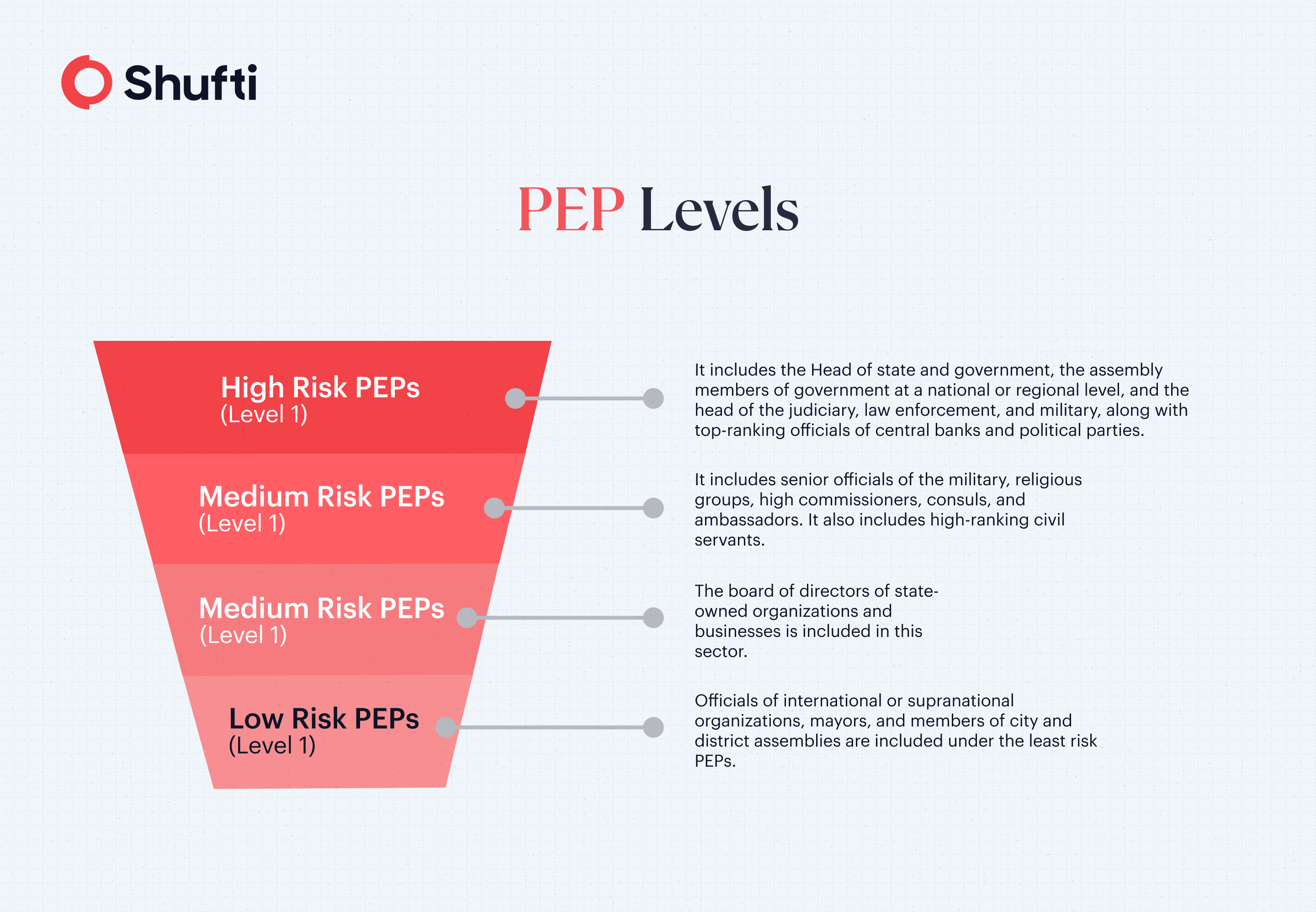
PEP categories are determined by the PEP level, which reflects an individual’s role and exposure to financial crime risks. Higher PEP levels usually include senior officials, while lower levels may include their family members and close associates.
The Subjective Nature of PEPs:
There is no single international standard for defining politically exposed persons. Subjective judgment has to be made in order to decide if an individual is politically exposed by taking into account the associated risks. These may be influenced by their seniority and time spent out of the office if they were ever in an eligible PEP position. In the same way, there is no defined objective on whether an individual qualifies as a family member or a close associate.
FATF Recommendations for PEPs:
There are confirmed risks associated with PEPs that justify stringent measures to be taken to put a halt to financial crimes such as money laundering, terrorist financing, and others. Businesses are required to take preventive measures before establishing a relationship with such persons. Businesses are to perform a proper PEP list screening whenever a new customer is onboarded to check the criminal history and associated risks.
FATF requires countries to ensure that financial institutions implement measures to prevent money laundering through financial institutions by PEPs and to detect potential misuse whenever it occurs. The requirements are preventive and to be on the safe side. Moreover, businesses cannot refuse business relationships with PEP just because the client is on the PEP list. FATF measures extend on a broader spectrum to fight against financial crimes such as money laundering, and not to put PEPs behind bars.
Identification of PEPs:
To comply with AML regulations and to trace and tackle PEPs, businesses need to have a proper procedure in place. Any business entity should know when to check for a PEP and why to check for it. PEP record should be integrated into the system of every business so that the onboarding customer is screened against it, and to nullify the associated risks and criminal activities. In this regard, strict Customer Due Diligence, along with PEP screening, must be performed before establishing a business relationship with any customer.
PEP Screening
PEP screening is a key control within PEP in AML frameworks designed to identify individuals holding prominent public positions. Financial institutions apply this screening as part of their banking procedures to detect potential corruption and financial crime risks. Since politically exposed persons carry higher exposure, strong PEP compliance measures help reduce regulatory penalties and protect institutional reputation.
What is the PEP Screening Process?
The PEP screening process starts at onboarding as part of KYC and broader pep in aml obligations. Customer details such as full name, date of birth, nationality, and identification credentials are screened against reliable global PEP databases. In the banking industry, PEP screening systems also review aliases, family members, and close associates to identify any indirect risk connections.
When a potential match is detected, a structured risk assessment is conducted to verify accuracy and remove false positives. If confirmed, enhanced due diligence is applied under internal PEP compliance policies. This may include evaluating the source of funds, source of wealth, and applying continuous transaction monitoring. Ongoing rescreening ensures updated risk profiling and supports long-term regulatory alignment.
Simplify PEP Screening and Risk Monitoring with Shufti
Shufti’s AML and PEP screening capabilities make PEP compliance easier and more reliable for financial institutions and regulated businesses. With its AI-powered global screening engine, Shufti checks customers and counterparties against comprehensive politically exposed person lists and watchlists, helping identify high-risk profiles during onboarding and ongoing monitoring. By reducing false positives and consolidating risk intelligence into one profile, Shufti supports stronger anti-money laundering and compliance controls.
Request a demo to explore how Shufti can streamline your PEP screening and AML compliance processes.
Frequently Asked Questions
What is a Politically Exposed Person (PEP) and how is it identified?
A politically exposed person (PEP) is someone holding a prominent public position, like a senior government official or high-ranking executive in a state-owned entity, with higher exposure to corruption and financial crime risks. PEP status is verified through screening against trusted global PEP databases during KYC and AML checks.
How Often Should PEP Lists Be Updated and Reviewed?
PEP lists should be updated regularly to reflect changes in political appointments and public roles. Ongoing monitoring and periodic rescreening ensure accurate and up-to-date risk assessment.
Why is it Important to identify and monitor PEPs?
Identifying PEPs helps organizations manage corruption, bribery, and reputational risks effectively. Continuous monitoring strengthens regulatory compliance and reduces exposure to financial penalties.
Why are PEPs considered high-risk for businesses?
PEPs are considered high-risk because their political influence or government connections can increase the chance of bribery, corruption, or money laundering, making transactions linked to them more vulnerable. A PEP can pose a threat by exposing businesses to legal, financial, or reputational risks if involved in illicit activities, even indirectly, potentially resulting in fines or loss of trust.
What Industries are Most Exposed to PEP Risks?
Industries handling large transactions or sensitive client funds, like banking, real estate, insurance, and fintech, are most exposed to PEP-related risks due to their high-risk financial operations.
How PEP Screening Protects Businesses from Reputational Damage?
PEP screening helps identify high-risk individuals before engagement, allowing businesses to take preventive measures and maintain trust, ensuring regulatory compliance and safeguarding their reputation.