AMLR Solutions
  AMLR Consultation
 EUDI Wallet
 Onboarding
 Ongoing Monitoring
 FRAML
FRAML KYC
KYC KYB
KYB KYI
KYI Age Assurance
 Workforce IAM
 Candidate Verification
 Account Takeover
 Bonus/ Promotion Abuse
 Chargeback Fraud
 Deepfake
 Document Fraud
 Fraud Networks
 Impersonation Fraud
 Money Mule Activity
 Multi-Accounting
 Party Fraud
 Regulatory & Compliance Risks
 Synthetic Identity Fraud
 Adult Content
 Banking
 Crypto
 Fintech
 Forex
Forex Compliance
 Fraud prevention
 Trust & safety
 Global expansion
 Compliance Officers
 Developers
 Fraud Analysts
 Product Managers
 Journey Builder
  Global Trust Platform
 Customer Profiles
 Vendor Comparison
 IDV Case Management
 AML Case Management
 Regulatory Reporting
 Agentic Rule Builder
  AI Compliance Co-Pilot
  Fraud Analytics
 Fraud Hub
  OCR
OCR Shufti AI
 Bank Account Verification
  Biometric Duplication
 Database Checks
 Document Intelligence
 Government ID
 Mobile Driver's License
 NFC
NFC Selfie Liveness
 Brand Personalisation
 Deployment Options
 Identity Methods
 IDV Modes
 Multi-tenancy
 On-Premise IDV
 Secure Capture
 Shufti MCP













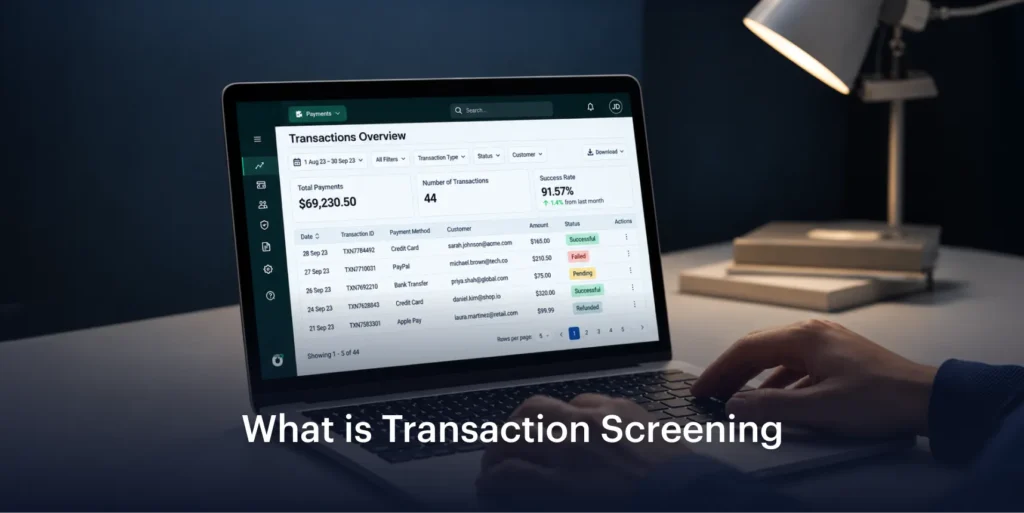

Transaction Screening is the process of checking the parties, banks, goods, vessels, and locations in a payment, including free-text fields such as payment references, against sanctions and watchlists. Where the institution’s risks and applicable rules justify it, screening also looks for indicators of prohibited goods or activities, such as a payment reference naming restricted goods or a sanctioned port. The check is usually run before the payment is completed, so a potential match can be held for review and then released, rejected, or frozen if it involves the designated person or entity, a sanctioned state or region, or restricted goods. It is the payment-level control behind the freezing obligations in the FATF recommendations and the national sanction laws.
Transaction Screening meaning in AML:
AML transaction screening operates within the broader AML compliance program. In AML, transaction screening asks one question of each payment. Does anyone or anything in this transfer appear on a list you are legally barred from dealing with?
The check involves:
- Payer and payee names and addresses
- Intermediary and Correspondent institutions that include BIC and SWIFT codes.
- Purpose of the transfer and free text fields such as references and the remittance information.
- Wallet Addresses in case of Crypto-asset transfers.
The common failure point happens when only the structured name fields are screened. Sanctioned party details can appear in the payment reference or the intermediary bank field, where name-only screening can miss them.
Transaction Screening VS Transaction Monitoring
| Transaction Screening | Basis Of Comparison | Transaction Monitoring |
| Before execution, in real time | Timing | During or after execution, over time |
| Checks the details of a transaction as it happens | Transaction Details | Analyses transaction patterns and history over time to identify suspicious behaviour |
| Parties against sanctions and watchlists | What It Checks | Behaviour against the customer’s expected profile |
| Hold, freeze, or reject the payment | Outcome | Alert that may lead to a suspicious activity report |
Transaction Screening Process:
Identify Transaction Information:
The institutions identify which payment fields and supporting documents are relevant. It includes the payer and beneficiary names, addresses, bank identifier codes, intermediary banks, and payment descriptions. Trade transactions can involve different factors, including checks on vessels, shipping companies, and locations.
Select and Maintain Screening Lists:
The lists need to cover the sanctions regimes and risks relevant to the business, based on its markets, customer type, and payment corridors. The updates should be made to reach screening systems promptly. The list matching also has its own limitations. Under the OFAC’s 50 percent rule, an unlisted entity is blocked when one or more blocked persons own 50% or more of it, directly or indirectly, in aggregate. Therefore, ownership checks also matter along with the AML name screening.
Compare details and generate alerts:
The transaction screening system compares the transaction information with the relevant entries. Fuzzy matching helps in identifying similar names despite spelling differences or transliteration. The matching setting requires testing because overly restrictive settings can miss targets, while excessive sensitivity can overwhelm the reviewers with irrelevant alerts.
Investigation of Potential Alerts:
An alert can be a possible match, not a confirmed breach. The reviewers have to compare the available identifiers, such as addresses, dates of birth, and registration numbers, and can obtain further information where it is necessary. Then, they get access to the applicable prohibition and any exemption or license. A similar name alone can never identify whether the parties are identical or not.
Decide, Document, and Report:
The outcome involves clearing a false positive, escalating an unresolved alert, rejecting a prohibited transaction, or freezing funds. Blocking and rejection have different types of legal consequences. A confirmed match must be frozen or stopped immediately. The institutions are required to retain the information reviewed, decision rationale, and the actions that are being taken, and to submit the required regulatory reports.
Legal Requirements:
| Jurisdiction | Requirements |
| United Kingdom | Regulation 28(11) of the Money Laundering Regulations 2017 requires ongoing scrutiny of transactions against the customer’s business and risk profile. Separate sanctions regulations govern asset freezing and reporting to OFSI. |
| European Union | Under Regulation (EU) 2023/1113, Article 8 requires payee payment service providers to apply risk-based procedures when required transfer information is incomplete. Article 23 requires payment and crypto-asset service providers to maintain controls for implementing EU and national sanctions. |
| United States | Applicable OFAC sanctions determine whether a transaction must be blocked or rejected. Under 31 CFR §§ 501.603 and 501.604, reportable blocking and rejection actions generally require notification within 10 business days. |
For the EU instant euro transfers, Article 5d of Regulation (EU) No 260/2012 requires covered providers to check users at least daily and immediately when there are relevant sanctions changes that take effect. It prohibits additional checks against those EU-targeted financial sanctions during individual transfer execution. Other sanctions and AML obligations still apply.