








 AMLR Solutions
  AMLR Consultation
 EUDI Wallet
 Onboarding
 Ongoing Monitoring
 FRAML
FRAML KYC
KYC KYB
KYB KYI
KYI Age Assurance
 Workforce IAM
 Candidate Verification
 Account Takeover
 Bonus/ Promotion Abuse
 Chargeback Fraud
 Deepfake
 Document Fraud
 Fraud Networks
 Impersonation Fraud
 Money Mule Activity
 Multi-Accounting
 Party Fraud
 Regulatory & Compliance Risks
 Synthetic Identity Fraud
 Adult Content
 Banking
 Crypto
 Fintech
 Forex
Forex Compliance
 Fraud prevention
 Trust & safety
 Global expansion
 Compliance Officers
 Developers
 Fraud Analysts
 Product Managers
 Journey Builder
  Global Trust Platform
 Customer Profiles
 Vendor Comparison
 IDV Case Management
 AML Case Management
 Regulatory Reporting
 Agentic Rule Builder
  AI Compliance Co-Pilot
  Fraud Analytics
 Fraud Hub
  OCR
OCR Shufti AI
 Bank Account Verification
  Biometric Duplication
 Database Checks
 Document Intelligence
 Government ID
 Mobile Driver's License
 NFC
NFC Selfie Liveness
 Brand Personalisation
 Deployment Options
 Identity Methods
 IDV Modes
 Multi-tenancy
 On-Premise IDV
 Secure Capture
 Shufti MCP


NFC VERIFICATION
NFC Verification That Builds Trust with Every Tap
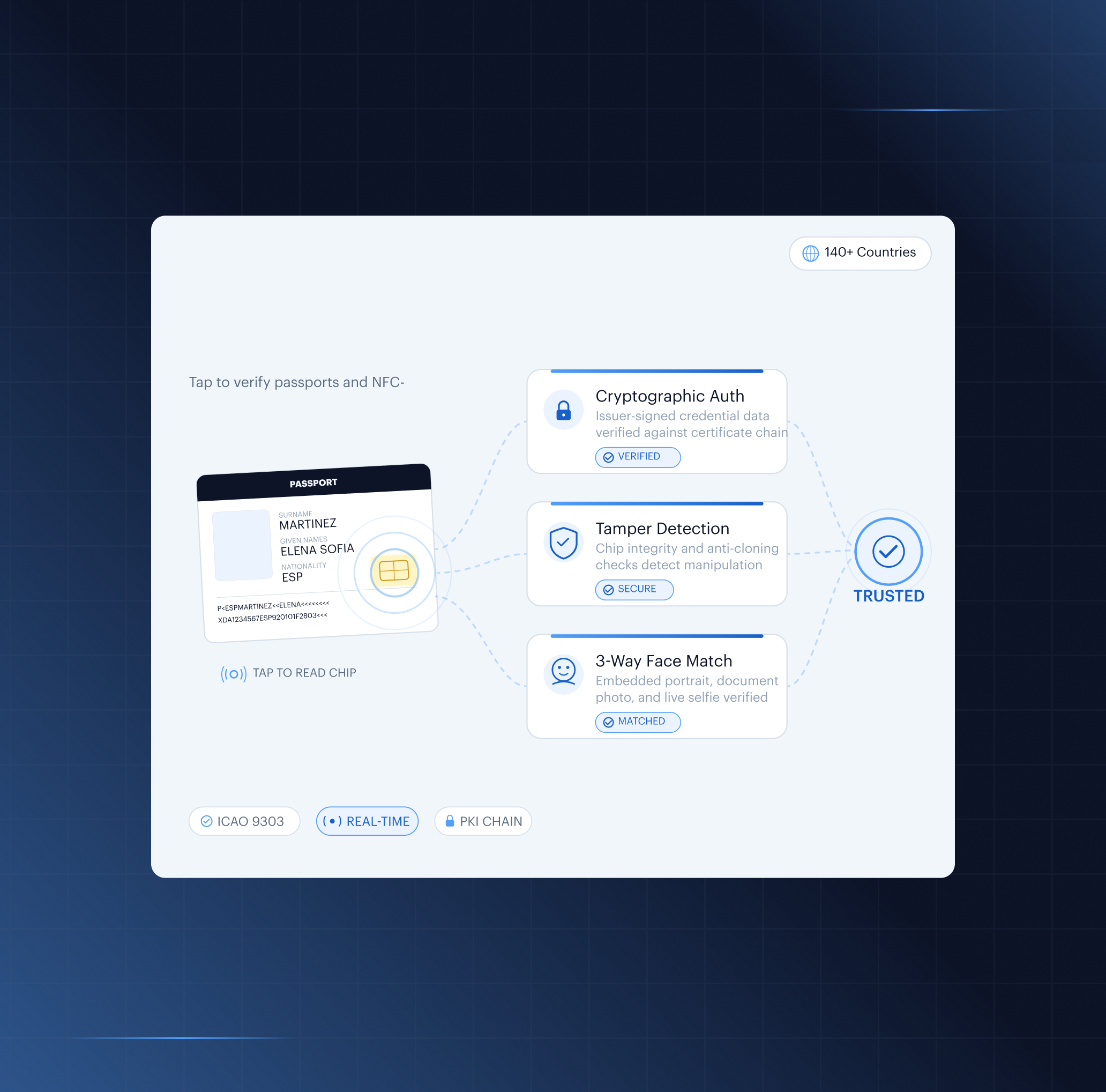
Tap to verify passports and NFC-enabled IDs against issuer-signed credential data across 140+ countries. Shufti confirms document authenticity cryptographically, detects tampering and cloning, and matches the holder via embedded portrait, document photo, and face with liveness.
Real Time NFC Verification for Regulated Flows







NFC Verification, Built for Remote ID Authentication
Advanced Document Authentication
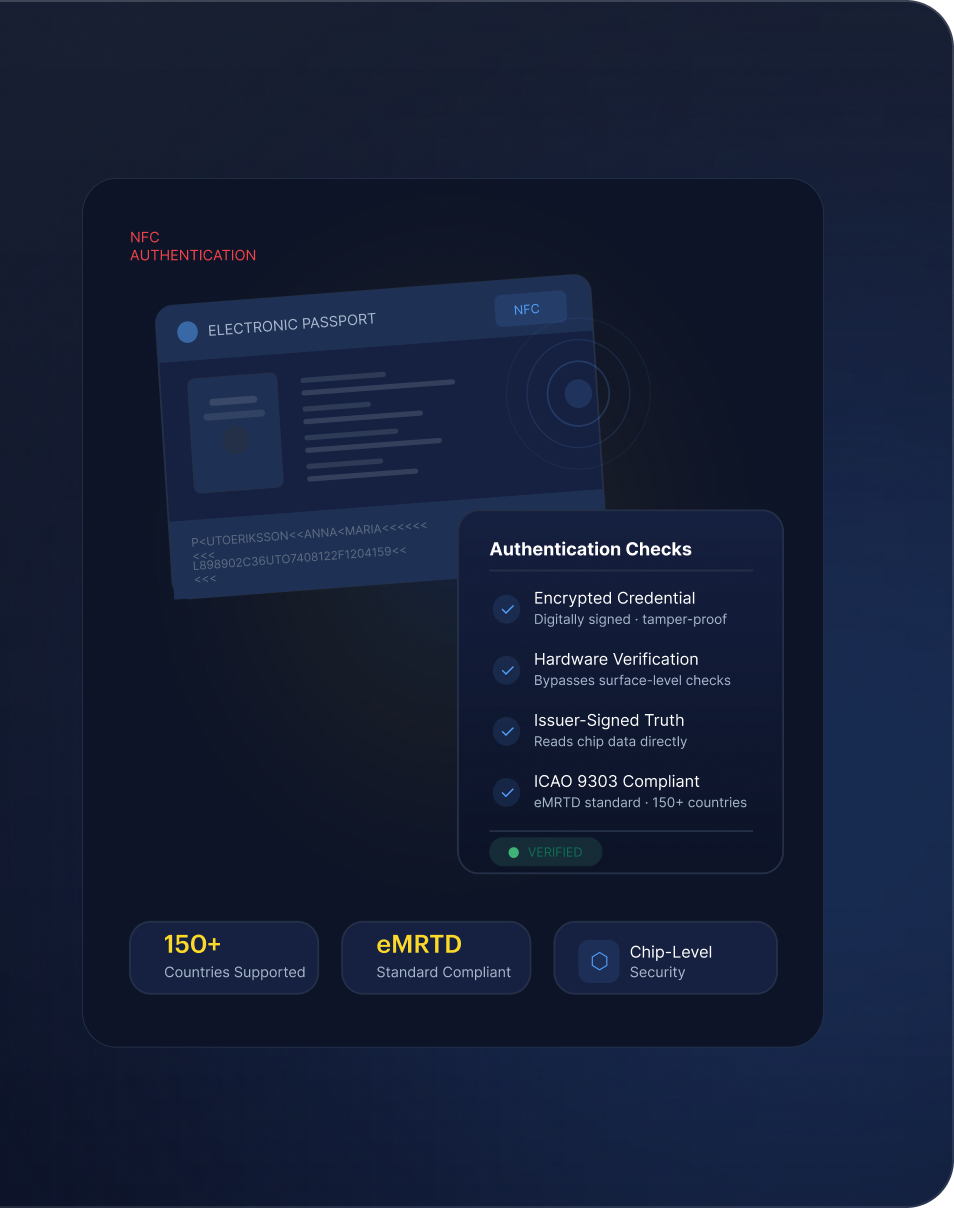
Shufti reads the NFC-enabled credential embedded in e-ID documents, where the data is digitally signed and encrypted. Forging or tampering with the issuer-signed information becomes near impossible.
Electronic forgery can defeat printed security patterns like guilloche, OVI, and rainbow prints. Hardware-secured verification bypasses surface checks entirely and reads the issuer-signed truth directly.
ICAO 9303 already mandates eMRTD-enabled passports and IDs across 150+ countries. Shufti's NFC verification meets the standard and detects criminal attempts instantly during onboarding.
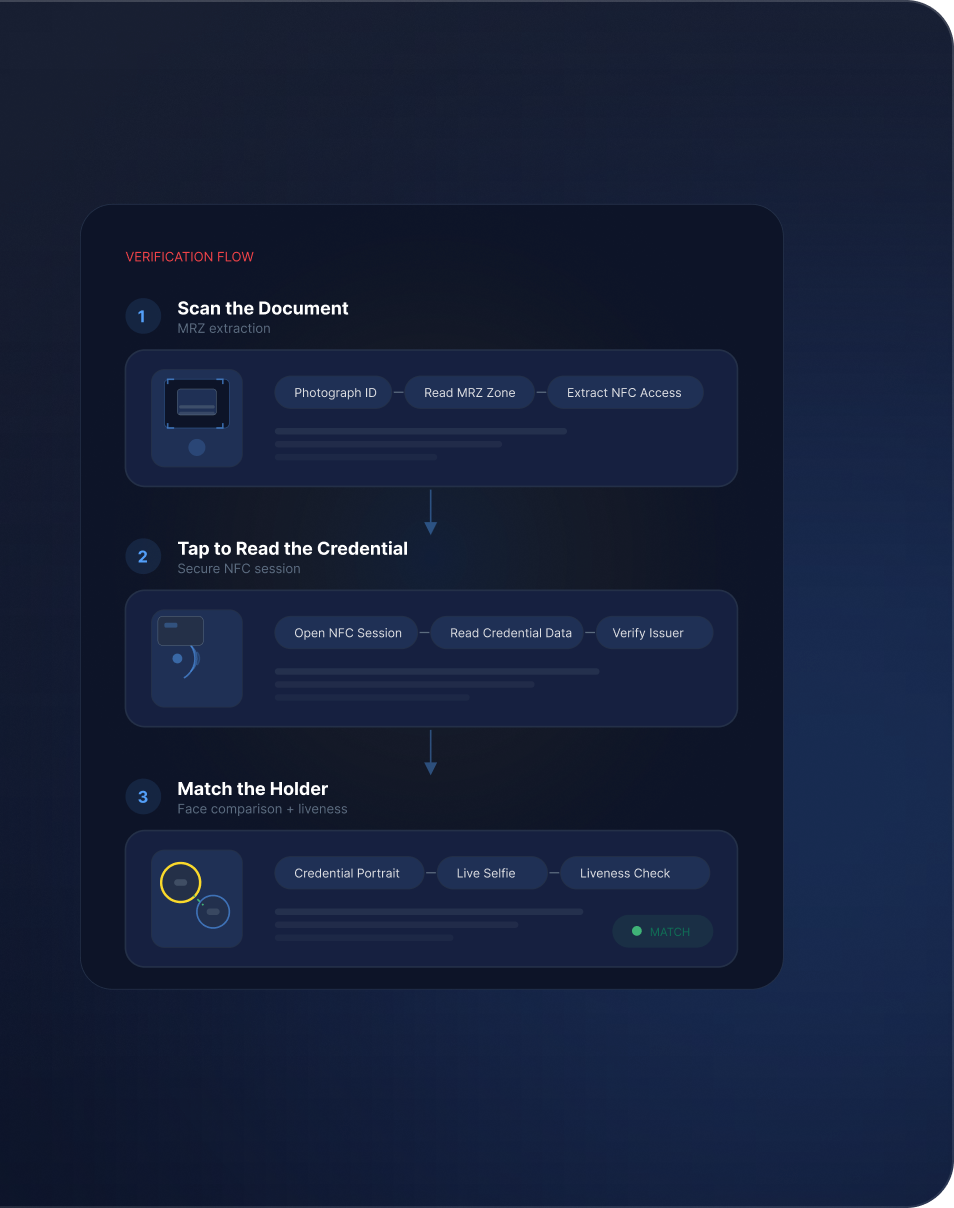
Verification Flow
The user photographs their ID document. Shufti reads the Machine Readable Zone (MRZ) to extract the data needed to unlock secure access to the document’s NFC credential.
The user taps their document against their phone. Shufti opens a secure NFC session, reads the credential data, verifies issuer signatures, and confirms the document has not been tampered with or cloned.
The high-resolution portrait stored on the credential is compared against a live selfie with liveness detection. This confirms the person holding the document is the person it belongs to.
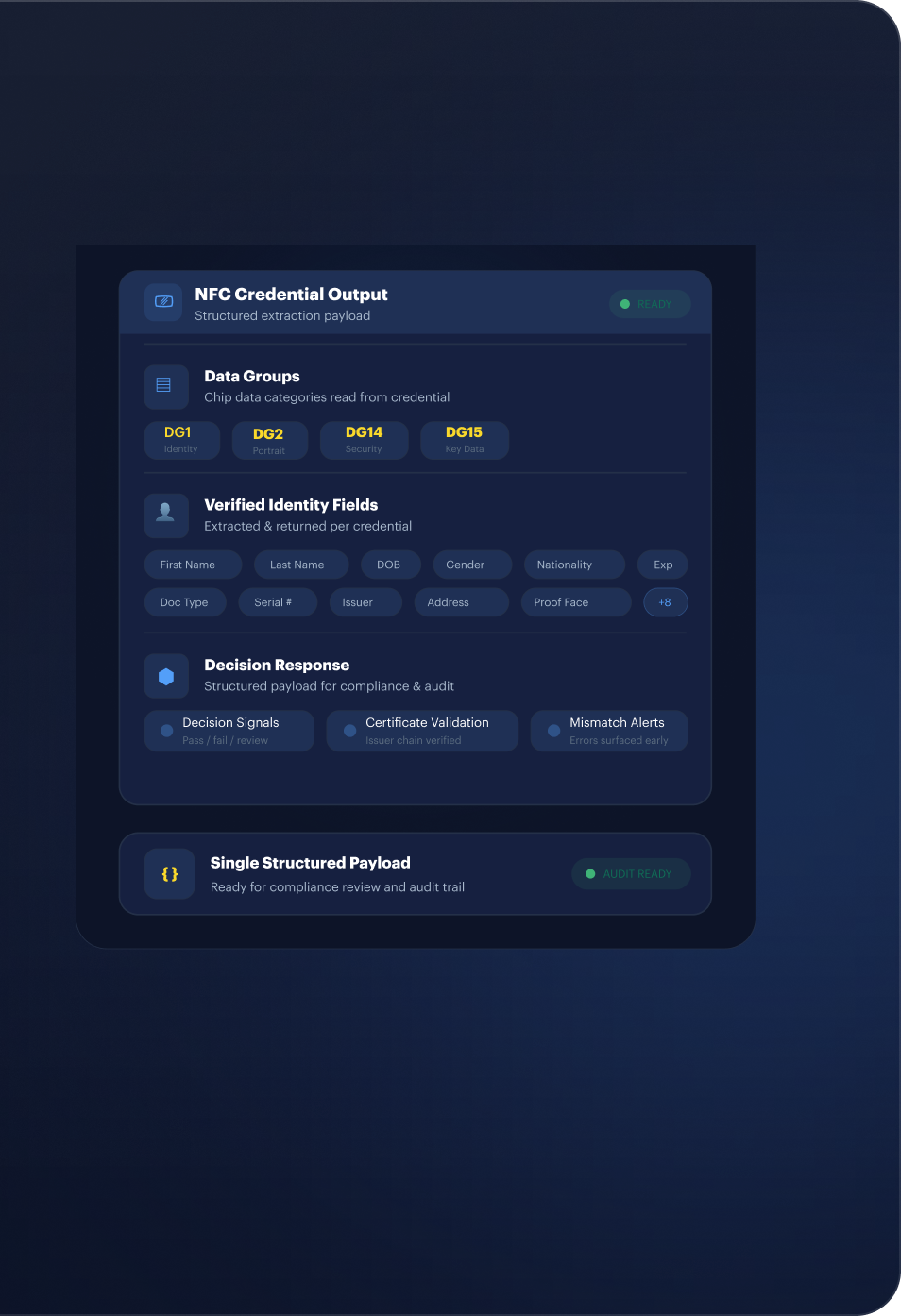
Data Extraction & Review-Ready Outputs
Reads DG1 for identity and document details, DG2 for the high-resolution portrait, and DG14/DG15 for security and key material when present.
Returns first name, last name, personal number, gender, date of birth, expiry date, serial number, document type, nationality, issuer authority, permanent address, place of birth, telephone, issuing authority, issue date, and the high-resolution eKYC proof face (DG2 portrait). Additional fields returned when present on the document.
Credential-to-document mismatches and handling errors are surfaced before the decision is returned. Final output includes decision signals, certificate validation status, and supporting reasons in one structured payload, ready for compliance review and audit.
Verify Every User Across Every Market
Passive eIDVs
Background checks through authoritative databases.
See all SourcesActive eIDVs
Real-time verification through trusted digital identity providers.
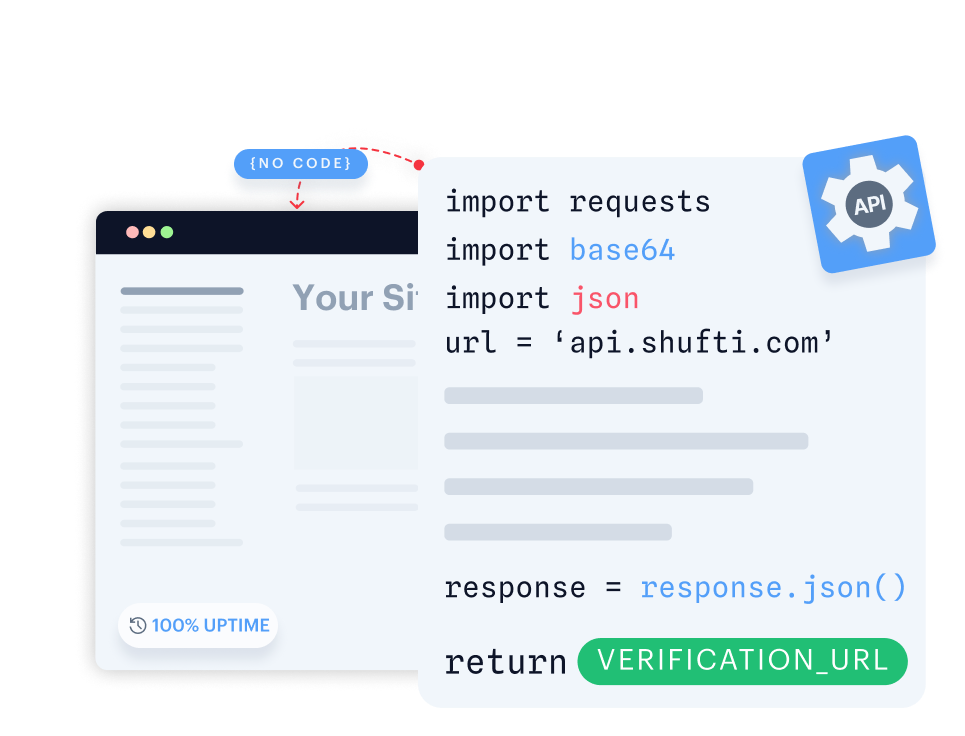
See all ProvidersSingle API, Seamless Integration
Build fully customisable verification flows with seamless backend integration.
- Gain full control by customising verification flows end-to-end.
- Integrate seamlessly with your backend for quick implementation.
- Design flexible verification journeys tailored to your users.
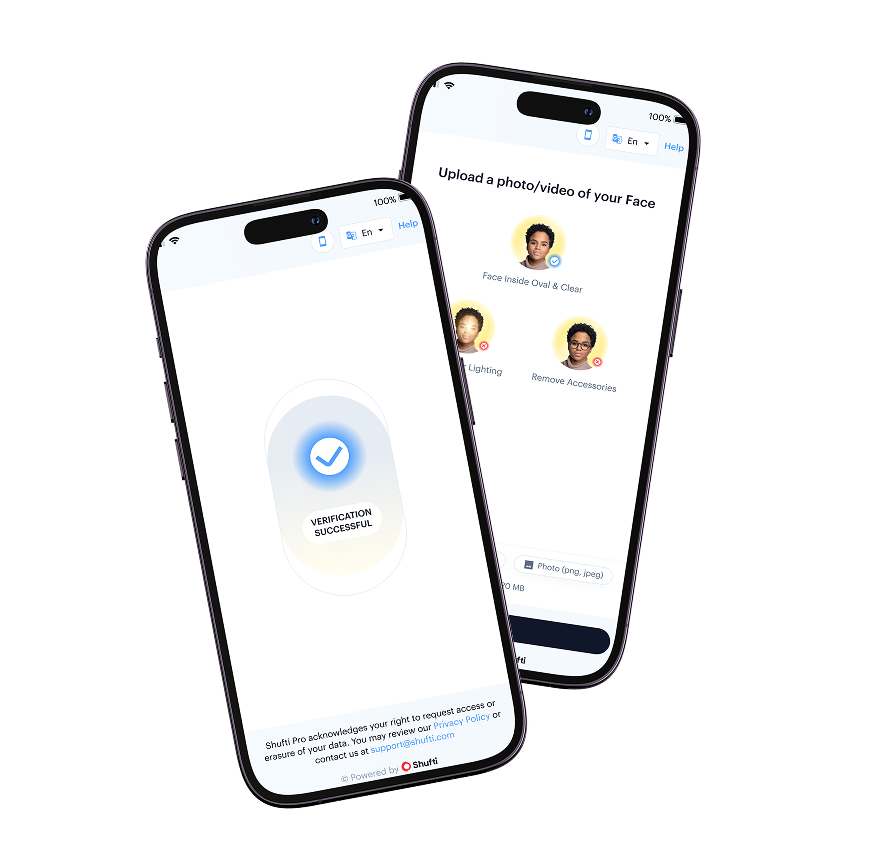
Launch a native verification experience in your mobile app within minutes.
- Launch native verification within minutes on iOS or Android.
- Use ready-made UI with camera, capture, and real-time feedback.
- Customise flows to fit seamlessly into your mobile app.
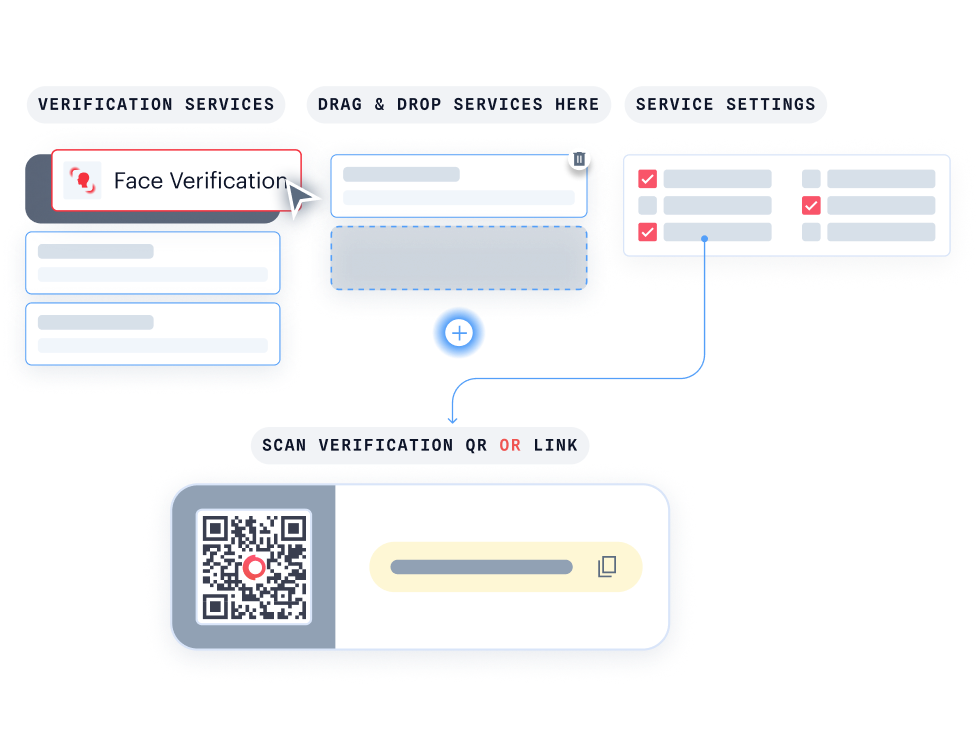
With KYC Journey Builder, create personalised verification journeys without writing a single line of code.
- Customise your journey effortlessly with drag-and-drop functionality.
- Instantly see how your verification flow looks for your users.
- Easily connect with Hosted Verification for a consistent, branded experience.
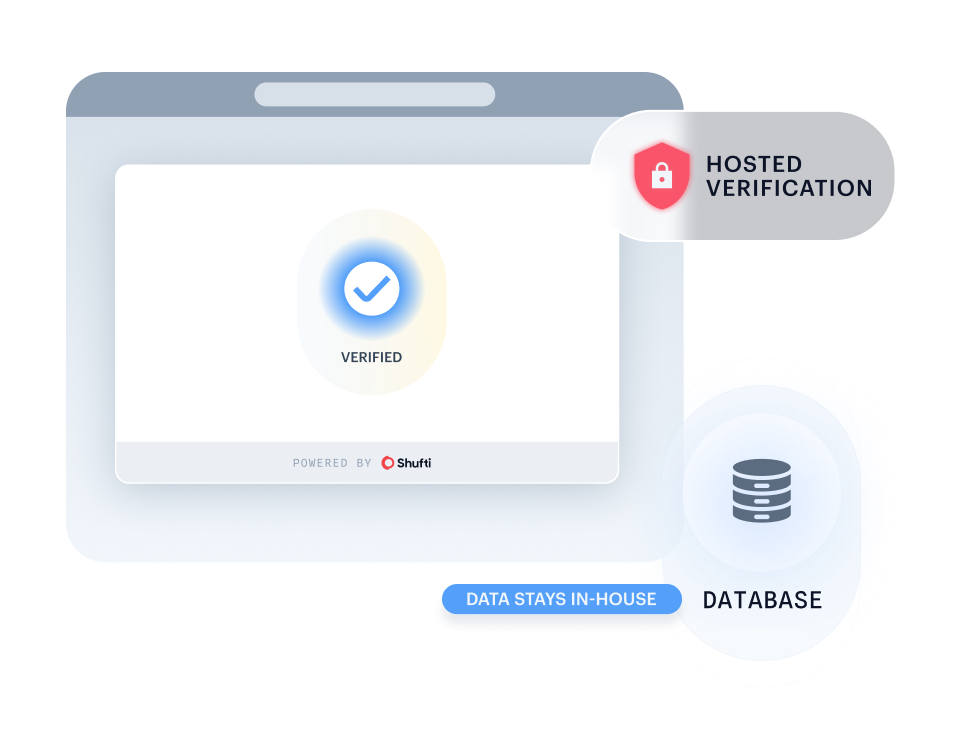
Run Shufti within your own identical-capability infrastructure for maximum data control and privacy.
- Keep all sensitive information in-house to meet strict governance and data residency requirements.
- Keep sensitive information fully private and secure in-house.
- Deploy in highly regulated sectors without compromising compliance.
Industry-Specific Solutions
Built For Your Business
Chip-Verified Sellers, Not Just Verified Names
Re-entered sellers slip past name-only checks, letting off-boarded actors return under new identities. NFC verification anchors every onboarding to issuer-signed chip data, making seller cycling detectable across markets.

Don’t just take our word for it, hear from our customers
The Confidence Our Clients Share

The future of digital identity is defined by trust, interoperability, and regulatory alignment, so our partnership with Shufti reinforces DevCode Identity’s commitment to supporting our global customers with the most secure, best-in-class, compliant identity verification solutions available today.
Combining our Conversion Driven Compliance Orchestration Platform with Shufti’s global KYC and IDV capabilities allows our customers not only to navigate complex regulatory demands but also to maintain a seamless customer onboarding experience with the highest achievable conversion rates.
We’re proud to continue our partnership with Shufti as we expand into new jurisdictions.
Shufti’s verification technology not only strengthens our compliance framework but also ensures our players enjoy a smooth, secure onboarding experience.
We aim to offer our clients and their traders the very best tools with which to do their jobs, we’re excited to be able to work with Shufti.
They’re a leading company, and we’re looking forward to offering their solutions to our clients through our CRM.
The relationship with Shufti was born out of frustration with an existing provider, so we started our discussion with Shufti.
The response time was excellent, from the start of speaking to sales to getting up and running with the demo.
TECHNICAL DEEP DIVE
Frequently Asked Questions
What documents support NFC verification?
Most modern biometric passports and many national ID cards with an embedded contactless chip. Support varies by country and document type.
Does NFC replace Document Verification?
No. NFC adds a chip layer on top of document verification. The flow starts with a document scan to read the MRZ and open chip access, then uses chip verification to increase assurance.
What does Shufti verify via NFC?
Shufti checks issuer signatures to detect tampering after issuance and, where supported, runs chip authenticity checks to reduce clone or emulation risk, then matches the chip portrait against a live selfie.
What data can be read via NFC?
Identity and document details plus a high-resolution portrait, with additional fields depending on the issuer and document.
What are DG1 and DG2?
DG1 contains the identity and document details stored on the chip. DG2 contains the chip's high-resolution portrait used for face matching.
Which countries require NFC verification?
Requirements vary by jurisdiction and use case. NFC-based checks are increasingly expected in regulated sectors such as banking, crypto, and travel, and are supported wherever ICAO 9303 eMRTD documents are issued, spanning 150+ countries. Shufti can enforce NFC as a mandatory or optional step per country and policy.
What if the user cannot complete NFC?
If the device does not support NFC or the read fails, the journey can continue through standard document and biometric verification, with NFC applied only where policy requires it.
What are the deployment options?
Deploy in cloud or on-prem depending on your security, privacy, and compliance requirements, and run NFC verification alongside other checks in the Shufti verification suite.
What is an NFC-enabled document?
An NFC-enabled document is an ID that contains an embedded contactless chip storing issuer-signed data, such as a biometric passport (eMRTD) or many modern national ID cards. The chip is read by tapping the document against an NFC-capable smartphone.
Can NFC chip data be altered?
The data on the chip is digitally signed by the issuing authority. Any alteration breaks the cryptographic signature, so tampering after issuance is detectable and the credential fails verification.
What happens to digital signatures if chip data is altered?
If any field on the chip is modified, the issuer's digital signature no longer matches the data. Shufti validates the signature against the issuer's certificate chain, so altered data is flagged and rejected before a decision is returned.
Can an NFC chip be faked?
Cloning or emulating a genuine chip is extremely difficult, because the issuer-signed data and, where supported, the chip authentication keys cannot be reproduced without the issuer's private key. Shufti runs authenticity checks to reduce clone and emulation risk.
How does Shufti detect alterations or fakes?
Shufti verifies the issuer's digital signature against the certificate chain, checks chip integrity, and, where supported, performs active or chip authentication to detect clones. Mismatches between the chip, the document, and the holder are surfaced before the decision.
How does the verification process work?
The user scans their document so Shufti can read the MRZ and unlock chip access, then taps the document to open a secure NFC session that reads and verifies the issuer-signed credential, and finally takes a live selfie so the chip portrait is matched against the holder with liveness detection.
Add Cryptographic Proof to Onboarding
Verify passports and IDs with issuer-signed credential data and portrait matching with liveness. Clear outcomes your team can trust.
Your Go-To for KYC/AML & Fraud
Resources

22 May, 2025
Shufti Secure Capture: Advanced Identity Verification to Reduce Fraud & Drop-Off
Poor capture drives most manual reviews. Shows how Shufti Secure Capture lifts accuracy at the point of capture, cutting review queues and total onboarding time.
Guide