 Runs On Your Cloud
 No Data Sharing
 No Contract Required
 Explore Now








 Face Verification
 Address Verification
 Document Verification
 Age Verification
 VideoIdent
 Fast ID
 eIDV
eIDV
 NFC Verification
 Consent Verification
 Business Verification
 Due Diligence
 Investor Verification
 E-Signature
 Behavioural Biometrics
 Device Fingerprinting
 MFA
MFA
 AML Screening
 Business AML Screening
 User Risk Assessment
 Transaction Screening
 Adverse Media Screening

 Identity Verification
 KYC
KYC
 KYB
KYB
 KYI
KYI
 Bonus Abuse
 Fraud Prevention
 Deepfakes
 Banking
 Crypto
 Fintech
 Forex
Forex
 Gaming
 Gig Economy
 Marketplace
 Social Networks
 Product Managers
 Compliance Officers
 Fraud Analyst
 Global Trust Platform
 Journey Builder
 Vendor Comparison

 Content library
 Blogs
Blogs
 News
News
 Reports
 Insights
 Knowledgebase
 ROI calculator
 Blind Spot Audit
 Deepfake Detection
 Liveness Detection
 Document Originality
 Document Deepfake
 Events & Webinar
 Podcast Studio
 Spotlight Studio
 API Documentation
 Mobile SDKs
 Service Status
 Help Center
 Contact Us
 Technical Support
 Compliance
 Supported Document
 About
About
 Career
 Press Release
 Certifications
 Partnership
 Awards
Top 5 Reasons KYC Software Deployments Fail When Reality Hits

- 01 1. Poor Integrations with Existing Systems and Processes:
- 02 2. Ignoring Scalability and Evolving Risk Landscapes:
- 03 3. Overreliance on Out of the Box Configurations:
- 04 4. Misalignment Between KYC Software and Regulator Reality:
- 05 5. Poor User Adoption: A Human Element That Can’t Be Ignored
- 06 How to Select the Right KYC Software:
- 07 How Shufti’s KYC Solution Addresses these Post Deployment Challenges:
For Financial Institutions (FIs), KYC systems are the first line of defence against fraud, money laundering, and terrorist financing. In product demos, KYC solutions often perform flawlessly.
However, when transitioning from demo to live operations, latency, noisy data, and edge cases make the story different. From scaling issues to faulty integrations, deployments reveal cracks in KYC software that were not fully addressed during testing.
Here are the top 5 reasons KYC software deployments fail when reality hits, and how FIs can avoid these pitfalls by choosing the right KYC solution provider.
1. Poor Integrations with Existing Systems and Processes:
Integration failures are a leading cause of KYC deployment failures. During a demo, the KYC software may appear to work in isolation, but in the real world, it must exchange data reliably with Customer Relationship Management Solutions (CRMs), customer databases, fraud detection tools, and other third-party platforms that are already integrated with the FI’s system.
With poor integration, a customer named John Doe would be entered twice into the system. Once under his full name and again under his initials J.Doe, because the poorly integrated KYC software could not accurately match customer data from CRM with data provided during ID verification.
When KYC software API integration fails to integrate with CRM systems, the duplication of customer data creates two separate profiles of the same individual, leading to inconsistent verification results, customer abandonment due to inconsistent communication, and manual data cross-checking to reconcile discrepancies.
This results in inefficiencies and undermines the software’s effectiveness.
2. Ignoring Scalability and Evolving Risk Landscapes:
Outside controlled parameters in demo showcases, KYC software may struggle in environments with high transaction volumes and real-time processing demands, especially for banks and large e-commerce platforms.
When KYC software deployments handle high transaction volumes, many systems begin to show signs of strain. Slow processing, system crashes, and incomplete verifications are common issues that arise when systems fail to scale effectively.
A surge in transactions during a peak sales event, or a seasonal traffic increase during Christmas, would impose significant strain on KYC systems that were never built for such applications.
If a business’s KYC solution is unable to handle high transaction volumes or large customer bases, KYC deployment risks:
- Frustrating customers due to slow verification response time
- Potential non-compliance if real-time processing is delayed.
- Increased operational costs due to the system’s inability to keep up.
Thus, for FIs and businesses alike, the “right” KYC software is the one that is tailored to their specific risk profile and nature of business.
3. Overreliance on Out of the Box Configurations:
KYC solutions that offer a rigid onboarding process fail to cater to unique customer segments. Vietnamese, for instance, is a diacritic-rich language that follows a fundamentally different structure from Western Parsing. KYC software solutions trained on Western parsing models will struggle to extract accurate context-specific information from a diacritic-rich language that uses different parsing models (such as Vietnamese).
If an FI chooses to scale its business to non-Western markets, standardized KYC software that does not cater to different demographics may not be the best fit.
A standardized KYC onboarding system might be too complex for low-risk customers, but too simple for high-risk clients. It fails to balance between user-friendliness and regulatory thoroughness, leading to poor adoption or inefficient processes.
This is what a lack of flexibility in onboarding looks like:
- High dropout rates during the verification process.
- Frustrated customers lead to poor customer experience and retention.
- Increased compliance risks from failing to apply the right level of verification.
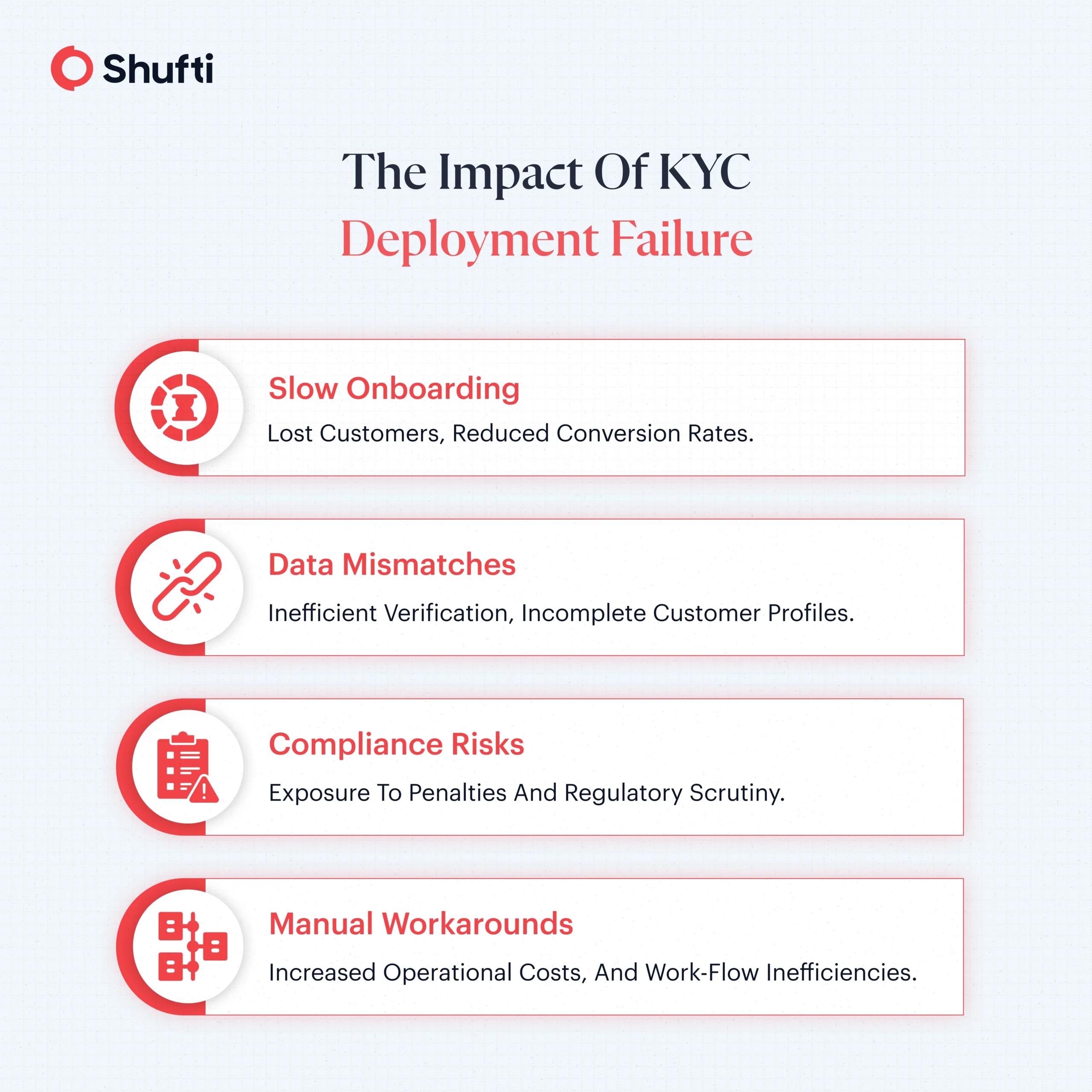
4. Misalignment Between KYC Software and Regulator Reality:
Adherence to regulatory compliance is one of the core offerings of any KYC software solution. Such tools may demonstrate this ability well in controlled environments where rules can be pre-configured. In the real-world, where customers are spread over multiple jurisdictions, each with its own set of regulatory landscapes, legacy KYC systems fail to incorporate ongoing changes that expand across multiple jurisdictions.
The rules on which the demo was based on day 1 can be replaced entirely by a new policy on day 100, and that may occur in different jurisdictions simultaneously.
KYC tools that cannot perform on a daily basis, adapt to regulatory updates, and apply new rules to existing customers will inevitably fail at deployment after the system goes live.
Deployment failures due to verification gaps are not immediately apparent. These discrepancies show up during audits, inspections, or remediation reviews, when compliance agents are forced to explain inconsistent decisions, incomplete records, or outdated checks.
When such is the case, compliance teams have to reactively remediate, address backlogs, and mitigate any regulatory exposure – all of which are classic signs of a KYC deployment that did not hold up outside of demos.
5. Poor User Adoption: A Human Element That Can’t Be Ignored
No matter how well-designed KYC software is, it can’t succeed without proper user adoption. Even the most advanced solution can fail if employees don’t use it correctly or don’t fully understand its features. In reality, compliance agents face incomplete data, time pressure, regulatory scrutiny, and numerous other factors, with the KYC system bearing the brunt of them.
When a KYC solution fails to take these realities into consideration, compliance agents start maintaining a parallel human process outside the platform. The KYC platform remains deployed, but it is no longer the system of record.
KYC is judgment-driven and regulator-facing. Compliance teams must be able to understand, trust, and explain every decision the system makes. If a deployed KYC tool cannot support clear decision-making and adapt to real investigation workflows, the deployment fails.
Poor user adoption results in:
- Increased manual interventions defeat the purpose of automation.
- Decreased operational efficiency.
- Higher risk of human error leading to compliance failures.
How to Select the Right KYC Software:
The key to identifying the right KYC solution requires clarity on what a KYC system must deliver based on the FI’s risk exposure, customer base, jurisdictions, and operating model. KYC deployments largely fail for two main reasons: first, KYC software that struggles to handle real-world integration, scale, and the operational realities outlined in this blog. Second, FIs choose generic KYC software that is not suited to their specific business requirements.
A strong KYC deployment is achieved when FIs select a robust KYC solution that provides services tailored to the FI’s risk profile and exposure.
How Shufti’s KYC Solution Addresses these Post Deployment Challenges:
FIs and digital businesses struggle with KYC software because real-world KYC deployments are more complex than brochures suggest. Once a solution is live, rigid configurations, operational blind spots, lack of scalability, and faulty integrations all explain why KYC deployments fail.
Shufti’s KYC solution is built for production conditions where high volumes, diverse documents, and multi-market obligations collide. The platform supports customizable verification journeys, real-time identity verification, and global risk screening, so compliance teams can apply the right level of checks per risk segment and jurisdiction
Request a demo to evaluate Shufti against real-world challenges, not theoretical promises.