 Runs On Your Cloud
 No Data Sharing
 No Contract Required
 Explore Now







 Face Verification
 Address Verification
 Document Verification
 Age Verification
 VideoIdent
 Fast ID
 eIDV
eIDV
 NFC Verification
 Consent Verification
 Business Verification
 Due Diligence
 Investor Verification
 E-Signature
 Behavioural Biometrics
 Device Fingerprinting
 MFA
MFA
 AML Screening
 Business AML Screening
 User Risk Assessment
 Transaction Screening
 Adverse Media Screening
 Identity Verification
 KYC
KYC
 KYB
KYB
 KYI
KYI
 Bonus Abuse
 Fraud Prevention
 Deepfakes
 Banking
 Crypto
 Fintech
 Forex
Forex
 Gaming
 Gig Economy
 Marketplace
 Social Networks
 Product Managers
 Compliance Officers
 Fraud Analyst
 Global Trust Platform
 Journey Builder
 Vendor Comparison
 Content library
 Blogs
Blogs
 News
News
 Reports
 Insights
 Knowledgebase
 ROI calculator
 Blind Spot Audit
 Deepfake Detection
 Liveness Detection
 Document Originality
 Document Deepfake
 Events & Webinar
 Podcast Studio
 Spotlight Studio
 API Documentation
 Mobile SDKs
 Service Status
 Help Center
 Contact Us
 Technical Support
 Compliance
 Supported Document
 About
About
 Career
 Press Release
 Certifications
 Partnership
 Awards
Why Address Verification Fails in Brazil and How Shufti Fixes It
- 01 Why Is Address Verification Difficult in Brazil?
- 02 Why Traditional OCR-Based Address Verification Breaks in Brazil?
- 03 CPF Dependency as an Address Validation Control Point
- 04 How Shufti Handles Brazil Address Verification Complexity and CPF Accuracy?
- 05 Results Observed in Shufti’s Brazil Deployments
- 06 What Businesses Should Consider in Brazil Address Verification Vendors
- 07 Business Outcomes for Companies Operating in Brazil
- 08 Enabling Scalable, Country-Aware Address Verification with Shufti
Brazil is experiencing rapid digital growth while also encountering strict regulations for compliance. This creates one of the most challenging environments for address verification worldwide.
Financial services and platforms providing services for payments, gaming, and crypto depend on proof of address alongside identity data to meet onboarding, AML, and fraud obligations, yet Brazil’s infrastructure imposes constraints rarely seen elsewhere in Latin America.
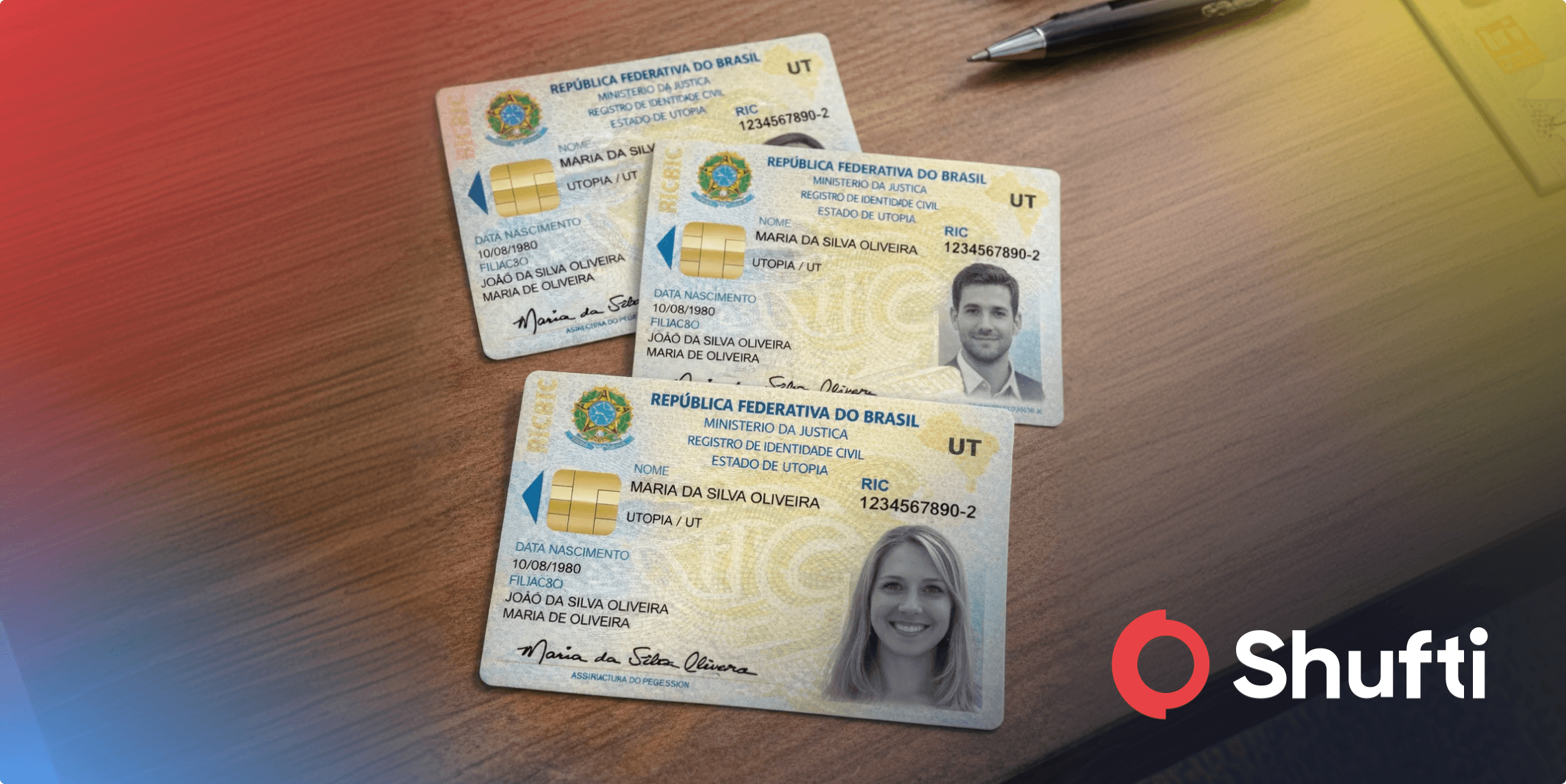
To make this issue even more complicated is the CPF (Cadastro de Pessoas Físicas), which is a base identifier that forms the basis of database checks, enrichment processes, and address validation decisions. The issuance of fragmented identity documents and the continued use of paper-based records make Brazil a condition that is unfavorable to standard address verification systems that depend on reliable extraction and matching.
To ensure regulated onboarding, KYC and Address Verification in Brazil must have a more accepting document diversity tolerance, strong OCR resilience, and greater CPF validation controls.
Shufti is more proactive in Brazil, moving past simple OCR performance to nation-specific verification technology that strengthens address extraction, validation, and audit confidence at scale.
It is possible to navigate through these challenges by first unpacking the structural complexities and the history that formed the unique ecosystem of Brazil.
Why Is Address Verification Difficult in Brazil?
The challenges Brazil faces with address verification are structural rather than technological. They come from how documents are issued and maintained, as well as accepted over time.
State-Level Identity Issuance and Long-Tail Legacy Documents
Brazil’s federal structure places document issuance largely in the hands of individual states. It creates fragmentation that resists standardisation. Different document layouts are still valid and used by people from various generations. They offer a range of print quality and formatting options.
For instant address verification, this fragmentation matters because identity documents are often cross-checked against proof-of-address records. When identity traits and identifiers differ significantly, it becomes much harder to reliably connect a person to an address.
Paper-Based Documents and Print Degradation
Paper-based documents remain common in Brazilian onboarding flows, including proof of address. Over time, the physical documents can affect ink quality, increase surface noise, and reduce legibility. Smudging, fading, creases, and stains frequently obscure address lines and CEP digits.
These issues not only affect visual clarity. However, address blocks can lose structural integrity, lines can merge, and incomplete characters can occur. When OCR cannot accurately capture names, CPF, or address data, location verification decisions lose reliability.
In regulated businesses, such issues result in more false positives, more time spent manually reviewing them, and slower onboarding. This instantly reduces the efficiency of compliance and its ability to attract new customers.
Multiple Proof of Address Sources Across Sectors
Unlike markets that rely on a limited set of address documents, in Brazil spans bank statements, telecom invoices, utility bills, insurance letters, and other official correspondence. These documents appear as scanned PDFs, photographed prints, screenshots, or digitally issued files.
Each format affects how addresses are laid out, where they are placed, and how they are labeled. Address blocks may be multi-line, unlabeled, or embedded within dense text. OCR systems that focus mainly on identity cards often have difficulty extracting and organizing address data consistently from these sources.
CEP and Address Formatting Inconsistency
Brazil’s CEP is a key anchor for address verification, yet its presentation deviates widely. CEP may appear prominently, embedded in a line of text, or partly concealed by stamps and overlays. Address fields such as bairro, city, and state appear in various orders and formats depending on issuer conventions.
Without normalization, even valid addresses can appear as mismatches. This increases review workload, slows onboarding, and inflates operational costs.
Why Traditional OCR-Based Address Verification Breaks in Brazil?
Most verification platforms are engineered for predictable document structures. They assume consistent layouts, labeled domains, and clear address blocks. Proof-of-address documents in Brazil rarely fulfil these premises.
High text recognition accuracy alone does not guarantee address verification success. Failures transpire when systems cannot identify the full address block, separate multi-line fields, interpret CEP placement, or account for issuer-specific formatting.
These patterns are invariably observed throughout the regulated onboarding programs that are informed by Shufti’s production deployments in Brazil.
Multi-Line Address Blocks and Unclear Boundaries
Information about addresses is often divided into several lines. The number of buildings constructed, the unit number, the address, the neighborhood, the street, the city, the state, and the postal code may be displayed as individual information. OCR systems have a tendency to confuse or omit lines, especially when the boundaries of borders are not clearly defined. This results in unfinished addresses that fail to meet the corresponding requirements.
Missing or Inconsistent Address Labels
Field labelling is inconsistent in many proof-of-address documents. Others have headings like “Endereco”, and others do not have any label. This is when customer names and addresses are displayed in one block. It is not easy to define fields correctly using label-dependent extraction systems.
Stamps, Watermarks, and Overlays
Addresses are often overlapped by official stamps as well as issuer graphics. Traditional OCR often treats these overlays as noise, increasing the risk of missing CEP digits or unit numbers. Automated Address verification does not work when important elements cannot be disaggregated with certainty.
Document Date and Recency Extraction
The recent address proof is demanded by many compliance programs. If document dates cannot be reliably extracted, recency checks become manual, increasing friction and review workload.
CPF Dependency as an Address Validation Control Point
CPF is one of the vital control points when it comes to address verification in Brazil. In addition to the identity verification, CPF accuracy can define the possibility of address enrichment and validation questions.
Practically, residential address verification is frequently reliant on the extraction of the CPF from an identity document or a bill and the subsequent utilization of this data to confirm address information by means of designated databases. When CPF extraction fails, address verification often fails as well. The errors caused by OCR are compounded into failed queries, false matches, and manual reviews.
CPF accuracy is not an independent feature of address verification in regulated businesses in Brazil. It promotes the reliability, defensibility, and effectiveness of address-based decisions.
How Shufti Handles Brazil Address Verification Complexity and CPF Accuracy?
Brazil needs verification processes that tolerate variability instead of strict templates. To address the complicated document situation in Brazil, Shufti can supply document intelligence that is country-specific.
Document Intelligence Built for Fragmentation
Shufti considers Brazilian documents as dynamic formats rather than templates. The system learns layout patterns across issuers and generations. This supports a consistent interpretation of address blocks and identifiers despite structural variability.
Noise-Resilient OCR for Paper-Based Proof of Address
Preprocessing reduces the impact of physical degradation and captures artefacts. Intelligent segmentation separates merged lines, improving the extraction of multi-line address blocks and CEP data from low-quality documents.
Context-Aware Address Field Classification
Field identification depends on how different objects relate to each other and the signals in their surroundings, not just on labels. This allows a more reliable split of issuer metadata, customer names, and address lines. It preserves the full address block required for verification.
Stamp-Aware Extraction Logic
Stamp detection identifies overlays without discarding fundamental content. This improves the extraction of CEP digits and street numbers when stamps cross address regions.
CPF Checksum Validation Before Address Enrichment
Shufti applies CPF check-digit validation before downstream address checks. This helps in reducing OCR-induced errors and fabricated identifiers, which eventually improve enrichment success rates and stabilize address validation workflows.
Results Observed in Shufti’s Brazil Deployments
Shufti treated CPF accuracy as a system-wide control point while strengthening proof-of-address extraction and verification.
Achieving 98.85% CPF Extraction Accuracy
Brazil-specific training and logic for validations have improved CPF extraction accuracy compared with previous providers. Higher CPF confidence supported more reliable address validation as well as reduced avoidable exceptions.
Fewer Failed Address Validation Calls and Lower Review Workload
Checksum validation reduced failed enrichment calls caused by OCR errors. As address verification often depends on CPF-anchored queries, fewer identifier failures translate into lower manual review volumes.
Higher Address Approval Confidence with Fewer False Mismatches
Better address extraction has reduced errors caused by incomplete address information, missing postal codes, or misread unit details. This improvement helps increase confidence in approvals while still maintaining compliance controls.
What Businesses Should Consider in Brazil Address Verification Vendors
- Support for proof-of-address document types used in Brazil
- Precision in extracting multi-line address blocks
- CEP normalization and formatting handling
- Stamp and overlay handling for address regions
- Document date extraction for recency checks
- CPF checksum validation before address enrichment
- Clear exception explanations for audit readiness
Business Outcomes for Companies Operating in Brazil
When high accuracy address verification becomes reliable, onboarding operations improve without weakening compliance posture. Approval confidence increases as fewer records fail due to address extraction gaps. Review workload declines as exceptions decrease. Onboarding timelines improve even in an environment where legacy paper documents remain common.
Most importantly, make decisions that better meet regulatory expectations. This helps ensure readiness for audits in a location known for strict enforcement.
Enabling Scalable, Country-Aware Address Verification with Shufti
Brazil demonstrates why address verification cannot rely on standardised templates. Proof-of-address diversity, CEP inconsistency, and CPF dependency demand country-aware intelligence engineered for real operating conditions.
Shufti strengthens address verification in Brazil by incorporating robust proof-of-address extraction with strong CPF accuracy as a foundational control point. When uncertainty leads to extra manual work and slow approvals, having accurate information becomes essential for business.
See how Shufti enables compliant growth in high-complexity markets. Request a free demo to understand how a country-aware immediate address validation service delivers measurable operational outcomes.