AMLR Solutions
  AMLR Consultation
 EUDI Wallet
 Onboarding
 Ongoing Monitoring
 FRAML
FRAML KYC
KYC KYB
KYB KYI
KYI Age Assurance
 Workforce IAM
 Candidate Verification
 Account Takeover
 Bonus/ Promotion Abuse
 Chargeback Fraud
 Deepfake
 Document Fraud
 Fraud Networks
 Impersonation Fraud
 Money Mule Activity
 Multi-Accounting
 Party Fraud
 Regulatory & Compliance Risks
 Synthetic Identity Fraud
 Adult Content
 Banking
 Crypto
 Fintech
 Forex
Forex Compliance
 Fraud prevention
 Trust & safety
 Global expansion
 Compliance Officers
 Developers
 Fraud Analysts
 Product Managers
 Journey Builder
  Global Trust Platform
 Customer Profiles
 Vendor Comparison
 IDV Case Management
 AML Case Management
 Regulatory Reporting
 Agentic Rule Builder
  AI Compliance Co-Pilot
  Fraud Analytics
 Fraud Hub
  OCR
OCR Shufti AI
 Bank Account Verification
  Biometric Duplication
 Database Checks
 Document Intelligence
 Government ID
 Mobile Driver's License
 NFC
NFC Selfie Liveness
 Brand Personalisation
 Deployment Options
 Identity Methods
 IDV Modes
 Multi-tenancy
 On-Premise IDV
 Secure Capture
 Shufti MCP















Proof of address is one of the most common requirements in customer onboarding, and one of the hardest to get right at scale. A bank or fintech can capture a customer’s identity document in seconds, then still struggle to confirm where that person actually lives. Customers submit utility bills, bank statements, and tenancy agreements in different formats, languages, and standards, and the rules for what qualifies change from one country to the next.
What you’ll learn:
|
What is proof of address?
A proof of address is an official document that confirms where a person lives, showing their full legal name and current residential address. Banks, fintechs, and other regulated firms collect it during KYC onboarding to meet anti-money laundering rules. Common examples include utility bills, bank statements, and government-issued letters.
The set of documents that qualify varies by country, so it matters which documents a given regulator and institution will accept. This sits at the centre of know your customer (KYC) and anti-money laundering compliance, where regulated organisations must ask customers to submit proof of address during onboarding and confirm it against a trusted source before an account is opened.
A useful distinction: proof of address confirms where someone lives now, while proof of identity confirms who they are. In many countries, one document cannot satisfy both, which is why firms often collect two separate pieces of evidence.
What is proof of residence?
Proof of residence, also called proof of address or proof of residency, is an official document that confirms where a person lives. In KYC and AML checks, financial institutions use it to verify a customer’s stated address. According to Shufti, accepted documents typically include utility bills, bank statements, and government-issued letters dated within the last three months.
What counts as a valid proof of address?
A document is usually accepted as proof of address when it meets five conditions. Most rejections happen because one of these is missing.
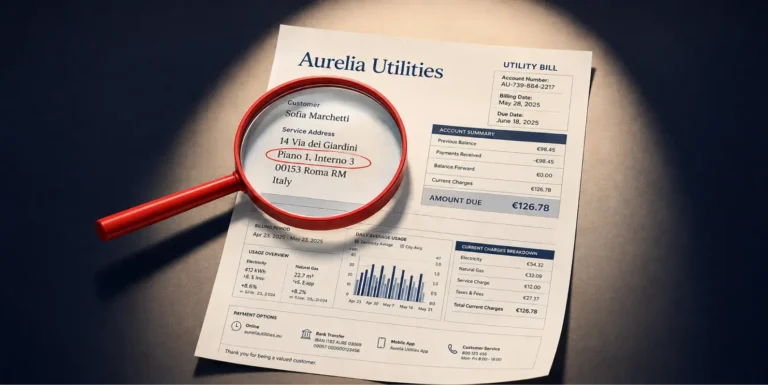
- It shows your full legal name, matching the name on your identity document.
- It displays your current residential address in full, including any unit or flat number.
- It comes from a recognised issuer, such as a bank, utility company, government agency, or insurer, with the issuer’s name visible.
- It carries a clear issue date. Most institutions require a document issued within the last three months, though some accept up to six or twelve months depending on the document type and country.
- It is an original or a clean downloaded copy, not a screenshot with missing detail or, where originals are required, a plain photocopy.

Proof of Residency Documents and Examples
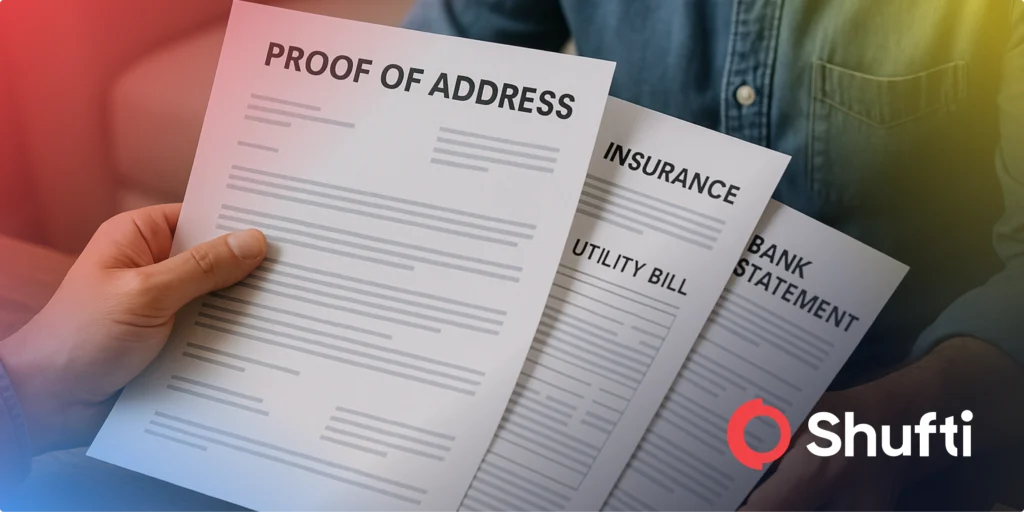
Examples of proof of residency include a utility bill, a bank or credit card statement, a council tax or municipal bill, a government-issued letter, a tenancy or lease agreement, and a mortgage statement. Each document must show the person’s full name and residential address and, in most cases, be dated within the last three months.
|
Document |
Usually accepted | Recency requirement |
| Utility bill (electricity, water, gas) | Yes |
Within 3 months |
|
Bank or credit card statement |
Yes | Within 3 months |
| Council tax or municipal bill | Yes |
Within 12 months |
|
Government-issued letter (tax, benefits) |
Yes | Within 3 months |
| Tenancy or lease agreement | Yes |
Current term |
|
Mortgage statement |
Yes | Within 12 months |
|
Mobile phone bill |
Sometimes |
Within 3 months |
| Handwritten note or printed envelope |
No |
Not accepted |
|
PO box address only |
No |
Not accepted |
Requirements vary by regulator and industry. Shufti lets institutions configure which document types and date ranges they accept, then validates each submission against those rules automatically.
What is not accepted as proof of address
A document is rejected as proof of address when it falls into one of these categories:
- Outdated – issued outside the institution’s freshness window, commonly three to six months.
- Handwritten notes or letters – not from a recognised issuer and unverifiable.
- Screenshots – cannot confirm authenticity or completeness.
- Purchase invoices and receipts – confirm a transaction, not a residence.
- Parcel delivery labels – generated by the sender, not an official issuer.
- Mobile phone bills – billing address is easy to change and not tied to a physical premises.
- Identity documents used alone – a passport or national ID proves identity, not address.
- Incomplete documents – missing full name, address, issue date, or issuer name.
Proof of address vs proof of residency
In day-to-day KYC, proof of address and proof of residence are often used interchangeably, but there is a distinction worth knowing. Proof of address confirms one fact: where you live now. Proof of residency establishes a legal or established connection to a place, which can include how long you have lived there and whether you own or rent. Residency proof is used for tax, immigration, school enrolment, and in-region benefits.
| Aspect | Proof of address | Proof of residency |
|
What it confirms |
Your current residential address | Your legal or established connection to a place |
| Typical purpose | Account opening, KYC, deliveries |
Tax status, immigration, school enrolment, benefits |
|
Detail required |
Name and current address | Name, address, often duration and relationship |
| Common documents | Utility bill, bank statement, council letter |
Tenancy agreement, property deed, tax return, residency letter |
|
Time sensitivity |
Recent, often within three months |
May cover a longer period or a specific date range |
Many documents serve both purposes, depending on the context in which they are requested.
Proof of residence vs proof of address vs proof of residency
The three terms describe the same document: an official record that confirms a person’s residential address. The difference is regional wording and the situation the document is requested for, not the underlying purpose.
|
Term |
Where it is used | Most common context | Typical documents |
| Proof of address | United Kingdom, and the standard term across global banking and KYC | Opening a bank account, onboarding to a financial service, AML compliance |
Utility bill, bank statement, council tax bill |
|
Proof of residence |
South Africa and Commonwealth countries | FICA verification, opening accounts, government services | Utility bill, municipal statement, bank statement, affidavit |
| Proof of residency | United States | Driver’s licence and state ID, REAL ID, voter registration, in-state tuition |
Utility bill, lease agreement, mortgage statement, government letter |
For identity verification and compliance, the label matters less than the document meeting three tests: it must be issued by a trusted source, show the person’s full name and residential address, and be recent, usually within the last three months.
How recent must a proof of address be?
A proof of address document is usually valid only if it was issued within the last three to six months. The exact window depends on the jurisdiction, the document type, and the institution’s anti-money laundering policy. Documents outside this period are commonly rejected because they may no longer reflect the person’s current residence. If your document falls outside the window, request a fresh copy from the issuer before you submit.
Where is proof of address required?
Proof of address is requested wherever a business needs to tie a customer to a real location, either for regulation or for fraud control. Common cases include:
- Banking and fintech: opening accounts and meeting customer due diligence rules.
- Crypto exchanges: onboarding under tightening AML obligations for virtual asset providers.
- Online gaming and gambling: confirming residence for licensing and responsible-gambling rules.
- Forex and trading platforms: verifying clients before they can fund and trade.
- Lending and credit: confirming residence as part of affordability and identity checks.
- Marketplaces and the gig economy: verifying sellers, drivers, and high-value users.
Shufti supports address verification across these sectors. See the relevant industry pages for banking, crypto, fintech, gaming, and forex for sector-specific detail.
How to get proof of address, including without bills
To obtain proof of address, request a recent document that lists your full name and home address, such as a utility bill, bank statement, tenancy agreement, or government letter, and check the institution’s accepted list and freshness window first. If no paper document is available, some institutions verify an address electronically against government, telecom, or credit bureau records instead.
If you do not have a utility bill in your name, which is common for renters, recent movers, and students, you still have options:
- Ask your bank for a stamped statement or an official confirmation-of-address letter.
- Request a council, tax, or benefits letter from a government body.
- Use a tenancy agreement, or a signed letter from your landlord confirming where you live.
- Register on the electoral roll to create an official record at your address.
- Provide a notarised declaration of residence, where the institution accepts one.
- If you are a student, ask your university for a letter or a hall-of-residence confirmation.
Can proof of address be digital?
Yes. Digital proof of address replaces the manual review of a posted document with a remote, data-driven check that complies with data protection rules such as GDPR. The customer uploads or shares a document and supporting signals, and the address is validated electronically.
How digital proof of address works
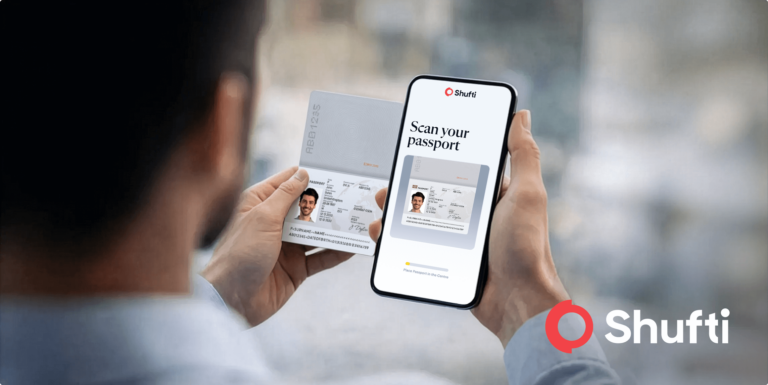
- The document is captured and read with optical character recognition (OCR), which parses the address into components such as street, city, and postcode, across multiple languages and scripts.
- The document is checked for authenticity, quality, and freshness.
- The declared address is cross-checked against device metadata, IP, or GPS signals.
- The address is matched against trusted data sources, such as government records, telco data, credit bureaus, and postal databases.
- The address is checked for deliverability and physical existence, and screened against fraud-hotspot and reused-address lists.
Why digital verification is often more secure
A traditional check relies on one or two static documents, and many physical address documents were never designed to deter fraud. A digital check uses several independent signals at once, which makes it harder to defeat with an edited or fabricated document. For businesses, it also reduces onboarding drop-off and manual review time, and it produces a clear evidence trail for audit and compliance.
How proof of address fraud works, and how businesses detect it
Proof of address is a frequent target for fraud, because a single forged or reused document can support a fake identity. The scale of the problem is part of why these checks exist: the United Nations Office on Drugs and Crime estimates that 2 to 5 per cent of global GDP, between roughly 800 billion and 2 trillion US dollars, is laundered each year.Juniper Research estimates that online payment fraud losses will exceed $343 billion cumulatively between 2023 and 2027, increasing the importance of robust KYC and address verification processes. Identity theft compounds this further. The US Federal Trade Commission received more than 1.1 million identity theft reports in 2024, with consumers reporting over $12.5 billion in total fraud losses, a 25% increase over the prior year, underscoring why address verification remains a frontline defence against fraudulent onboarding.
Common ways fraudsters fake proof of address
- Editing the name or address fields on a genuine bill or statement.
- Buying template or novelty utility bills built to look authentic.
- Submitting a real document tied to a different person, or to an address that does not physically exist.
- Using mail-forwarding services or PO boxes to hide a true location.
- Reusing one household document across several fake identities, a pattern seen in synthetic identity fraud.
- Altering the issue date to make an old document appear recent.
How verification systems detect these attempts
- Document metadata and edit-history analysis, which flags the editing software used and signs of tampering.
- Template matching against known issuer formats to expose fakes.
- Font, spacing, and field-alignment checks that catch manual edits, alongside checks on logos and seals.
- Geolocation cross-checks that compare the declared address with the device’s IP or GPS location.
- Address-existence and deliverability checks against postal and geocoding databases.
- Reuse and velocity checks that catch the same address appearing across many applications.
The most important principle is that a proof of address check should not run in isolation. The strongest defence comes from cross-referencing the extracted name and address against the customer’s identity record and stated address, so a document that looks clean on its own is still caught when it does not match the rest of the application.
See how Shufti detects manipulated and reused address documents in real time. Book a demo.
Proof of address requirements by region
How an address is proven varies widely from one country to another. In many places one identity document does not satisfy both the proof of identity and the proof of address rules, so institutions collect more than one document. For country-level detail, see our guides to proof of address in the UK and address verification in Mexico.
| Region | How address is proven | Notable points |
|
European Union |
National ID (address-bearing in some states) or a separate document |
Varies by state; the EU is moving to digital identity wallets under the updated eIDAS framework |
| United Kingdom | Separate proof of identity and proof of address |
One document cannot serve both; rules under the Money Laundering Regulations 2017 |
|
United States |
Customer Identification Program; flexible federal and state documents | Required by the USA PATRIOT Act; a Social Security card alone is insufficient |
| South Africa | Proof of residential address under the Financial Intelligence Centre Act (FICA) |
Usually expected within three months; many document types accepted |
|
Singapore and wider APAC |
National ID often carries the address; digital options available |
Singpass enables verified data sharing, reducing document uploads |
As more countries move to digital identity and use less paper, firms that operate across borders need rules flexible enough to handle both document-based and electronic verification. (Confirm the eIDAS and FICA references before publishing.)
Proof of address in KYC and AML compliance
For regulated businesses, proof of address is part of customer due diligence under anti-money laundering law. The international baseline is FATF Recommendation 10, which requires firms to identify and verify customers using reliable and independent sources. This is implemented through named frameworks in each region:
- United States: the Customer Identification Program, required under the USA PATRIOT Act and overseen with FinCEN guidance.
- European Union: the Anti-Money Laundering Directives, with the 2024 EU AML package establishing the Anti-Money Laundering Authority (AMLA).
- United Kingdom: the Money Laundering Regulations 2017 and JMLSG guidance, overseen by the Financial Conduct Authority.
Verifying addresses does several jobs for a compliance team. It helps confirm that a customer is a real person rather than a fabricated identity. It supports sanctions and politically exposed person (PEP) screening by tying a customer to a location. And it creates an audit trail that a regulator can inspect. Weak address checks are a common entry point for synthetic identities, which is why supervisors expect address verification to be accurate, recorded, and run against the wider identity profile rather than on its own.
Mapping address checks to your CDD obligations? Talk to the Shufti team.
Best practices for verifying proof of address
For businesses, a consistent and well-evidenced process matters more than any single document type. A defensible verification sequence looks like this:
- Confirm document authenticity with automated document analysis, not visual review alone.
- Check that the document falls within your jurisdiction’s freshness window.
- Match the full legal name and address to the customer’s verified identity record, rather than treating the address check as a standalone step.
- Confirm the issuer is a legitimate, independent source such as a bank, telecom provider, or government agency.
- Capture the complete address, including any unit or flat number, and confirm it is deliverable, not only present.
- Verify that the address physically exists, and where the risk warrants it, that the customer is there, using IP or GPS signals.
- Handle documents in non-Latin scripts and multiple languages rather than rejecting them outright.
- Keep a clear record of the check for audit and regulatory review.
Proof of address vs identity and age checks
A proof of address check is one of several onboarding checks, each confirming a different fact. They are often combined.
| Check | What it confirms | Typical evidence |
|
Proof of address |
Where the customer currently lives |
Utility bill, bank statement, government letter |
|
Identity verification |
Who the customer is |
Passport, national ID, or driving licence, with a biometric check |
|
Age verification |
How old the customer is |
An ID document or age-estimation methods |
How Shufti verifies proof of address
Many businesses still face delays, fraud, and compliance gaps caused by incomplete or unreliable address documents. Shufti verifies an address using three methods that work on their own or together, depending on the market and the level of risk.
| Method | How it works | Best suited to |
| Document-based | Validates a submitted document across 240+ countries, checking authenticity, quality, freshness, and address structure with OCR. |
Markets where document submission is the norm. |
|
Non-document |
Confirms the address against trusted sources such as government databases, telecom providers, and credit bureaus. | Reducing onboarding friction and churn. |
| Geo-based | Compares IP and GPS signals against the declared address and flags large discrepancies. |
Detecting location mismatches and fraud signals. |
Address verification also forms part of business verification (KYB) when onboarding companies rather than individuals. To see how an address verification solution fits your onboarding flow, request a demo.
Conclusion
Unreliable or incomplete proof of address documents still cause onboarding delays, fraud exposure, and compliance gaps. A verification approach that stays consistent across regions, and adapts to local document standards, removes most of that friction. Shufti verifies a customer’s address in a single check using three methods: document-based verification across 240+ countries and jurisdictions, non-document verification against trusted data sources, and geo-based verification using IP and GPS signals. Each method can run on its own or together, depending on the market and the level of risk. To see how address verification fits your onboarding flow, request a demo.
Frequently Asked Questions
What counts as a valid proof of address?
A valid proof of address is an official, recent document that shows a person's full legal name and current residential address. It must come from a recognised source such as a utility provider, bank, or government body, and is usually accepted only if it is dated within the last three to six months. Common examples include utility bills, bank statements, and tenancy agreements.
What documents can be used as proof of address?
The most widely accepted proof of address documents are utility bills, bank or building society statements, government and council letters, tenancy agreements, mortgage statements, insurance documents, and tax documents. Acceptance depends on the institution and the country, so some regulated firms ask for two separate documents or a document issued within a fixed time window.
Can a bank statement be used as proof of address?
Yes. A bank statement from a regulated bank or building society that shows your full name and current address is widely accepted. Both posted and downloaded PDF statements are usually allowed, though some institutions reject statements from app-only or neobanks, and a statement used for address generally cannot also serve as your proof of identity.
Is a mobile phone bill accepted as proof of address?
Often not. A landline telephone bill usually counts as a utility bill, but many banks and government bodies reject a mobile phone bill, because the billing address is easy to change and is not tied to a physical premises. Electricity, gas, and water bills are safer choices.
What can be used as proof of address without utility bills?
When utility bills are unavailable, accepted alternatives often include a bank statement, a tenancy agreement, a government or council letter, a mortgage statement, an insurance document, or an official benefits letter. Registering on the electoral roll also creates an official record, and some firms use non-document verification that confirms an address against government, telecom, or credit bureau data.
How recent does a proof of address document need to be?
Most banks and regulated firms require a proof of address document issued within the last three to six months. Older documents are usually rejected because they may no longer reflect where the person currently lives. The exact validity window depends on the jurisdiction, the document type, and the institution's anti-money laundering policy.
What is the difference between proof of address and proof of residency?
Proof of address confirms where you currently live. Proof of residency goes further and establishes a legal or established connection to a place, which can include how long you have lived there, whether you own or rent, and in some cases your residency status. Many documents serve both purposes depending on the context.
How do businesses verify a customer's proof of address?
Businesses verify proof of address during KYC onboarding by checking that a submitted document is authentic, recent, and matches the customer's declared address, then cross-referencing it against the wider identity record. Shufti supports this with three methods: document-based verification across 240+ countries, non-document verification against trusted data sources, and geo-based verification using IP and GPS signals.