
 Runs On Your Cloud
 No Data Sharing
 No Contract Required
 Explore Now








 Face Verification
 Address Verification
 Document Verification
 Age Verification
 VideoIdent
 Fast ID
 eIDV
eIDV
 NFC Verification
 Consent Verification
 Business Verification
 Due Diligence
 Investor Verification
 E-Signature
 Behavioural Biometrics
 Device Fingerprinting
 MFA
MFA
 AML Screening
 Business AML Screening
 User Risk Assessment
 Transaction Screening
 Adverse Media Screening

 Identity Verification
 KYC
KYC
 KYB
KYB
 KYI
KYI
 Bonus Abuse
 Fraud Prevention
 Banking
 Crypto
 Fintech
 Forex
Forex
 Gaming
 Gig Economy
 Marketplace
 Social Networks
 Product Managers
 Compliance Officers
 Fraud Analyst
 Global Trust Platform
 Journey Builder

 Content library
 Blogs
Blogs
 News
News
 Reports
 Insights
 Knowledgebase
 ROI calculator
 Blind Spot Audit
 Deepfake Detection
 Liveness Detection
 Document Originality
 Document Deepfake
 Events & Webinar
 Podcast Studio
 Spotlight Studio
 API Documentation
 Mobile SDKs
 Service Status
 Help Center
 Contact Us
 Technical Support
 Compliance
 Supported Document
 About
About
 Career
 Press Release
 Certifications
 Partnership
 Awards
How Risk Management in Banking Drives Security and Long-Term Growth?

- 01 What is Risk Management in Banking?
- 02 Why Risk Management in Banking is Essential for Modern Banks?
- 03 How the Banking Risk Management Process Works in Practice?
- 04 Core Types of Banking Risks and How Banks Reduce Exposure
- 05 How AI Is Transforming the Way Banks Manage Risk?
- 06 How Shufti Supports Risk Management in Banking?
Banks face overlapping pressures from credit losses, liquidity stress, cyber incidents, and regulatory scrutiny. When risk controls fail at the onboarding stage, fraud and compliance exposure often compound downstream.
From sudden market swings to advanced digital fraud, modern banks operate in an environment where a single misstep can trigger credit loss, fraud loss, liquidity stress, or an enforcement action. The PwC Global Banking Risk Study 2025 explains that traditional risk management approaches are no longer enough. As threats evolve and risks become more connected, weaknesses in existing controls are becoming more expensive for banks to manage.
This makes risk management not just a regulatory requirement, but a strategic imperative. Compliance teams can be better prepared if they understand how banks identify, assess, and mitigate risks, and how innovations like AI are defining a stronger financial standing.
What is Risk Management in Banking?
Risk management in banking denotes the continuous process of identifying, reviewing, and controlling risks, which may jeopardize the financial stability, daily activities, and regulatory position of a bank. In contrast to most industries, banks are exposed to various risk exposures simultaneously, such as credit losses, market volatility, liquidity stress, regulatory violations, and technology risks.
Over time, risk management has shifted from isolated controls to enterprise risk management in the banking sector, allowing banks to see and manage risk across the entire organization. Effective regulatory supervision by authorities like BIS, the US Federal Reserve, and fast digitalization have transformed risk management into an ongoing, comprehensive discipline, not a fixed compliance need.
Why Risk Management in Banking is Essential for Modern Banks?
Banks operate in a world where one slip can create a ripple effect across markets, interrupt business, and shake public trust. Increasing digital fraud, financial instability, and rising regulatory demands make these risks harder to handle than ever.
The effects are not limited to direct financial loss. In case of a liquidity crisis or a breakdown in the operations of banks, consumer confidence is lost rapidly, and this can prompt a wider market collapse. Investors and customers anticipate the institutions to be responsible, and any lapses may cause permanent reputational losses that no recovery plan can undo completely.
Proactive risk governance presents an alternative to reactive risk management, which aims at addressing and responding to incidents by preventing them before they occur. Risk management at all levels of decision-making helps banks to secure their assets, retain customer confidence, and stay within the boundaries of regulations. This proactive strategy will turn risk into a source of stability, resilience, and long-term growth.
How the Banking Risk Management Process Works in Practice?
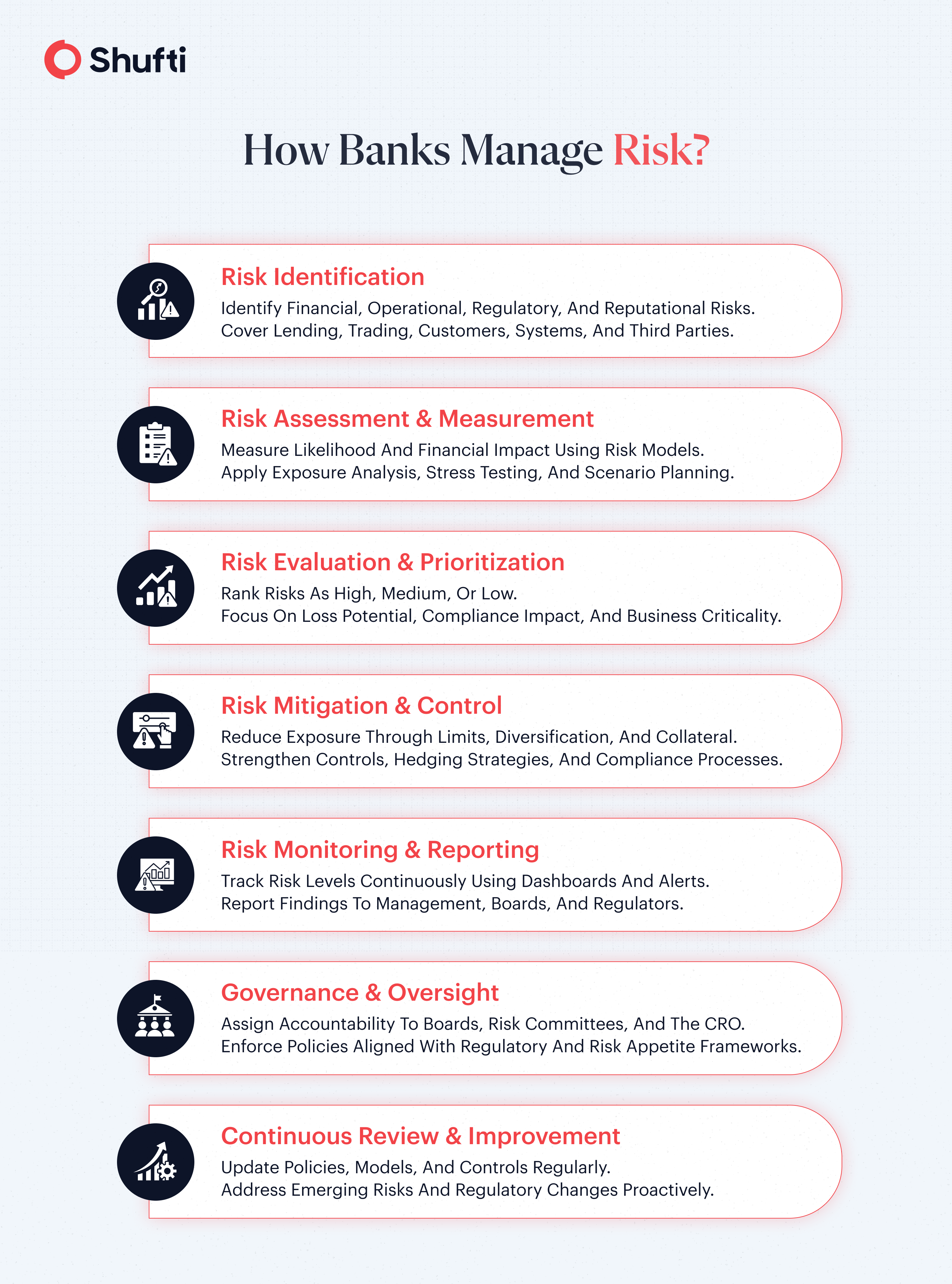
Banking risk management process is aimed at ensuring that institutions remain resilient in the face of financial, operational, and regulatory pressures. It starts with risk identification, wherein potential risks posed by credit defaults to cybersecurity threats are identified in all business units. Through comprehensive identification, not a single risk is left behind, even when it crosses traditional departments, and this is vital since isolated operations can conceal the emergence of threats until they become expensive.
Risk identification is followed by assessment and prioritization. Not every risk is equal, and banks consider the chance of its occurrence and the financial, operational, and reputation outcomes. This assists decision-makers in having resources concentrated on the most urgent threat instead of being too diffuse.
Risk mitigation and control implementation is the third stage in which the policies, processes, and technology solutions are designed to minimize exposure. For example, credit risk can be addressed with increased lending standards, whereas operational risk might be mitigated by enhancing the training of staff or adopting enhanced cybersecurity measures. The use of real-time data, automation, and dashboards to track controls and quickly identify anomalies is becoming standard practice in modern banks, transforming risk management from reactive to proactive.
Lastly, ongoing monitoring and reporting keep risk controls in force as market conditions, regulatory requirements, and technology change. Frequent reporting to senior management and boards enables well-informed decisions and rapid changes when threats evolve. Through a mix of structured processes and cross-functional cooperation, the banks are able to stay operational and react to new risks as part of daily business, and not as a checklist.
Core Types of Banking Risks and How Banks Reduce Exposure
Banks encounter an interdependent network of possible risks that can affect financial stability, operations, and trust. Understanding each risk and its mitigation is essential for resilient banking.
Credit Risk:
Credit risk is a situation that occurs when borrowers cannot repay loans or fulfil contractual obligations. Banks manage this by evaluating the creditworthiness, diversification of portfolios, and use of prudent lending limits to prevent possible losses.
Market Risk:
Market risk comes up when interest rates, foreign exchange, or assets fluctuate, and it impacts investments and trading portfolios. It is mitigated by multiple protocols, which involve diversification of the portfolio and hedging, as well as balancing between short-term and long-term positions.
Liquidity Risk:
Liquidity risk arises when a bank fails to convert assets into cash fast enough to meet obligations. Liquid reserves, regular stress tests, and contingent funding plans are used to ensure that the bank is able to cover withdrawals and short-term needs.
Operational and Cybersecurity Risk:
These threats are internal failures, human error, or cyberattacks. Banks deal with them by providing superior internal controls, ongoing employee training, advanced IT infrastructure, and real-time monitoring to identify anomalies before they get out of hand.
Financial Crime Risk:
Financial crime risk is a central pillar of modern banking risk management. It includes exposure to money laundering, terrorist financing, sanctions violations, identity fraud, and synthetic identities.
Many of these risks originate at customer onboarding, where weak identity verification, incomplete KYC procedures, or insufficient sanctions screening can allow high-risk individuals or entities to enter the financial system.
Banks mitigate financial crime risk through risk-based customer due diligence, sanctions and PEP screening, and ongoing customer risk assessments. Identity verification and continuous monitoring serve as the first and ongoing lines of defense against regulatory penalties and reputational damage.
Bank Compliance Risk:
Compliance risk arises when a bank fails to meet regulatory obligations, particularly in areas such as AML, sanctions compliance, data protection, and reporting requirements. Regulatory enforcement actions can lead to significant financial penalties and reputational harm.
To manage this risk, banks integrate automated compliance controls, regulatory reporting systems, and enterprise-wide monitoring frameworks that align regulatory requirements with day-to-day operations.
Reputational Risk:
Reputational risk tends to emerge as a by-product of any other risk, posing a threat to customer confidence and market belief. Credibility of the bank is safeguarded by proactive communication, ethical practices, and quick response plans.
How AI Is Transforming the Way Banks Manage Risk?
Artificial intelligence is revolutionizing the manner in which banks consider risk management, shifting the banks towards reactive to proactive decision-making. AI in banking risk management allows transactions to be tracked continuously, identifying abnormalities and patterns that might signal fraud or operational errors. The ability to analyze large volumes of data in real-time allows banks to identify threats at significantly quicker rates than the more manual systems of the past, which minimizes errors and delays.
Predictive risk modelling is also supported by AI, and it assists banks in anticipating potential losses, liquidity deficits, or credit defaults before they occur. AI-powered early-warning systems offer actionable insights, enabling risk teams to prioritize intervention and allocate resources efficiently. Industry research shows that many banks are increasingly using AI‑powered tools for risk and compliance tasks, from anomaly detection to predictive analytics, which helps teams manage complex risks more effectively.
How Shufti Supports Risk Management in Banking?
Shufti plays a pivotal role in helping banks manage risk by providing advanced identity verification that reduces exposure to financial fraud, operational errors, and compliance breaches. Shufti supports regulatory alignment with minimal human error and manual processing by automating KYC and AML checks. Its real-time verification services enable the banks to swiftly evaluate the risk of customers, anticipate suspicious behavior, and avert potential losses before they can increase.
On top of compliance, Shufti reinforces the whole risk management system to integrate with the current banking processes smoothly, deliver actionable information, and assist proactive decision-making. Banks are not only complying with regulatory requirements but also strengthening trust, protecting assets, and pursuing a more advanced risk management approach with Shufti.
Book a demo today to see how Shufti can transform your risk management process in banking in real time.