 Runs On Your Cloud
 No Data Sharing
 No Contract Required
 Explore Now







 Face Verification
 Address Verification
 Document Verification
 Age Verification
 VideoIdent
 Fast ID
 eIDV
eIDV
 NFC Verification
 Consent Verification
 Business Verification
 Due Diligence
 Investor Verification
 E-Signature
 Behavioural Biometrics
 Device Fingerprinting
 MFA
MFA
 AML Screening
 Business AML Screening
 User Risk Assessment
 Transaction Screening
 Adverse Media Screening
 Identity Verification
 KYC
KYC
 KYB
KYB
 KYI
KYI
 Bonus Abuse
 Fraud Prevention
 Deepfakes
 Banking
 Crypto
 Fintech
 Forex
Forex
 Gaming
 Gig Economy
 Marketplace
 Social Networks
 Product Managers
 Compliance Officers
 Fraud Analyst
 Global Trust Platform
 Journey Builder
 Vendor Comparison
 Content library
 Blogs
Blogs
 News
News
 Reports
 Insights
 Knowledgebase
 ROI calculator
 Blind Spot Audit
 Deepfake Detection
 Liveness Detection
 Document Originality
 Document Deepfake
 Events & Webinar
 Podcast Studio
 Spotlight Studio
 API Documentation
 Mobile SDKs
 Service Status
 Help Center
 Contact Us
 Technical Support
 Compliance
 Supported Document
 About
About
 Career
 Press Release
 Certifications
 Partnership
 Awards
How IDV Pass Rate and Accuracy Rate Affect Onboarding Drop-Off and Fraud Risk
Customer onboarding has become a direct growth driver, yet identity verification performance is often evaluated through isolated numbers rather than overall impact. The debate around the pass rate vs accuracy rate in identity verification often confuses product, risk, and compliance teams striving to maximize conversions without risking additional exposure to fraud.
High pass rate can be an indicator of smoother onboarding, but it does not tell whether fraudulent applications are being stopped with the right level of precision. IDV pass rates and IDV accuracy rates are among the most significant identity verification metrics, wherein the former measures the number of users who pass verification successfully, and the latter is measured through error rates that show how many genuine users are rejected and how many fraudulent or mismatched identities are approved.
Focusing on only one of these indicators can weaken fraud controls, increase customer drop-off, or create compliance challenges. It is necessary to have a balanced evaluation framework to achieve sustainable onboarding performance.
Pass Rate vs Accuracy Rate in Identity Verification: What Truly Defines IDV Performance?
Performance in identity verification cannot be judged by approval volume alone. A better insight into how verification systems decide will guide product and risk groups to understand results in the correct way. The real issue is not about selecting between pass rate and accuracy rate. It is understanding how each of these metrics impacts onboarding quality and fraud prevention controls.
What is Pass Rate in Identity Verification?
IDV pass rates reflect the percentage of users who successfully complete the verification process. In case there are one hundred users seeking verification, with eighty approved, the pass rate is eighty percent. This measure has a direct impact on the ease of the user moving through the onboarding process and the efficiency with which they open accounts.
What is the First-Pass Verification Rate?
Another related metric is the first-pass verification rate, which measures how many users successfully complete verification on first attempt without any retries or manual intervention. High-first-pass performance will minimize friction, decrease operational workload, and enhance user satisfaction. A reduced number of repeat attempts will result in fewer frustrations among actual customers and less support demand among internal teams.
What are IDV Match Rates?
First-pass verification also relies on comparison level metrics sometimes also referred to as IDV match rates, such as selfie-to-document match (1:1) or selfie-to-database match (1:N). NIST terms these metrics as False Match Rate (FMR) which is the percentage of comparisons that were not actually a match and False Non-Match Rate (FNMR) which is percentage of genuine matches falsely rejected. An important clarification is that these are one-to-one comparison metrics and do not by themselves tell about overall verification or onboarding outcomes.
When facial matching and document validation (comparing document details to official database) perform reliably, legitimate users are more likely to complete verification on the first attempt without unnecessary delays.
However, higher IDV pass rates do not automatically determine how secure or fraud-resistant a solution is. If thresholds are relaxed too much in order to maximize approvals, fraudulent identities may slip through. So, IDV thresholds must be carefully calibrated in order to enhance the pass rate efficiency of onboarding without undermining fraud controls.
What Do IDV Accuracy Rates Really Measure?
In identity verification, accuracy is better understood through decision quality metrics such as false acceptance, false rejection, false match, and false non-match rates, as opposed to merely relying on approval volume or numbers.
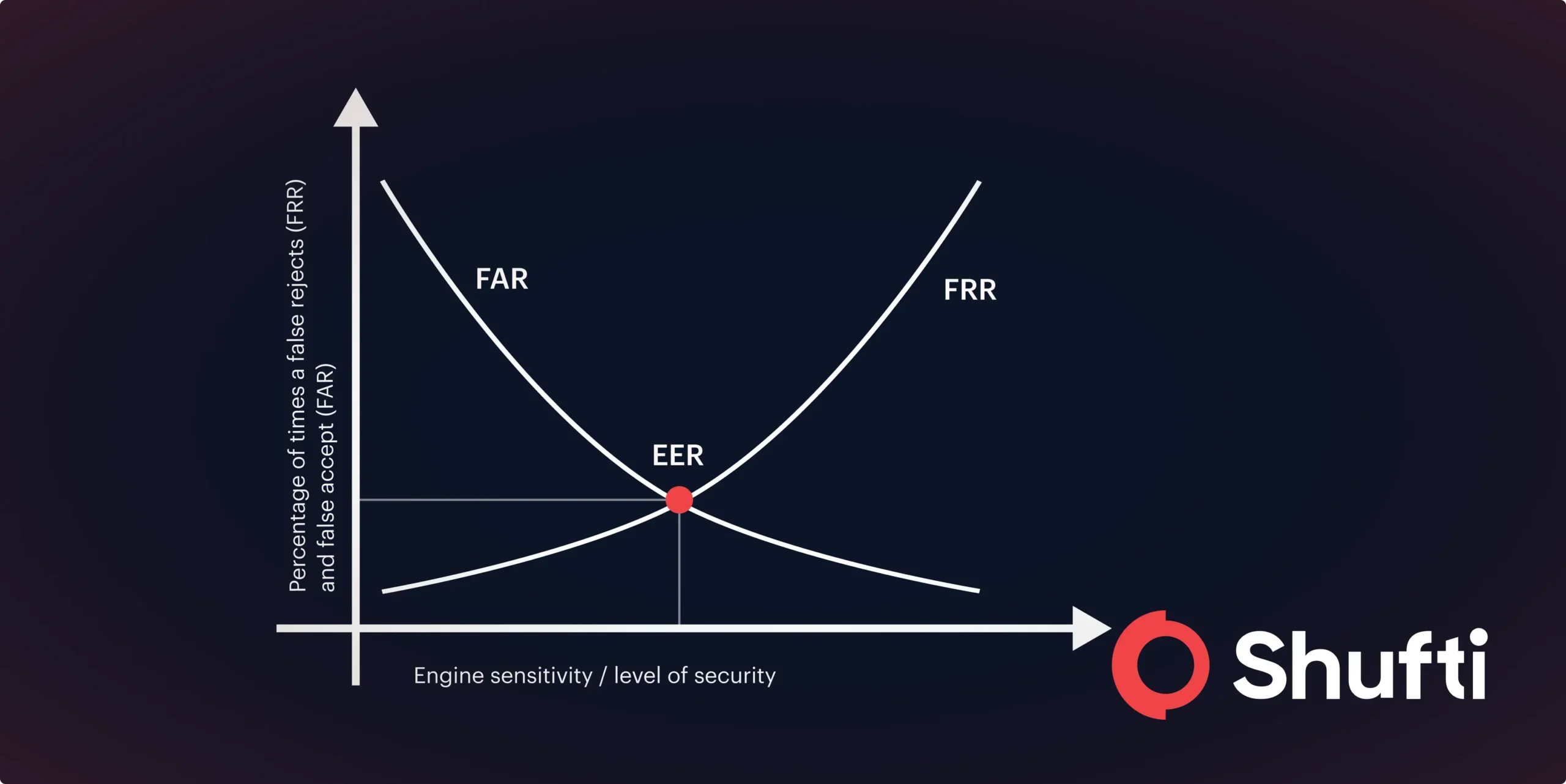
Instead of looking at the number of approved users, accuracy considers whether approvals and rejections are reasonable. This balance is characterized by two critical components, including the false acceptance rate (FAR) and the false rejection rate (FRR).
The false acceptance rate is used to determine the percentage of fraud or unauthenticated identities that are approved. High FAR enhances financial loss, regulatory risk, and reputational risk. False rejection rate is the rate at which legitimate users are incorrectly rejected by verification. High FRR causes friction, harms trust, and promotes abandonment.
Biometric systems are tested with FAR and FRR benchmarks in globally accepted testing standards, such as testing by the National Institute of Standards and Technology (NIST), to assess reliability under controlled conditions. These metrics clearly show that remediating or fixing one error rate tends to influence the other. Stricter controls can decrease false acceptances, yet excess strictness can increase false rejections.
Measures of identity verification are thus aimed at optimizing the relationship between these error rates rather than pursuing the highest approval percentage. The real success is in a well-balanced system that prevents fraud without causing disruption to the regular user.
How Pass Rate and Accuracy Rate Balance Conversion and Fraud Controls?
Optimizing identity verification is not about pushing a single number higher. Companies that only aim to boost the IDV pass rates might experience a short-term rise in onboarding but may be opening up to a higher risk of fraud. Conversely, increased control with the sole aim of enhancing the accuracy of the IDV may inadvertently cause friction, which may drive away the honest customer. Sustainable performance needs balance since the two metrics have a direct impact on revenue, compliance, and operational cost.
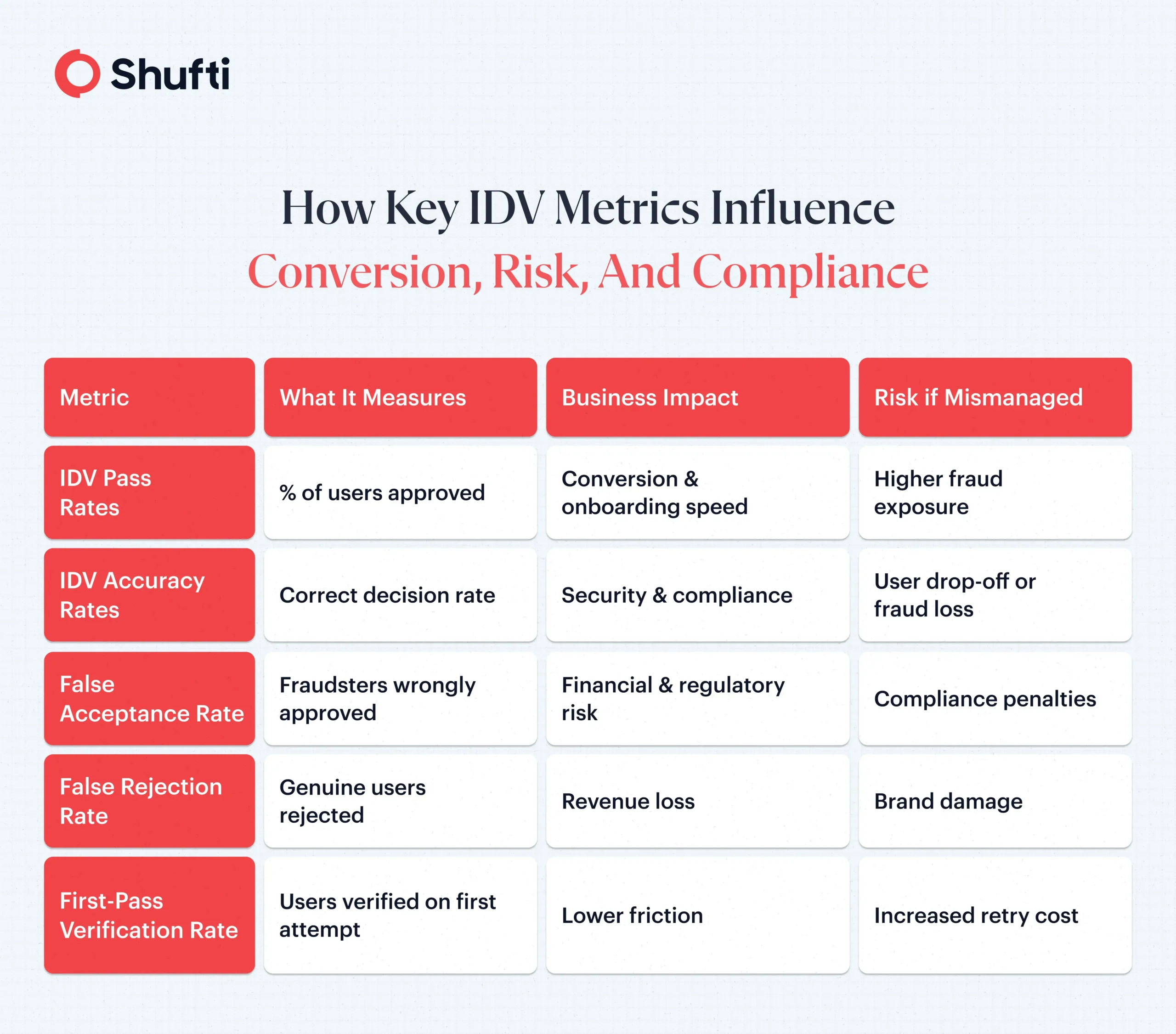
The practical consequences differ according to industries. In the case of financial institutions, poor management of the false acceptance rate may result in regulatory review and fines. In fintech environments, an elevated false rejection rate can trigger onboarding abandonment, reducing conversion rates and increasing acquisition costs. Online gaming platforms face a different pressure: that overly generous approvals increase fraud exposure, while excessive restrictions frustrate genuine players. In each case, identity verification metrics shape business outcomes far beyond the verification step itself.
Contemporary IDV systems are responding to this tension by having layered decision-making. Multi-layer checks enhance belief in identity claims without depending on one signal. Risk-based verification logic modifies scrutiny based on the risk profile of the user. Integrating database validation with biometric analysis enhances IDV match rates with a greater chance of legitimate users passing efficiently and suspicious attempts being filtered out. Ongoing adjustment of match thresholds keeps both FAR and FRR within reasonable limits instead of increasing with time.
The return on investment in identity verification is therefore determined by balance. High IDV accuracy is a defense against fraud and regulatory risk, whereas good IDV pass rates support growth and improve user experience. Organizations that consider these measures as linked performance metrics, but not competitive targets, are in a better position to minimize drop-off during the onboarding process, manage risk, and realize the full potential of their verification strategy.
How Shufti Helps Businesses Achieve a Higher Pass Rate without Compromising on Accuracy?
When firms try to raise pass rates by relaxing controls, fraud risk rises. When they add too many checks across the board, genuine users drop off before onboarding is complete.
Shufti helps teams improve pass rates without adding unnecessary friction through docless eIDV, passive liveness, and layered verification journeys that adapt to risk. Trusted data sources can verify identity attributes without always requiring manual document uploads, while passive biometric checks reduce user effort during onboarding. At the same time, risk-based verification flows apply proportionate scrutiny, allowing lower-risk genuine users to move forward more smoothly while higher-risk cases face stronger checks.
The platform has also demonstrated zero failures for selfie and document extraction in independent evaluations, including the one recently conducted by the U.S. Department of Homeland Security’s Remote Identity Validation Rally 2025.
Request a demo to see how Shufti can help improve onboarding performance even with tighter fraud controls.