AMLR Solutions
  AMLR Consultation
 EUDI Wallet
 Onboarding
 Ongoing Monitoring
 FRAML
FRAML KYC
KYC KYB
KYB KYI
KYI Age Assurance
 Workforce IAM
 Candidate Verification
 Account Takeover
 Bonus/ Promotion Abuse
 Chargeback Fraud
 Deepfake
 Document Fraud
 Fraud Networks
 Impersonation Fraud
 Money Mule Activity
 Multi-Accounting
 Party Fraud
 Regulatory & Compliance Risks
 Synthetic Identity Fraud
 Adult Content
 Banking
 Crypto
 Fintech
 Forex
Forex Compliance
 Fraud prevention
 Trust & safety
 Global expansion
 Compliance Officers
 Developers
 Fraud Analysts
 Product Managers
 Journey Builder
  Global Trust Platform
 Customer Profiles
 Vendor Comparison
 IDV Case Management
 AML Case Management
 Regulatory Reporting
 Agentic Rule Builder
  AI Compliance Co-Pilot
  Fraud Analytics
 Fraud Hub
  OCR
OCR Shufti AI
 Bank Account Verification
  Biometric Duplication
 Database Checks
 Document Intelligence
 Government ID
 Mobile Driver's License
 NFC
NFC Selfie Liveness
 Brand Personalisation
 Deployment Options
 Identity Methods
 IDV Modes
 Multi-tenancy
 On-Premise IDV
 Secure Capture
 Shufti MCP















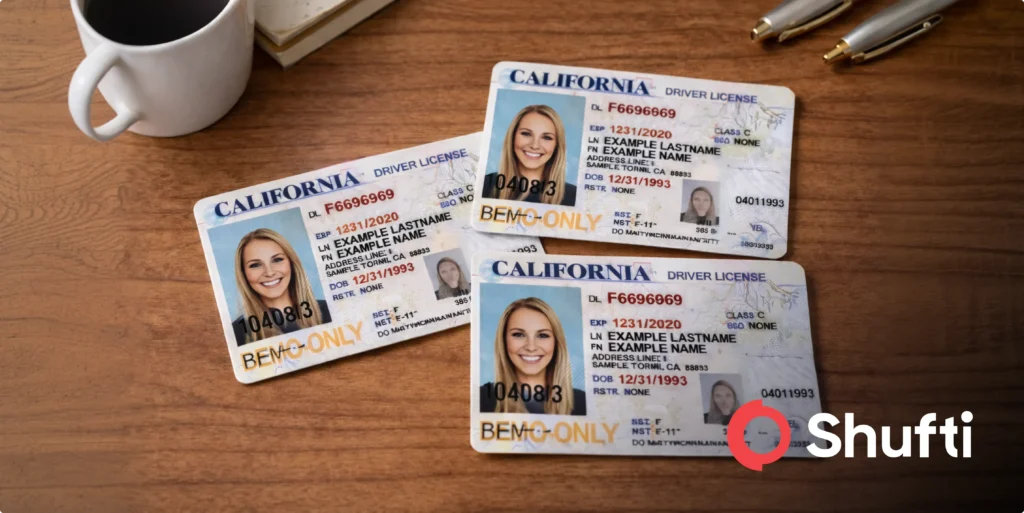

In January 2024, the U.S. Department of Justice charged the creator of OnlyFake after the platform sold more than 10,000 digital fake identification documents and allowed customers to generate fake IDs online for 56 countries in hours. The same year, a man in Amsterdam stood trial for opening nearly 50 bank accounts using deepfake technology, pairing stolen real identities with AI-generated faces to pass onboarding controls designed to stop exactly that.
These are not isolated incidents. Fraud teams at banks, crypto exchanges, and age-regulated platforms are logging a consistent pattern: the AI-generated fake ID that failed yesterday has already been iterated and resubmitted today. Businesses that rely on static image checks, basic OCR, or inconsistent manual review have handed attackers a repeatable, low-cost path through their front door.
This guide covers how that path works, why traditional verification breaks against it, and the layered technical controls that close it.
Key Takeaways:
- AI-generated fake IDs are now camera-perfect, making upload-only KYC checks easy to bypass.
- Forensic document analysis detects pixel, texture, and font anomalies that rule-based systems miss.
- Liveness detection with real-time capture closes the largest attack surface in onboarding flows.
- Businesses that fail to detect fake KYC submissions face regulatory fines and criminal liability.
- A layered defense document forensics, face match, risk scoring, and monitoring raises the cost of fraud high enough to deter repeat attacks.
What is an AI fake ID?
An AI fake ID is a synthetic identity document generated from scratch by machine-learning models trained on real credentials. Because it copies no single genuine document, template matching against known fakes cannot catch it. Unlike traditional forgeries which copied or altered existing documents. AI-generated IDs are created from scratch, meaning they do not match any single original and cannot be detected by template comparison against known fakes.
These documents replicate the full visual and structural anatomy of real credentials: ID numbers, barcodes, photographs, fonts, holograms, and MRZ (machine-readable zone) strings. They are designed specifically to pass digital onboarding flows, and they are increasingly being used as a tool for synthetic identity fraud where a real fake ID carries fabricated or stolen details that look internally consistent.
Common forms include:
- A driver’s licence with a fabricated date of birth, an AI-generated portrait, and an ID number that does not appear in any government database.
- A passport document with a scannable barcode that validates the format but carries synthetic personal data.
- A residency card with correct fonts, seals, and border artwork, but credentials that belong to no real person.
- An ID that carries the real, stolen details of an existing person paired with a synthetic photograph is the most dangerous variant for age verification fraud, account takeover, and money laundering.
The last variant is increasingly common in fake ID for age verification attacks on regulated platforms. The document carries a real person’s verified birthdate, which passes format checks, while the face belongs to the attacker bypassing the date-of-birth control without triggering it.
The surge of AI-generated documents
Generative AI has moved from creative assistant to fraud enabler. Tools that once required specialist skill to operate are now accessible to anyone with a browser and a cryptocurrency wallet and they produce output that passes visual inspection by trained humans.
Five capabilities have driven the surge in AI-generated documents over the past two years.
Generative AI trained on authentic documents
Modern generative models analyze thousands of legitimate IDs to clone every visual element holograms, fonts, layout grids, color profiles. The resulting document is not a photocopy of a real ID. It is a new, synthetic document that follows every authentic design rule without copying any single original. That distinction matters for detection: old forgery-detection logic that matched known fakes fails against a document that has never existed before.
Leaked government document templates
Dark-web marketplaces share detailed specifications for government documents from dozens of countries, including color codes, exact measurements, and security-feature placements. Combined with generative AI, these templates allow fraudsters to produce a realistic fake ID that matches the technical specification of a genuine government-issued document to within millimetres.
Fraud-as-a-service platforms
Criminal enterprises now operate on-demand services where a customer can get a fake passport, driver’s licence, national ID in a matter of hours. Payments go through cryptocurrency. Delivery is digital. OnlyFake was the most visible example; it was not the last. The barrier to obtaining a fake ID online has dropped from weeks of underground network access to a single browser session.
Layered AI attack combinations
The most sophisticated fraud combines multiple AI-generated elements: a synthetic document, a deepfake portrait, and a synthetic identity framework built from real and fabricated data. Each layer looks credible in isolation. Together they create a composite profile that defeats point checks and passes systems designed to verify one element at a time.
Open-source AI and commodity compute
Access to open-source image models and cheap cloud compute means that producing fake IDs online no longer requires criminal infrastructure. A technically literate individual can run a local model, iterate on a fake id online, and submit it from a personal device. Document fraud is no longer limited to organised crime.
How AI-generated IDs enable KYC bypass
AI fake IDs defeat KYC because upload-only flows accept static files an attacker can iterate and resubmit at near-zero cost, while template, OCR, and database checks confirm format, not authenticity. Liveness and face match are what close the gap.
KYC bypass passing an identity verification check with a fraudulent credential is the explicit design goal of every AI-generated fake ID. Understanding how that bypass works is the first step toward closing it.
Upload-only flows have no proof of presence
When a verification flow accepts a static image upload, it cannot distinguish between a photograph of a real document captured in the moment and an AI-generated image file submitted from a script. Fraudsters iterate quickly: generate an AI-generated fake ID, submit it, read the rejection signal, adjust the output, and resubmit. Upload-only flows allow this cycle to run indefinitely at near-zero cost.
Attackers can also strip or manipulate image metadata before uploading, removing the capture-context signals that help reveal synthetic origin. Without real-time capture enforced at the SDK level, there is no reliable proof that a human held a physical document in front of a live camera.
Template and OCR checks confirm format, not authenticity
Template matching confirms that a document looks like the right type. OCR confirms that text fields are readable. Neither control detects a fake kyc submission that follows the correct layout while hiding anomalies in pixel distribution, texture gradients, and security-feature regions that require forensic analysis to surface.
AI-generated documents are built to satisfy format checks. They follow the correct grid, produce readable text, and generate valid barcode strings. The forgery lives at the microscopic level the pixel-level inconsistencies, the non-uniform texture gradients, the font-rendering artifacts from a generative model rather than a government printing press. Rule-based detection does not inspect at that level.
Synthetic identity data defeats database lookups
A pure database check if this ID number exists in a government register fails against AI-generated IDs that carry real, stolen credentials. The ID number validates. The MRZ string validates. The address validates. The only element that does not validate is the face, which is why liveness detection and face match are not optional additions to a KYC stack: they are the controls that close the gap left by every document-level check.
Step-up flows reduce false positives without closing the door
Risk-based step-up verification where borderline confidence scores trigger an additional verification layer rather than a binary pass/fail reduces friction for legitimate users while raising the cost for attackers. A user who submits a document that passes forensic checks at 95% confidence moves through without interruption.
A submission that scores 60% triggers a face match with liveness, a device integrity check, and a manual review flag. Attackers targeting a repeatable path find that the path changes each time.
Three methods to detect AI-generated fake IDs
The three layers that detect AI-generated fake IDs are forensic document analysis (pixel, texture, font, and metadata signals), biometric face match with liveness detection, and cross-referencing against global document format rules and databases.
The same AI that creates synthetic documents can detect them if the detection model is trained on the right failure signatures and applied across the right layers.
1. Forensic document verification
Forensic document analysis asks a different question than format checking. It does not ask “does this document match the template?” It asks “was this document produced by the physical printing process a government uses, or by a generative model running on commodity hardware?”
The answer lives in the physics of the document
Pixel-Level Analysis
Pixel-level analysis examines colour distribution across the document at a resolution beyond human perception. Government printing produces specific pixel-level consistency patterns. AI-generated documents introduce mathematical inconsistencies in colour distribution that look fine to the human eye but deviate from authentic printing signatures in ways a trained model detects reliably.
Texture Non-Uniformity
Texture non-uniformity is one of the most reliable forensic signals. Authentic documents carry specific texture patterns from their physical printing materials and lamination processes. AI-generated images tend to produce smoother, more uniform gradients in regions that should show the irregular micro-texture of physical printing. Advanced image analysis quantifies this deviation.
Font Rendering Analysis
Font rendering analysis examines every character curve, spacing, weight against the output of government printing equipment. Generative models produce font rendering that differs from government printers at the sub-pixel level. The differences are invisible to a human reviewer and detectable by a forensic model trained on both authentic and synthetic outputs.
Microprinting Inconsistencies
Microprinting inconsistencies are among the most definitive signals. Authentic microprinting is sharp, high-contrast, and precisely positioned. AI-generated documents either omit microprint regions or reproduce them with insufficient definition, a failure mode that trained forensic systems surface reliably.
Metadata Anomaly Detection
Metadata anomaly detection examines the digital fingerprint of document creation. Authentic documents captured live on a mobile device produce specific metadata patterns, device model, capture timestamp, GPS context, focus data that a synthetic image file, however convincing visually, cannot replicate without fabrication. Metadata fabrication itself introduces detectable inconsistencies.
2. Biometric validation with liveness detection
Biometric validation closes the gap that document forensics leaves. A document can be forensically authentic and still be used by the wrong person. A face match with liveness detection confirms that the person submitting the document is the person depicted in it and that neither element is synthetic.
Facial Recognition
Facial recognition compares the document photograph with a live selfie using biometric feature mapping that works across angles, lighting conditions, and image quality. The comparison is mathematical, not visual, and operates across the range of image conditions that real-world submissions produce.
Liveness Detection
Liveness detection prevents the injection of a pre-recorded video, a photograph of a photograph, or a deepfake video into the verification flow. Shufti’s liveness engine holds iBeta Level 3 conformance under ISO/IEC 30107-3 the highest standard for presentation attack detection, tested against expert-level attackers with no budget constraints and no time limits.
Behavioral Analysis
Behavioral analysis examines the verification session itself: interaction timing, device motion patterns, session consistency. Automated submissions where a script submits a batch of AI-generated IDs across multiple accounts produce session-level signals that deviate from human-driven verification behaviour.
3. Cross-referencing with global document databases and format rules
Advanced identity verification systems maintain current specifications for every jurisdiction’s identity documents including regional variants, version histories, and security-feature evolution. An AI-generated fake ID that uses the correct general template for a UK driving licence but applies the wrong hologram pattern for the 2021 variant fails this check, even if it passes pixel-level inspection at a coarser resolution.
Cross-referencing also validates MRZ strings, barcode contents, and the internal consistency of personal data fields against each other. A date of birth in the visual zone that does not match the MRZ-encoded date is a failure signal. A document number that follows the correct format for its stated jurisdiction but encodes an impossible checksum fails the same way.
The Real Cost of Getting it Wrong Regulatory Fines and Legal Consequences
Failing to detect AI-generated fake IDs is not only a fraud problem. It is a compliance liability. Regulators globally are increasing scrutiny of identity verification controls, and enforcement actions are growing in both frequency and severity.
| Company | Fine | Reason |
|---|---|---|
| Vodafone Germany | €45 million | Insufficient fraud monitoring and contract verification controls led to unauthorised third-party access |
| S-Pankki Oyj (Finland) | €1.8 million | A security flaw allowed unauthorised account access due to weak identity controls |
| Orange Espagne (Spain) | €1.2 million | Inadequate identity checks enabled SIM-swap fraud across customer accounts |
| Optus (Australia) | AUD 826,320 | Scammers exploited a flaw in identity verification software to bypass checks and take over mobile accounts |
Several regulatory frameworks are directly relevant to AI-generated document fraud.
- EU GDPR allows fines of up to 4% of global annual turnover for failing to implement adequate technical measures to protect personal data, including identity controls.
- FinCEN (United States) has issued explicit alerts confirming that criminals are using generative AI to alter or fully generate ID images, and have successfully opened accounts using synthetic identities. The Financial Crimes Enforcement Network considers this an active threat requiring explicit controls.
- UK Economic Crime and Corporate Transparency Act 2023 introduced a “failure to prevent fraud” offence, holding companies accountable when they fail to prevent fraud committed by those acting on the organisation’s behalf. The direction of travel is clear: businesses will be expected to demonstrate documented, tested fraud prevention controls not just policy statements.
- FATF AML Standards expect regulated entities to implement risk-based identity verification. An AI-generated fake ID that passes onboarding can enable undetected money laundering. If discovered, regulators will examine whether your controls were adequate at the point of onboarding, not just at the point of discovery.
Mobile identity verification: real-time capture vs ID uploads
Real-time SDK capture beats upload-based verification because it requires a live camera session with liveness and device-integrity signals that a pre-generated image file cannot replicate.
The single most impactful architectural change a business can make to reduce AI fake ID exposure is moving from upload-based verification to real-time SDK capture. Upload flows are designed for convenience; they were not designed for an adversarial environment where AI-generated images can be generated to meet quality requirements and submitted programmatically.
| Upload-Based Verification (High Risk) | Real-Time SDK Verification (Recommended) |
|---|---|
| Accepts static image files | Requires live camera capture |
| Metadata can be stripped or fabricated | Device integrity and geolocation signals captured |
| No proof of real-time presence required | Liveness detection confirms physical presence |
| AI-generated images are indistinguishable | Motion, focus, and lighting shifts analysed in real time |
| Designed for convenience, not adversarial AI | Designed to defeat AI fraud at the point of capture |
Real-time capture introduces proof-of-presence by design. Every submission is tied to a live camera session on a real device, with device integrity signals and a liveness check that cannot be replicated by a script submitting a pre-generated file. The capture behaviour itself motion, focus changes, session timing provides signals that reinforce or contradict the document’s claimed authenticity.
Defense-in-depth: making AI ID fraud too costly to repeat
A layered defense (document forensics, face match and liveness, risk scoring with step-up, and ongoing monitoring) makes AI ID fraud too unreliable and expensive to repeat at scale.
Fraudsters look for low-cost, repeatable paths. A layered approach increases failure rates, raises the time and coordination cost per attempt, and turns a scalable attack into an uneconomic one.
Layer 1:
Document verification forensic analysis, not just OCR. Template matching and barcode validation are the floor, not the ceiling. Pixel-level, texture, font, and metadata forensics are the controls that catch AI-generated fake IDs that satisfy format checks.
Layer 2:
Face match and liveness detection closing the gap between a verified document and a verified person. A real fake id carries a real person’s data; face match confirms the submitter matches the photograph. Liveness confirms neither element is synthetic.
Layer 3:
Risk scoring and step-up verification reserving friction for the cases that warrant it. Borderline confidence scores trigger additional checks rather than hard failures, reducing false positives for legitimate users while raising the attacker’s cost for every submission.
Layer 4:
Ongoing monitoring and anomaly detection catching what slips through onboarding. Post-onboarding transaction behaviour, session patterns, and device consistency checks surface accounts that passed onboarding but show fraud signals in operation.
How Shufti helps identify forged identities that your IDV may have missed
Compliance teams running manual reviews or legacy document checks report the same pattern: the AI-generated fake IDs that pass are the ones that fail at the forensic layer, not the format layer. Format checks are necessary; they are not sufficient against generative models that are explicitly trained to satisfy them.
Shufti’s document verification was built to operate at the forensic level pixel analysis, texture mapping, font rendering, and metadata integrity combined with biometric validation and iBeta Level 3 liveness detection in a single integrated flow. That stack closes the attack surface that upload-only, OCR-first, and rule-based approaches leave open.
Frequently Asked Questions
What is AI-generated ID fraud?
AI-generated ID fraud is the use of synthetic identity documents created by generative machine learning models to pass identity verification checks. Unlike traditional forgeries, AI-generated IDs are produced from scratch rather than copied from existing documents, making them harder to detect with template matching or rule-based systems. They are used to open fraudulent accounts, bypass age verification, launder money, and commit synthetic identity fraud at scale.
What is the difference between an AI-generated fake ID and a traditional forgery?
A traditional forgery copies or modifies an existing document. An AI-generated fake ID is created entirely from scratch by a generative model trained on authentic credentials. This means it does not match any known fake on file, cannot be caught by database comparison against existing forgeries, and is designed to satisfy the specific format checks that digital verification systems apply.
Can AI-generated fake IDs pass liveness detection?
Standard liveness checks can be defeated by pre-recorded video injection or deepfake video streams. Presentation attack detection at iBeta Level 3 the current industry benchmark under ISO/IEC 30107-3 is tested specifically against expert-level deepfake and injection attacks. Very few vendors hold this level of conformance; it tests under conditions that replicate adversarial attackers with no time or budget constraints.
Why do upload-based KYC flows fail against AI fake IDs?
Upload flows accept static image files, which means an attacker can generate an AI-based fake ID, submit it, adjust the output based on the rejection signal, and resubmit indefinitely, at near-zero cost. Real-time SDK capture eliminates this loop by requiring live camera capture, device integrity signals, and liveness confirmation that cannot be replicated by a file submission.
What should businesses do if an AI-generated fake ID passes onboarding?
Post-onboarding monitoring catches what onboarding misses. Transaction behaviour, session patterns, and device consistency checks surface accounts showing fraud signals in operation. The same risk-scoring layer that triggers step-up verification at onboarding continues to operate post-onboarding so a single missed fake ID does not become a long-term loss position. Businesses should also review the specific verification step that failed and assess whether forensic document analysis was applied or whether the check stopped at format validation.