











Online shopping opened new doors of convenience for consumers and business opportunities for sellers. However, issues linked to delivery addresses have been silently impacting both, deteriorating consumer experience and incurring business losses.
With a major part of human life now being spent on digital gadgets, the plausibility of everything still comes down to a physical address that can essentially verify a person’s identity.
What are the consequences for the businesses when they are unable to verify these addresses properly?
Why Address Accuracy Matters for e-Commerce?
Without address verification, minor inconsistencies in customer-entered address data have a very high chance of going unnoticed at checkout. If a customer adds items to their cart, enters all of their details but has some typos in their address while entering, the order goes through, and the package gets dispatched, only for it to remain undelivered, or it finds itself on someone else’s doorstep.
Consistent address errors have emerged as a systematic problem that results in customers losing trust and an increase in fraudulent activities, highlighting the need for address accuracy.
Business Cost of Failed or Inaccurate Deliveries
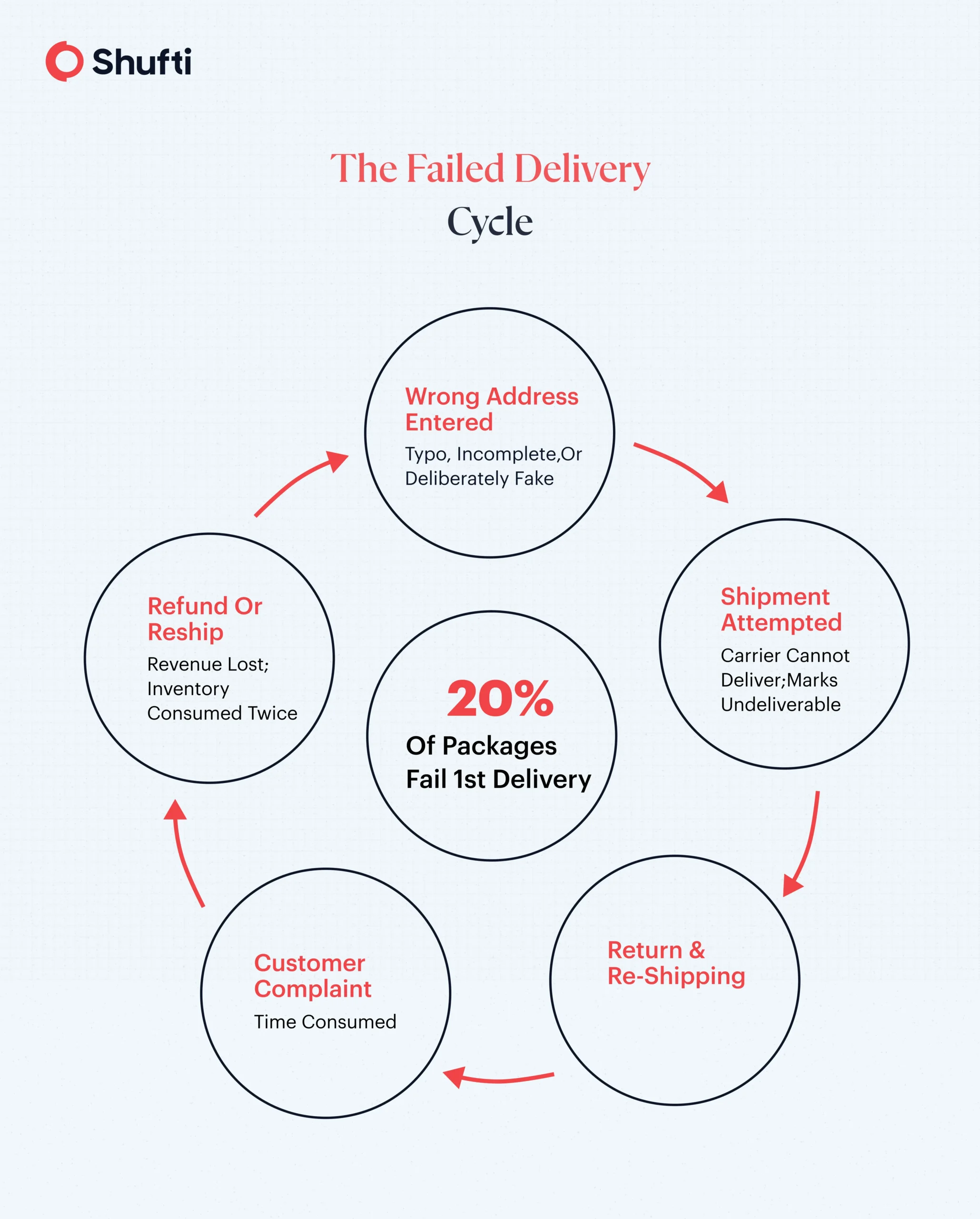
According to an HBR report, up to 20% of e-commerce packages are not delivered on the first attempt. This failure can cause damage that can be very hard to repair for e-commerce businesses, especially when they do not have much fault of their own in the first place.
A Retail Times report states that retailers from the UK and Europe suffered a financial impact of 464 million pounds due to lost parcels during peak shopping season in 2025. This includes £435 million in lost revenue, £9 million in shipping costs, and £20.3 million in WISMO (Where is my order?)-related customer service costs.
The Surge in Fraud along with the Address Problem
Honest mistakes aside, address data is the most vulnerable to manipulation in e-commerce fraud. A fraudster who is placing an order with a stolen card will use a real-looking shipping address in order to ensure their order looks plausible and believable. The fraudster is going to ensure that the address belongs to a valid postal zone, and can pass a basic formatting check even if their device is at a different geolocation altogether.
The difference between the given/declared address and the device location can be one of the first indicators of potential fraud. Despite this, most standard checkout flows do not have the necessary and relevant mechanism to detect it.
For instance, a user in Florida who routes an order through a VPN in Eastern Europe is a risk signal, but only if one is actively looking for it.
Another classic example of a fraud pattern is a batch of orders being shipped to the same given address but under different names and card numbers. In order to rule out any possibility of fraudulent activity, cross-referencing of address data is required at both scale and speed, which manual review simply cannot match.
What Is Address Validation and How Does It Solve Delivery Challenges in E-Commerce?
Address validation is the process of ensuring that an address is in the correct formatting and already exists in formal postal databases. It also verifies that the address mentioned is actually deliverable before it proceeds to cause any problems when hitting downstream systems.
How an Address Validation Software Processes Unstructured Addresses?
Fixing the address problem in the field of e-commerce requires a step-by-step process with essentially three things required to work together, those are:
- Decomposition of all unstructured and scattered input to convert it into a standard format
- Confirmation that address actually exists as a physical location and deliverable
- Additional risk signals, like device location/IP, to identify potential fraudulent behavior
Modern address validation software covers all of these steps in real time without breaking or adding steps in the checkout experience.
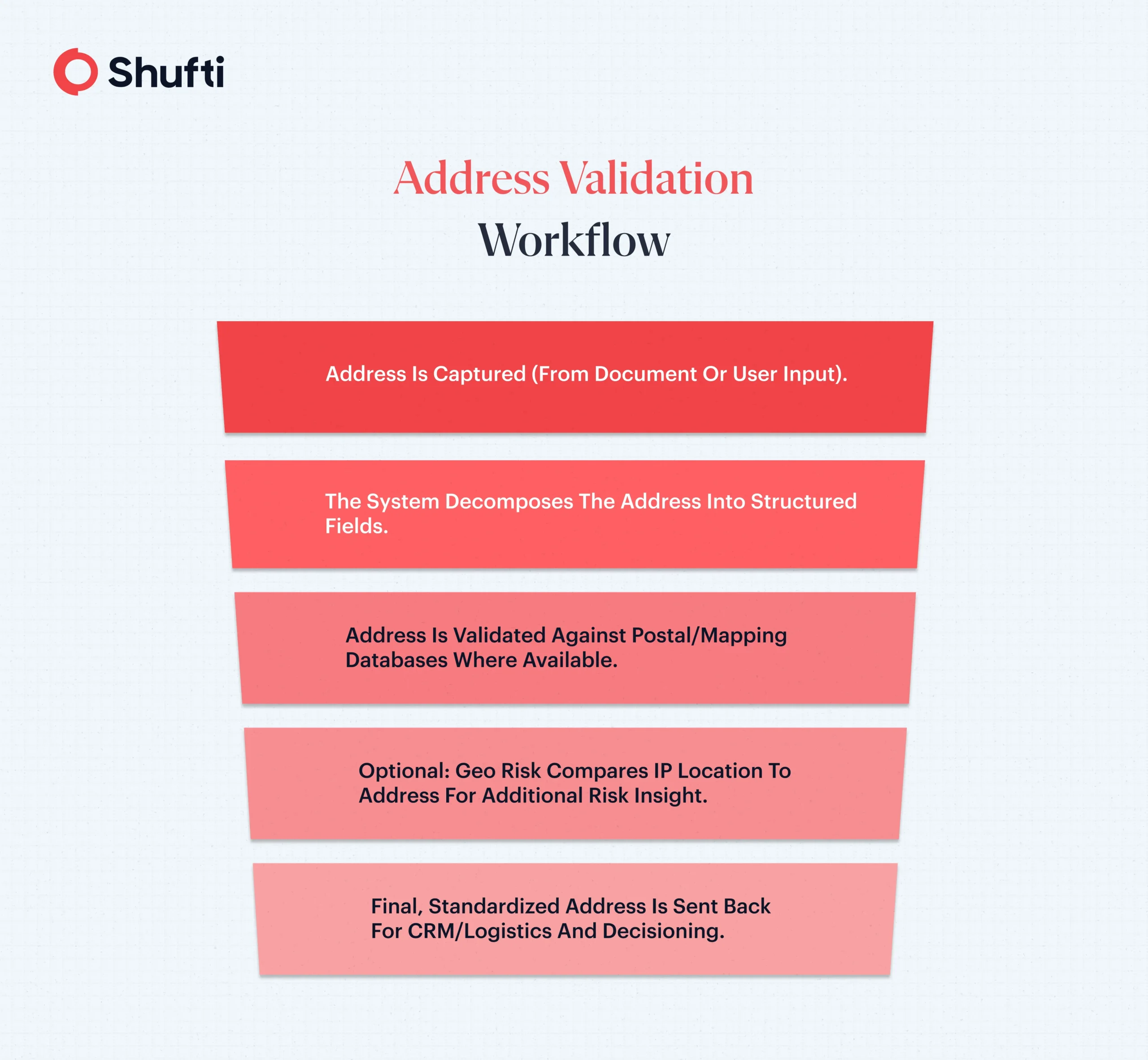
When a shopper submits an address in a free-form, address validation software structures it by breaking it down into a street number, postal code, city and region of that address. The next step is cross-referencing them against official postal databases like Royal Mail and USPS.
For businesses that sell across borders, address validation services that operate at the make selling easier for them. Rather than adhering to and maintaining separate rules for every country’s postal format, a global address validation tool could handle these structural differences automatically.
Address Normalization that Prevents Rejection of Genuine Customers
Fuzzy matching differentiates between a good address validation tool and a basic one. The purpose of fuzzy matching is not to reject genuine customers due to formatting differences, abbreviations or minor typos. For example, a good system should be able to recognise formatting differences, minor typos and abbreviations like “street vs st”, “Flat/Appart vs Apt” and “Avenue vs Ave”. These minor issues should not be a reason for a failed address check or a failed delivery.
How exactly does this help? This reduces false rejects, which is one of the most damaging forms of checkout drop-off of customers. The customers who are blocked rarely complain; they simply choose to leave. Smart address validation services are to match intent rather than demanding “each character perfect” input.
Adding Geolocation Intelligence to Address Validation to Mitigate Fraud Risks
Session-level device intelligence supports address validation in mitigating fraud risks. During checkout, risk signals detect VPN and proxy usage, flag suspicious devices, and measure the distance between the device’s IP location and the declared shipping address.
If multiple risk signals compound, the system will flag the user, triggering more scrutiny without creating friction for the legitimate and honest customers.
How Shufti Solves Delivery Challenges in e-Commerce with Imperfect User Inputs?
Delivery failures, chargebacks, and weak address data can quietly erode revenue for e-commerce businesses. Shufti helps merchants validate addresses, verify residency, and detect location anomalies through one address verification suite built for conversion and risk control.
Request a demo to see how Shufti supports cleaner checkouts and stronger fraud checks.