 Runs On Your Cloud
 No Data Sharing
 No Contract Required
 Explore Now






 Face Verification
 Address Verification
 Document Verification
 Age Verification
 VideoIdent
 Fast ID
 eIDV
eIDV
 NFC Verification
 Consent Verification
 Business Verification
 Due Diligence
 Investor Verification
 E-Signature
 Behavioural Biometrics
 Device Fingerprinting
 MFA
MFA
 AML Screening
 Business AML Screening
 User Risk Assessment
 Transaction Screening
 Adverse Media Screening
 Identity Verification
 KYC
KYC
 KYB
KYB
 KYI
KYI
 Bonus Abuse
 Fraud Prevention
 Deepfakes
 Banking
 Crypto
 Fintech
 Forex
Forex
 Gaming
 Gig Economy
 Marketplace
 Social Networks
 Product Managers
 Compliance Officers
 Fraud Analyst
 Global Trust Platform
 Journey Builder
 Vendor Comparison
 Content library
 Blogs
Blogs
 News
News
 Reports
 Insights
 Knowledgebase
 ROI calculator
 Blind Spot Audit
 Deepfake Detection
 Liveness Detection
 Document Originality
 Document Deepfake
 Events & Webinar
 Podcast Studio
 Spotlight Studio
 API Documentation
 Mobile SDKs
 Service Status
 Help Center
 Contact Us
 Technical Support
 Compliance
 Supported Document
 About
About
 Career
 Press Release
 Certifications
 Partnership
 Awards
A Brief Insight into Crypto Regulations in the Asia-Pacific Region
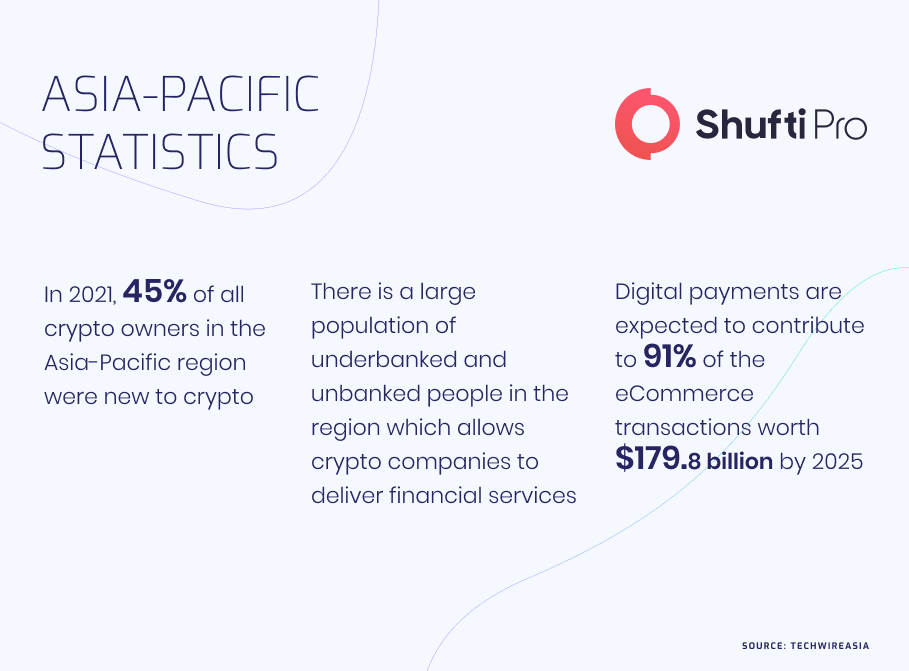
The Asia-Pacific region is one of the areas with the highest rate of crypto adoption. Considering the rapid growth of crypto in the region, law enforcers and regulatory authorities are seen developing new regulations to oversee the sector. These regulations are aimed at securing the interest of crypto customers, protecting the financial system, and empowering economic growth. According to a Gemini report, “2021 was a breakout year in the Asia Pacific.” Indonesia has been ranked number one with a 41% rate of crypto adoption, followed by Singapore at 30% and Hong Kong at 24%.
A Country-wise Look at Crypto Regulations
The Asia-Pacific region clearly demonstrates the potential for becoming one of the areas of the world where crypto can be adopted as a regulated currency.
Indonesia
Indonesians clearly take crypto as the ideal alternative to normal currencies in times of inflation. Compared to 23% of the citizens of the US, Germany, and France, 61% of Indonesians consider crypto the future of currency. Even though the country does not allow payments in digital currencies, crypto assets can be traded on the commodities exchange under the supervision of the Commodity Futures Trading Regulatory Agency (CoFTRA or BAPPEBTI.) The regulatory body allows the trading of 229 cryptocurrencies.
The official statement says:
“With the issuance of the CoFTRA (Perba) regulation, it is hoped that physical trading of crypto assets in Indonesia will be able to provide legal certainty as well as protection for people who transact physical crypto assets in Indonesia.”
Crypto exchanges must register with the CoFTRA, and financial service providers are banned from providing crypto services. Crypto asset trading requirements include a minimum capital of IDR80,000,000,000, as well as holding 80% of the capital in equity. There are also requirements for an established business structure, trading rules, IT, audit, legal, customer support & service, accounting and finance divisions.
The CEO and founder of Binance, Changpeng Zhao states,
“With fast technology adoption and strong economic potential, Indonesia could become one of the leading centres of the blockchain and crypto ecosystem in Southeast Asia.”
Indonesia’s rapid economic growth, youthful population, and digital adoption rates are pointing toward the country becoming the world’s 4th largest economy by 2050.
Singapore
When it comes to crypto regulations, Singapore is one of the first countries that pops up in the headlines. At the end of 2021, the Monetary Authority of Singapore (MAS) rejected the licenses of crypto companies for ineffective CDD protocols. More than 100 of the companies that sent applications for a crypto license were either rejected or forced to take back their applications. The companies that did get exempted were those that were already running their operations in the country before the licensing regime was introduced.
A spokesperson for the Monetary Authority of Singapore (MAS) said, “digital payment token service providers in Singapore … have to comply with requirements to mitigate such risks, including the need to carry out proper customer due diligence, conduct regular account reviews, and monitor and report suspicious transactions.”
Virtual Asset Service Providers (VASPs) deal with buying, selling, exchanging digital tokens, or providing custodial services for digital tokens fall under the scope of the Payment Services Act (PSA). The country has also passed the Financial Services and Markets Bill (FSM Bill), which is aimed at improving the requirements for the industry when it becomes effective.
China
In China, authorities have imposed a straightforward ban on all crypto operations including crypto transactions or Bitcoin mining. The country is developing its own Central Bank Digital Currency (CBDC) called the digital yuan, digital renminbi, or e-CNY.
Japan
Japan’s crypto applications are mainly overseen by the Payment Services Act, while the primary financial regulator is the Financial Services Agency (FSA). Firms that deal with cryptocurrencies, either buying, selling, or exchanging, fall under the category of Crypto Asset Exchange Services (CAES) and must be registered with the FSA. The same is applicable to firms that manage or hold the crypto assets belonging to their clients. Japan has stringent regulations for custody of crypto assets, like the requirement of retaining 95% of assets in storage that has no connection with the internet, and keeping the crypto wallets of individuals and business entities separate.
Despite Japan being the world’s 3rd largest economy and having a high-tech environment, only 4% of the population use crypto. The majority of the payments in Japan are still based on cash. It’s not easy for crypto firms to register as a CAES in Japan, as there is an additional requirement for a Japanese subsidiary with local expertise in FSA. The FSA also requires that the firm trying to register as a CAES provides evidence of being financially stable, having operational expertise, and having internal measures that adhere to Japan’s standards for financial institutions.
Hong Kong
Crypto regulators in Hong Kong issued a Joint Circular on Intermediaries’ Virtual Asset Related Activities in January, which oversees virtual asset-related operations. Only professional investors and investment firms are allowed to directly invest in cryptocurrencies. The condition is that they must have a minimum amount of HK$8 million in their portfolio. That being said, retail investors are allowed to access crypto-investments through ETFs and futures on certain digital currency exchanges. This is also possible only when a financial intermediary is involved and the investment is not a complex product.
It’s obligatory for virtual asset service providers that offer services to retail investors in Hong Kong to comply with existing requirements for derivative products. They must also perform a virtual asset-knowledge test as a security measure. Furthermore, VASPs are required to ensure that the client is financially stable and can cope with the risk of potential losses due to crypto investments.
What Shufti Offers
Preventing financial crimes like money laundering and terrorist financing requires cryptocurrency exchanges to incorporate adequate AML checks and KYC procedures. These practices have not only been endorsed by global regulatory authorities but have shown encouraging results in the real world as well. As cryptocurrency adoption is showing no signs of slowing down, firms must invest in the right AML solutions to streamline compliance and fraud detection processes.
Shufti’s Anti-Money Laundering (AML) screening allows cryptocurrency firms to stay compliant with regulatory standards as well as prevent money laundering. Powered by thousands of AI algorithms, Shufti’s AML screening solution runs background checks on customers against 1700+ global watchlists in less than a second with 98.67% accuracy.
Want to learn more about our AML Screening solution?