 Runs On Your Cloud
 No Data Sharing
 No Contract Required
 Explore Now







 Face Verification
 Address Verification
 Document Verification
 Age Verification
 VideoIdent
 Fast ID
 eIDV
eIDV
 NFC Verification
 Consent Verification
 Business Verification
 Due Diligence
 Investor Verification
 E-Signature
 Behavioural Biometrics
 Device Fingerprinting
 MFA
MFA
 AML Screening
 Business AML Screening
 User Risk Assessment
 Transaction Screening
 Adverse Media Screening

 Identity Verification
 KYC
KYC
 KYB
KYB
 KYI
KYI
 Bonus Abuse
 Fraud Prevention
 Deepfakes
 Banking
 Crypto
 Fintech
 Forex
Forex
 Gaming
 Gig Economy
 Marketplace
 Social Networks
 Product Managers
 Compliance Officers
 Fraud Analyst
 Global Trust Platform
 Journey Builder
 Vendor Comparison

 Content library
 Blogs
Blogs
 News
News
 Reports
 Insights
 Knowledgebase
 ROI calculator
 Blind Spot Audit
 Deepfake Detection
 Liveness Detection
 Document Originality
 Document Deepfake
 Events & Webinar
 Podcast Studio
 Spotlight Studio
 API Documentation
 Mobile SDKs
 Service Status
 Help Center
 Contact Us
 Technical Support
 Compliance
 Supported Document
 About
About
 Career
 Press Release
 Certifications
 Partnership
 Awards
Identity Verification for Peer-to-Peer Esports Wagering in the U.S
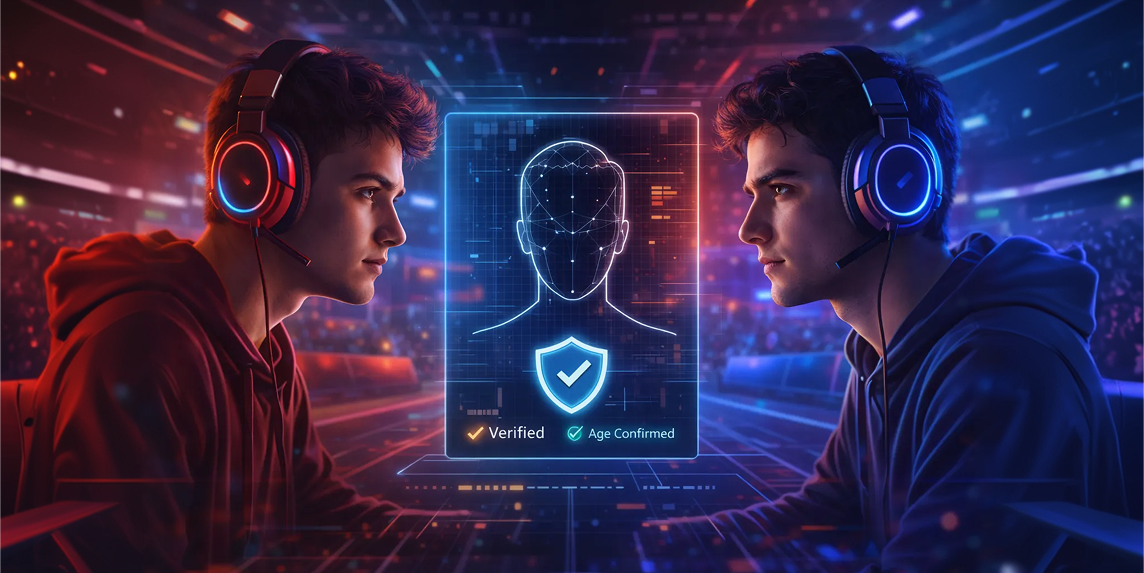
Peer-to-peer wagering in the U.S. Esports market is currently rising, indicating the increasing interest in competitive gaming as well as the revenue potential it offers.
As platforms enable players to challenge each other directly, the regulatory environment has intensified, particularly for high-risk digital services operating across state lines. There are special risks in peer-to-peer wagering, such as ensuring the participants are of age, preventing and identifying fraud, and ensuring that anti-money laundering laws are met. These platforms are being examined more closely than ever by the regulatory bodies, and there is a demand to have transparent, verifiable, and auditable processes. For U.S. operators, this scrutiny increasingly mirrors expectations applied to regulated gaming platforms, particularly around age gating, identity integrity, and audit-ready controls.
Why Identity Verification Is Necessary For P2P Wagering?
P2P betting is quite different from conventional sportsbooks. The P2P platform serves as an intermediary between two persons who compete over stakes in a P2P environment. This model is built on trust. When a gamer feels that their opponent is playing on a fake account or the site is not properly vetting the players, the environment falls apart.
Eliminating Underage Access
Age verification is critical for regulatory compliance and social accountability. IDV uses advanced facial age estimation and document cross-referencing to ensure that every player on P2P wagering platforms is of legal age. This is necessary to protect platforms from regulatory fines and to safeguard the gaming community.
Combatting Account Takeovers (ATO)
In competitive gaming, high-ranking accounts have real-world value. Hackers often target these accounts to steal funds or participate in fraudulent wagers. By using Facial Biometric Verification at key intervals (such as large withdrawals), identity verification ensures that the person playing is the person who owns the account.
Removing Friction at “First-Click”
Clients of online gaming companies are known to be intolerant of lag, and this applies to the sign-up process as well. If verification takes long, such customers are highly likely to switch to other platforms. Advanced IDV solutions like Shufti’s Auto-only mode can process verifications in a few seconds, keeping the “conversion funnel” open while the security checks run in the background.
Preventing Multi-Accounting and Promotional Abuse
Peer-to-peer environments are especially vulnerable to duplicate accounts used for bonus exploitation, odds manipulation, and collusive play, directly impacting platform fairness and revenue.
Detecting Post-Onboarding Fraud Through Continuous Monitoring
Static, one-time identity checks fail to capture evolving risk signals such as behavioral anomalies, coordinated activity, or laundering patterns that emerge after account creation.
Adapting Verification Controls to High-Velocity Digital Risk
Esports wagering operates at real-time speed, requiring adaptive, AI-driven verification frameworks that can respond dynamically without disrupting gameplay.
Why Identity Verification Is the Backbone of P2P Wagering?
Biometric verification and liveness checks also increase integrity, which is guaranteed in real time, that the user is who they say they are. These are especially important in gaming facilities, where fast onboarding needs to be accompanied by high levels of security. With verification of age and validation of personal data, platforms can help to avoid underage involvement and reduce the possibility of fraud and multiple accounts.
In addition to an initial check, continuous monitoring, such as anti-money laundering (AML) checks, allows for identifying suspicious activity in time, even in non-traditional financial transactions within the gaming ecosystem. Continuous identity assurance across the account lifecycle allows platforms to respond to behavioral risk, not just transactional anomalies.
The importance of identity verification goes well beyond just meeting compliance requirements. It helps protect the platform’s reputation, ensures fair competition, and shields players from the threats posed by malicious actors. Essentially, verification takes the idea of trust and turns it into a measurable standard of operation. This enables platforms to grow responsibly while upholding their credibility in complex, high-risk digital environments that are heavily regulated.
Business Impact: Trust, Speed, Safety, and Scalability
- Trust: The basis on which platforms and communities are established in peer-to-peer eSports wagering. The identity verification is central in building this trust, where all participants are legitimate and in line with regulatory requirements.
- Speed: Automated identity verification reduces onboarding friction, lowers drop-off rates, accelerates player acquisition, and maintains regulatory compliance without sacrificing user experience in fast-paced esports wagering environments.
- Safety: Advanced fraud detection and manual-review reduction protect platform integrity by identifying duplicate accounts, identity misuse, and suspicious behavior early, allowing teams to focus on oversight.
- Scalability: A modular, flexible verification stack enables rapid adaptation to evolving U.S. regulations, supporting sustainable growth, multi-state expansion, and long-term compliance without costly system reengineering efforts.
How Shufti and Gamer Wager Partnership is enabling its U.S. Expansion?
Shufti has partnered with Gamer Wager to support secure, compliant peer-to-peer eSports wagering as the platform expands in the United States. The partnership brings Shufti’s identity verification and compliance capabilities into Gamer Wager’s onboarding flow, helping the platform strengthen age checks, reduce multi-accounting and fraud, and apply risk-based controls that align with regulated gaming expectations.
Through this collaboration, Gamer Wager can deploy layered verification that fits a peer-to-peer wagering model. These checks include document verification, facial biometric verification with liveness detection, document-free identity verification through eIDV, AML screening, ongoing monitoring, and proof of address verification for higher-risk scenarios. The outcome is a stronger trust and compliance foundation that can scale as the platform grows across different U.S. jurisdictions.
In the case of platforms like Gamer Wager, it is essential to provide a low-friction onboarding experience. If account creation is too complex, it can result in dropping out prospective customers, impacting both user experience and platform growth. Moreover, there is a risk of legal and reputational issues to the platform in case of any inability to adhere to the regulations. Reliability and honesty are essential in peer-to-peer games; the participants must be confident that their opponents are real and that the game is free of fraudulent acts. In order to live up to these demands, a verification system must be robust and adaptable to accommodate ambitious growth as well as comply with stringent regulatory requirements. An API based compliance layer enables platforms to enter new jurisdictions without the need to complicate operations or introduce compliance loopholes.
The Path Forward for Regulated Esports Wagering
Esports wagering is becoming more accepted in mainstream markets, with stricter regulations in place around the world. As competitive gaming meets standard wagering practices, platforms must follow the same rules as traditional financial and gaming businesses. This change shows a clear need for strong and flexible verification systems that fit the fast-changing and high-risk digital environment.
When done right, identity verification helps rather than hinders. It allows platforms to grow safely, protect players, and meet regulators’ expectations without making the user experience worse. In this situation, trust becomes an important asset, built through regular verification, constant monitoring, and clear risk management. As regulations become stricter, how well platforms verify their users will set apart those that can grow sustainably from those that struggle to win long-term regulatory trust.
Partnerships like Shufti and Gamer Wager show how technology, compliance, and user-friendly design can work together for sustainable growth. As esports wagering develops, effective and secure verification will be key for platforms that want to gain lasting credibility and regulatory trust.