AMLR Solutions
  AMLR Consultation
 EUDI Wallet
 Onboarding
 Ongoing Monitoring
 FRAML
FRAML KYC
KYC KYB
KYB KYI
KYI Age Assurance
 Workforce IAM
 Candidate Verification
 Account Takeover
 Bonus/ Promotion Abuse
 Chargeback Fraud
 Deepfake
 Document Fraud
 Fraud Networks
 Impersonation Fraud
 Money Mule Activity
 Multi-Accounting
 Party Fraud
 Regulatory & Compliance Risks
 Synthetic Identity Fraud
 Adult Content
 Banking
 Crypto
 Fintech
 Forex
Forex Compliance
 Fraud prevention
 Trust & safety
 Global expansion
 Compliance Officers
 Developers
 Fraud Analysts
 Product Managers
 Journey Builder
  Global Trust Platform
 Customer Profiles
 Vendor Comparison
 IDV Case Management
 AML Case Management
 Regulatory Reporting
 Agentic Rule Builder
  AI Compliance Co-Pilot
  Fraud Analytics
 Fraud Hub
  OCR
OCR Shufti AI
 Bank Account Verification
  Biometric Duplication
 Database Checks
 Document Intelligence
 Government ID
 Mobile Driver's License
 NFC
NFC Selfie Liveness
 Brand Personalisation
 Deployment Options
 Identity Methods
 IDV Modes
 Multi-tenancy
 On-Premise IDV
 Secure Capture
 Shufti MCP












TL;DR:
- Fake IDs fall into three types: borrowed/stolen, altered, or fully forged, each one defeating a different kind of check (face match, data cross-check, or feature inspection).
- Key red flags: inconsistent fonts, holograms that don’t shift under light, missing UV imagery, a barcode/MRZ mismatch, and a photo that doesn’t match the holder.
- A one-minute manual check covers six steps: feel the card, tilt it, light it from behind, check it under UV, scan the barcode/MRZ, and match the face.
- Genuine REAL ID-compliant cards combine overt features (holograms, raised text) with covert ones (UV imagery, laser perforation, microprint) security details also vary by state.
- Forgers can copy visible features but consistently miss covert ones requiring special equipment and no manual check catches a borrowed genuine ID.
- Automated detection (AI document verification, OCR/barcode reading, facial recognition, liveness detection, NFC chip verification) catches what manual checks miss, especially as AI-generated fakes improve humans only spot AI-generated images correctly 62% of the time.
- Accepting a fake ID risks AML fines, licence loss, chargebacks, and reputational damage, making automated, auditable verification a compliance necessity.
Fake IDs are no longer the crude laminate cards of a decade ago. AI image tools, template marketplaces on the dark web, and organized fraud rings now produce counterfeits that reproduce holograms, microprint, and tactile features convincingly enough to pass a quick glance. Identity theft and document fraud already cost North American consumers and businesses more than $10 billion in a single year, and the human eye is barely keeping up: a 2025 Microsoft study found people correctly flagged AI-generated images only 62% of the time, just above a coin flip.
This guide is the practical version: the exact red flags to look for, a one-minute checking method, the security features a genuine ID should carry, a state-by-state reference, and the automated tools that catch what people miss. (For the specific threat of fully synthetic, machine-generated documents.
What Counts as a Fake ID? The Three Types You’ll Encounter
Quick answer: A fake ID is any identity document that has been forged, altered, or presented by someone other than its rightful owner to misrepresent identity or age. The three types are borrowed/stolen, altered, and fully forged, and each fails a different kind of check.
- Borrowed or stolen IDs are genuine documents used by an impostor. Every physical security feature is real, so the only tell is the person: the face, age, and behaviour won’t match the card. These defeat document checks but fail a biometric or photo-to-face comparison.
- Altered IDs start as real cards that have been physically or digitally modified: a changed date of birth, a swapped photo, or a tampered barcode. Look for mismatched fonts, lamination damage, and printed data that disagrees with the encoded barcode or MRZ.
- Forged IDs are manufactured from scratch to imitate an official template. Quality varies wildly; the better ones replicate overt features but usually slip on covert ones such as UV imagery, laser perforation, or microprint.
Knowing the type matters because no single check catches all three. Catching impostors needs a face match; catching forgeries needs feature inspection; catching alterations needs data cross-checks.
What Does a Fake ID Look Like? Key Red Flags
Quick answer: The most reliable red flags are inconsistent fonts or spacing, holograms that don’t shift under light, missing UV features, a barcode that doesn’t match the printed data, peeling or oddly thick lamination, and a photo that doesn’t match the person presenting it.
Run through this checklist whenever an ID feels off:
- Typography and layout: blurry, uneven, or non-standard fonts; misaligned text; spacing that differs from a known-good card.
- Holograms and optically variable ink: genuine holograms and color-shifting seals move and change colour as you tilt the card; flat, static, or “printed-on” effects are forgeries.
- UV features: under a UV/blacklight, real IDs reveal hidden state imagery and a secondary photo; a card that stays dark is suspect.
- Microprint and fine-line patterns: authentic cards carry crisp microtext and guilloche patterns that blur or disappear on counterfeits.
- Barcode / MRZ mismatch: scan the back; the encoded data must match the printed name, DOB, and document number exactly.
- Tactile feel: run a finger over the card. Genuine IDs have raised text or laser engraving; fakes often feel flat, too thick, too thin, or have peeling edges.
- Photo and data consistency: the portrait should match the person, and the ghost (secondary) image should match the primary photo. Watch for misspellings and impossible dates.
Any single flag is a reason to look harder; two or more is a reason to escalate.
How to Check an ID in Under a Minute: A Step-by-Step Method
Quick Answer: Feel the card for tactile text, tilt it to confirm holograms and color-shifting ink move, check it under UV light, hold it to a light source to reveal laser perforation and the ghost image, scan the barcode to confirm the data matches, and compare the photo to the person.
- Feel it. Genuine IDs have raised or laser-engraved text on the date of birth or signature. A perfectly flat card is a warning sign.
- Tilt it. Holograms and optically variable ink should shift colour and move. Static images don’t.
- Light it from behind. Many states embed laser-perforated symbols and a faint ghost portrait that only appears when backlit.
- Use UV. Confirm the state’s UV imagery and the UV-reactive secondary photo are present and correctly placed.
- Scan the barcode or read the MRZ. The encoded data must match the printed information. A mismatch is one of the strongest indicators of tampering.
- Match the face. Compare the portrait and the ghost image to the person in front of you: age, bone structure, and hairline.
- Ask one unscripted question. Impostors using borrowed IDs often hesitate on their own address, ZIP code, or birth year. Behavioural cues matter; FinCEN notes fraudsters frequently stumble on basic identity questions or rely on prompts from a phone.
Manual checks are a strong first line of defence, but they cannot guarantee detection against high-quality forgeries, which is why high-volume and regulated businesses pair them with automated document verification.
Fake ID vs. Real ID: What the Genuine Document Should Have
Quick Answer: A real ID combines overt features you can see and feel (holograms, optically variable ink, raised text, a ghost photo) with covert features that need light or a scanner (UV imagery, laser perforation, microprint, and a barcode/MRZ whose data matches the front).
A genuine card that complies with the REAL ID Act should carry layered security:
- Holograms and optically variable devices that shift under light and match the state’s current design.
- Laser perforation: a state symbol made of tiny holes, visible only when held up to light.
- UV imagery that reveals hidden graphics and a secondary photo under ultraviolet light.
- Microprint and fine-line patterns that stay crisp under magnification.
- Tactile elements: raised text or laser engraving you can feel.
- A ghost (secondary) image that matches the primary portrait.
- A barcode and/or MRZ encoding data that matches the printed fields exactly.
- High-quality lamination and clean, standardized card edges with no bubbling or peeling.
No single feature is proof of authenticity. Detection works by confirming that several features are present, consistent, and internally agreed.
How to Spot a Fake ID by State
Quick Answer: US IDs share a baseline set by AAMVA and the REAL ID Act, but each state adds its own overt symbols and covert features, so accurate detection needs state-specific knowledge. The table below summarizes the signature features of the most commonly checked states.
| State | Signature overt feature | Covert / security features | What forgeries usually miss |
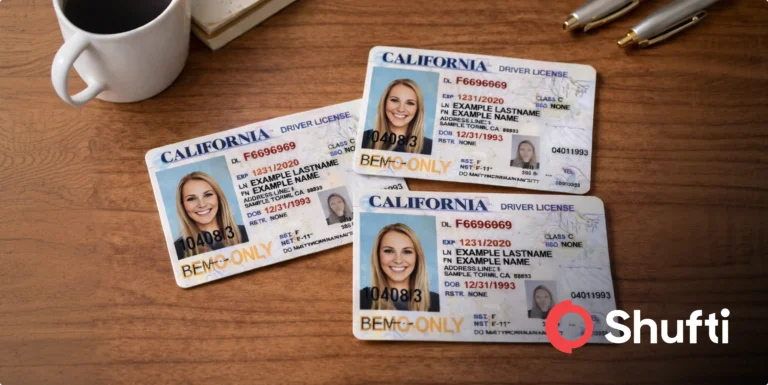
| California | UV-reactive golden bear and state outline; transparent window | Ghost image, raised signature, tactile DOB | Flat “bear,” no UV reaction, soft window |
| Texas | Color-shifting (optically variable) state seal | Laser-perforated ghost image, tactile DOB | Seal that doesn’t shift, flat ghost image |
| New York | Laser-perforated Statue of Liberty (backlit) | Embedded ghost image, REAL ID star / enhanced chip | Printed (not perforated) Liberty, no backlight effect |
| Florida | UV-reactive state outline | Microprint, ghost image, tactile DOB | Missing microprint, no UV |
| Illinois | Fine-line guilloche background | UV-reactive secondary photo, laser perforation | Blurred fine lines, dark under UV |
| Pennsylvania | UV keystone / Liberty Bell imagery | Detailed ghost image, microprint | Misaligned ghost image, weak microprint |
| Ohio | Laser-perforated state outline | UV features, ghost image | Printed outline, no perforation |
| Georgia | UV-reactive state features | Raised lettering, ghost image | Flat text, no UV |
| Michigan | UV imagery | Ghost image, tactile lettering | Missing tactile feel |
| North Carolina | UV state outline | Ghost image, microprint | No UV, soft microprint |
| Arizona | Optically variable ink | Laser-etched tactile areas | Ink that doesn’t shift |
| Virginia | UV state imagery (cardinal) | Ghost image, fine-line patterns | No UV reaction |
| New Jersey | Laser-perforated state outline | UV imagery, ghost image | Printed outline, no backlight effect |
| Washington | UV imagery (state outline) | Ghost image, microprint | Missing UV / microprint |
| Massachusetts | Laser-perforated state symbol | UV features, ghost image | No perforation under light |
State card designs are updated regularly, and full template details are restricted for security reasons. For authoritative, current references, businesses should consult the AAMVA DL/ID Card Design Standard and official state DMV resources, and keep their verification templates up to date.
What Forgers Usually Get Wrong, and Where Manual Checks Fail
Quick Answer: Counterfeiters can copy what’s visible (layout, photo, even a printed “hologram”), but they consistently miss what needs special equipment: UV imagery, laser perforation, microprint, and barcode/MRZ data that matches the front. Manual checks fail under time pressure, high volume, and against borrowed genuine IDs.
The features that trip up forgers are the covert ones, because they require materials and machinery most counterfeiters don’t have. The features that trip up staff are speed and consistency: a busy door, a tired analyst, or an untrained new hire will miss a flat hologram or a barcode mismatch. And no level of inspection catches a borrowed genuine ID, because that requires matching the face to the photo. This combination of evolving forgeries and human variability is why scalable verification increasingly relies on automation.
Industry-by-Industry: Where Fake IDs Hit Hardest
Quick Answer: Banking and fintech face account-opening and synthetic-identity fraud; crypto and forex face onboarding and AML exposure; iGaming and gambling face age and self-exclusion breaches; marketplaces face seller fraud; hospitality and age-restricted retail face liability for underage sales.
- Banking and fintech: fake and synthetic identities open mule accounts and pass weak onboarding. Combine document checks, biometric face match, and database screening, and re-verify periodically.
- Crypto and forex: high-risk, heavily regulated onboarding. Enforce real-time document and liveness verification before deposits or trades, with automated suspicious-activity flags.
- iGaming and gambling: verify both identity and age at sign-up to enforce age limits and self-exclusion; minimize friction with automated proofing.
- Online marketplaces: verify sellers and high-risk buyers at onboarding to prevent account and listing fraud.
- Hospitality, nightlife and age-restricted retail: train staff on UV, hologram, and tactile checks, and back them with scanning to create an audit trail and a clear refusal policy.
Tools That Detect Fake IDs Automatically
Quick Answer: Automated detection layers AI-driven document verification, OCR and barcode/MRZ reading, template and database matching, facial recognition, and liveness detection, catching covert-feature failures and impostors that manual review misses.
- AI document verification analyzes a captured ID against authentic templates, checking holograms, fonts, microprint, and tampering far faster and more consistently than the eye.
- OCR and barcode/MRZ readers extract and cross-check encoded data against the printed fields to expose alterations.
- Facial recognition and 1:1 matching compare the ID portrait to a live selfie to catch borrowed and stolen documents.
- Liveness detection confirms a real person is present, not a photo, mask, deepfake, or screen replay.
- NFC chip verification reads the cryptographically signed chip in modern passports and eIDs for the highest assurance.
The Cost of Getting It Wrong: Penalties and Risk
Quick Answer: Accepting a fake ID can mean regulatory fines, AML and licensing penalties, chargebacks and fraud losses, and lasting reputational damage, which is why detection is a compliance requirement, not just good practice.
For regulated businesses, a missed fake ID is rarely a single event. It can mean onboarding a money mule, breaching AML or age-verification obligations, exposure to fines and licence risk, and the downstream cost of fraud and chargebacks. In several documented cases, forged IDs have been used to drain accounts and impersonate genuine customers, damaging both balance sheets and brand trust. Reliable, auditable verification is the control that keeps these risks contained.
How Shufti Detects Fake IDs
Shufti verifies identity documents from 240+ countries and territories using AI-powered document verification, biometric face verification, and iBeta Level 3 certified liveness detection, catching forged, altered, and borrowed IDs in real time, even from low-quality captures. It cross-checks document data, confirms a real person is present, and supports NFC chip verification for the highest level of assurance, helping businesses cut fraud, speed up onboarding, and stay compliant.
Frequently Asked Questions
What are the most common signs of a fake ID?
The most common signs are inconsistent fonts or spacing, holograms that don't shift under light, missing UV features, a barcode that doesn't match the printed data, peeling or unusually thick lamination, and a photo that doesn't match the person presenting the ID.
What does a fake ID look like?
A fake ID often looks almost right at a glance but fails on detail: flat or printed "holograms," soft or missing microprint, no reaction under UV light, a ghost image that doesn't match the main photo, and edges or lamination that feel wrong to the touch.
How can you tell a fake ID from a real one?
Confirm that several security features are present and agree: tilt the card for color-shifting ink, hold it to light for laser perforation and the ghost image, check it under UV, and scan the barcode or MRZ to verify the encoded data matches the printed fields.
How do you spot a fake ID by state?
Each US state adds its own overt symbol and covert features on top of the AAMVA and REAL ID baseline, such as California's UV golden bear, New York's laser-perforated Statue of Liberty, and Texas's color-shifting state seal. Accurate detection requires checking the specific features of the issuing state.
Can apps and scanners detect fake IDs reliably?
Yes. AI document verification and barcode/MRZ scanners compare an ID against authentic templates and cross-check encoded data, detecting inconsistencies across multiple security layers that are easy to miss by eye, especially when combined with facial recognition and liveness detection.
How can staff check an ID without technology?
Staff can feel the card for raised text, tilt it to confirm holograms move, view it under UV light, hold it to a light source to reveal laser perforation and the ghost image, compare the photo to the person, and ask an unscripted question such as the holder's ZIP code or birth year.
Why are fake IDs harder to detect in 2026?
AI image tools and dark-web template marketplaces let fraudsters reproduce overt features quickly and cheaply, and research shows people detect AI-generated images only about 62% of the time, pushing reliable detection toward automated, biometric, and liveness-based verification. Fully synthetic, machine-generated documents are a distinct threat with their own detection methods.
What are the penalties for accepting a fake ID?
Penalties vary by jurisdiction and sector but can include regulatory and AML fines, loss of licences (for example, liquor or gaming), fraud and chargeback losses, and reputational damage, making documented, auditable verification a compliance necessity.