 Runs On Your Cloud
 No Data Sharing
 No Contract Required
 Explore Now
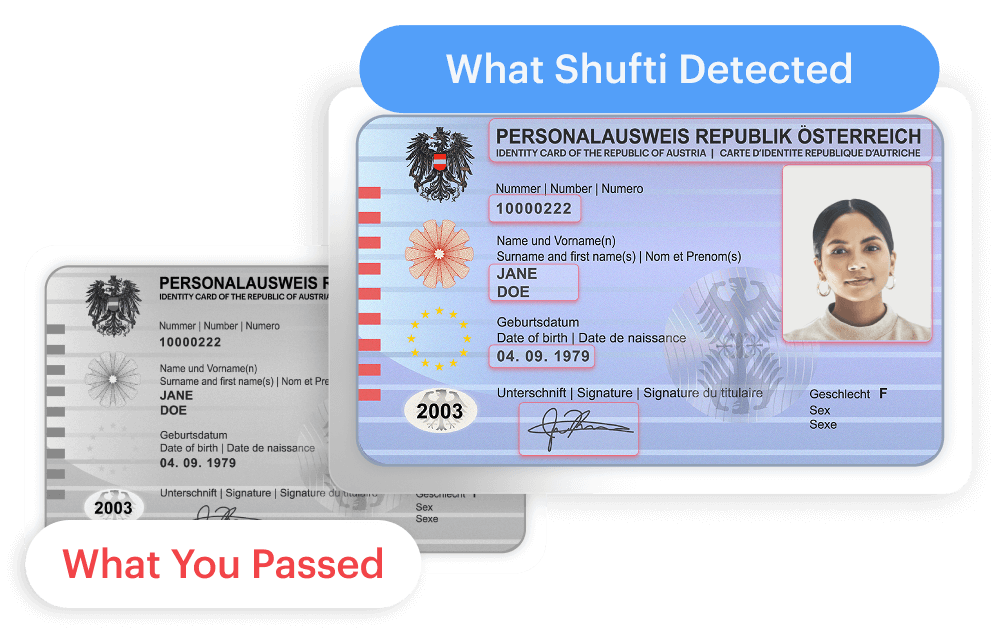





 Face Verification
 Address Verification
 Document Verification
 Age Verification
 VideoIdent
 Fast ID
 eIDV
eIDV
 NFC Verification
 Consent Verification
 Business Verification
 Due Diligence
 Investor Verification
 E-Signature
 Behavioural Biometrics
 Device Fingerprinting
 MFA
MFA
 AML Screening
 Business AML Screening
 User Risk Assessment
 Transaction Screening
 Adverse Media Screening
 Identity Verification
 KYC
KYC
 KYB
KYB
 KYI
KYI
 Bonus Abuse
 Fraud Prevention
 Deepfakes
 Banking
 Crypto
 Fintech
 Forex
Forex
 Gaming
 Gig Economy
 Marketplace
 Social Networks
 Product Managers
 Compliance Officers
 Fraud Analyst
 Global Trust Platform
 Journey Builder
 Vendor Comparison
 Content library
 Blogs
Blogs
 News
News
 Reports
 Insights
 Knowledgebase
 ROI calculator
 Blind Spot Audit
 Deepfake Detection
 Liveness Detection
 Document Originality
 Document Deepfake
 Events & Webinar
 Podcast Studio
 Spotlight Studio
 API Documentation
 Mobile SDKs
 Service Status
 Help Center
 Contact Us
 Technical Support
 Compliance
 Supported Document
 About
About
 Career
 Press Release
 Certifications
 Partnership
 Awards
How IDV Prevents Streaming Frauds in the Music Industry
- 01 What Is Streaming Fraud?
- 02 The Scale of Streaming Fraud in the Music Industry
- 03 How Streaming Fraud Actually Works?
- 04 How Streaming Fraud Impacts Artists and Listeners?
- 05 How music streaming platforms can benefit from IDV Solutions?
- 06 Building a Trustworthy Music Streaming Ecosystem with Shufti
For more than a decade, online music and video streaming have reshaped how the world discovers artists, builds fandoms, and entertains itself. Music streaming platforms now account for the majority of global recorded music revenues, and the ease of uploading content has lowered barriers for countless new musicians. However, beneath this success story sits a fast-growing crisis that most listeners never see: streaming fraud.
Although the term sounds simple, streaming fraud is far from a minor nuisance. It distorts royalties, drains billions from legitimate creators, manipulates charts, misleads audiences, and erodes trust in online music streaming services. As algorithms driven by AI are shaping digital music, the stakes associated with it are also spiking along with the sophistication of fraud.
This piece examines what streaming fraud actually is, how it works, why it is accelerating, why ordinary users should care, and what the industry must do next to secure the future of music.
What Is Streaming Fraud?
Any deliberate manipulation of plays, views, likes, or engagement on streaming platforms to artificially alter the performance metrics or revenue is referred to as streaming fraud. While the public often treats fake streams as a harmless vanity, the reality is much more consequential. Every fraudulent play directly impacts the royalty pool, which means legitimate artists earn less even when their real audience grows.
Streaming fraud takes many forms. Some actors deploy automated bots or large-scale stream farms, rows of emulated devices running playlists 24 hours a day, to gain popularity. Others impersonate real artists, uploading stolen or AI-generated tracks under similar names to capture royalties intended for any deserving artist. In some cases, criminal networks use stolen card data to create thousands of fake premium accounts that endlessly stream specific catalogs. More recently, AI streaming fraud has emerged, where machine-generated tracks are mass-produced to exploit payout systems and fill recommendation feeds with low-cost, high-volume content.
The intent behind all this is to gain revenue through fraudulent manipulation of streaming platforms without the provision of any cultural or artistic value.
The Scale of Streaming Fraud in the Music Industry
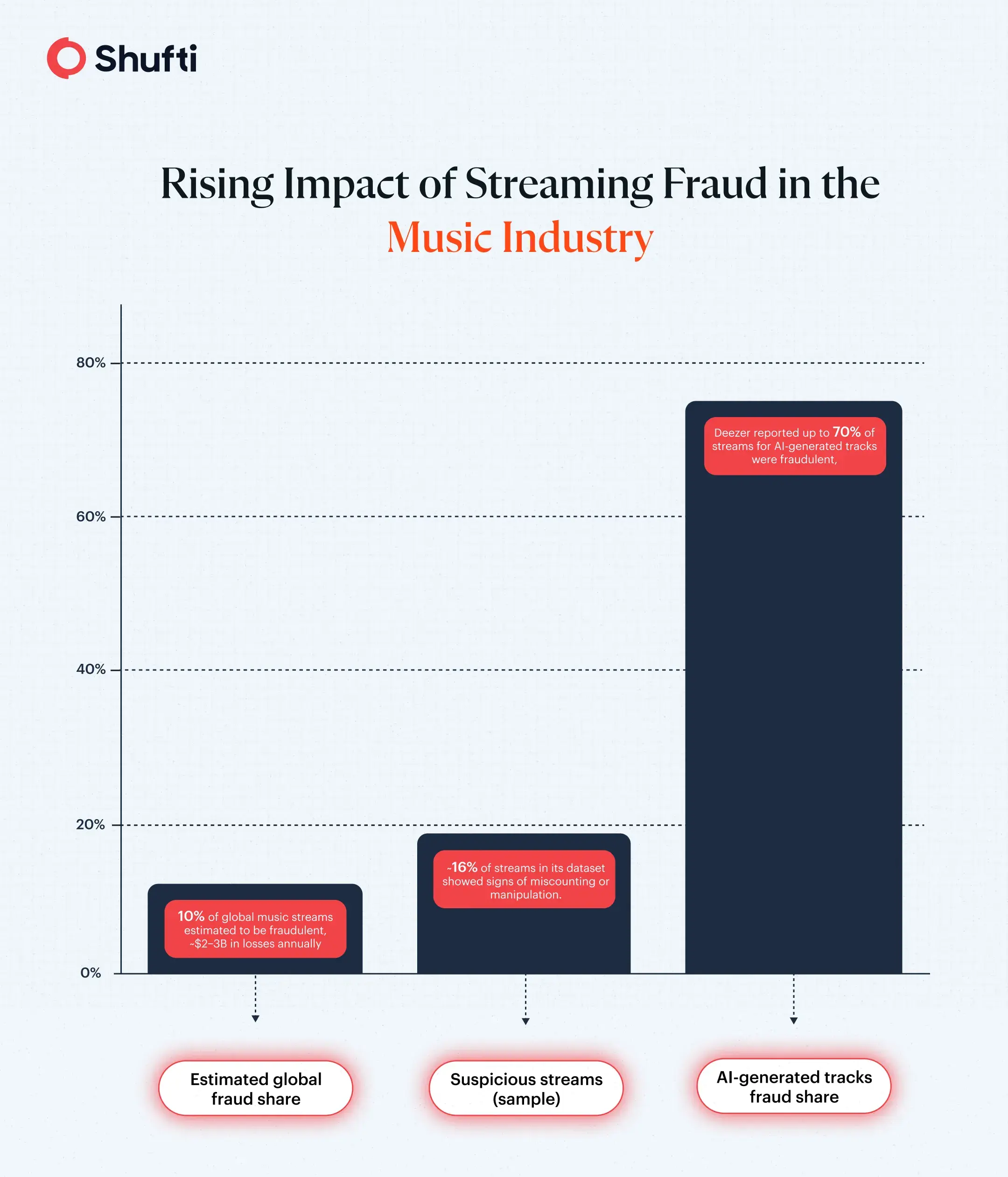
Fraud in music streaming has shifted from a niche-specific issue to a widespread systemic threat. According to Beatdapp, a streaming technology company, roughly 10% of all song streams globally are estimated to be fraudulent, translating into average losses of USD 2–3 billion annually for the music industry.
Similar analysis by Legitary, a streaming audit technology company, shows that out of 700 billion stream samples, 16% of those music streams are “suspicious,” signalling miscounts, fraudulent activity, or clear manipulations.
The music streaming companies also shed light on the magnitude of the problem. Over the past 12 months, one of the largest music streaming company, Spotify, announced it had removed more than 75 million “spammy” or AI-generated tracks from its catalog.
Meanwhile, Spotify’s competitor Deezer, while speaking publicly about the surge in fraudulent uploads, revealed that for “fully AI-generated tracks,” up to 70% of streams from AI-generated tracks are fraudulent, even though such AI-generated content remains a small fraction of total streams; the impact affects genuine artists and their listeners.
Taken together, these numbers mean that on a base of trillions of global streams (e.g., global streaming was reported over 7.1 trillion song streams in 2023, generating $19.1B), millions upon millions of those plays likely stem from manipulation, undermining royalty pools, distorting charts, and misdirecting revenue and recognition away from genuine artists.
How Streaming Fraud Actually Works?
The story of streaming fraud doesn’t begin with a hacker in a hoodie. It starts with an upload.
A fraudster takes an AI-generated track, assigns it to a fictional artist, attaches a generic cover, and fills in metadata that looks plausible enough to go undetected by the system. In minutes, that track joins millions of others on a streaming platform, treated by the system as just another song.
This looks like a simple upload; however, this is followed by three foundational steps of modern streaming: algorithms, identity, and monetization. Streaming fraud works because bad actors exploit the loopholes in all three steps.
Act I: The Upload – Content Without a Story
Streaming platforms and distributors are built for openness. Anyone can upload music; anyone can distribute globally. Such a level of accessibility has helped countless real artists in their struggle, but it also lets fraudsters blend in.
Instead of following the essence and aesthetics of music, fraudsters focus on volume. AI tools generate hundreds of tracks: background beats, ambient noise, “sleep” playlists. Others scrape existing songs from real artists and re-upload them with slightly altered titles or near-identical names.
Distributors try to catch the obvious abuse, while the sophisticated ones go unnoticed by the light identity checks. As a result of the absence of an effective identity verification process, rights ownership of the music isn’t deeply verified, and fraudulent catalogs go live with little resistance. Once they’re in, the system treats them like any other release.
Act II: The Illusion of Listening – Bots as Fake Fans
With the music live, the next step is to create fake demand.
Botnets and emulated devices begin streaming these tracks on repeat. VPNs scatter traffic across countries to reflect a global audience. In some cases, stolen payment cards are used to create large numbers of premium accounts, which earn higher royalties and look less suspicious than streaming from free accounts.
To the algorithms, this looks like real momentum: play counts spike, completion rates seem strong, and the system quietly boosts these tracks into mixes and playlists. Real listeners may start encountering them, unaware they’re seeing the result of automated manipulation instead of organic discovery.
Artificial activity trains the recommendation engine, which then recommends these AI-generated tracks to the listeners who never chose them in the first place.
Act III: The Cash-Out – Real Money from Fake Streams
The final step happens in the royalty system.
Most streaming services rely on a pro-rata model: all subscription and ad revenue is pooled, then divided by the total number of streams to calculate what each play is worth. When fake streams flood that total, they don’t just generate income for fraudsters; they reduce the value of every authentic artist.
The inflated plays on the fraudulent catalog now represent a noticeable share of global streams. Royalties are paid out to distributor accounts, shell companies, or lightly regulated entities. The fraudster withdraws real money earned from non-existent listeners.
Meanwhile, legitimate artists and rights-holders lose out. Their fanbases may grow, but their slice of the royalty pool shrinks. Charts, trending sections, and discovery feeds become less a reflection of what people want to hear and more of a falsely engineered recommendation.
How Streaming Fraud Impacts Artists and Listeners?
Online music and video streaming runs on automation, at-scale content uploads, algorithmic recommendations, fast onboarding, and near-instant payouts. Those same efficiencies create some gaps that fraudsters abuse when identity checks and verification of content are weak. Fraudulent engagement trains algorithms to recommend manipulated catalogs, so independent and mid-tier artists struggle to win playlist slots or visibility, even when they’ve built real audiences.
For listeners, streaming fraud leads to poorer recommendations and a discovery experience cluttered with low-quality, irrelevant, or synthetic music. Advertisers pay for impressions that land on bots, platforms spend more time and money on cleanup, labels dispute royalties, and regulators question whether streaming services are doing enough to protect artists and listeners. Eventually, it doesn’t remain a technical problem, but the problem becomes who actually gets the fanbase they deserve and who quietly disappears in the noise.
How music streaming platforms can benefit from IDV Solutions?
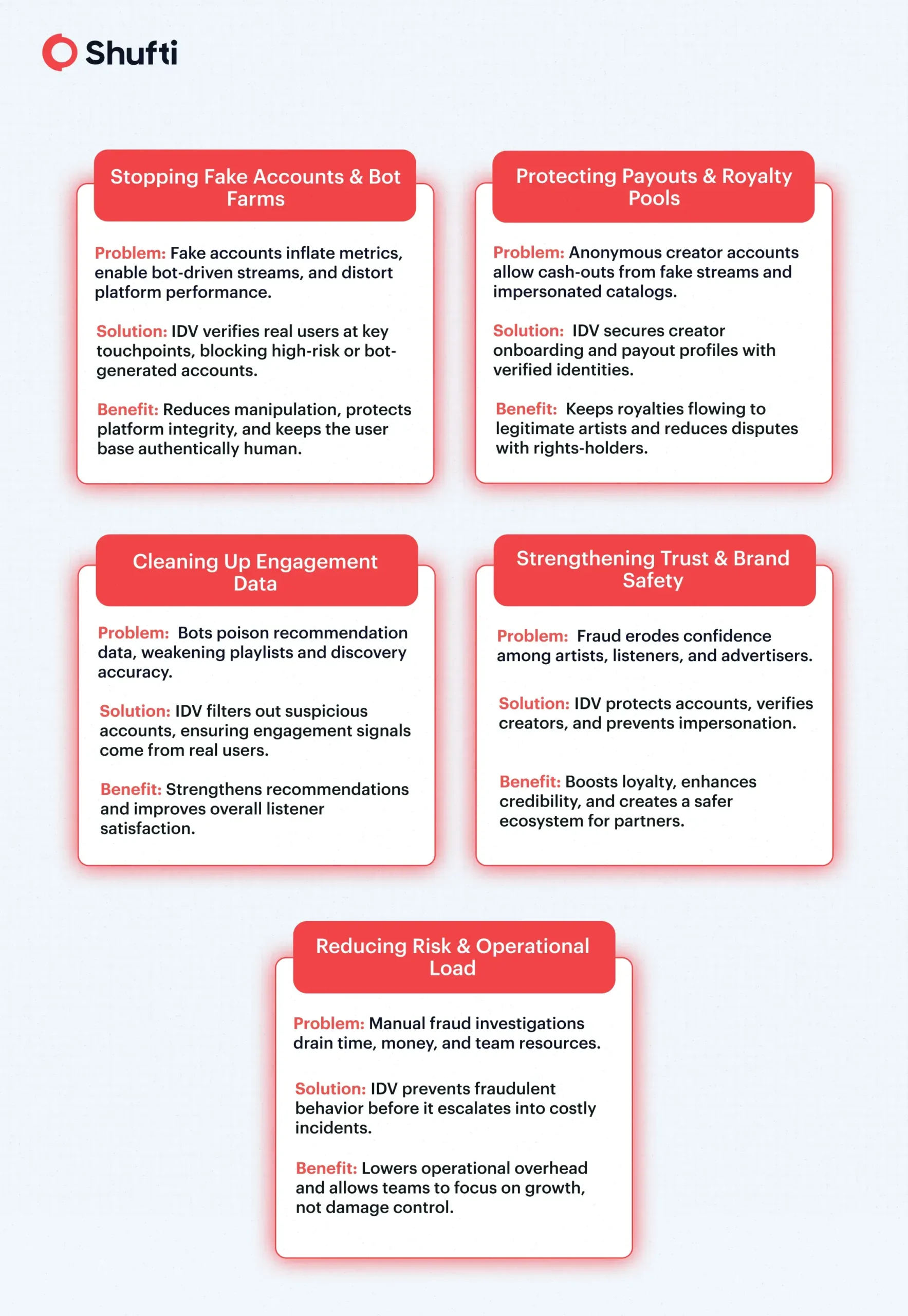
As streaming fraud becomes more and more sophisticated, the industry is slowly recognizing a fundamental truth: algorithms alone cannot stop the problem. Fraud is ultimately a question of identity.
When anyone can engage, upload content, and claim payouts without undergoing an efficient and accurate solution to verify their identity, fraudsters will continue to exploit the loopholes. Therefore, online music streaming platforms need to embrace effective identity verification in the user journey.
Building a Trustworthy Music Streaming Ecosystem with Shufti
The fight against streaming fraud ultimately comes down to protecting identity, integrity, and trust. To achieve this, streaming platforms need more than manual review or mere basic bot detection. They need indeceivable, intelligent systems that are capable of verifying real users, analyzing behavioral signals, distinguishing humans from automated networks, and securing every stage of the streaming journey.
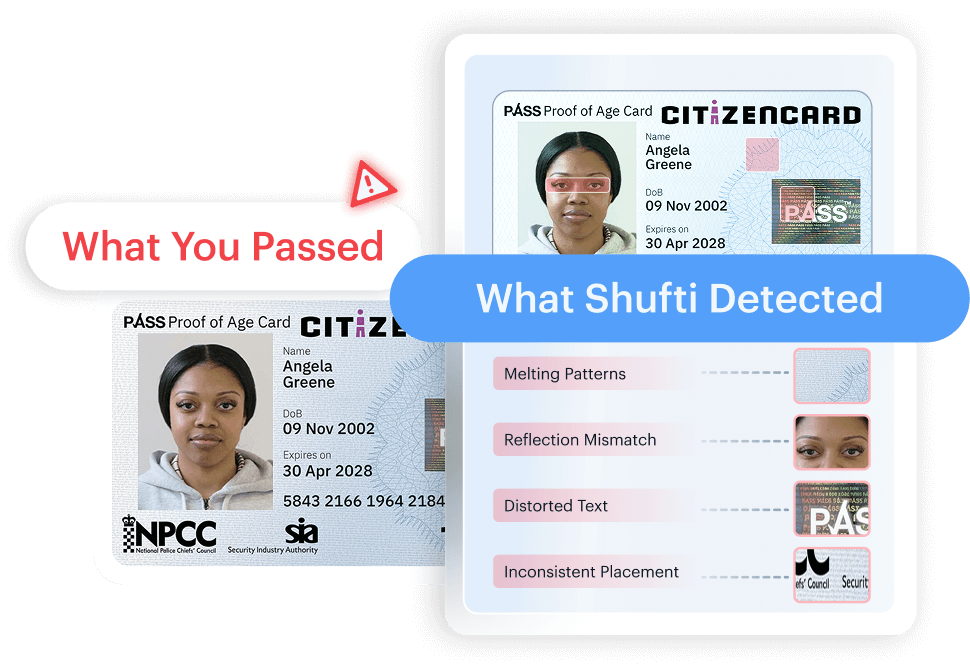
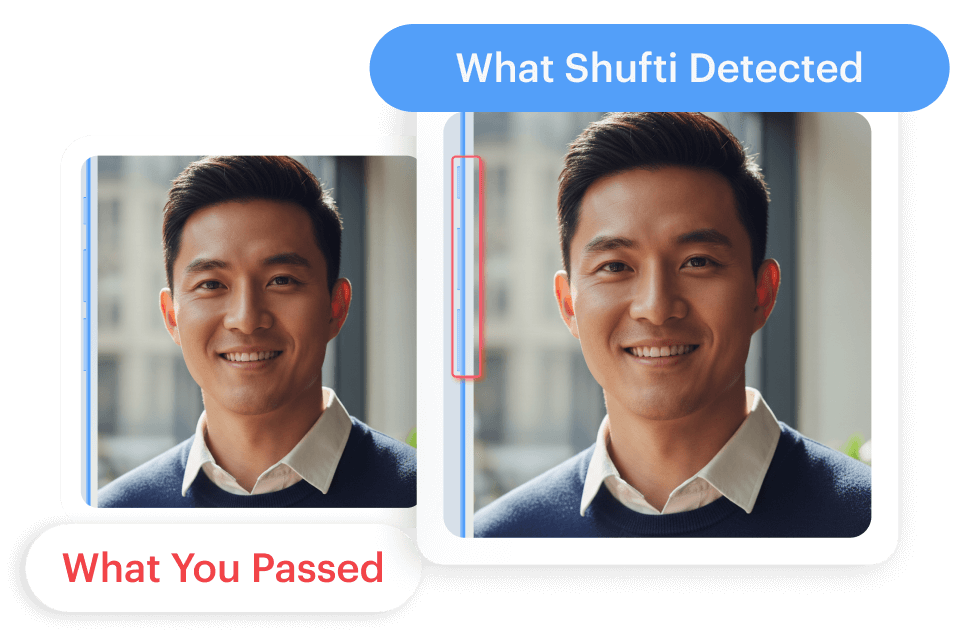
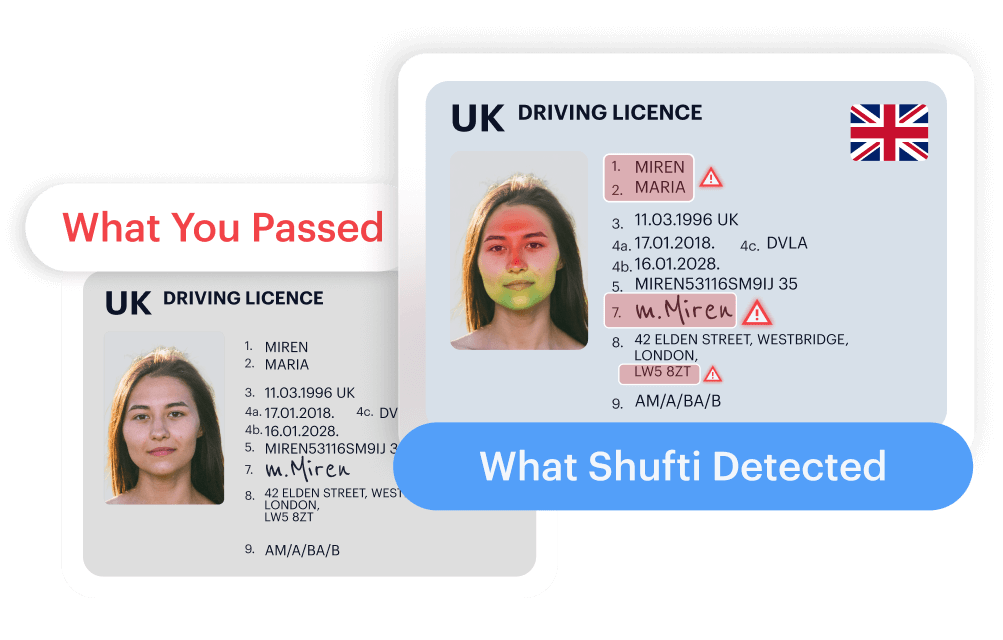
Shufti delivers global KYC, KYB, AML screening, and advanced identity verification that can support music streaming platforms at each point where fraud enters the ecosystem. The platform verifies artists and rights-holders, screens payout accounts, and applies device and behavioural intelligence to spot bot-driven engagement and multi-account abuse.
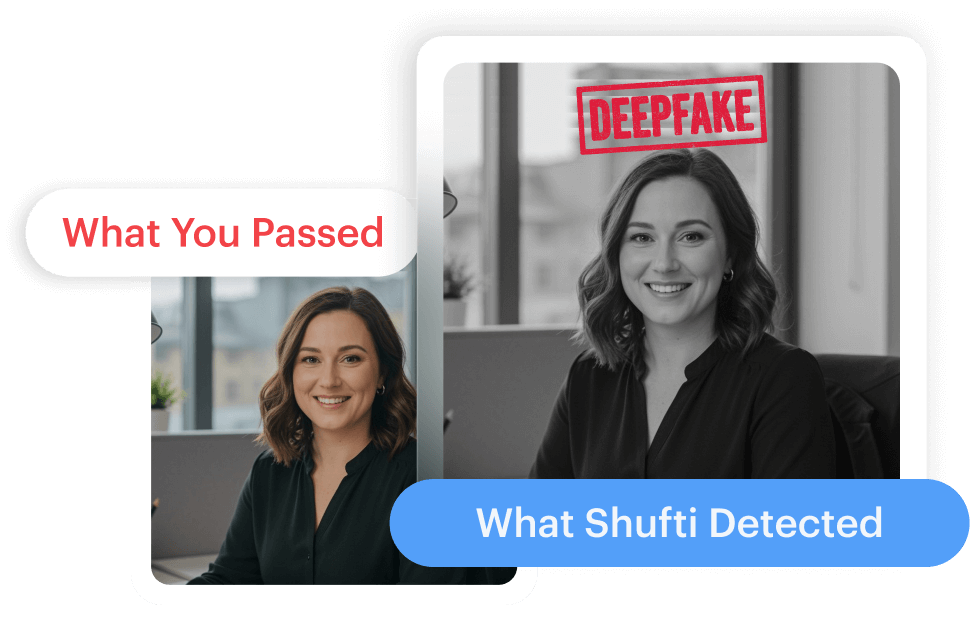
Through partnerships such as MUSIC, Shufti already helps the music community protect artist identities against impersonation, bots, and AI-generated deepfakes.
Request a demo or explore Shufti’s self-service portal to see how streaming fraud can be detected and blocked in real time.