 Runs On Your Cloud
 No Data Sharing
 No Contract Required
 Explore Now







 Face Verification
 Address Verification
 Document Verification
 Age Verification
 VideoIdent
 Fast ID
 eIDV
eIDV
 NFC Verification
 Consent Verification
 Business Verification
 Due Diligence
 Investor Verification
 E-Signature
 Behavioural Biometrics
 Device Fingerprinting
 MFA
MFA
 AML Screening
 Business AML Screening
 User Risk Assessment
 Transaction Screening
 Adverse Media Screening

 Identity Verification
 KYC
KYC
 KYB
KYB
 KYI
KYI
 Bonus Abuse
 Fraud Prevention
 Deepfakes
 Multi-Accounting
 Banking
 Crypto
 Fintech
 Forex
Forex
 Gaming
 Gig Economy
 Marketplace
 Social Networks
 Product Managers
 Compliance Officers
 Fraud Analyst
 Global Trust Platform
 Journey Builder
 Vendor Comparison

 Content library
 Blogs
Blogs
 News
News
 Reports
 Insights
 Knowledgebase
 ROI calculator
 Blind Spot Audit
 Deepfake Detection
 Liveness Detection
 Document Originality
 Document Deepfake
 Events & Webinar
 Podcast Studio
 Spotlight Studio
 API Documentation
 Mobile SDKs
 Service Status
 Help Center
 Contact Us
 Technical Support
 Compliance
 Supported Documents
 About
About
 Career
 Press Release
 Certifications
 Partnership
 Awards
What is the Total Cost of Ownership (TCO) for Identity Verification Solutions

Identity Verification has become a core requirement for secure onboarding, fraud prevention, and regulator-compliant mechanisms. But finding the right IDV vendor that suits the FI’s business needs is just the first step. While a $1.10 verification per check looks attractive when compared to a $2.50 alternative on paper, the real total cost of ownership for IDV is hidden in the friction that drives customers away.
This article breaks down the costs of identity verification software, why TCO matters, and how to accurately calculate IDV costs.
What Does Identity Verification TCO Really Mean?
TCO refers to the total cost of acquiring, integrating, operating, and scaling an identity verification solution throughout its lifecycle, not just the cost per IDV check. The TCO of an IDV solution takes into account:
- The average number of IDV checks per year.
- The number of compliance agents required to manually review flagged cases, including the average salary of a manual reviewer.
- Estimated opportunity costs from customers who abandoned onboarding (including their lifetime value/year.
This figure is added to indirect expenses, including integration, maintenance, and internal compliance overhead. A thorough understanding of the true cost of an IDV solution is a crucial factor in selecting the right IDV vendor.
How Much Does Identity Verification Software Cost?
Pricing in the identity verification market varies widely because solutions differ in coverage, assurance level, and delivery model. Most vendors use combinations of the following:
1. Per‑Verification Pricing (Pay-As-You-Go):
A common way to charge for IDV software is based on usage, where businesses are billed for the number of identity checks they perform.
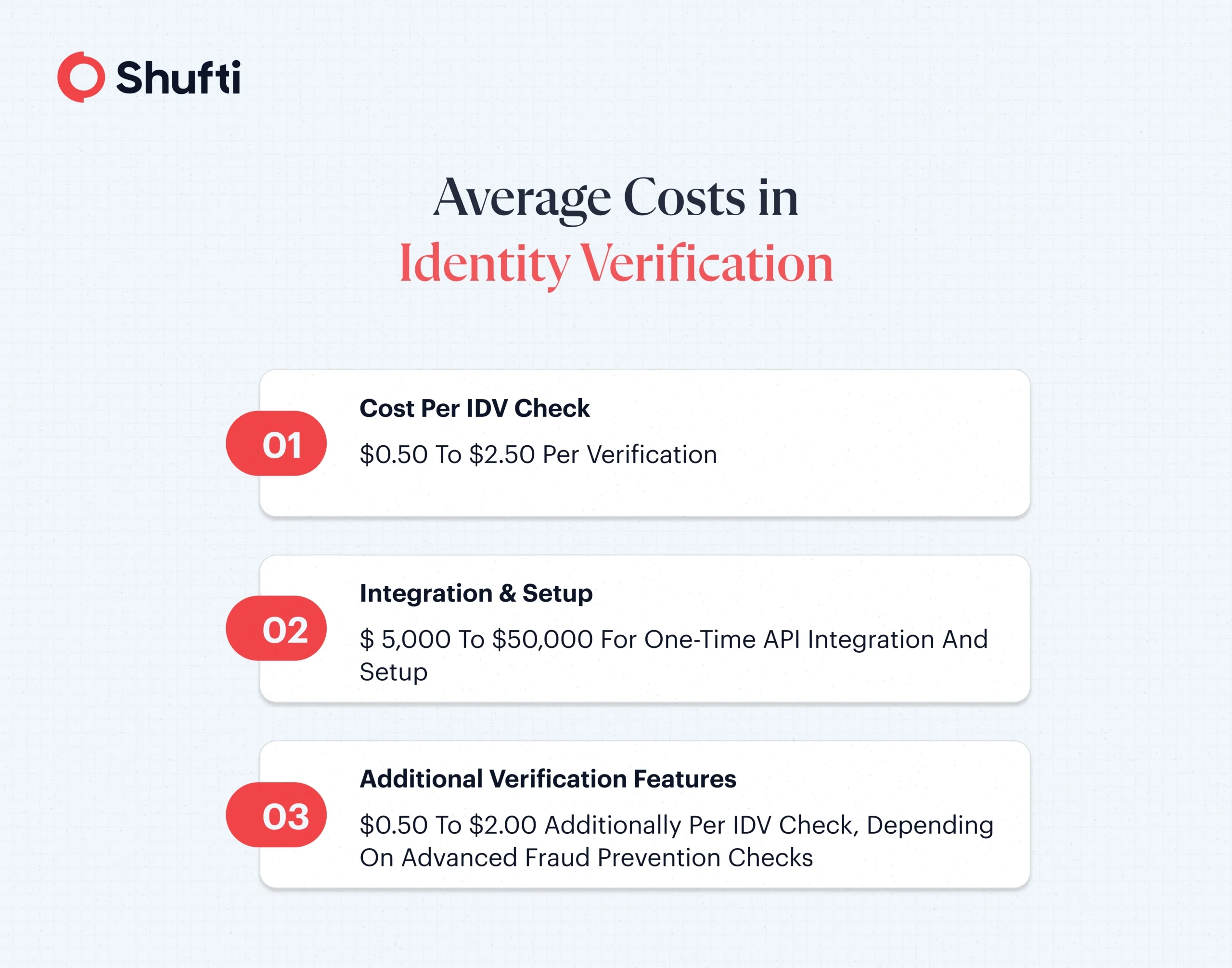
With average per-check prices ranging from $0.50 to $2.50, this pay-per-check service is preferred by businesses with fluctuating verification volumes. The exact cost of verification checks also varies with the type of check required. A basic document verification may cost $0.50 per check, but a biometric matching and liveness detection service (for heavily regulated industries such as crypto) may cost $2.00–2.50 per check.
However, businesses with large volumes of customer checks that must be verified can turn this per-check cost into a cost-effective model, often receiving discounts for bringing in large volumes.
This flexible approach lets businesses manage costs as they scale.
2. Tiered and Commitment Pricing
Tiered and commitment-based pricing is favoured by organizations that have predictable verification volumes. This allows businesses to commit to a certain volume of verification checks annually, which allows them to secure a lower pay-per-check pricing model. A company that commits to 500,000 checks annually could pay $1.00 per check on average. However, it is important for businesses to accurately forecast their verification checks. Since forecasting the commitment amount of verification checks per year automatically raises the cost per check.
Larger organizations often negotiate tiered pricing or minimum annual commitments. These provide lower per‑check costs at high volumes but require predictable usage and financial planning.
3. Add‑On Feature Fees
Some advanced capabilities, such as multi‑factor authentication (MFA), deepfake liveness detection, or bespoke API integrations, may cost more than basic checks. These add-ons can incur additional expenses, with about $1.00 added to the base cost of a single verification check. Additionally, customer API integrations incur a one-time payment of $5000 to $20,000, depending on the complexity of the integration with the FI’s existing system.
The IDV TCO Formula:
To find the true cost, FIs must calculate the Fully Loaded Cost per Successful Onboarding. The following formula may be used to calculate the real total cost of owning an IDV solution.
Core Equation: TCO = Vendor Fees + Manual Labor Cost + Lost Revenue (Abandonment)
TCO = (V x P) + (M x L) + (A x LTV)
- V (Volume): Total verification attempts. High-friction tools often force users to retry multiple times, bloating the bill without increasing the customer count.
- P (Price): The vendor fee per check.
- M (Manual Reviews): The number of verification checks that need human intervention because the automated system flagged them as “maybes”.
- L (Labor Cost): The cost of maintaining a human compliance team. In 2026, with the complexity of global regulations, the average manual review can cost $8.00 – $12.00 in labor and overhead.
- A (Abandonment): Customers who quit because the process was too slow or clunky.
- LTV (Lifetime Value): The revenue lost when a “good” user walks away.
This formula helps FIs and regulated businesses capture the key cost drivers of identity verification. Through this analysis, businesses can more accurately assess the real total cost of ownership for their IDV solutions.
The Difference Between “Cheap” and “Premium” IDV Vendors:
Let’s compare two IDV solutions for a company processing 10,000 sign-ups per month, with an average Customer Lifetime Value (LTV) of $500.
1. Option A – the cheaper solution:
Option A’s pricing model for 10,000 sign-ups per month may look like:
- Vendor Fee: $1 per verification, totaling $10,000 per month.
- Manual Review Costs: With 20% of verifications requiring manual review at $10/review, totalling $20,000 per month.
- Abandonment: 15% abandonment rate equalling 1,500 customers lost per month – totalling $750,000 lost in revenue (1,500 x $500 LTV)
Bringing the total cost for Option A to $780,000 in total.
2. Option B – the premium solution:
Option B’s pricing model for 10,000 sign-ups per month includes:
- Vendor Fee: $2 per verification, totaling $20,000 per month
- Manual Review Costs: 5% of verification requiring manual review at $10 per view, totalling $5000 per month
- Abandonment: 5% abandonment rate equalling 500 customers lost per month, totalling $250,000 in lost revenue (500 x $500 LTV).
Thus, bringing the total cost of option B to $275,000.
Therefore, a comparison of the two options reveals that while option B has a higher upfront cost due to higher vendor fees, the savings in labour and the lower abandonment rate make it the more cost-effective choice in the long term.
For FIs and regulated businesses that focus on price per verification, this comparison is an important insight into understanding that while upfront price-per-check costs may be higher, other cost drivers determine which option is more feasible in the long run.
How to Calculate Identity Verification TCO Step‑by‑Step?
The exact TCO of an IDV solution depends largely on the specific business requirements. The following may help FIs and businesses to determine the kind of IDV solution they require:
1. Define Time Frame:
Define a time frame that aligns with procurement reality and the nature of the business. While small businesses utilize shorter time frames, 3 years is a common time frame for the evaluation of expenses.
2. Estimate Verification Volume:
Project the number of identity verifications per month or year based on the current frequency. This projection should include retries/re-submissions as well, not just the projected volume of new customer onboarding.
3. Calculate Vendor Costs:
Add both the variable costs (price per-check & additional charges for premium IDV services) and fixed costs (enterprise packages, subscription fees) to calculate the annual IDV vendor costs.
4. Figure out Implementation Costs:
The TCO of an IDV solution also includes one-time setup expenses, such as API/SDK integration costs, quality assurance and testing, and security reviews.
5. List Operational Costs:
Factor in an estimated percentage of cases that require manual review, since staffing time for flagged cases can become a major driver of identity verification TCO.
A structured TCO model makes it easier for FIs to assess which IDV platform delivers the strongest value in line with the FI’s business requirements.
Shufti Pricing and TCO Positioning
Shufti’s pricing model is designed for transparency and flexibility: a free tier for early evaluation, pay‑per‑check pricing for growth, and customizable enterprise plans for high‑volume use cases. This scalable approach lets businesses align compliance costs with real usage rather than arbitrary licence fees, helping lower TCO.
An identity verification partner like Shufti that offers flexible API‑based pricing and minimizes operational friction so businesses can keep the TCO predictable and tied to actual outcomes rather than guesswork.