 Runs On Your Cloud
 No Data Sharing
 No Contract Required
 Explore Now







 Face Verification
 Address Verification
 Document Verification
 Age Verification
 VideoIdent
 Fast ID
 eIDV
eIDV
 NFC Verification
 Consent Verification
 Business Verification
 Due Diligence
 Investor Verification
 E-Signature
 Behavioural Biometrics
 Device Fingerprinting
 MFA
MFA
 AML Screening
 Business AML Screening
 User Risk Assessment
 Transaction Screening
 Adverse Media Screening

 Identity Verification
 KYC
KYC
 KYB
KYB
 KYI
KYI
 Bonus Abuse
 Fraud Prevention
 Deepfakes
 Banking
 Crypto
 Fintech
 Forex
Forex
 Gaming
 Gig Economy
 Marketplace
 Social Networks
 Product Managers
 Compliance Officers
 Fraud Analyst
 Global Trust Platform
 Journey Builder
 Vendor Comparison

 Content library
 Blogs
Blogs
 News
News
 Reports
 Insights
 Knowledgebase
 ROI calculator
 Blind Spot Audit
 Deepfake Detection
 Liveness Detection
 Document Originality
 Document Deepfake
 Events & Webinar
 Podcast Studio
 Spotlight Studio
 API Documentation
 Mobile SDKs
 Service Status
 Help Center
 Contact Us
 Technical Support
 Compliance
 Supported Document
 About
About
 Career
 Press Release
 Certifications
 Partnership
 Awards
UK Knife Laws and Two-Step Age Verification

The latest ONS Crime Survey for England and Wales recorded 50,510 knife or sharp instrument-related offences in the year ending March 2024. Knife crime has become a serious public issue in the UK, especially in populated urban settlements.
In response, the UK Government plans to take direct action against e-commerce platforms as part of the Government’s broader Safer Streets Mission. The Crime and Policing Bill introduces minimum standards for age and ID checks for knife purchases, ensuring the buyer and the recipient are the same person and meet the set age threshold.
However, these changes represent a major shift in compliance requirements: e-commerce businesses are now obligated not only to verify the buyer’s age at purchase but also to enforce identity verification from purchase through delivery.
Consequently, the following article discusses the IDV obligation imposed by the Bill on online businesses and the utility of a modern KYC solution.
Significance of the Crime and Policing Bill
The latest estimates of the ONS Crime Survey Report for England and Wales make one thing clear: knife-related crimes have become a public safety issue. In response, the proposed Bill takes a tougher stance on the remote sale of knives and other bladed articles. A central feature of this bill is the two-step process that ties the buyer’s identity at checkout to the recipient at the door.
The key objectives of the Bill aim to:
- Preventing underage access to knives.
- Reducing proxy buying, where an adult purchases knives on behalf of someone underage.
- Closing delivery handover gaps, where a package is received by someone other than the verified buyer. Additionally, the Bill explicitly prohibits drop-offs of such items at doorsteps; they must be handed over to the buyer after identity verification.
Thus, identity verification spans the entire customer journey. This new regulation affects everything from checkout to fraud prevention, courier workflows, and audit evidence for disputes or legal claims.
Did You Know?
Like Knives, the sale of crossbows to individuals under the age of 18 is also banned under the Crossbows Act 1987. The new Crime and Policing Bill applies the same criteria for knives to the sale of crossbows.
Consequently, online platforms engaged in the sale of crossbows shall also have to comply with these new requirements once the Bill receives Royal Assent.
Key Age Verification and Identity Requirements of UK Knife Laws
The Crime and Policing Bill introduced several compliance obligations for e-commerce sites.
- Enhanced checks for the remote purchase of knives and other bladed items.
- A two-step age verification process that verifies identity at both purchase and delivery to verify that the buyer and recipient are the same person.
- A duty to report bulk remote knife sales, where patterns of suspicious activity need to be reported to authorities.
- Personal liability of senior managers of online platforms for failure to remove advertisements of illegal/banned knives.
Here is how the proposed regulations would work in practice:
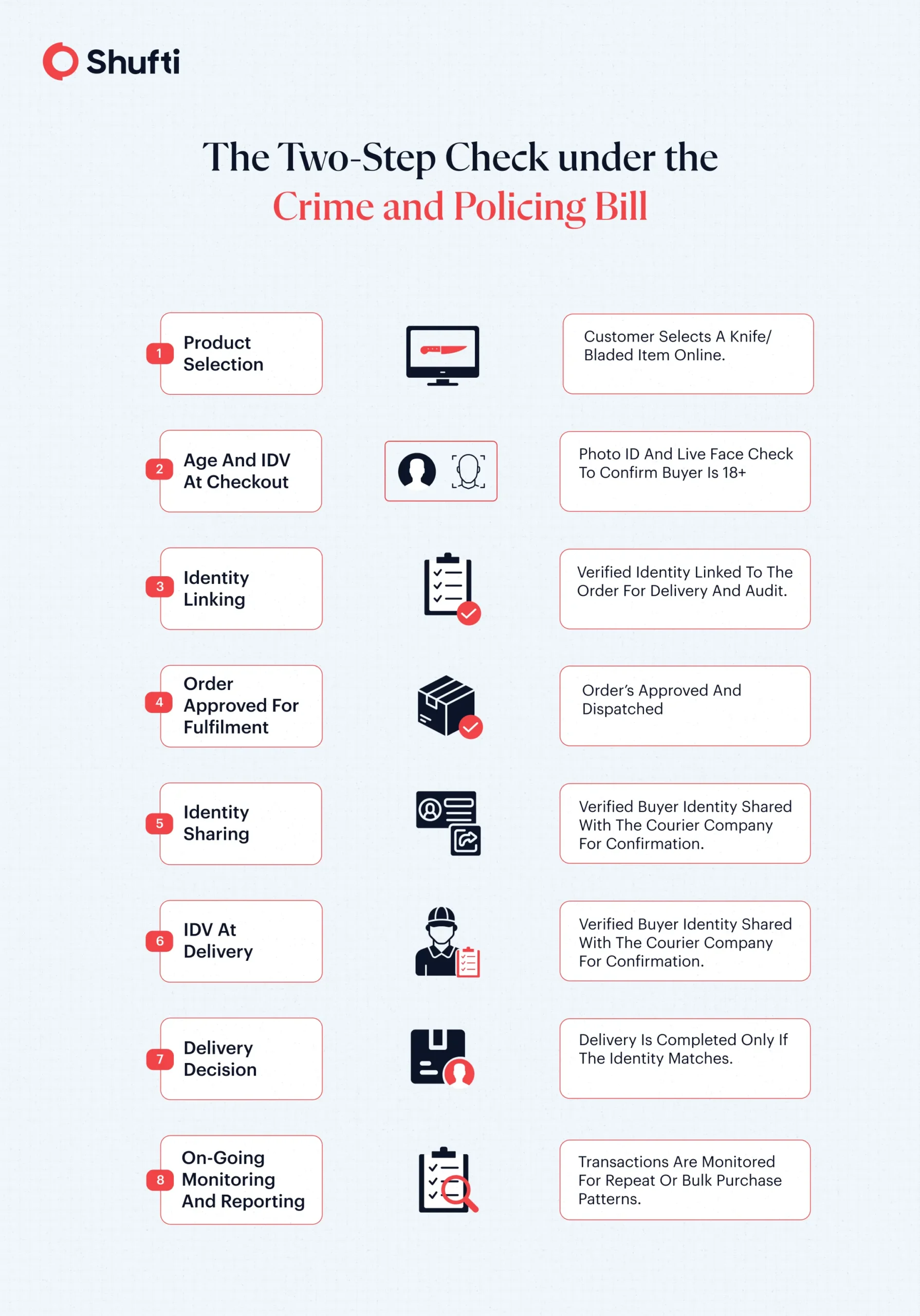
Verification of Age at Checkout – The First Step:
The first step is to verify the buyer’s age and identity at the point of purchase. Unlike traditional age verification, this step involves photo ID checks rather than a simple self-declaration or checkbox. The goal is to prevent underage purchasing and identity misuse. Businesses must:
- Verify identity using photographic identification, such as a Passport or a UK driving license, including a recent photograph of the buyer to verify identity with documents.
- Link the ID document to the person making the purchase in real-time.
- Retain audit-ready records to support investigations if needed.
Identity Verification at Delivery – The Second Step:
After successful identity verification at checkout, businesses must ensure the knife is delivered to the same individual who made the purchase. Delivery companies will be required to verify the recipient’s identity before handing over a package, closing the delivery loophole that allows a valid adult purchase to be passed to someone underage.
For online marketplaces, this means:
- Delivery drivers and collection point operators must have a consistent process for checking photographic identity documents provided by the buyer.
- The identity verification information of the seller and the courier has to match for delivery.
When to Report Bulk and Repeat Purchases?
As an additional security measure, the Bill also imposes a mandatory obligation on e-commerce platforms to report bulk sales of “bladed articles” to the police. To verify and account for bulk orders, businesses need to monitor transactions for unusual buying patterns, such as multiple purchases from the same address or from the same account.
In the context of the Bill, bulk orders do not only refer to a single large order, but also to small orders spread over weeks or months that are being delivered to the same address, or being purchased by the same individual.
Common Challenges for Online Marketplaces
The Crime and Policing Bill introduces a number of operational challenges for online marketplaces. To recap, these include:
- Stringent Identity Verification measures that replace basic self-declarations, requiring businesses to implement a more robust method for ID verification and linking said verification to that specific customer.
- Delivery checks must be integrated into existing workflows, adding complexity to an already time-sensitive process.
- Bulk and repeat purchase reporting requires enhanced monitoring to detect patterns across accounts, addresses, and purchase history.
How Shufti Supports Two-Step Age and Identity Verification?
The Crime and Policing Bill’s new requirements make it clear that e-commerce businesses will be required to implement mandatory identity verification at both the checkout and delivery stages.
Shufti supports identity-backed age verification checks through document and face verification with liveness, helping e-commerce platforms build audit-ready evidence for regulated sales journeys. Through document verification and facial verification, Shufti’s identity verification solutions are ideally suited to meet these requirements, providing businesses with the tools they need to efficiently comply with the two-step process.
For delivery-stage compliance, Shufti’s Fast ID service enables businesses to save identity data that can be reused to support IDV checks with platform and courier workflows, helping produce consistent audit evidence across purchase and handover.
A demo can help teams assess how the two-step requirement fits into existing checkout and delivery workflows. Book one today!