 Runs On Your Cloud
 No Data Sharing
 No Contract Required
 Explore Now








 Face Verification
 Address Verification
 Document Verification
 Age Verification
 VideoIdent
 Fast ID
 eIDV
eIDV
 NFC Verification
 Consent Verification
 Business Verification
 Due Diligence
 Investor Verification
 E-Signature
 Behavioural Biometrics
 Device Fingerprinting
 MFA
MFA
 AML Screening
 Business AML Screening
 User Risk Assessment
 Transaction Screening
 Adverse Media Screening

 Identity Verification
 KYC
KYC
 KYB
KYB
 KYI
KYI
 Bonus Abuse
 Fraud Prevention
 Deepfakes
 Banking
 Crypto
 Fintech
 Forex
Forex
 Gaming
 Gig Economy
 Marketplace
 Social Networks
 Product Managers
 Compliance Officers
 Fraud Analyst
 Global Trust Platform
 Journey Builder
 Vendor Comparison

 Content library
 Blogs
Blogs
 News
News
 Reports
 Insights
 Knowledgebase
 ROI calculator
 Blind Spot Audit
 Deepfake Detection
 Liveness Detection
 Document Originality
 Document Deepfake
 Events & Webinar
 Podcast Studio
 Spotlight Studio
 API Documentation
 Mobile SDKs
 Service Status
 Help Center
 Contact Us
 Technical Support
 Compliance
 Supported Document
 About
About
 Career
 Press Release
 Certifications
 Partnership
 Awards
Unified KYC API for Developers That Reduces Integration Complexity with Shufti
- 01 What a Unified KYC Endpoint is and Why it Matters for Engineering
- 02 Why Multiple KYC Endpoints Break Real-World Integrations
- 03 A Developer-Friendly REST API Designed for Predictability
- 04 Request-Level Configuration that gives Teams Flexibility
- 05 Unified API for On-Site and Off-Site Onboarding Journeys
- 06 Switch Between Sync and Async Without Rebuilding
- 07 Data Residency and Deployment for Regulated Environments
- 08 We Help You Scale KYC Without the Technical Debt
In KYC, every onboarding flow has one moment where trust is decided. And that moment is shaped by latency, failure points, and how many things can go wrong between “user started verification” and “decision returned”. But before we discuss what breaks, let’s define what teams actually mean by a unified KYC endpoint.
What a Unified KYC Endpoint is and Why it Matters for Engineering
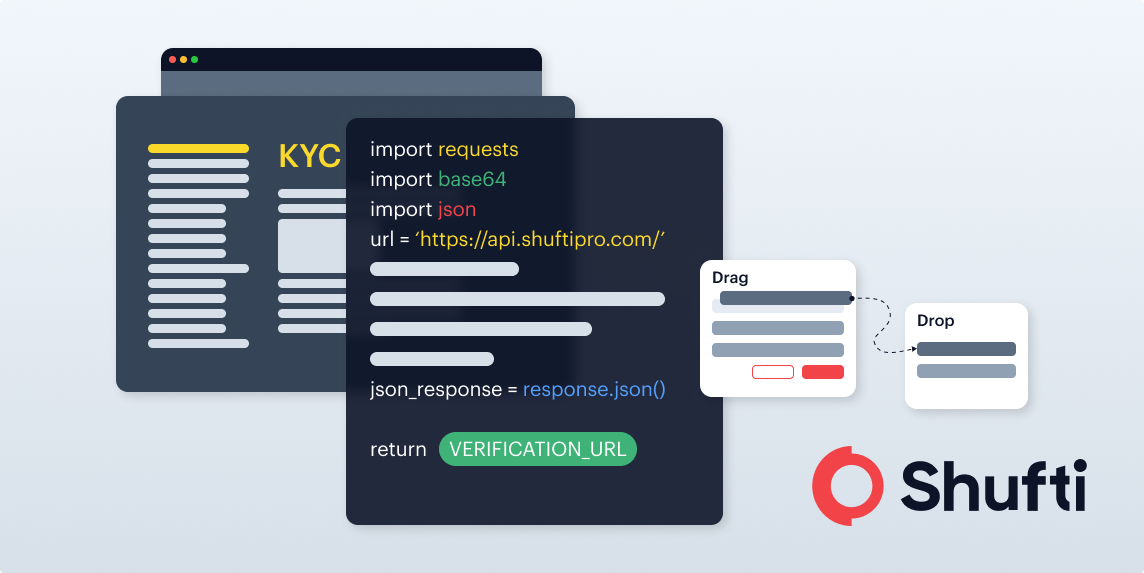
A unified endpoint is a single API integration surface where you trigger identity verification, fraud checks, and compliance screening through one request pattern, controlled by parameters.
Instead of integrating separate endpoints, you send one request that specifies which checks to run, how the user will complete verification, and how results should be returned. And you get back one clean outcome with a single verification reference to track, a consistent status model, and a unified result payload delivered immediately or via webhook
For engineering teams, the real pain rarely comes from verification accuracy but rather from the integration fragmentations with multiple endpoints for different checks, rigid settings that cannot be adjusted per use case, inconsistent payloads, rigid configurations, and onboarding flows that do not map to real product journeys.
Over time, teams end up maintaining custom workflow layers, duplicating configurations, and embedding policy exceptions into code.
This is the problem a unified KYC API is supposed to solve. In this blog, we break down how multi-endpoint KYC integrations create unnecessary workflow complexity and failure points, what a unified endpoint changes at the architecture level, and what to look for beyond a single endpoint label.
We’ll cover how Shufti’s single-endpoint KYC API supports production reliability and performance, request-level configuration for different products and risk tiers, flexible deployment and data residency needs, predictable REST patterns, hybrid onboarding journeys, and the ability to switch between synchronous and asynchronous processing without rebuilding your integration.
Why Multiple KYC Endpoints Break Real-World Integrations
Most KYC failures happen because of poor integration methods for each service, such as document verification, facial verification and AML checks, which means you end up with different request formats, response formats, retry logic and monitoring paths for each service you are integrating.
Shufti removes this fragmentation rather than having to integrate and maintain several different services. It gives you the capability to integrate a single unified endpoint that can perform one or many verifications in a single request.
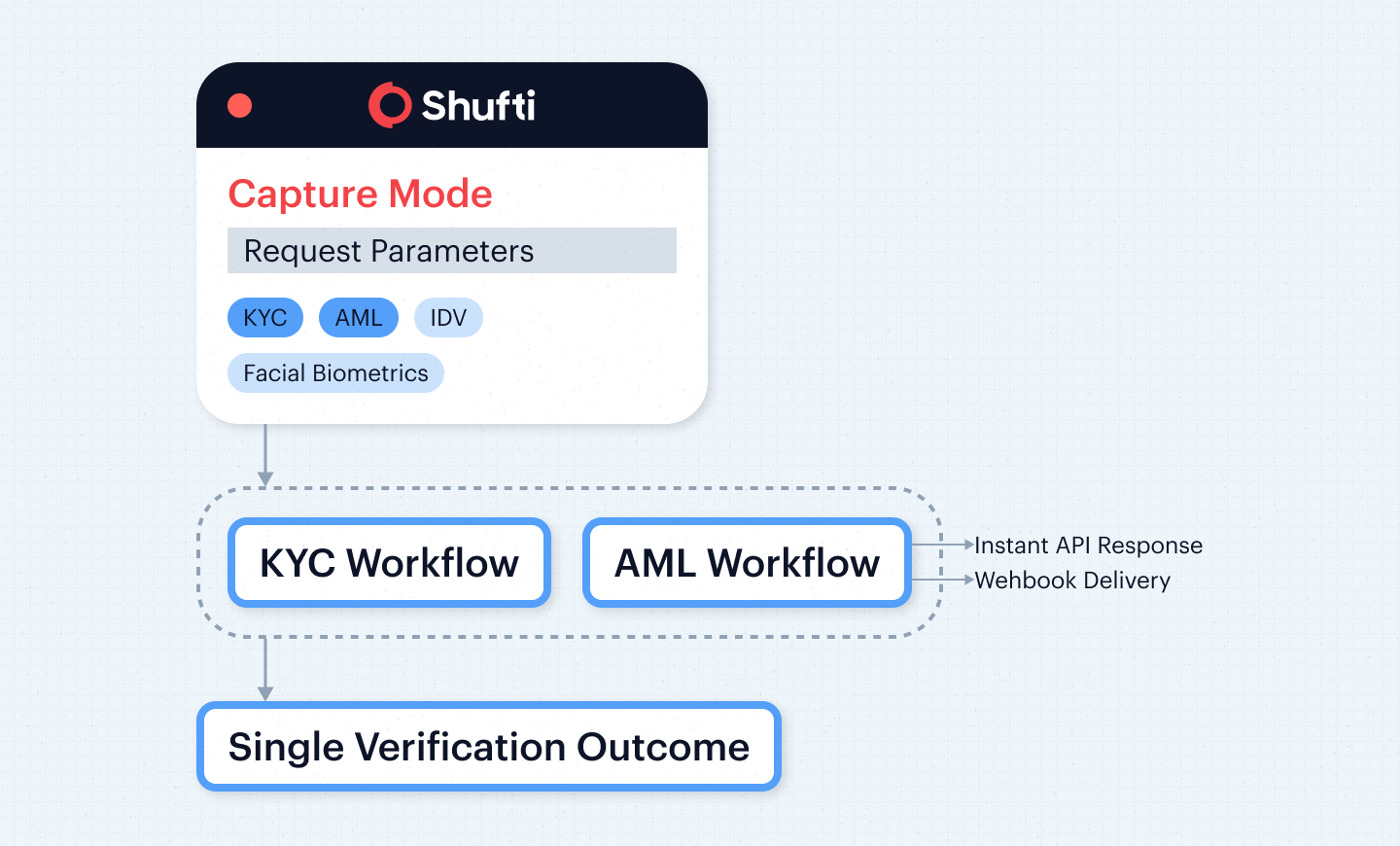
What a unified endpoint actually solves:
- One endpoint controlled entirely through request parameters
- Combined KYC and AML workflows in a single call
- One verification outcome, returned instantly or delivered via webhook
This means less workflow management, fewer failure scenarios, and a cleaner, easier-to-track verification state.
-
Enterprise Reliability and Performance Built into the API
A unified endpoint only matters if it stays fast and available under real onboarding load. Shufti’s KYC API is built for production environments with SLA-backed uptime of 99% and performance commitments designed for real-time onboarding journeys.
For latency-sensitive flows, Shufti supports P95 response-time commitments, including an ~200ms API response time for generating the onset URL. This helps reduce drop-offs and keeps verification predictable even as traffic scales.
A Developer-Friendly REST API Designed for Predictability
KYC workflows are complex by nature. The role of the API is to make that complexity predictable. When creating workflows to verify users, giving consideration to all the different components and exceptions available is important. In this respect, the API behind your workflow must minimize ambiguity for you and other developers.
Shufti’s KYC API follows conventional REST standards, making it easy for both you and other developers to implement and support integrations. All requests sent using the API are stateless; response formats will always follow a predictable pattern.
What this means in practice:
- Simple, developer-friendly request and response payloads
- Clear and consistent data structures across verification types
- No unnecessary nesting or over-engineered formats
- Straightforward authentication aligned with common practices
This reduces implementation time, lowers integration risk, and makes the system easier to scale and debug.
Request-Level Configuration that gives Teams Flexibility
Global KYC settings function until the complexities of the real world appear. Different products, regions, and risk tiers rarely share the same verification rules, and when exceptions are needed, it’s extremely common for many providers to force teams to either clone projects, duplicate settings, or embed verification rules into application logic.
Shufti avoids this by supporting fine-grained request-level configuration, which allows teams to override verification behaviour per request without affecting global policies.

What teams control per request:
- Allow or restrict specific document types
- Accept or reject colour copies, screenshots, laminated documents, and similar formats
- Decide whether documents must be captured live or can be uploaded
- Apply different behaviour per service within the same request when needed
This keeps compliance rules clean, reduces configuration sprawl, and prevents policy logic from leaking into your codebase.
Unified API for On-Site and Off-Site Onboarding Journeys
Real onboarding experiences can be different across different companies. Some organisations embed verification inside their product, while others prefer the provider to handle end-user interaction externally, and many run hybrid flows where some data is collected in-app, and the provider captures the missing pieces.
Shufti’s hybrid onboarding enables teams to keep their preferred UX for the parts they control, while Shufti completes the verification flow for the remaining steps, all under the same request and the same endpoint.
How hybrid onboarding works:
- The merchants submit pre-collected user data
- Shufti collects only the missing verification inputs
- The verification runs under a single request
- Onboarding can match your UX and operating model without separate integration paths
This makes architecture simpler and reduces rework when the onboarding strategy evolves.
Switch Between Sync and Async Without Rebuilding
The way that products and risk tiers differ may affect the method of verification. For instance, some onboarding flows require a decision instantly, while others work better asynchronously, especially when deeper screening, additional data checks, or manual review are involved.
Shufti supports both synchronous and asynchronous verification through the same endpoint, thereby eliminating the need to create two separate methods of integration.
Processing options:
- Synchronous mode returns results in the same call
- Asynchronous mode is enabled through a parameter and delivers results via callback or webhook
Engineering can choose the right mode per product or user segment without changing the integration.
Data Residency and Deployment for Regulated Environments
KYC involves sensitive identity data, which means regional hosting and infrastructure constraints aren’t edge cases; they’re common blockers.
Shufti supports data residency requirements and can deploy customers in specific regions based on business and compliance needs.
Infrastructure can also match the customer’s operating model rather than forcing a single deployment pattern.
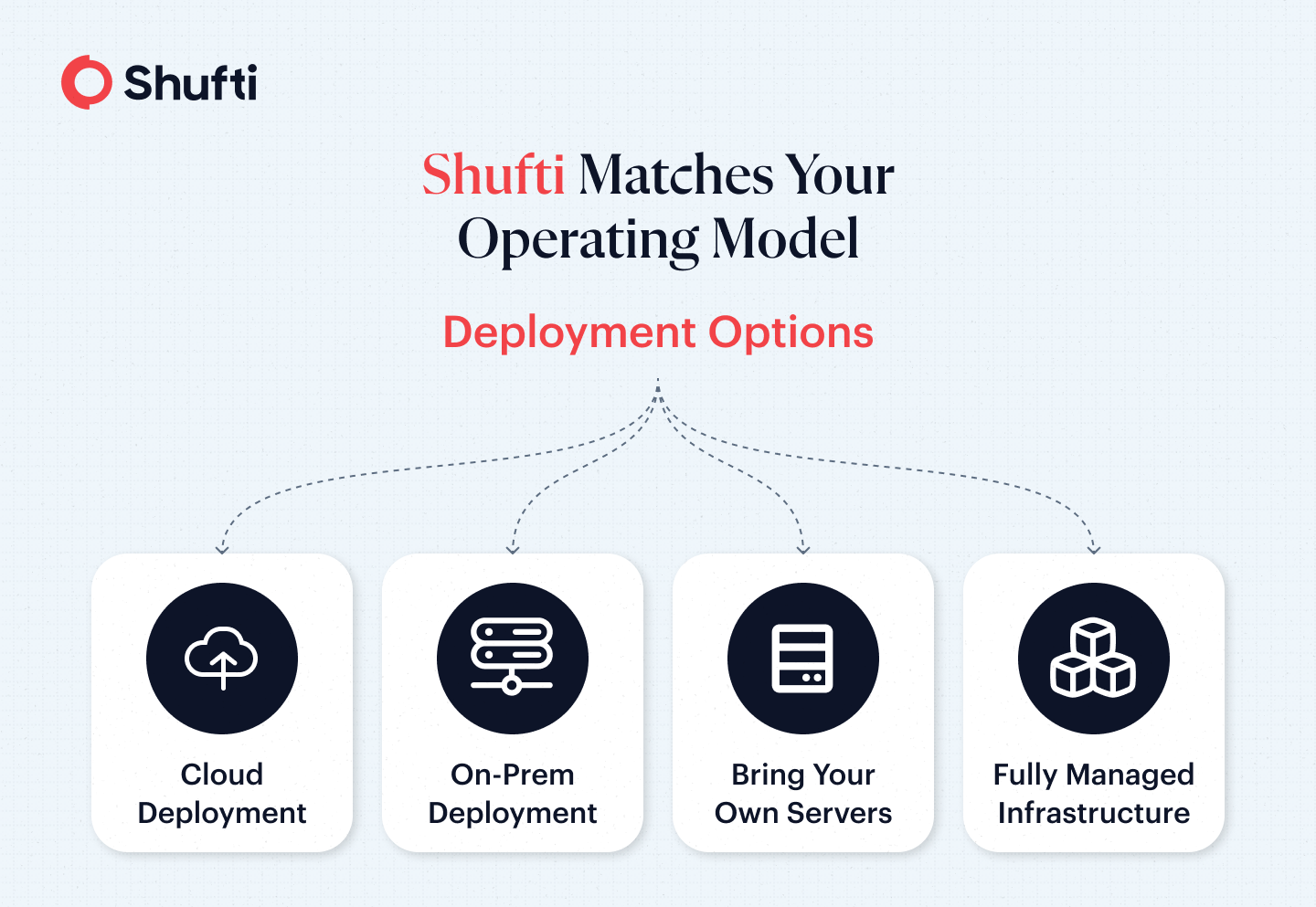
Deployment options supported by Shufti:
- Cloud deployment
- On-prem deployment
- Bring-your-own servers
- Fully managed infrastructure
This provides regulated teams with more control, eliminating the need for separate systems, vendors, or architectures.
We Help You Scale KYC Without the Technical Debt
Shufti is built for teams that want reduced integration complexity, clean architecture with stable interfaces, fewer duplicated configurations and less project sprawl, expansion into multiple markets without new endpoints, and scale without accumulating technical debt.
Instead of forcing onboarding flows to fit a rigid verification system, Shufti’s API adapts to your organisation, allowing engineering to maintain control, compliance to remain configurable, and product teams to scale across regions with fewer structural changes.