











The UK Online Safety Act 2023 did not arrive with a gentle transition period. Ofcom’s guidance on highly effective age assurance set four enforceable criteria (technical accuracy, robustness, reliability, and fairness) and made clear that a checkbox date-of-birth field does not qualify. For any enterprise evaluating vendor options, the gap between a point solution and a production-grade age verification platform is the difference between passing a first audit and building a stack that scales to the next regulation.
Platform capabilities, certifications, and vendor evaluation questions determine whether a vendor is built for enterprise compliance or just a first deployment.
Platform vs point solution: why the distinction matters at scale
A point solution verifies age. A platform manages age verification across multiple products, geographies, methods, and regulatory contexts and gives your compliance and product teams the controls to adapt when the rules change.
The practical difference shows up in three places. First, a platform carries multiple verification methods (document OCR, biometric face matching, facial age estimation, database checks, digital identity wallets) in a single integration, so your orchestration layer decides the method at runtime based on the user’s region, device, and risk profile. Second, a platform maintains an audit trail and reporting dashboard that your legal team can produce in a regulator inquiry, not just a pass/fail signal your engineering team has to reconstruct from logs. Third, a platform has a support model built around compliance outcomes, not just API uptime. If Ofcom or the Kommission fur Jugendmedienschutz (KJM) issues new guidance mid-quarter, your vendor’s response is what protects your next certification window.
Buying a point solution for a single market is a reasonable starting position. Buying one when you operate across five jurisdictions is a procurement liability.
What capabilities should an enterprise age verification platform have?
The question to ask about each claimed capability is not whether the vendor has it, but how it performs under the conditions your users actually experience, including peak load, shared devices, low-quality cameras, international documents, and users with accessibility needs.
Six capabilities deserve a line item in every RFP.
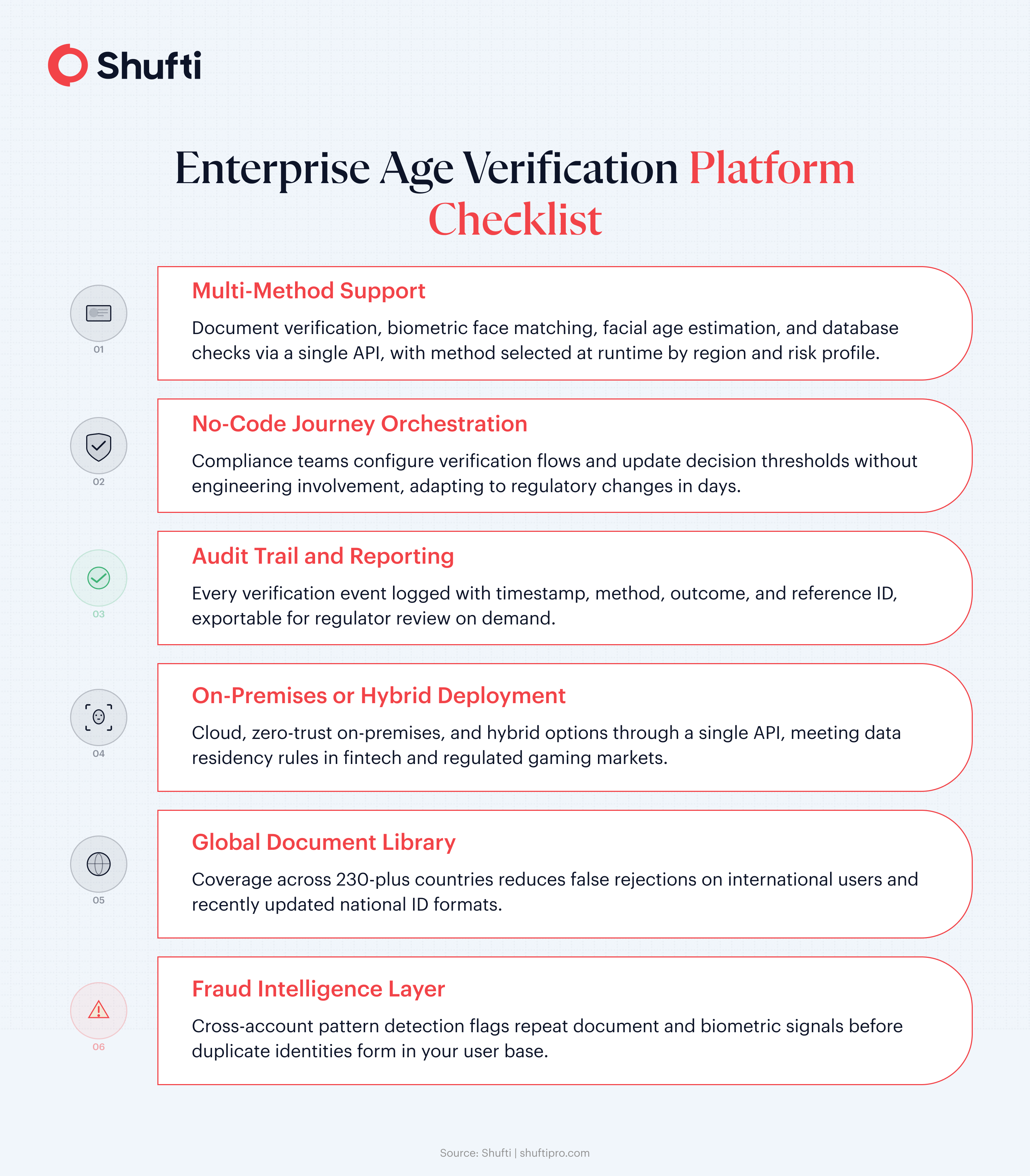
Multi-method support
The platform must support document verification, biometric face matching with liveness, facial age estimation, and database-backed eIDV checks from a single integration. Age verification methods vary by jurisdiction and friction tolerance, and a platform that only supports one method will require a rearchitecture when regulations shift.
No-code journey orchestration
Your product team should be able to configure verification flows, set fallback logic, and update decision thresholds without writing code. Platforms that require engineering involvement for every regional policy update create compliance lag.
Audit trail and reporting dashboard
Regulators ask for evidence of consistent enforcement, not just a claim that you have age verification in place. The platform must log every verification event with a timestamp, method used, decision outcome, and reference ID your team can retrieve and export.
On-premises or hybrid deployment
Cloud-only is a deal-breaker for platforms operating in fintech or regulated gaming markets where data residency matters. Look for a vendor offering zero-trust on-premises deployment alongside cloud and hybrid options through a single API.
Global document library
A shallow document library creates false rejections on international users, particularly for recently updated national ID formats the vendor has not trained on. Ask for the exact document-type count, not a rounded approximation.
Fraud intelligence layer
The platform should flag serial fraud patterns, including the same document presented across multiple accounts and the same face used to create duplicate identities. Passive liveness alone does not catch repeat fraudsters.
As of March 2026, the IEEE Standards Association notes that platforms adopting AI-powered biometric age estimation are now expected to pair it with stronger governance controls and independent evaluation, not just technical accuracy benchmarks.
How do you verify an age verification platform’s certifications and compliance readiness?
Certification claims in vendor materials often appear without context. Knowing which certifications to require, and what they actually test for, is the fastest way to separate substantive compliance from marketing copy.
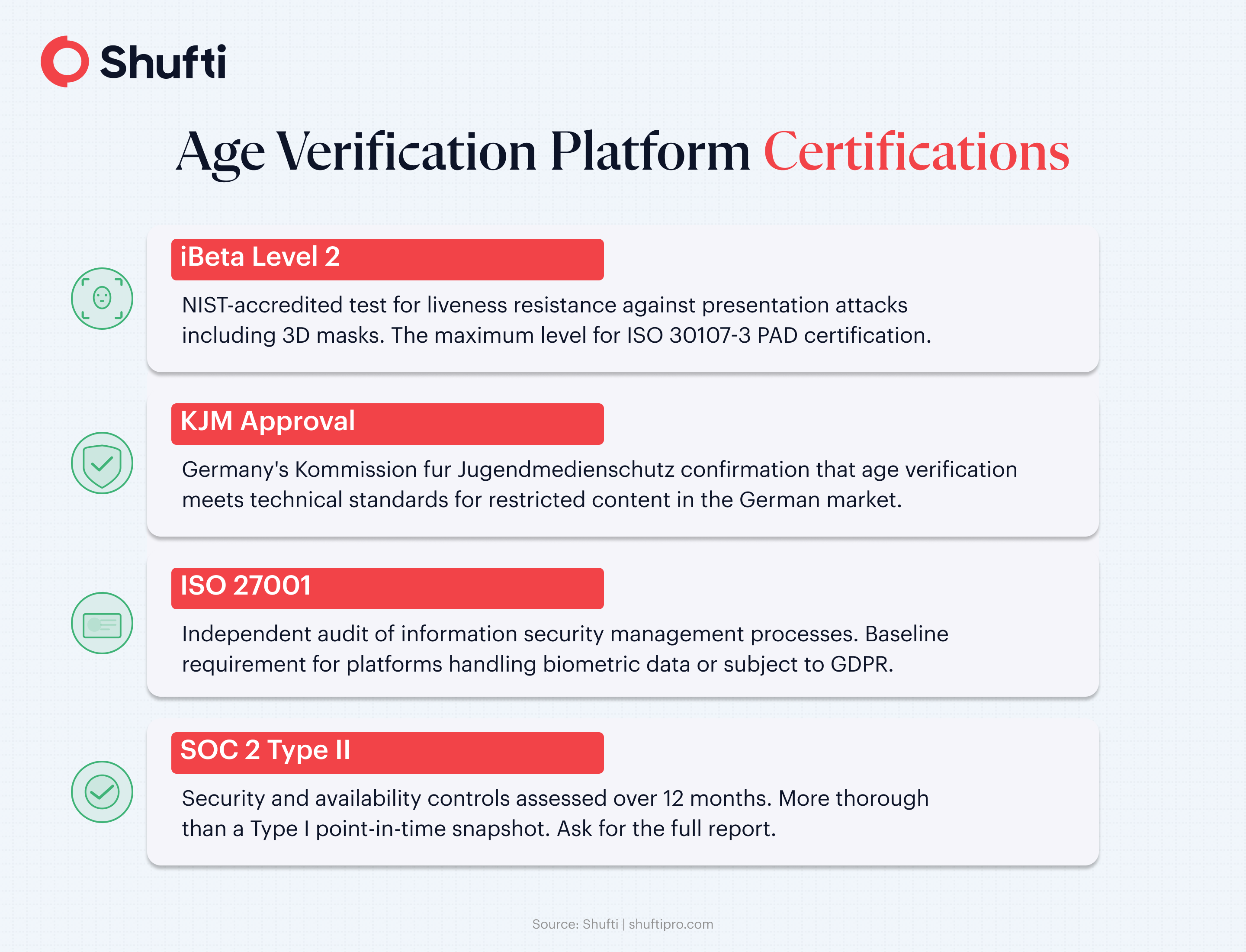
iBeta Level 2 (ISO 30107-3)
The iBeta Quality Assurance lab is accredited by the US National Institute of Standards and Technology (NIST) to test biometric systems against Presentation Attack Detection (PAD). Level 2 is the current maximum certification level and tests resistance against high-quality spoofs including 3D masks and digitally manipulated images. A platform claiming liveness detection without iBeta Level 2 has not been independently tested against the attacks your users will face.
KJM approval
The Kommission fur Jugendmedienschutz (KJM) is Germany’s regulatory body for youth media protection. KJM approval confirms that a platform’s age verification process meets the technical and process standards required for restricted content distribution in Germany. For any operator in the German-speaking market, KJM approval is a non-negotiable line item.
ISO 27001
Covers information security management and confirms that the vendor’s data handling processes have been independently audited. For platforms subject to the General Data Protection Regulation (GDPR) or processing biometric data, ISO 27001 is a baseline expectation, not a differentiator.
SOC 2 Type II
A SOC 2 Type II report covers security and availability controls over a 12-month period, making it more meaningful than a Type I point-in-time snapshot, especially when evaluating the full report rather than just a badge.
The European Commission‘s October 2025 EU Age Verification Blueprint is built on the same technical specifications as EU Digital Identity Wallets rolling out by the end of 2026, which means a platform that cannot accept wallet-based age credentials will face a Digital Services Act compliance gap within the year.
What vendor evaluation questions should I ask before committing to a platform?
Three questions consistently reveal whether a vendor can support an enterprise deployment, as opposed to a proof of concept.
What is your process when a regulation changes?
Vendors that treat regulatory change as an engineering ticket have a different risk profile than vendors with a compliance team that tracks legislative calendars across your operating jurisdictions. The answer reveals whether you are buying a product or a compliance partnership.
Can you show us your audit trail output from a production deployment?
A vendor who cannot produce a sample export from a live environment has not been through a regulator inquiry. A vendor who can show you exactly what Ofcom or a national data protection authority would receive is a materially lower compliance risk. Age verification regulations differ by market, and your audit trail needs to satisfy multiple regulators simultaneously.
What is your uptime record during your three highest-traffic days in the last 12 months?
Age gates that fail under load do not fail quietly. They create both a regulatory exposure (users accessing age-restricted content) and a commercial exposure (users abandoning the verification flow permanently).
How Shufti helps enterprises deploy age verification at scale
The evaluation criteria above describe what a capable platform looks like. Shufti’s age verification platform is built to meet them across the markets where the regulatory bar is highest.
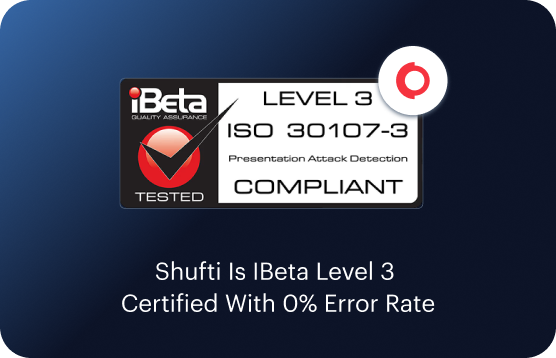
Shufti carries iBeta Level 1, Level 2, and Level 3 certification for PAD resistance, and KJM approval for the German market. The platform supports document verification, biometric face matching with liveness, facial age estimation, and database-backed checks across 230+ countries and 3,000+ document types in 150 languages. Deployment options cover cloud, on-premises (zero-trust), and hybrid through a single API, so your architecture does not change when data residency requirements do.
The no-code Journey Builder lets compliance and product teams configure verification flows and update decision logic without engineering involvement, which means regulatory changes translate into platform updates within days rather than release cycles. Every verification event is logged with a full audit trail exportable for regulator review.
Shufti’s fraud intelligence layer identifies serial fraud attempts across accounts, cross-referencing document patterns and biometric signals to flag repeat attempts before they create duplicate identities in your user base. For reusable age verification use cases, where a returning user’s previously verified credential reduces friction on repeat visits, Shufti’s Fast ID capability handles re-verification without requiring the user to repeat the full flow.
Selecting the wrong age verification platform creates a compliance liability that compounds with every new regulation your business enters. Shufti’s age verification platform provides the certifications, deployment flexibility, and multi-jurisdiction coverage enterprise compliance teams need. Book a demo to see how it performs on your own document types and traffic volumes.
Frequently Asked Questions
What is the difference between an age verification platform and age verification software?
Age verification software typically refers to a single-method tool for a specific use case. A platform integrates multiple verification methods, supports multi-jurisdiction compliance, and includes reporting, orchestration, and deployment controls for enterprise-scale operations.
What certifications should an age verification platform hold?
A platform should hold, at minimum, iBeta Level 2 for PAD/liveness resistance (ISO 30107-3), KJM approval for German market compliance, ISO 27001 for information security management, and SOC 2 Type II for security and availability controls.
Can an age verification platform be deployed on-premises?
Yes, leading platforms offer on-premises and hybrid deployment options alongside cloud, which matters for operators with data residency requirements or operating in regulated sectors like fintech or healthcare.
What is no-code age verification journey orchestration?
It is the ability to configure verification flows, set method fallback logic, and update decision thresholds through a visual interface rather than code, letting compliance teams adapt to regulatory changes without engineering resources.
How does an age verification platform handle multiple jurisdictions?
A capable platform applies the correct verification method and compliance rules per the user's jurisdiction at runtime, maintains audit trails per region, and maps each method to the applicable regulatory standard in markets like the UK, EU, Germany, and the US.