





 Face Verification
 Address Verification
 Document Verification
 Age Verification
 VideoIdent
 Fast ID
 Docless Verification
 Consent Verification
 NFC Verification
 Business Verification
 Due Diligence
 Investor Verification
 E-Signature

 QES
QES
 AML Screening
 Transaction Monitoring
 Adverse Media
 Business AML Screening
 PEP & RCA
 Sanctions
 Watchlist
 Behavioural Biometrics
 Device Fingerprinting
 Biometric Face Authentication
 MFA
MFA
 Fraud Hub
 Onboarding
 Ongoing Monitoring
 KYC
KYC
 KYB
KYB
 KYI
KYI
 Age Assurance
 Identity Verification
 Workforce IAM
 Candidate Verification
 Compliance
 Fraud prevention
 Trust & safety
 Global expansion
 Product Managers
 Compliance Officers
 Fraud Analysts
 Developers
 Deepfake Detection
 Bonus Abuse / Promotion Abuse
 Account Takeover
 Synthetic Identity Fraud
 Document Fraud
 Impersonation Fraud
 Multi-Accounting
 Fraud Networks
 Chargeback Fraud
 Money Mule Activity
 Party Fraud
 Regulatory & Compliance Risks
 Fintech
 Crypto
 iGaming
 Forex
Forex
 Social Network
 Marketplace
 Banking
 Gig Economy
 Payments
 Ride Hailing
 Adult Content
 Blind Spot Audit
 Deepfake Detector
 Liveness Spoofs
 Document Originality
 Document Deepfake
 Global Trust Platform
 Journey Builder
 Case Management
 Shufti AI
 Fraud Analytics
 Vendor Comparison
 Brand Personalisation
 AI Compliance Co-Pilot
 OCR
OCR
 Secure Capture
 Deployment Options
 Identity Methods
 API Documentation
 Mobile SDKs
 Service Status
 Help Center
 Contact Us
 Technical Support
 Supported Documents
 Supported Countries

 Content library
 Blogs
Blogs
 News
News
 Reports
 Insights
 Knowledgebase
 ROI calculator
 About
About
 Career
 Press Release
 Certifications
 Partnership
 Awards
 Events & Webinar
 Interactive Demo
 Podcast Studio
 Spotlight Studio
Age Verification Software for High-Risk Industries: A Compliance-First Evaluation Guide

-
Add us as a Preferred Source
- 01 Key Takeaways
- 02 What is Age Verification Software?
- 03 Why Industry Matters When Choosing Age Verification Software
- 04 Gambling and iGaming: UKGC, MGA, and US State-Level Requirements
- 05 Adult Content: UK OSA Part 5, France's SREN Law, and US State Laws
- 06 Alcohol, Tobacco, and Vaping E-Commerce: COPPA, FDA Deeming Rule, and EU Requirements
- 07 Cannabis: The US State-Level Patchwork
- 08 Social Media: DSA, KOSA, and Australia's Under-16 Ban
- 09 Video Games: PEGI, ESRB, and Loot Box Regulations
- 10 Software Requirements Checklist by Industry
- 11 How Shufti Maps to Each Sector
- 12 What to Look for Before You Sign
The age verification software market hit $2.22 billion in 2025 and is on track to reach $5 billion by 2033 (Verified Market Reports). That growth is not driven by one industry. It is driven by simultaneous regulatory pressure across gambling, adult content, alcohol, cannabis, social media, and video games, each with different compliance standards, different enforcement bodies, and different technical requirements for what counts as “verified.”
That is the problem most age verification software reviews ignore. They compare features in a vacuum. They list facial age estimation, document scanning, and database checks without telling you which of those methods actually satisfies the regulator in your industry. A gambling operator licensed by the UKGC has fundamentally different verification obligations than a cannabis dispensary in Massachusetts or an adult content platform serving French users.
This guide maps age verification software requirements to the specific regulations governing each high-risk sector. If you are evaluating an age verification platform for procurement, this is the compliance-first evaluation structure your shortlist process has been missing.
Key Takeaways
- Age verification requirements differ by industry, jurisdiction, and enforcement body. A single generic solution rarely covers all regulatory obligations.
- UK gambling operators must verify age before any deposit or play. No grace period. UKGC mandates pre-registration verification.
- Adult content platforms face the strictest new enforcement globally. Ofcom has fined operators up to £1 million, and France now requires double-blind age assurance.
- US cannabis operates under a state-by-state patchwork with no federal standard. Massachusetts requires double verification (entry and point of sale).
- Social media age verification is accelerating. Australia banned under-16s in December 2025, removing 4.7 million accounts.
- PEGI will require a minimum PEGI 16 rating for all games with loot boxes starting June 2026, creating new age-gating obligations for publishers.
- The right age verification software must match your industry’s accepted methods, data retention rules, and jurisdictional coverage.
What is Age Verification Software?
Age verification software is a compliance technology that confirms a user’s age before granting access to age-restricted products, services, or content. Unlike a simple “Are you 18?” checkbox, modern age verification platforms use a combination of government-issued ID checks, biometric face matching, liveness detection, database lookups, and AI-driven age estimation to verify whether a user genuinely meets the legal age threshold for a given jurisdiction.
Why Industry Matters When Choosing Age Verification Software
Not every age verification method is accepted by every regulator. Self-declaration (the “I am over 18” checkbox) is explicitly rejected by Ofcom, the UKGC, and France’s Arcom. Credit card checks satisfy some jurisdictions but fail others. Facial age estimation is accepted in some sectors and untested in others.
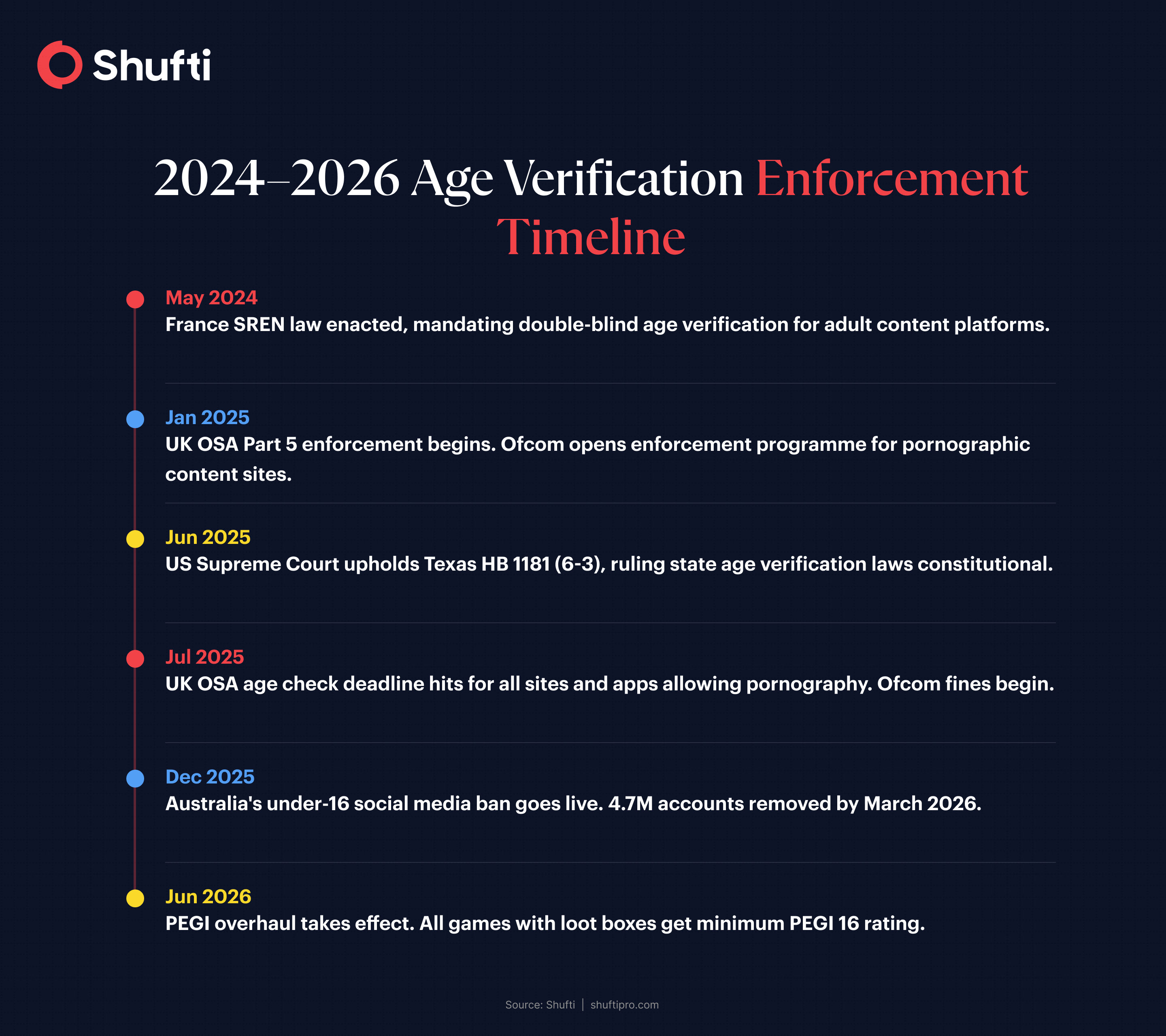
When a procurement team evaluates age verification providers without filtering for their industry’s regulatory requirements, they risk deploying a solution that passes internal testing but fails external audit. The consequences are not theoretical. Ofcom had opened investigations into more than 90 platforms and issued six fines by February 2026 (CMS Law-Now). France blocked Pornhub, RedTube, and YouPorn from French IP addresses entirely when their parent company failed to implement compliant age checks (Arcom).
The evaluation guide that follows is organized by industry because that is how regulators think. Your age verification software needs to satisfy the regulator that licenses your business, not the one that licenses someone else’s.
Gambling and iGaming: UKGC, MGA, and US State-Level Requirements
Gambling is the most mature sector for age verification enforcement. The UK Gambling Commission eliminated the 72-hour grace period that previously allowed customers to gamble before completing identity checks. Every operator must now verify a player’s age before any deposit or gameplay.
The UKGC’s minimum requires name, address, and date of birth verification, typically matched against credit reference agencies and electoral roll databases. If database matching fails, document-based verification (passport, driving licence) is required. Since February 2025, operators must also perform financial vulnerability checks once a customer’s net spend exceeds £150 in a rolling 30-day period.
Malta’s Gaming Authority, which licenses a large share of European-facing operators, requires KYC completion tied to deposit thresholds. Players depositing in virtual currencies must complete full verification within 30 days. US state-level requirements vary. New Jersey, Pennsylvania, and Michigan each mandate identity and age verification at registration, but the accepted methods and enforcement intensity differ by state gaming commission.
What your age verification software must do for gambling:
- Database-backed age verification against government and credit reference data sources
- Document verification fallback when database matching is inconclusive
- Real-time verification at the point of registration (not post-registration)
- Integration with responsible gambling tools (deposit limits, self-exclusion)
- Multi-jurisdictional support if you operate across UK, EU, and US state markets
Adult Content: UK OSA Part 5, France’s SREN Law, and US State Laws
Adult content platforms are facing the fastest-moving regulatory environment in age verification. Three separate regulatory regimes are now actively enforcing compliance.
United Kingdom:
The Online Safety Act Part 5 requires platforms hosting pornographic content to implement “highly effective” age assurance. Ofcom published acceptable methods including Open Banking verification, photo ID matching, facial age estimation, and digital identity services. Self-declaration and standard payment card checks do not qualify. Since July 2025, all sites and apps allowing pornography must have age checks in place. Ofcom fined Kick Online Entertainment £800,000 and another adult site operator £1 million for non-compliance. The maximum penalty is £18 million or 10% of global revenue, whichever is greater.
France
The SREN law (enacted May 2024) requires every adult content platform to implement at least one “double-blind” age assurance method. Double anonymity means the adult site does not learn the user’s identity and the age verification provider does not learn which sites the user visits. Compliance was mandatory from April 11, 2025. Platforms that failed to comply have been blocked from French IP addresses.
United States:
The Supreme Court upheld Texas HB 1181 in June 2025 in a 6-3 decision, ruling that state-level age verification requirements for adult content are constitutional (Hunton Andrews Kurth). Half of US states now mandate some form of age gating for adult content (National Law Review). Ten more states are expected to pass age verification legislation in 2026.
What your age verification software must do for adult content:
- “Highly effective” age assurance meeting Ofcom’s published standards (not self-declaration)
- Double-blind/double-anonymity architecture for French compliance
- Session-level re-verification (France requires checks at each session, not just at registration)
- Privacy-preserving design that minimizes data retention
- Coverage across UK, EU, and US state requirements simultaneously
Alcohol, Tobacco, and Vaping E-Commerce: COPPA, FDA Deeming Rule, and EU Requirements
Age-restricted product e-commerce operates under a different enforcement model. Unlike gambling or adult content where the platform itself is regulated, alcohol and tobacco regulations often place compliance burdens on the retailer and the delivery chain.
United States (FDA)
The FDA’s Deeming Rule requires electronic age verification for all online tobacco and vaping sales. Retailers must obtain full name, birth date, and residential address, then verify against commercially available government-sourced databases. The FDA raised the photo ID verification threshold from “under 27” to “under 30” in September 2024, and enforcement of the updated rule began January 2026. The agency has issued over 134,000 warning letters and more than 30,000 fines since 2020 for violations.
COPPA and minors
The FTC finalized significant COPPA amendments in April 2025, expanding the definition of personal information and requiring “mixed audience” platforms to determine age before collecting any data. In February 2026, the FTC issued a policy statement actively incentivizing age verification technology adoption (FTC), creating a safe harbor for operators that verify age responsibly.
EU requirements
The EU Tobacco Products Directive requires member states to ensure age verification for cross-border online sales. Implementation varies by country, but the EU Digital Identity Wallet rollout (targeting end of 2026) is expected to standardize age token verification across member states.
What your age verification software must do for alcohol/tobacco/vaping:
- Database verification against government-sourced records (FDA-compliant)
- Integration with e-commerce platforms (Shopify, WooCommerce, Magento)
- Delivery-stage verification capability for physical product fulfillment
- COPPA-compliant data handling if your site is accessible to mixed audiences
- Cross-border support if selling into EU markets
Cannabis: The US State-Level Patchwork
Cannabis age verification is uniquely complicated because of the federal-state conflict in the United States. Cannabis remains a Schedule I substance under federal law while being legal for adult use in 24+ states and for medical use in most others. This means there is no federal age verification standard for cannabis. Every state writes its own rules.
Most states require consumers to be at least 21 for recreational cannabis and 18+ for medical cannabis, but enforcement mechanisms vary. Massachusetts requires double age verification at dispensaries: once at the point of entry and again before the point of sale. California’s CPRA adds privacy constraints, requiring dispensaries to minimize PII collection and retain only what is “strictly necessary” for the transaction.
Online cannabis ordering and delivery add another layer. Hybrid workflows combining physical ID scans at the door with electronic database verification for delivery orders represent the most compliant path. Texas enacted the App Store Accountability Act (SB 2420) in May 2025, effective January 2026, which imposes age verification requirements on cannabis and hemp retail apps distributed through app stores.
What your age verification software must do for cannabis:
- ID scanning with barcode validation, UV light detection, and hologram checks for in-person
- Electronic database verification for online orders
- State-specific configuration (not a one-size-fits-all flow)
- Minimal PII retention to comply with state privacy laws (CPRA, Colorado teen privacy protections)
- Mobile driver’s license (mDL) acceptance where state policy allows
Social Media: DSA, KOSA, and Australia’s Under-16 Ban
Social media platforms face the newest wave of age verification mandates, and the regulatory velocity is unprecedented.
Australia
The world’s first under-16 social media ban went live December 10, 2025 (eSafety Commissioner). Facebook, Instagram, TikTok, Snapchat, Reddit, X, and YouTube were restricted. By March 2026, 4.7 million accounts had been removed or restricted and 300,000+ additional accounts were blocked. Platforms face fines up to $50 million AUD for non-compliance. The eSafety Commissioner expects platforms to use a “waterfall” approach combining facial age estimation, double-blind ID checks, and behavioral signal analysis.
EU Digital Services Act
Article 28 requires platforms accessible to minors to implement “appropriate and proportionate” age assurance measures. The European Commission published guidelines in July 2025 distinguishing between self-declaration (insufficient), age estimation, and age verification. The EU Age Verification Blueprint pilot launched in five member states (Denmark, Greece, Spain, France, Italy) with full implementation expected across all member states by end of 2026, integrated with the EU Digital Identity Wallet.
US (KOSA and state laws)
KOSA was reintroduced in the 119th Congress in May 2025 and does not explicitly require age verification but directs federal agencies to study device-level methods. The KIDS Act, introduced December 2025, would mandate age verification for mature content access. Multiple US states have already enacted their own social media age verification requirements.
What your age verification software must do for social media:
- Facial age estimation (non-document method for low-friction onboarding)
- Double-blind architecture for privacy-preserving compliance (Australia, EU)
- Behavioral signal analysis capability
- Scale to handle millions of verification events daily
- API-first integration for platform embedding
- Reusable age credentials to avoid repeated verification friction
Video Games: PEGI, ESRB, and Loot Box Regulations
Video games are the newest entrant to age verification requirements, driven by loot box regulation and in-game spending concerns.
PEGI announced the most significant overhaul to its rating system in over a decade in March 2026 (Reed Smith). Starting June 2026, any game selling “paid random items” (loot boxes) receives a minimum PEGI 16 rating. Games with time-limited or quantity-limited purchase offers receive a minimum PEGI 12. Games integrating NFTs or blockchain mechanisms automatically receive PEGI 18. These are not suggestions. They are enforced ratings that trigger age-gating obligations for publishers and platform storefronts.
The ESRB in the US has taken a different approach, relying on “In-Game Purchases (Includes Random Items)” labels rather than mandatory age ratings for loot box mechanics. However, the FTC’s settlement with HoYoverse banned loot box sales to children under 16 without parental consent, signaling increased regulatory attention.
The European Parliament’s IMCO Committee voted in October 2025 to call for the Digital Fairness Act to ban gambling-like mechanisms in games accessible to minors. If enacted, this would create binding EU-wide age verification requirements for any game with randomized paid content.
What your age verification software must do for video games:
- Age-gating at the point of purchase or download (storefront integration)
- Parental consent verification for under-16 users accessing loot box features
- PEGI and ESRB rating-aware age thresholds (not just 18+, but 12+ and 16+ tiers)
- Low-friction verification that does not disrupt the purchase flow
Software Requirements Checklist by Industry
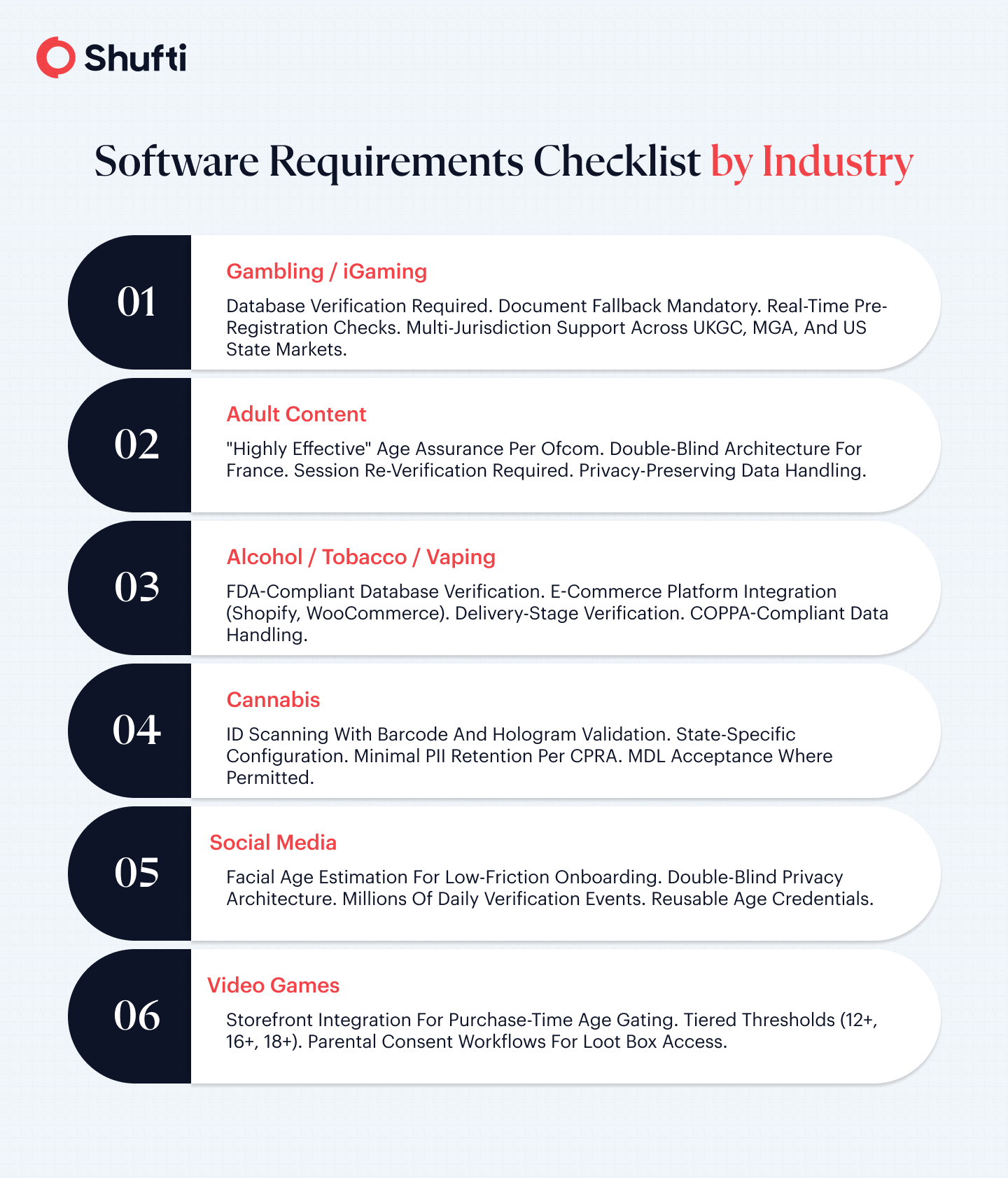
| Requirement | Gambling | Adult | Alcohol/ Tobacco | Cannabis | Social Media | Video Games |
| Database verification | Required | Accepted | Required (FDA) | Required | Optional | Optional |
| Document verification | Fallback | Accepted | Fallback | Required | Optional | Optional |
| Facial age estimation | Optional | Accepted (UK) | Not standard | Not standard | Required (AUS) | Optional |
| Double-blind architecture | Not required | Required (FR) | Not required | Not required | Required (EU) | Not required |
| Session re-verification | Not standard | Required (FR) | Not standard | Not standard | Not standard | Not standard |
| Parental consent flow | N/A | N/A | COPPA | N/A | Required | Required (FTC) |
| E-commerce integration | Not standard | Not standard | Required | Required | Not standard | Required |
| On-premises deployment | Optional | Recommended | Optional | Optional | Optional | Optional |
| Multi-jurisdiction support | Required | Required | Required | State-by-state | Required | Required |
| Reusable age tokens | Optional | Recommended | Optional | Not standard | Recommended | Optional |
This table is a starting point, not a finish line. Every cell should be validated against the specific jurisdictions where you operate. A gambling operator licensed only in the UK has different requirements than one holding UK, MGA, and New Jersey licenses simultaneously.
How Shufti Maps to Each Sector
Shufti’s age verification platform was built for multi-industry, multi-jurisdiction deployment. Rather than offering a single verification method and hoping it satisfies every regulator, Shufti provides configurable verification journeys through its no-code Journey Builder that can be tuned to each sector’s requirements.
For gambling operators, Shufti delivers database-backed age verification across 230+ countries with document verification fallback, satisfying UKGC, MGA, and US state requirements. The platform supports real-time pre-registration checks. Shufti is KJM-certified for age verification in Germany, one of the most rigorous approvals in the European market.
For adult content platforms, Shufti’s facial age estimation (powered by 98.72% biometric accuracy, highest iBeta Level 3 conformance) provides a privacy-preserving, non-document method that meets Ofcom’s “highly effective” standard. The platform supports on-premises deployment for GDPR-sensitive operations, keeping user data within controlled environments.
For alcohol, tobacco, and cannabis e-commerce, Shufti integrates with e-commerce platforms and provides document verification with barcode validation, hologram detection, and fraud checks across 10,000+ document types. For cannabis specifically, state-level configurations allow different verification flows per jurisdiction.
For social media platforms, Shufti’s face verification supports facial age estimation without requiring document uploads, reducing friction at the scale social platforms operate. The reusable identity capability via Fast ID means users verify once and can present age credentials across sessions without repeating the process.
For video game publishers, Shufti’s age verification supports tiered age thresholds (not just 18+), with parental consent workflows for the 12+ and 16+ PEGI tiers that loot box regulations now require.
Across every sector, Shufti processes 280 million+ identity checks annually, covers 230+ countries for document verification, and retrains its AI models hourly against new fraud vectors (Shufti internal data). If you need to see how the platform handles your specific industry’s requirements, request a demo and the team will walk through a sector-specific configuration.
What to Look for Before You Sign
Choosing the right age verification provider is ultimately about matching three things: the verification methods your regulator accepts, the jurisdictions you need coverage in, and the integration architecture your platform can support.
Ask every provider on your shortlist these questions: Which specific regulations has your solution been tested against? Can you show certification or regulatory approval in my industry’s jurisdiction? What is your data retention and deletion policy, and does it satisfy GDPR and applicable privacy laws? Can your system handle the verification volume my platform generates? And can I configure different verification flows per jurisdiction without rebuilding the integration?
The answers will separate vendors who built for compliance from those who built a feature and called it compliant.
| Talk to Shufti’s compliance team to evaluate whether the platform fits your industry’s specific regulatory requirements. Book a demo |
Frequently Asked Questions
What age verification software is approved for UK gambling sites?
The UKGC does not certify specific software vendors but requires operators to verify age before any deposit or play using database checks or government-issued ID documents. Age verification software that performs real-time database matching against credit reference agencies and electoral roll data, with document verification fallback, satisfies UKGC requirements.
Does age verification software need to be GDPR compliant?
Yes. Any age verification software processing personal data of EU or UK residents must comply with GDPR. This means purpose limitation (collecting data only for age verification), data minimization, defined retention periods, and user consent where required. Platforms operating under France's SREN law must also support double-blind architecture so the verification provider cannot identify which sites the user visits.
What is the best age verification solution for adult websites in the US?
Following the Supreme Court's June 2025 decision upholding Texas HB 1181, US adult content platforms need age verification that can adapt to state-by-state requirements. The best solution combines database verification with document-based fallback and supports the growing number of state laws mandating age checks. Half of US states now require age verification for adult content access.
Do cannabis dispensaries need age verification software?
Yes. Every US state with legal cannabis requires age verification at the point of sale. Most states mandate customers be 21+ for recreational cannabis. In-person dispensaries typically require ID scanning with barcode and hologram validation. Online ordering and delivery operations need electronic database verification. States like Massachusetts require double verification at both entry and checkout.
What age verification software works for Shopify or WooCommerce?
Age verification software for Shopify or WooCommerce must offer e-commerce platform integration (API or plugin), database-backed age checks compliant with FDA requirements for tobacco and vaping products, and support for age-gated product categories. Look for providers that support both pre-purchase verification (blocking checkout for underage users) and delivery-stage verification for physical products requiring age confirmation on receipt.