


 Face Verification
 Address Verification
 Document Verification
 Age Verification
 VideoIdent
 Fast ID
 Docless Verification
 Consent Verification
 NFC Verification
 Business Verification
 Due Diligence
 Investor Verification
 E-Signature

 QES
QES
 AML Screening
 Transaction Monitoring
 Adverse Media
 Business AML Screening
 PEP & RCA
 Sanctions
 Watchlist
 Behavioural Biometrics
 Device Fingerprinting
 Biometric Face Authentication
 MFA
MFA
 Fraud Hub
 Onboarding
 Ongoing Monitoring
 KYC
KYC
 KYB
KYB
 KYI
KYI
 Age Assurance
 Identity Verification
 Workforce IAM
 Candidate Verification
 Compliance
 Fraud prevention
 Trust & safety
 Global expansion
 Product Managers
 Compliance Officers
 Fraud Analysts
 Developers
 Deepfake Detection
 Bonus Abuse / Promotion Abuse
 Account Takeover
 Synthetic Identity Fraud
 Document Fraud
 Impersonation Fraud
 Multi-Accounting
 Fraud Networks
 Chargeback Fraud
 Money Mule Activity
 Party Fraud
 Regulatory & Compliance Risks
 Fintech
 Crypto
 iGaming
 Forex
Forex
 Social Network
 Marketplace
 Banking
 Gig Economy
 Payments
 Ride Hailing
 Adult Content
 Blind Spot Audit
 Deepfake Detector
 Liveness Spoofs
 Document Originality
 Document Deepfake
 Global Trust Platform
 Journey Builder
 Case Management
 Shufti AI
 Fraud Analytics
 Vendor Comparison
 Brand Personalisation
 AI Compliance Co-Pilot
 OCR
OCR
 Secure Capture
 Deployment Options
 Identity Methods
 API Documentation
 Mobile SDKs
 Service Status
 Help Center
 Contact Us
 Technical Support
 Supported Documents
 Supported Countries
 Content library
 Blogs
Blogs
 News
News
 Reports
 Insights
 Knowledgebase
 ROI calculator
 About
About
 Career
 Press Release
 Certifications
 Partnership
 Awards
 Events & Webinar
 Interactive Demo
 Podcast Studio
 Spotlight Studio
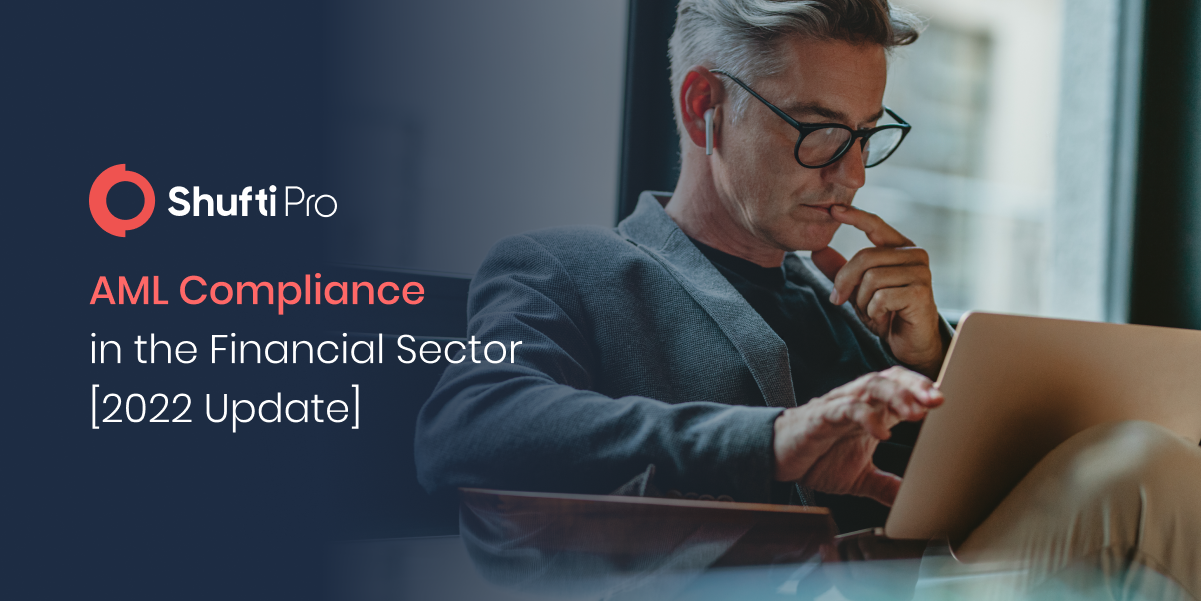
An Insight into AML Compliance in the Financial Sector [2022 Update]
The increasing global attention towards anti-money laundering (AML) and countering the financing of terrorism (CFT) has urged financial regulators to impose stringent restrictions on businesses. Anti-money laundering (AML) requirements are imposed on the financial sector to prevent money launderers from concealing the origins of their ill-gotten funds and businesses from facing compliance penalties.
International financial watchdogs like the Financial Action Task Force (FATF) and groups like the International Consortium of Investigative Journalists (ICIJ) are targeting financial crime throughout the world to find a common solution. Banks and other financial institutions are obliged by law to implement AML measures to avoid aiding money laundering activities.
Trends in Anti-Money Laundering Regulations
The US Department of Justice has recently been active when it comes to making efforts for anti-money laundering and civil forfeiture. A new panel is set to discuss the emerging AML enforcement trends and the most common safe havens for financial criminals that look to launder their proceeds of crime. Moreover, it will also discuss the role of Administration’s Strategy on Countering Corruption and the the implications for financial institutions. Another new trend in the AML landscape is the introduction of new regulations for digital assets.
Financial regulators are struggling to develop rules for constantly developing technologies of blockchain and the transactions for digital assets and cryptocurrencies. The regulatory developments like sanctions for crypto transactions are being discussed by the Department of Justice. On January 1, 2021, Congress passed an extensive AML Act that is an important part of the BSA/AML legislation. However, experts believe that its potential implementation will be altered by regulators and stakeholders in the real world.
AML in the Banking Sector
AML compliance regulations require banks and financial institutions to verify their customers’ identities and perform background screening to analyse the associated risk. The institutions are also required to submit a record of suspicious transactions along with details of why they are suspicious. The AML holding period obliges customers to deposit a particular amount in their account for a specific time. In the US, this time is five trading days. This period allows banks and insurance firms to identify the risks and perform the correct type of due diligence process – customer due diligence for low to medium risk cases, and enhanced due diligence for high-risk cases.
Money laundering, or concealing the origins of ill-gotten funds, involves methods to bypass regulatory checks and gaining legitimate funds. The illicit funds are chaneled through the legitimate financial system of a bank to make it appear as the real source. Money launderers usually deposit their money in smaller amounts to avoid being caught by regulatory checks as the limit for a single transaction is pre-defined.
Channeling dirty money through various transactions in increments allows financial criminals to defraud the bank and consequently stain its reputation. This is made possible due to the lack of robust AML Screening checks that monitor the past account activity of the customer and check for their presence in global sanctions lists and PEP lists. The lack of AML screening not only leads to increasing cases of money laundering, but there is also the concern of criminals using the ‘cleaned’ money for financing terrorism, organised crime and drug traficking.
How the Banking Sector Can be Secured
The most important institutions in the finance sector are banks, as they are responsible for handling numerous transactions every day. Banks face the constant threat of becoming the victims of financial criminals that try to find the loopholes within the institution’s system to fulfil their illicit motives. Furthermore, technological advancements in the form of FinTech solutions and the surge in online payments has created a demand for improved measures for the protection of customers’ personal information.
Know Your Customer (KYC)
Know Your Customer (KYC) verification is a process implemented by banks and financial institutions to verify their customers’ identities during onboarding. KYC is not only mandatory for all banks and financial institutions dealing with monetary transactions, but is the first and basic step of any AML compliance program. KYC verification involved the collection of the customers’ identity documents and verifying their legitimacy. Banks are obliged to verify whether their customers’ personal information matches their data in government records, which gives them proof of their identity. KYC solutions now verify identities using technologies like biometrics in the form of facial recognition and OCR technology in document verification.
Customer due diligence is the basic process incorporated by banks to collect the background information from a customer’s profile and analyse the risk of money laundering and terrorist financing. The core purpose of the due diligence process is for the bank to completely know who they are dealing with. Risk assessment is not possible without screening the customers against global sanctions lists and lists of politically exposed persons (PEPs) along with government records of criminal activity.
AML – Transaction Monitoring
The type and background of the customers of a bank or financial institution can never be predicted. Similarly, there are different type and amount of transactions to and from different sources. A customer who has an account in a particular bank can transfer or get money from another customer of another bank. This wide array of possibilities in transactions and sources puts banks in a difficult position when it comes to identifying suspicious transactions. Banks are required to analyse and keep record of the transactions made by their customers. In case where a bank doesn’t monitor transactions and ends up assisting payments made to sanctioned entities, they can face huge penalties.
It’s not just the fines that have adverse effects on the bank, but the stains on their reputation are often permanent and lead them to bankruptcy. For this reason, banks and financial are urged to monitor the transactions and their sources to ensure that they are not becoming a source in a money laundering plot. This means they are obliged to check the background and origins of funds in case of transactions that exceed the $10,000 threshold.
What Shufti Offers
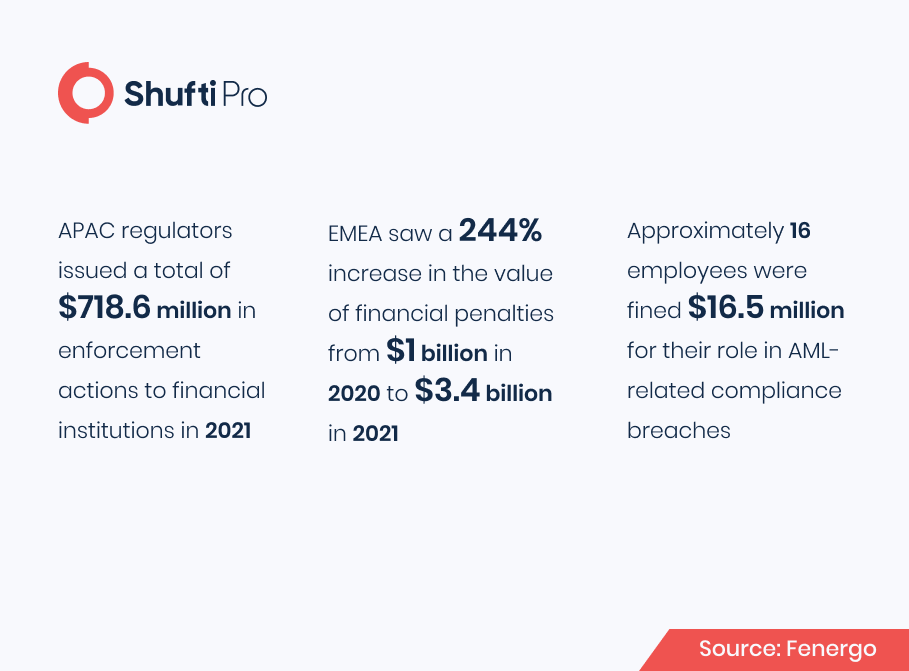
Identifying and eliminating the sources of financial crime that lead to money laundering and terrorist financing requires financial firms to incorporate robust AML Screening solutions. Global regulatory authorities have time and again warned banks and other financial institutions to ensure AML compliance to prevent financial crimes, avoid regulatory penalties , and the subsequent reputational damages.
Shufti’s robust AML screening involves the verification of a potential customer by screening them against global sanctions lists compiled by regulatory authorities such as the FATF, FinCEN, FINTRAC, and AUSTRAC. It involves authenticating the user information against 1700+ watchlists and Politically Exposed Person (PEP) lists in less than a second with an accuracy of 98.67%. As a result, fraudulent customers are detected and AML compliance is ensured.
Want to learn more about AML compliance for the financial sector?