 Runs On Your Cloud
 No Data Sharing
 No Contract Required
 Explore Now








 Face Verification
 Address Verification
 Document Verification
 Age Verification
 VideoIdent
 Fast ID
 eIDV
eIDV
 NFC Verification
 Consent Verification
 Business Verification
 Due Diligence
 Investor Verification
 E-Signature
 Behavioural Biometrics
 Device Fingerprinting
 MFA
MFA
 AML Screening
 Business AML Screening
 User Risk Assessment
 Transaction Screening
 Adverse Media Screening
 Identity Verification
 KYC
KYC
 KYB
KYB
 KYI
KYI
 Bonus Abuse
 Fraud Prevention
 Deepfakes
 Banking
 Crypto
 Fintech
 Forex
Forex
 Gaming
 Gig Economy
 Marketplace
 Social Networks
 Product Managers
 Compliance Officers
 Fraud Analyst
 Global Trust Platform
 Journey Builder
 Vendor Comparison
 Content library
 Blogs
Blogs
 News
News
 Reports
 Insights
 Knowledgebase
 ROI calculator
 Blind Spot Audit
 Deepfake Detection
 Liveness Detection
 Document Originality
 Document Deepfake
 Events & Webinar
 Podcast Studio
 Spotlight Studio
 API Documentation
 Mobile SDKs
 Service Status
 Help Center
 Contact Us
 Technical Support
 Compliance
 Supported Document
 About
About
 Career
 Press Release
 Certifications
 Partnership
 Awards
Here Is The Right Approach To Deepfake Detection In 2026 To Prevent Identity Spoofing

Deepfakes have become a bane of existence in the digital era. From casting dark shadows over political democracies through manipulated videos of public figures to being weaponized in large-scale disinformation campaigns, synthetic media has moved well beyond novelty use cases. As generative AI advances and new generation engines emerge, the need for advanced deepfake detection in 2026 also increases.
The situation is more alarming for the financial sector, where deepfakes help in spoofing the remote identity proofing systems and can lead to millions of dollars in losses. Businesses, therefore, should carefully evaluate the deepfake detection capabilities of Identity Verification Solutions to ensure robust KYC and secure access.
Need For Right Deepfake Detection In 2026
Official reporting continues to show that identity theft remains a high-volume and persistent risk category, and regulators have also begun to explicitly address how AI generated media can be used in fraud schemes. The U.S. Federal Trade Commission continues to track identity theft as a major consumer protection issue.
For example, the FTC Consumer Sentinel Network Data Book 2024 reports over six million total consumer reports in 2024 and includes identity theft reporting at scale within that dataset, showing how frequently personal identities are being misused across digital services.
At the same time, FinCEN has publicly warned financial institutions about fraud schemes involving deepfake media created with generative AI tools, reflecting that synthetic media is now part of the real fraud environment that institutions must detect and report.
This is why discussions around identity verification are shifting from static accuracy narratives to a more practical question. How should identity verification providers deliver Right Deepfake Detection in 2026 when the threat itself is continuously evolving and increasingly operational.
How Detection Approaches Are Evolving?
Traditional approaches to biometric spoofing focused on known artefacts such as printed photos, replayed videos, or simple masks. These methods relied on identifying relatively stable patterns and could remain effective for long periods with limited updates.
Deepfakes have disrupted this model. New face swapping engines, rendering techniques, and real time manipulation pipelines are emerging continuously. Attackers can test identity verification systems repeatedly, observe which signals are weighted most heavily, and adapt their approach accordingly. This has pushed the industry toward more adaptive, layered, and temporally aware detection strategies.
It is in this context that the World Economic Forum released its 2026 research report, Unmasking Cybercrime: Strengthening Digital Identity Verification Against Deepfakes, which specifically examines face swapping attacks that target KYC processes relying on face verification systems. It also evaluates the tactics, techniques and procedures used by threat actors, reviews commonly used face swapping tools, and provides a forward-looking threat analysis
The World Economic Forum’s Deepfake Research In Context
A key theme running through the report is that deepfake risk should be understood as a system-level problem. Face swaps are rarely deployed and are often combined with delivery and operational tactics that aim to defeat single-point checks. This is why the report emphasises that the defensive landscape must evolve in tandem with genAI advancements and that detection models must anticipate future patterns through continual learning, feedback integration, and cross platform signal correlation.
The report’s practical direction can be summarised through three takeaways that are highly relevant for identity verification providers.
Technological innovation should focus on transport aware and temporally consistent anti spoofing systems. Operational vigilance should focus on adaptive fraud analytics and risk escalation frameworks. Governance and collaboration should focus on unified industry standards, responsible data management, reformed government policies, and red team testing practices.
Moving Target The Challenge With Deepfake Detection
One of the most important challenges in deepfake detection is that it is a moving target. Face swapping generators evolve rapidly, often faster than traditional detection models are updated. New engines introduce different artefacts, rendering styles, and synchronization behaviours, making it risky to rely solely on detectors trained on historical patterns.
This is why the report places emphasis on temporal consistency. Real time face swaps often struggle to maintain perfect stability across frames, especially under compression, network variability, and device constraints. Monitoring frame to frame behaviour, visual coherence, and synchronization over short time windows becomes critical in distinguishing authentic human video from synthetic manipulation.
For identity verification providers, this means that Right Deepfake Detection in 2026 requires more than recognising known patterns. It requires designing a detection that remains resilient when unfamiliar generators appear and when attacks are delivered under real world constraints.
Shufti’s Approach To Deepfake Detection
A major challenge of deepfake detection in 2026 is generalizability.
Detectors that perform strongly in controlled evaluations may not always be generalizable to real threat scenarios, especially when attacks involve unfamiliar generators, compressed video, low light conditions, and real time manipulation methods that were not represented in training. In practice, this means detectors often need to be trained on specifics that reflect the threat environment they will actually face.
Shufti’s approach is built around this reality. Rather than relying on a single detector or static model, the solution treats deepfake detection as a continuous R&D driven process where research teams actively analyse emerging deepfake generation engines and improve detection capabilities accordingly.
Instead of depending on one detection method, Shufti applies a multi-layered approach with a strong focus on building temporally consistent anti spoofing systems.
Shufti’s solution has demonstrated its accuracy on the PDID database, which is based on in-the-wild deepfakes rather than lab generated samples. This matters because real world deepfakes often behave differently from synthetic test data, particularly once they are deployed through real devices and real networks.
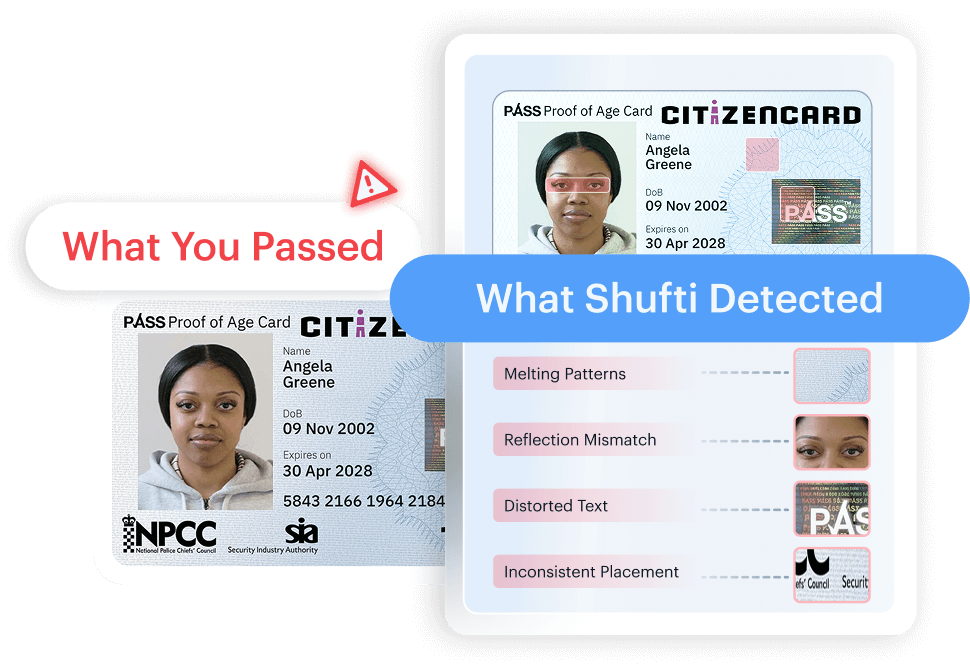
However, despite accuracy on lab-generated datasets and PDID, the R&D teams at Shufti analyze the real threat-scenarios in collaboration with stake-holders. This means checking the suspicious Identity documents for face-swaps, looking for the unknown generators and then training the detection models for new typologies. This continuous approach is based on the problem that deepfake detection faces difficulty with generalizability.
Deepfake-enabled identity spoofing will keep changing as new generation tools and delivery methods appear. The identity verification solutions will struggle if detection is treated as a one-time control, because deepfake detection in 2026 needs systems that can learn from real cases, adapt to unfamiliar generators, and trigger risk escalation when signals do not look consistent over time.
To help teams evaluate exposure in practice, Shufti also enables deepfake detection and identity risk testing through its AWS Marketplace listing, allowing businesses to test detection performance within their own cloud environment and assess the presence of synthetic identities across their existing customer base.