 Runs On Your Cloud
 No Data Sharing
 No Contract Required
 Explore Now





 Face Verification
 Address Verification
 Document Verification
 Age Verification
 VideoIdent
 Fast ID
 eIDV
eIDV
 NFC Verification
 Consent Verification
 Business Verification
 Due Diligence
 Investor Verification
 E-Signature
 Behavioural Biometrics
 Device Fingerprinting
 MFA
MFA
 AML Screening
 Business AML Screening
 User Risk Assessment
 Transaction Screening
 Adverse Media Screening
 Identity Verification
 KYC
KYC
 KYB
KYB
 KYI
KYI
 Bonus Abuse
 Fraud Prevention
 Deepfakes
 Banking
 Crypto
 Fintech
 Forex
Forex
 Gaming
 Gig Economy
 Marketplace
 Social Networks
 Product Managers
 Compliance Officers
 Fraud Analyst
 Global Trust Platform
 Journey Builder
 Vendor Comparison
 Content library
 Blogs
Blogs
 News
News
 Reports
 Insights
 Knowledgebase
 ROI calculator
 Blind Spot Audit
 Deepfake Detection
 Liveness Detection
 Document Originality
 Document Deepfake
 Events & Webinar
 Podcast Studio
 Spotlight Studio
 API Documentation
 Mobile SDKs
 Service Status
 Help Center
 Contact Us
 Technical Support
 Compliance
 Supported Document
 About
About
 Career
 Press Release
 Certifications
 Partnership
 Awards
Gambling Laws in Canada: A 2026 Compliance Guide for iGaming Operators

- 01 Online Gambling Laws in Canada and How They Actually Work
- 02 Provincial Gambling Market Structures in Canada
- 03 What are FINTRAC’s Identity Verification Requirements for iGaming Operators?
- 04 The Three Pain Points Driving KYC Investment in Canadian iGaming
- 05 How Shufti Helps Operators Launch and Scale in Canada?
If you’re an iGaming operator looking at North America, Canada should be circled on your map. The country’s online gambling market generated nearly US$3.9 billion in 2024 and is projected to reach US$8.7 billion by 2030.
Ontario alone recorded C$82.7 billion in total wagers during its 2024–25 fiscal year, with 2.6 million active player accounts with 47 licensed operators. In January 2026, Ontario hit an all-time monthly handle of C$9.52 billion, which is a 21.4% year-over-year increase.
But Canada is not a single market. It consists of 10 provinces and 3 territories, each of which has its own gambling regulator, its own rules, and its own interpretation of federal compliance obligations. To operate in Canada or to scale across provinces, operators need to understand the legal architecture that makes it all work. Let’s start with the legal structure.
Online Gambling Laws in Canada and How They Actually Work
Federal criminal law of Canada lays the foundation of the gambling framework, but it also sets boundaries in which provincial authorities can operate and regulate that sector. Operators not only need to understand Canada’s gambling industry architecture for entering or expanding into this market, but also for every compliance decision they’ll make.
Canadian Criminal Code that Sets Foundation and Boundaries of Gambling Framework
The starting point is simple. Under Sections 201–206 of the Criminal Code of Canada, all forms of gambling, betting, and lotteries are illegal throughout the country. Operating an illegal gambling service can result in up to 2 years in prison.
The entire legal gambling industry exists because of a single exception given in Section 207. This section allows provincial governments to “conduct and manage” what the law calls lottery schemes. The term “lottery scheme” is interpreted broadly to cover casinos, lotteries, sports betting, online gaming, and virtually every form of commercial gambling. Charities and religious organisations can also operate lottery schemes under a provincial licence, but only if proceeds go to charitable purposes. Whereas the pari-mutuel betting on horse racing is separately supervised at the federal level under Section 204.
The “Conduct and Manage” Principle
This is the single most important concept in Canadian gambling law. The province must always be the “operating mind” of any gambling activity. Private operators can be engaged to run day-to-day operations, but the province must exert sufficient control.
This is why even in Ontario’s open market, iGaming Ontario is legally conducting and managing the gambling and not the private operators. The Court of Appeal for Ontario confirmed this interpretation in 2024, ruling that the province’s iGaming model is in accordance with the Criminal Code.
The Criminal Code also states that no province can offer gambling services in another province unless an agreement with the other province or provincial legislation allows it. This is why each province is a different market with its own regulator, and why operators need to understand each one separately.
Bill C-218 (Amendment for Regulated Sports Betting)
Before August 2021, single-event sports betting was explicitly prohibited under section 207(4)(b) of the Criminal Code. Provinces could only offer parlay bets, which means wagers on multiple events put together. Bill C-218, the Safe and Regulated Sports Betting Act, removed this prohibition when it came into force on August 27, 2021. Provinces were immediately empowered to conduct and manage single-event sports betting within their borders.
This single legislative change triggered the current boom. It directly led to Ontario launching its competitive iGaming market in April 2022, Alberta passing its iGaming Alberta Act in 2025, and sports betting revenue exploding across every province. Without Bill C-218, the Canadian iGaming landscape as it exists today would not be possible.
The PCMLTFA & FINTRAC Role as an AML Layer
The Proceeds of Crime (Money Laundering) and Terrorist Financing Act (PCMLTFA) is the federal law that imposes AML and KYC obligations on “reporting entities” in the casino sector and related regulated structures. The Financial Transactions and Reports Analysis Centre of Canada (FINTRAC) enforces it. Depending on the model, the reporting entity may primarily be a provincial corporation managing the sector, but operators are still responsible for implementing front-end controls like KYC and AML checks for players.
Provincial Legislation Layer That Sets Operational Rules
Each province enacts its own legislation that creates the specific regulatory framework. This provincial framework then covers licensing, taxation, advertising rules, and responsible gambling requirements. Main laws for Canada gambling regulations that form the basis of how the gambling sector will be regulated in the relevant province are listed below:
| Province | Key Legislation | Regulator |
| Ontario | Gaming Control Act (1992) | AGCO + iGaming Ontario oversee the open private-operator market |
| Alberta | iGaming Alberta Act (2025) | Alberta iGaming Corporation to manage the new open market launching in 2026 |
| British Columbia | Gaming Control Act (new version effective April 13, 2026) | New Independent Gambling Control Office (IGCO) replacing GPEB |
| Quebec | Act Respecting Lotteries, Publicity, Contests and Amusement Machines | Loto-Québec runs Espacejeux |
| Saskatchewan | Alcohol and Gaming Regulation Act (1997) | SLGA + SIGA (Indigenous-led) partnership |
Provincial Gambling Market Structures in Canada
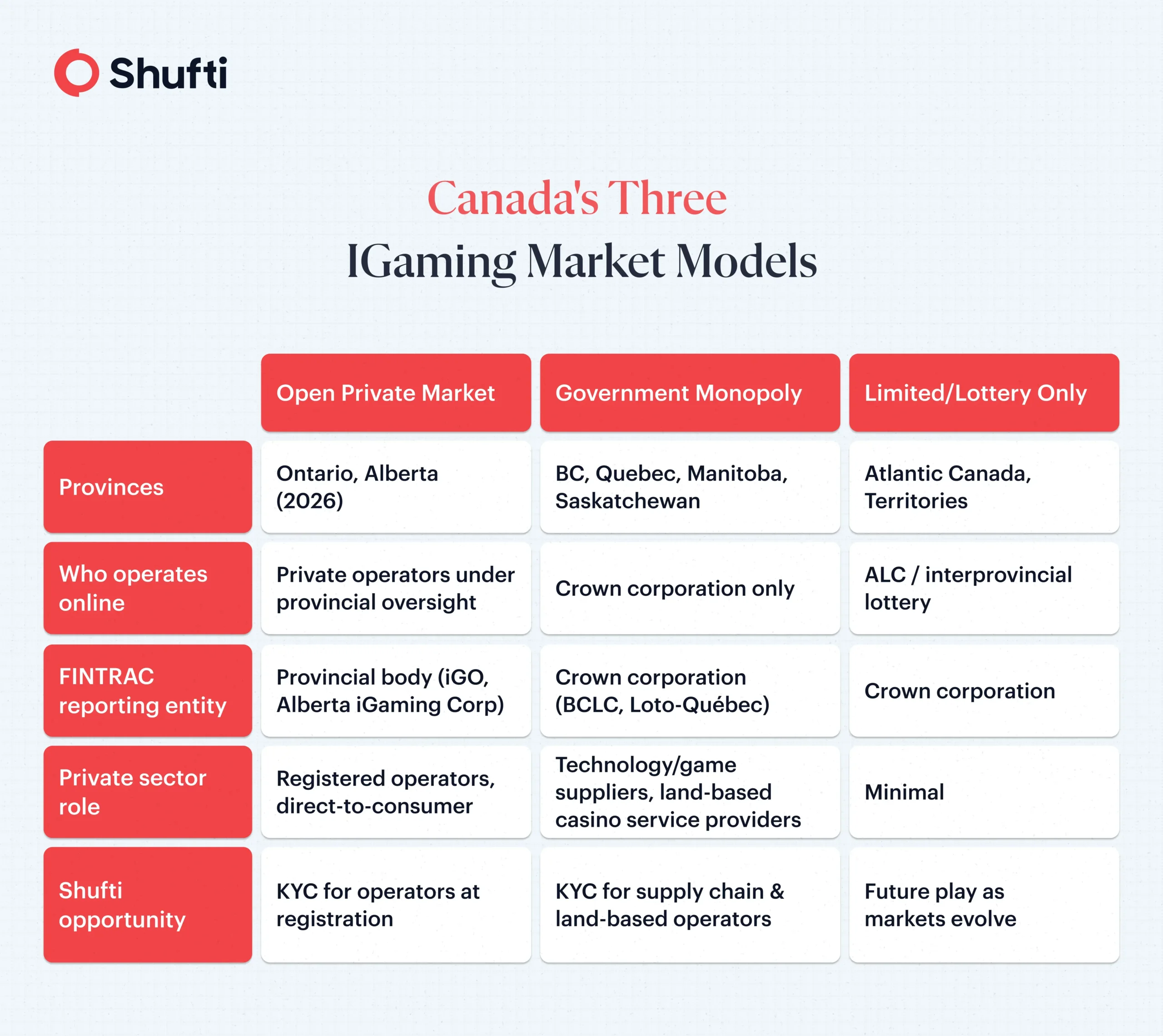
Gambling is legal in all 13 Canadian jurisdictions under set rules. The main difference is how each province structures its market and what that means for private operators and their compliance obligations.
-
Open Private-Operator Markets
Ontario is the only fully operational competitive private operator market today. As of March 2026, over 47 parent companies have registered to operate 80+ real-money gambling sites under iGaming Ontario’s oversight. Each operator is directly responsible for their own FINTRAC compliance, they file their own Suspicious Transaction Reports, maintain their own KYC programs, and face penalties directly. In 2026, the market has matured, and AGCO is tightening advertising rules, rolling out centralised self-exclusion standards, and cracking down on unregulated operators.
Alberta is preparing to launch its gaming industry, taking inspiration from Ontario’s successful model. The iGaming Alberta Act (2025) establishes that framework, with the creation of Alberta iGaming Corporation, which will manage the market. Private operators are expected to enter in 2026. Every operator will need FINTRAC-compliant KYC and AML infrastructure from day one because this is a licensing prerequisite, not an afterthought.
-
Government-Monopoly Online Markets
Most provinces operate a Crown corporation monopoly model, where a single government-run platform is the only legal online gambling option:
| Province | Platform | Key Detail |
| British Columbia | PlayNow (BCLC) |
|
| Quebec | Espacejeux (Loto-Québec) |
|
| Manitoba | PlayNow (via BCLC) |
|
| Saskatchewan | PlayNow (via BCLC/SIGA) |
|
In these provinces, the Crown corporation is the FINTRAC reporting entity. Private companies participate as technology suppliers, game providers, or land-based casino service providers. However, they still bear significant front-line AML obligations under the Crown corporation’s standards.
-
Limited/Lottery-Only Markets
The four Atlantic provinces (New Brunswick, Nova Scotia, PEI, and Newfoundland & Labrador) operate through the Atlantic Lottery Corporation (ALC) for lotteries and limited sports betting. None of these provinces has opened a regulated online casino market. The three territories (Yukon, Northwest Territories, and Nunavut) have negligible gambling infrastructure. Nunavut doesn’t even operate a standalone gaming corporation. In all these jurisdictions, residents usually access offshore gambling sites in a legal grey area.
-
Indigenous Jurisdictions
The Kahnawake Gaming Commission (Quebec) issues its own online gambling licences under Mohawk sovereignty and is one of the oldest online gambling regulators in the world. The Saskatchewan Indian Gaming Authority (SIGA) in Saskatchewan operates six casinos and partners with BCLC.
What are FINTRAC’s Identity Verification Requirements for iGaming Operators?
Every iGaming operator in Canada, whether it’s in Ontario’s open market, Alberta’s upcoming market, or serving as a supplier to a Crown corporation, must comply with the PCMLTFA. The following are different methods in practice at the point of player registration.
The Three Core Identity Verification Methods
FINTRAC allows five ways to verify an individual’s identity, but three are most relevant for iGaming remote onboarding:
| Method | What It Requires |
| Government Photo ID | A single valid, current government-issued photo ID with full name, unique ID number, and photo. This is a standalone method — no second source is needed. For remote verification, the document must be authenticated using software or technological tools. |
| Credit File | A Canadian credit bureau file that is at least 3 years old, with at least two trade lines, matching the person’s name, address, and date of birth. Must be checked in real time, not from a copy. Excludes younger “thin file” players. |
| Dual-Process | Two pieces of information from two independent, reliable sources confirming any two of: (1) name + date of birth, (2) name + address, or (3) name + financial account. Reliable sources include government bodies, Crown corporations, financial institutions, and utility providers. Social media is not acceptable. |
The government photo ID method is the fastest path as it needs one document, one verification, and it’s done. For most online onboarding, this is the primary method where a player uploads their driver’s licence or passport, and the operator’s system authenticates it digitally.
The dual-process method is the fallback for when a player doesn’t have a government photo ID or the document can’t be authenticated remotely. It requires pulling from two independent, reliable sources, which is operationally harder, but it still captures players that other methods miss.
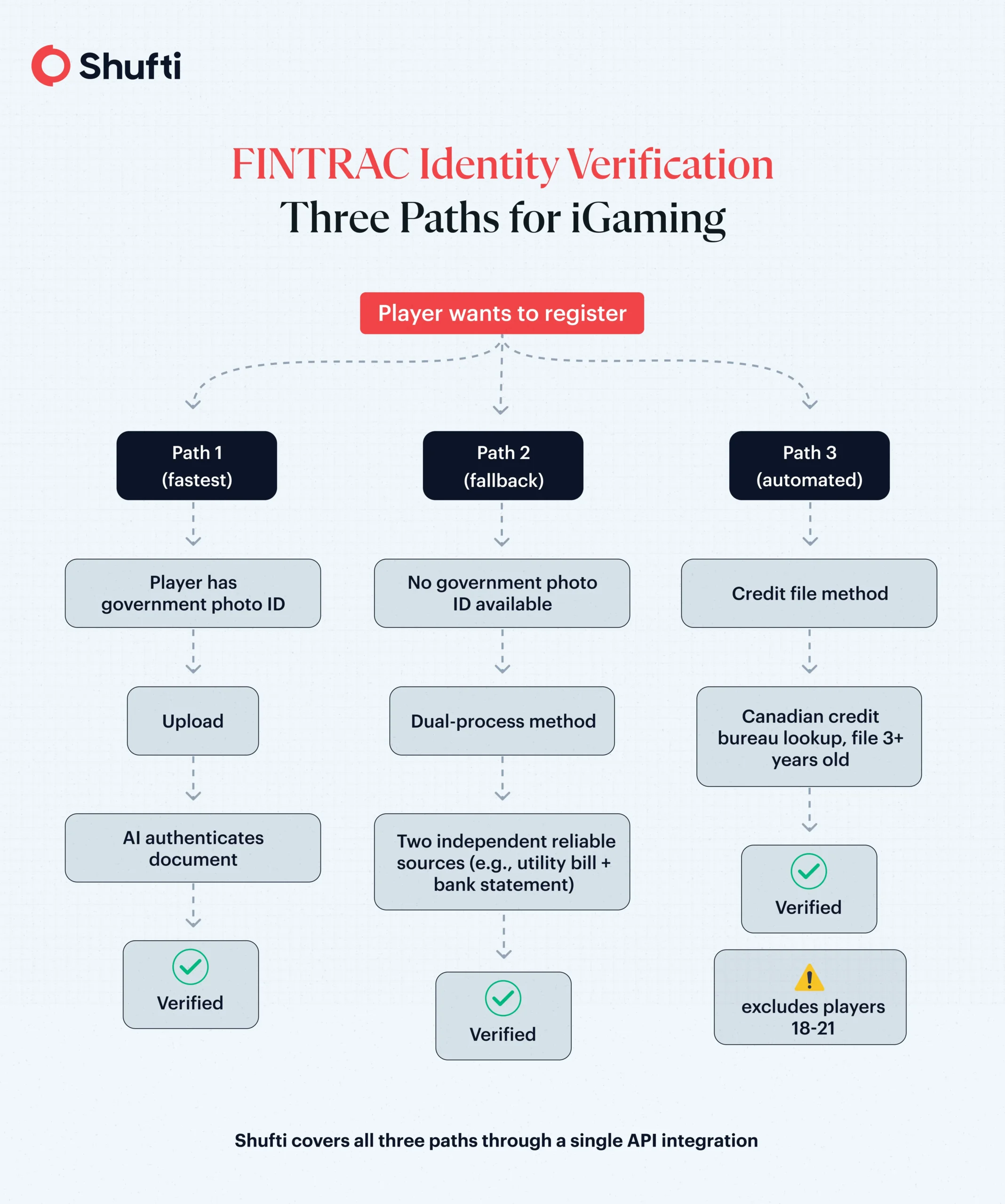
The credit file method is popular for automated onboarding because it requires no document upload, and it just involves a database lookup. But the 3-year file age requirement creates a blind spot: younger legal-age players (18–21) who don’t yet have established credit histories will fail this check even though they’re perfectly eligible to play. Operators relying solely on credit file verification are losing these players to competitors or to unregulated offshore sites.
Other AML Obligations after the Identity Verification
Identity verification is just the starting point. FINTRAC compliance also requires operators to
- screen players against PEP lists, and sanctions databases
- Monitor transactions for suspicious activity patterns
- Apply Enhanced Due Diligence for high-risk players
- retain all records for five years, available to FINTRAC within 30 days
- and report suspicious transactions, large cash transactions (C$10,000+), and casino disbursements
The Three Pain Points Driving KYC Investment in Canadian iGaming
1. The Grey Market Squeeze
Canadian regulators are actively dismantling the grey market. The AGCO has contacted Canadian media platforms to shut down promotion of unregulated sites. Manitoba secured a landmark injunction against offshore operator Bodog, which is the first enforcement action of its kind. And the Canadian Lottery Coalition is lobbying for federal legislation to restrict offshore operators serving Canadians. For licensed operators, every player pushed out of the grey market is a potential customer, but capturing them requires a frictionless, secure onboarding experience that proves your platform is legitimate. Payment service providers should pay attention to: under the PCMLTFA, PSPs can face criminal liability for serving unauthorised offshore operators.
2. Multi-Province Scaling Complexity
Operators licensed in Ontario and preparing for Alberta face a scaling problem. Each province has different rules, different regulators, and different compliance expectations. The question becomes: can your KYC provider flex across jurisdictions without forcing you to rebuild your onboarding flow each time? A provider that has global coverage and offers configurable risk workflows lets operators adapt to new provincial requirements through configuration, without requiring re-engineering.
3. The Thin-File Conversion Gap
Operators using credit-file-only verification are systematically losing younger legal-age players who don’t have a 3-year credit history. A 19-year-old in Ontario with a valid driver’s licence and a smartphone should be able to sign up and play. The solution is a verification provider that offers multiple choices for customer acquisition, such as government photo ID authentication as the primary method, with automated dual-process verification as the fallback, and credit file checks as an additional option. This captures every eligible player without compromising compliance.
How Shufti Helps Operators Launch and Scale in Canada?
Shufti’s AI-powered platform is built for the complexity of Canada’s regulatory patchwork. The platform supports document verification, eIDV checks against trusted data sources, AML screening, and configurable workflows that can help operators build onboarding journeys that meet FINTRAC requirements.
Shufti already serves iGaming operators globally, including partnerships with platforms like ApuestaPR and Gamer Wager. The platform is designed for high-risk industries where regulations are toughest and require flexible workflows that adapt to jurisdictional requirements.
Request a demo to explore how Shufti can support iGaming operators launching and expanding into Canada.