 Runs On Your Cloud
 No Data Sharing
 No Contract Required
 Explore Now







 Face Verification
 Address Verification
 Document Verification
 Age Verification
 VideoIdent
 Fast ID
 eIDV
eIDV
 NFC Verification
 Consent Verification
 Business Verification
 Due Diligence
 Investor Verification
 E-Signature
 Behavioural Biometrics
 Device Fingerprinting
 MFA
MFA
 AML Screening
 Business AML Screening
 User Risk Assessment
 Transaction Screening
 Adverse Media Screening
 Identity Verification
 KYC
KYC
 KYB
KYB
 KYI
KYI
 Bonus Abuse
 Fraud Prevention
 Deepfakes
 Banking
 Crypto
 Fintech
 Forex
Forex
 Gaming
 Gig Economy
 Marketplace
 Social Networks
 Product Managers
 Compliance Officers
 Fraud Analyst
 Global Trust Platform
 Journey Builder
 Vendor Comparison
 Content library
 Blogs
Blogs
 News
News
 Reports
 Insights
 Knowledgebase
 ROI calculator
 Blind Spot Audit
 Deepfake Detection
 Liveness Detection
 Document Originality
 Document Deepfake
 Events & Webinar
 Podcast Studio
 Spotlight Studio
 API Documentation
 Mobile SDKs
 Service Status
 Help Center
 Contact Us
 Technical Support
 Compliance
 Supported Document
 About
About
 Career
 Press Release
 Certifications
 Partnership
 Awards
How to Spot a Fake ID? A Growing Identity Verification Challenge
- 01 The Surge in Fake ID Usage and Synthetic Identity Fraud
- 02 Why Businesses Struggle With How to Spot a Fake ID at Scale?
- 03 What Are the Signs of a Fake ID? Key Red Flags Businesses Must Know
- 04 How to Spot a Fake ID by State: Why State-Level Knowledge Matters
- 05 What Security Features Should a Real ID Have?
- 06 How Shufti Helps Businesses Detect Fake IDs With Precision?
Identity document fraud is intensifying at a measurable pace. Document fraud is an international problem that causes a serious loss of money.
In recent years, losses in North America exceeded $10 billion, primarily due to identity theft and counterfeit documents.
Meanwhile, the synthetic identity fraud has grown tremendously, with the help of AI-powered tools and dark web markets that allow the production of fake IDs that are incredibly believable within a short time.
Fraudsters are now imitating security features with frightening precision, and manual inspection is becoming less reliable. A June 2025 study by Thomas Roca, PhD et al. at Microsoft found that humans correctly identified AI-generated images only 62% of the time, just slightly above chance, highlighting how easily synthetic visuals can evade human detection.
The Surge in Fake ID Usage and Synthetic Identity Fraud
The intensity and complexity of the use of fake IDs are rapidly increasing, with the assistance of AI-based forging applications and organized fraud rings. Synthetic identity fraud has increased rapidly, reflecting how quickly attackers can assemble credible yet entirely fabricated identities.
There are three major categories to consider in fake ID detection:
- Borrowed/StolenIDs: These involve impersonating the owner’s IDs using genuine documents, and in most cases, surface-level checks are only conducted.
- Altered IDs: These retain the original structure but distort key data points, such as dates of birth.
- Forged IDs: They are entirely fake and designed to imitate official formats and built-in security measures.
Financial fraud and account controls are increasing because attackers have been able to take advantage of poor verification procedures. Meanwhile, breaking the rules exposes companies to fines, especially in circumstances where the system of compliance does not recognize fraudulent identities early enough.
Why Businesses Struggle With How to Spot a Fake ID at Scale?
In most organizations, the issue of scaling How to Spot a Fake ID continues to be a challenge in operation. Manual verification also brings variability, which directly affects accuracy and consistency. Human analysts are subject to error, especially in evaluating minute differences in a time-strained situation. The lack of consistency in the checks among teams further undermines control frameworks, whereas the lack of training diminishes the possibility of identifying the changing indicators of fake ID.
Simultaneously, counterfeiters are producing counterfeit goods with a higher degree of sophistication; in many cases, they duplicate holograms, textures, and formatting with high accuracy. This renders conventional human-based inspection increasingly inaccurate. As a result, the onboarding process becomes sluggish, and there are more false positives, which causes inconvenience to the legitimate users.
Reliable verification requires structured validation of document features, data consistency, and user authenticity through more advanced and standardized approaches.
What Are the Signs of a Fake ID? Key Red Flags Businesses Must Know
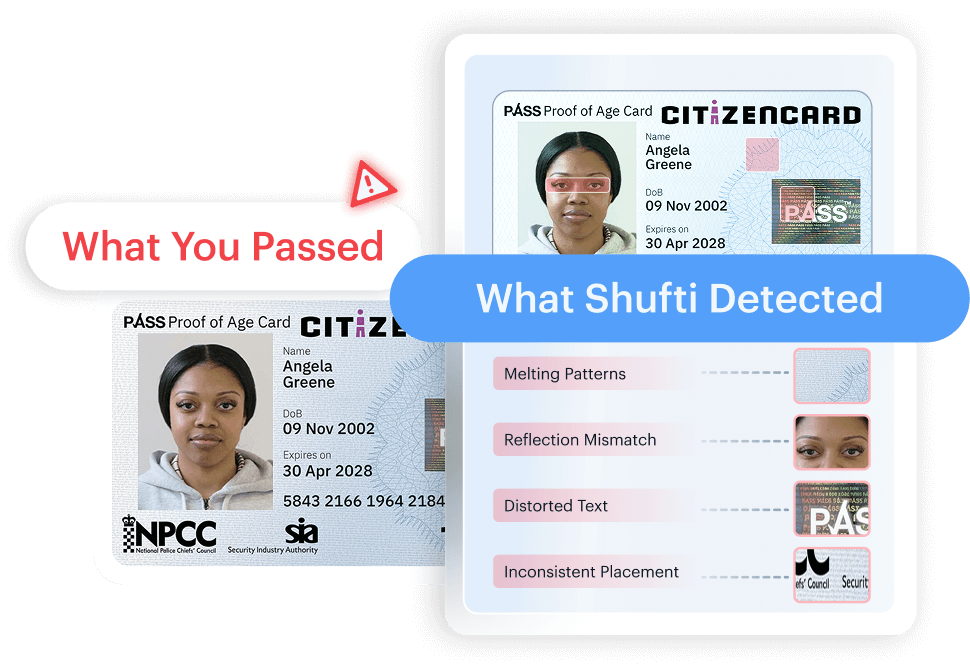
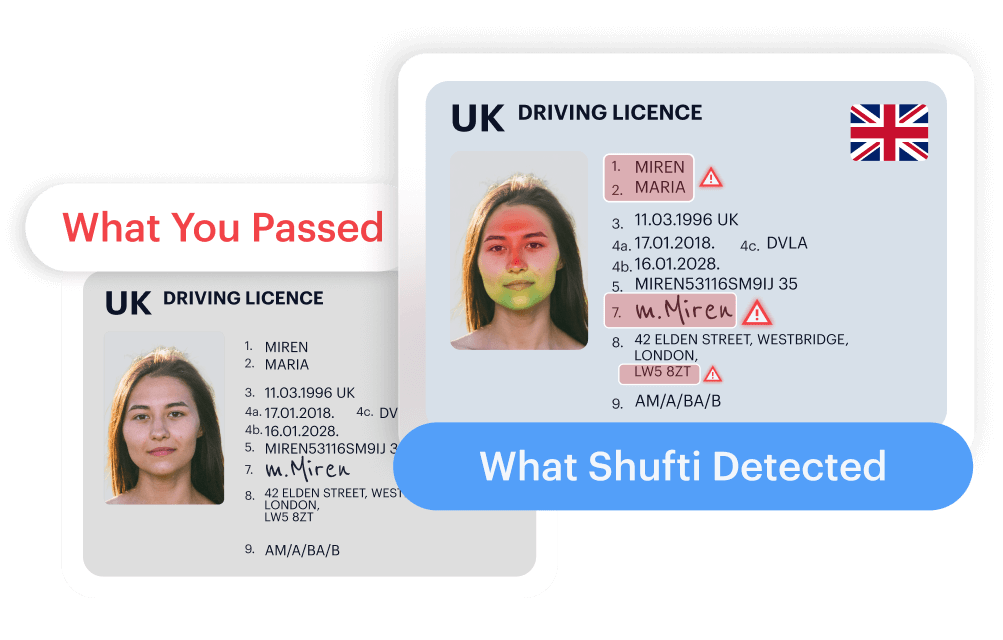
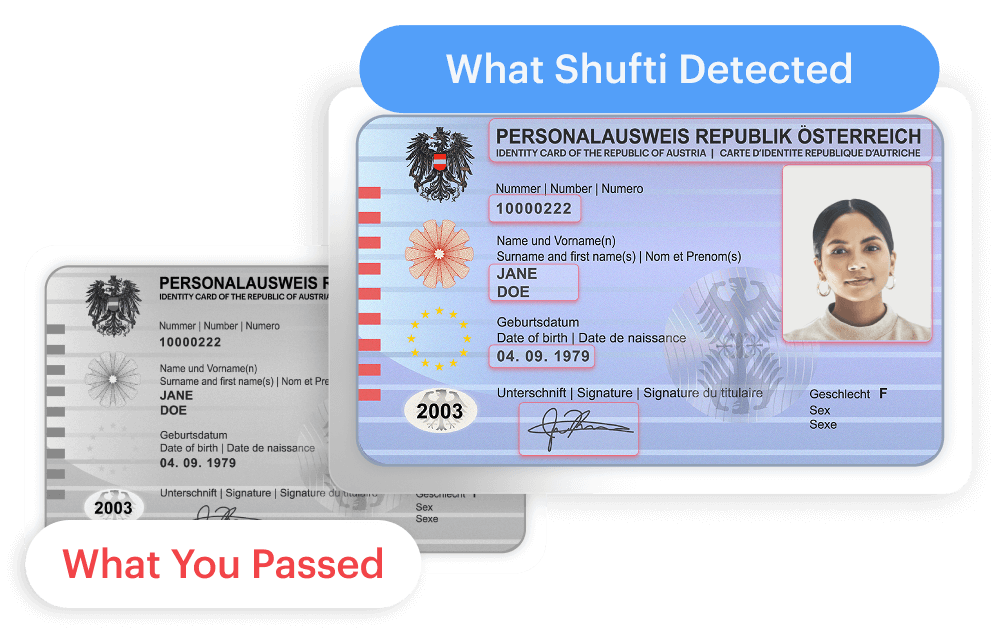
While counterfeit techniques continue to evolve, several consistent indicators remain effective in identifying fraudulent documents. The key signs of fake ID include:
- Blurry fonts, uneven spacing, or misaligned text that deviates from standardized formats
- Incorrect or static holograms that fail to shift under light
- Missing or inconsistent UV features when examined under blacklight
- Barcode mismatches where encoded data does not align with printed information
- Peeling laminate, unusual thickness, or irregular texture suggesting tampering
- Data inconsistencies such as incorrect dates, misspellings, or formatting errors
These indicators align with findings from a 2024 alert issued by the Financial Crimes Enforcement Network, which highlights how counterfeit identity documents—particularly U.S. passport cards—often exhibit flaws such as poor-quality images, missing holographic elements, lack of tactile features, and inconsistencies in embedded data.
Behavioral cues also provide valuable context. Nervous demeanor, delayed responses, or conflicting answers may indicate attempted misuse. According to FinCEN, fraudsters may also struggle to answer basic identity-related questions, rely on external guidance (e.g., via phone), or display unusual interest in account limits and withdrawal thresholds.
When evaluated together, these indicators enable more informed decisions, reducing reliance on single checks and improving the overall detection rate.
How to Spot a Fake ID by State: Why State-Level Knowledge Matters
ID formats and layouts, and security elements embedded on IDs vary considerably across jurisdictions, and thus non-standardized checks are inadequate. Although the REAL ID Act sets minimum compliance standards and AAMVA sets structural standards, individual states include unique visual and tactile design. This variation makes localized verification logic essential for accurate detection.
How to Spot a Fake Illinois ID?
Illinois IDs rely heavily on precise hologram placement and intricate fine-line patterns. Any form of distortion of these patterns is an indicator of possible tampering. Moreover, genuine IDs have a second photo that is UV-reactive, and must match the primary photograph in review.
How to Spot a Fake Texas ID?
Texas IDs have a ghost image that is engraved with a laser-powered gear and should have a sharp and uniform look. Color-changing seals should be able to change color when tilted, whereas the date of birth should be a touchable feature that can be touched with the hands.
How to Spot a California Fake ID?
California IDs consist of a UV-reactive golden bear and a window with key data on it. The signature of the cardholder is also embossed, which gives a feel verification point that can not always be reproduced properly by fake versions.
How to Spot a Fake Pennsylvania ID?
Pennsylvania IDs include state-specific UV imagery, detailed ghost images, and microprint patterns. These details have to be carefully examined, since a lack of consistency in clarity or alignment can be a sign of forgery.
What Security Features Should a Real ID Have?
Businesses need to consider embedded authentication entry points and physical integrity signatures. The Core authentication features include:
- Holograms that shift dynamically under light and match state-specific designs
- Laser perforation forms precise patterns visible when backlit
- UV imagery that reveals hidden graphics under ultraviolet inspection
- Tactile elements, such as raised text or laser engraving, for touch-based validation
- MRZ or barcodes encoding data that must align with printed information
Material integrity checks include:
- Lamination of high quality that does not bubble or peel.
- Smooth, standardized card edges consistent with official manufacturing
A combination of these features brings about layered verification, which offers better protection against forgery attempts.
How Shufti Helps Businesses Detect Fake IDs With Precision?
Shufti helps organizations to accurately verify fake IDs using AI-based document verification, real-time identity technology, and broad global ID coverage.
Its technology is efficient when it comes to analyzing low-quality inputs and integrating liveness verification and biometric verification to confirm that the individual is a real person.
The benefits of businesses are less risk of fraud, quicker onboarding, better regulation compliance, and increased first-attempt approval.
Book a demo with Shufti today to strengthen your fake ID detection strategy and safeguard operations at scale.