 Runs On Your Cloud
 No Data Sharing
 No Contract Required
 Explore Now







 Face Verification
 Address Verification
 Document Verification
 Age Verification
 VideoIdent
 Fast ID
 eIDV
eIDV
 NFC Verification
 Consent Verification
 Business Verification
 Due Diligence
 Investor Verification
 E-Signature
 Behavioural Biometrics
 Device Fingerprinting
 MFA
MFA
 AML Screening
 Business AML Screening
 User Risk Assessment
 Transaction Screening
 Adverse Media Screening

 Identity Verification
 KYC
KYC
 KYB
KYB
 KYI
KYI
 Bonus Abuse
 Fraud Prevention
 Deepfakes
 Banking
 Crypto
 Fintech
 Forex
Forex
 Gaming
 Gig Economy
 Marketplace
 Social Networks
 Product Managers
 Compliance Officers
 Fraud Analyst
 Global Trust Platform
 Journey Builder
 Vendor Comparison

 Content library
 Blogs
Blogs
 News
News
 Reports
 Insights
 Knowledgebase
 ROI calculator
 Blind Spot Audit
 Deepfake Detection
 Liveness Detection
 Document Originality
 Document Deepfake
 Events & Webinar
 Podcast Studio
 Spotlight Studio
 API Documentation
 Mobile SDKs
 Service Status
 Help Center
 Contact Us
 Technical Support
 Compliance
 Supported Document
 About
About
 Career
 Press Release
 Certifications
 Partnership
 Awards
The US Corporate Transparency Act – What’s New? [December 2022]
- 01 Who is a Beneficial Owner?
- 02 How many businesses will be impacted by CTA?
- 03 How soon do companies need to report beneficial ownership?
- 04 What are the penalties for not complying with the CTA’s Reporting Requirements?
- 05 Which companies must report?
- 06 Which companies are exempt from reporting?
- 07 What needs to be reported?
- 08 The Challenges of Implementing CTA and What The Future Holds for Companies
Generally, small to medium businesses in the US continue operating without disclosing the beneficial owners’ information to the government. All of that however, is about to change in 2023.
The US Corporate Transparency Act (CTA) is one the latest laws that passed on the 22nd October 2019, and enacted by the Congress on 1st January, 2021 by overriding a presidential veto.
The purpose of CTA is to disclose beneficial ownership for all businesses and companies formed either by US citizens or foreigners.
It will help the US Government in an ongoing fight against money laundering and financial crimes. This is in line with other countries such as Canada, the UK and the European Union.
Sharing the details of beneficial owners of companies is one additional step that the US is taking to ensure transparency of businesses operated by individuals within or outside of the country. Let’s dive deep into what this law actually is, how it implements businesses, and what information needs to be reported to the federal authorities.
Who is a Beneficial Owner?
According to the CTA’s requirements, the following criteria defines the ownership interest:
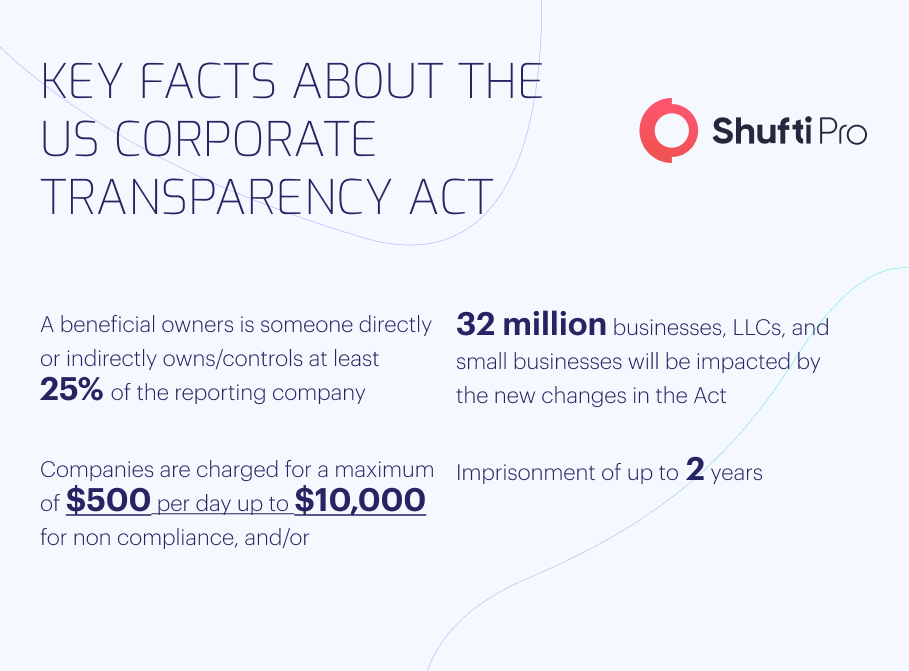
- Directly or indirectly owns/controls at least 25% of the reporting company
- Exercises substantial ownership and control of the company
And the following criteria defines substantial control of the company:
- Individuals with the power and/or authority to direct control or influence decision-making process
- Senior advisors of the company
How many businesses will be impacted by CTA?
According to an estimate, roughly 32 million business entities, LLCs and small businesses will be impacted by sweeping new changes in the regulation.
The affected businesses will now have to disclose the beneficial owners’ identities, source of income, and other documentation to ensure compliance with anti-money laundering laws.
In September 2022, a final rule implementing the CTA was issued by the Financial Crimes Enforcement Network (FinCen). The regulations will go into effect on the 1st of January, 2024, which gives business owners a year’s time, at the writing of this story.
How soon do companies need to report beneficial ownership?
All companies are obliged under law to report BOI (Beneficial Ownership Information) if formed before 1st January 2024, to FinCen by 1st January 2025. Companies formed on or after 1st January 2024 need to report BOI within 30 calendar days. Should there be any change in ownership, it also needs to be reported to FinCen within 30 calendar days.
What are the penalties for not complying with the CTA’s Reporting Requirements?
It is imperative that companies continue ensuring compliance with all types of AML regulations in their operating countries. For this specific case, failure to comply with the reporting requirements of CTA can lead to civil and criminal penalties, whereby:
- The companies are charged for a maximum of $500 per day up to $10,000 for non compliance, and/or
- Imprisonment of up to 2 years
Which companies must report?
A reporting company is defined as any corporation, LLC (Limited Liability Company), or any other business registered with SEC (Securities and Exchange Commissions) in any state, or formed in a foreign country but registered within the US. To understand better, it is imperative to understand the difference between a domestic and a foreign company.
Domestic Company
All types of limited liability partnerships, business trusts, or any small business registered by an American citizen physically within the US.
Foreign Company
Any corporation, limited liability company, or any other entity formed under a foreign country and registered in any state or tribal jurisdiction of the US.
There are no restrictions in place by the US government on the creation, ownership, and the operations of a company registered by a foreign national from outside of the country. States with the highest amount of foreign-owned businesses are Delaware and Vyoming.
Which companies are exempt from reporting?
There are 23 different types of “reporting companies” exempt from filing their BOI including:
- Large companies – Businesses employing a minimum of 20 full-time employees, earning $5 million in annual revenues with physical presence in the US.
- SEC-registered issuers
- Banks, Bank holding companies, loan holding companies, and credit unions
- Insurance firms
- Registered CEA (Commodity Exchange Act) utilities
- Investment Advisors
- Accounting firms
- Dormant or inactive companies
- Tax-exempt companies
What needs to be reported?
In report to FinCen, the company needs to provide:
- Every beneficiary’s full name
- Date of Birth
- Residential or Business address
- Passport or Driving Licence
The Challenges of Implementing CTA and What The Future Holds for Companies
The CTA and the Final Rule represents a final nail in the coffin in ongoing AML regulations. The 32 million companies that fall under the scope of the Final Rule are single-owner LLCs, foreign-owned entities and small businesses.
According to FinCen’s estimate, the total cost of compliance could amount to $21.7 billion for the first year and $5.65 billion per year thereafter.
Companies must develop SOPs to assess reporting obligations and ensure compliance. This means that companies need to make calculated decisions to avoid getting hit with penalties and severe fines.
Shufti’s AML Screening Solutions can help you remain compliant by ensuring that onboarding new clients have their identities verified across 1,700+ international criminal watchlists.
Compliance is costly, but non-compliance is even costlier. Want to learn more?