 Runs On Your Cloud
 No Data Sharing
 No Contract Required
 Explore Now







 Face Verification
 Address Verification
 Document Verification
 Age Verification
 VideoIdent
 Fast ID
 eIDV
eIDV
 NFC Verification
 Consent Verification
 Business Verification
 Due Diligence
 Investor Verification
 E-Signature
 Behavioural Biometrics
 Device Fingerprinting
 MFA
MFA
 AML Screening
 Business AML Screening
 User Risk Assessment
 Transaction Screening
 Adverse Media Screening
 Identity Verification
 KYC
KYC
 KYB
KYB
 KYI
KYI
 Bonus Abuse
 Fraud Prevention
 Deepfakes
 Banking
 Crypto
 Fintech
 Forex
Forex
 Gaming
 Gig Economy
 Marketplace
 Social Networks
 Product Managers
 Compliance Officers
 Fraud Analyst
 Global Trust Platform
 Journey Builder
 Vendor Comparison

 Content library
 Blogs
Blogs
 News
News
 Reports
 Insights
 Knowledgebase
 ROI calculator
 Blind Spot Audit
 Deepfake Detection
 Liveness Detection
 Document Originality
 Document Deepfake
 Events & Webinar
 Podcast Studio
 Spotlight Studio
 API Documentation
 Mobile SDKs
 Service Status
 Help Center
 Contact Us
 Technical Support
 Compliance
 Supported Document
 About
About
 Career
 Press Release
 Certifications
 Partnership
 Awards
UAE Pass & Identity Verification | What UAE Businesses Need to Know in 2026
The UAE has spent the better part of a decade building one of the most sophisticated digital government ecosystems in the world. UAE Pass sits at the center of that ecosystem, and for the millions of residents, citizens, and visitors who use it daily, it has quietly become the default way of proving who they are online.
For financial service providers and businesses in the UAE and MENA region, that shift matters. Customers today expect to open a bank account, sign up for a financial service, or complete IDV without stepping into a branch or scanning the same document for the fifth time. That expectation has been set by the UAE’s own infrastructure, and businesses that cannot meet it are already feeling it in their drop-off rates and onboarding completion numbers.
What is the UAE Pass?
UAE Pass is the UAE’s national digital identity system, launched jointly by the Telecommunications and Digital Government Regulatory Authority (TDRA), Dubai Digital Authority, and Abu Dhabi Digital Authority. It gives every resident, citizen, and visitor a single verified digital identity that works across thousands of government and private-sector services through one login in one app.
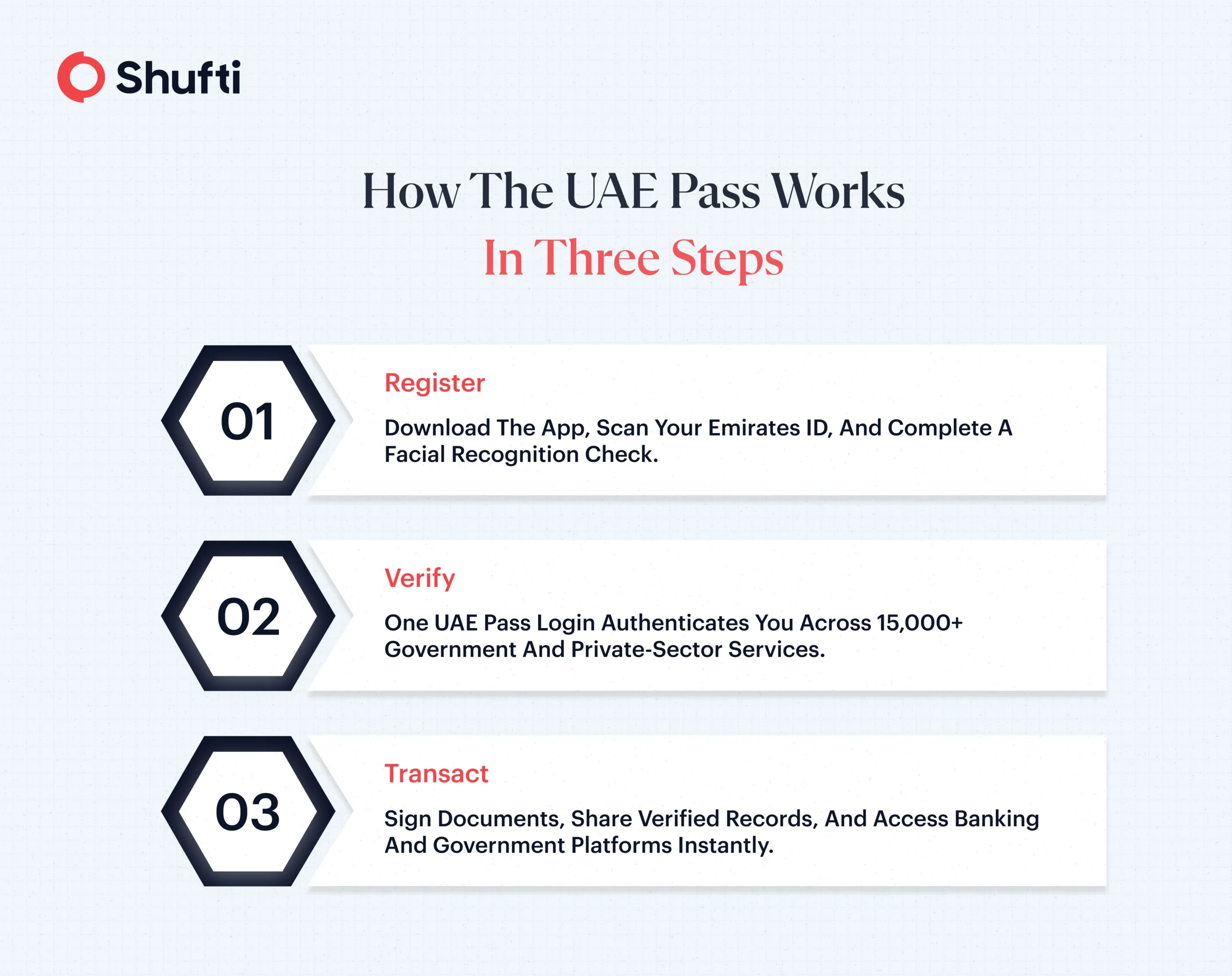
The UAE Pass registration process is straightforward. A user downloads the app, scans their Emirates ID, and completes a biometric facial recognition check. Once the initial setup is completed, UAE Pass becomes their digital identity across the board.
A UAE Pass login helps users authenticate their identity in banking apps, government portals, telecom services, and more. The scale of adoption reflects how deeply embedded the UAE Pass digital identity has become in everyday life. The platform now has over:
- 11 million users.
- More than 15,000 services across 350+ entities, and
- has processed over 2.6 billion digital transactions.
For businesses in the UAE, a significant segment of consumers is already on the platform, verified, biometrically authenticated, and ready to onboard.
The Central Bank of the UAE’s Guidance on Digital Identification for CDD states that Licensed Financial Institutions may use both documentary and non-documentary sources to verify the identity of their customers, and does not impose any restrictions on whether identity evidence takes a physical or digital form. The Guidance lists the UAE Pass as an identification system in the UAE, giving this national verification platform a government-backed assurance.
Challenge of Identity Verification for Businesses in the UAE
Understanding how UAE Pass works is one thing. Building an onboarding flow that actually leverages it is another; and that is exactly where many businesses struggle.
The customer base that banks, fintechs, and telecom operators serve across MENA is extraordinarily diverse. UAE residents on the UAE Pass are one segment. But there are also Saudi nationals, Egyptian expats, Pakistani professionals, Indian entrepreneurs, European investors, and tourists who do not have an Emirates ID or UAE Pass account. Building a verification flow that handles this entire spectrum is not a small task. In fact, 88 % of the UAE’S population are foreigners without Emirati IDs.
Most businesses end up in one of two situations: they lean into UAE Pass online verification for local residents and cobble together a separate process for everyone else, or they default to a single document-based flow that lacks the frictionless experience UAE Pass can offer. Either way, there are gaps in coverage, in user experience, or in both.
Seamless Compliance with UAE Pass eIDV Integration
When the UAE Pass is built directly into an IDV platform, the experience changes considerably on both sides.
On the customer side, UAE residents who have completed UAE Pass verification no longer need to re-upload documents they have already verified on the platform. They authenticate through UAE Pass, which confirms their identity using data from the Pass, and the onboarding process continues. It is fast, familiar, and friction-free, which matters enormously in a region where mobile-first digital experiences have set high expectations.
On the business side, having the UAE Pass sit within a broader IDV platform (rather than a single integration) centralizes the verification flow in one place. UAE Pass eKYC handles UAE residents, document verification, NFC verification, face verification, and liveness detection, catering to non-residents, visitors, and tourists. The platform intelligently routes each user to the appropriate method based on their country and document type.
The practical reality is that integrating a modern IDV platform that already supports UAE Pass gives these institutions a much faster path to UAE Pass readiness. Rather than managing a direct UAE Pass integration separately, banks get UAE Pass eKYC, document verification, biometric face verification, liveness detection, and global coverage through a single API connection. The compliance obligations are met, the onboarding experience is improved, and the institution does not need to build and maintain multiple integrations to get there.
How Shufti Helps UAE Businesses Scale with the UAE Pass:
If your team is still managing multiple verification tools, chasing document uploads, or losing customers halfway through onboarding, the integration is the problem. Shufti consolidates ID Verification solution into a single API-driven flow. UAE Pass users verify in seconds, and Shufti’s non-documentary verification means customers who cannot produce a document on the spot do not have to.
One integration. No gaps. No drop-off.
Integrate the UAE pass with your IDV platform and deliver a frictionless identity verification experience for your customers. Book a demo today!