AMLR Solutions
 AMLR Consultation
 Onboarding
 Ongoing Monitoring
 FRAML
FRAML KYC
KYC KYB
KYB KYI
KYI Age Assurance
 Workforce IAM
 Candidate Verification
 Account Takeover
 Bonus/ Promotion Abuse
 Chargeback Fraud
 Deepfake
 Document Fraud
 Fraud Networks
 Impersonation Fraud
 Money Mule Activity
 Multi-Accounting
 Party Fraud
 Regulatory & Compliance Risks
 Synthetic Identity Fraud
 Adult Content
 Banking
 Crypto
 Fintech
 Forex
Forex Compliance
 Fraud prevention
 Trust & safety
 Global expansion
 Compliance Officers
 Developers
 Fraud Analysts
 Product Managers
 Advanced Journey Builder (AJB)
 Global Trust Platform
 Customer Profiles
 Vendor Comparison
 IDV Case Management
 AML Case Management
 Regulatory Reporting
 Travel Rule Protocols
 Agentic Rule Builder
 AI Compliance Co-Pilot
 Fraud Analytics
 Fraud Hub
 OCR
OCR Shufti AI
 Bank Account Verification
 Biometric Duplication
 Database Checks
 Document Intelligence
 Government ID
 Mobile Driver's License
 NFC
NFC Selfie Liveness
 Brand Personalisation
 Deployment Options
 Identity Methods
 IDV Modes
 Multi-tenancy
 On-Premise IDV
 Secure Capture










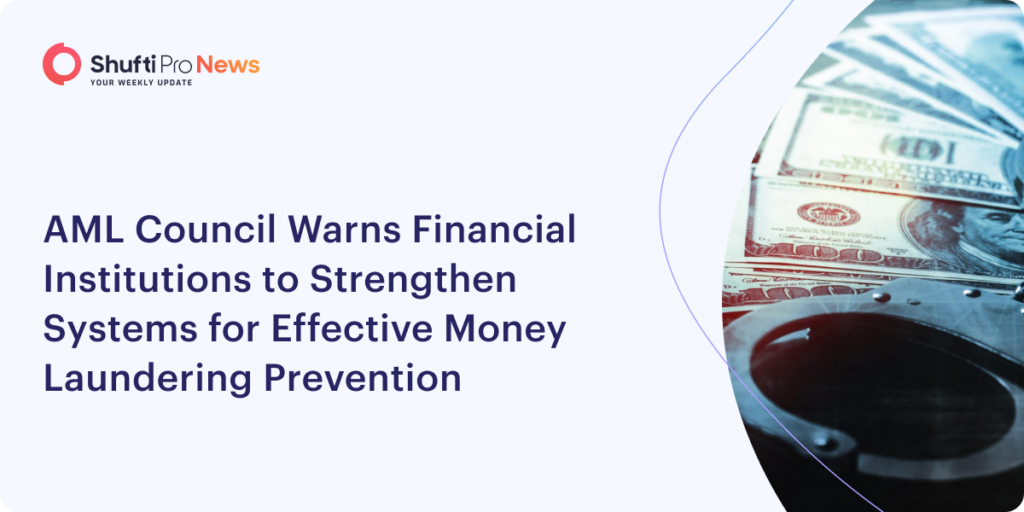
Banks and financial institutions should implement a strengthened anti-money laundering system to prevent illegal activities, terrorist financing, and other crimes, as well as sanction screening systems from identifying potential threats and vulnerabilities, according to the Anti-Money Laundering Council (AMLC).
The Anti-Money Laundering Council recommends that financial institutions strengthen their anti-money laundering systems and sanctions to prevent illegal activities, terrorist financing, and other suspicious activities, as well as implement sanction screening systems to identify potential vulnerabilities and threats. According to the AMLC, most sanctions screening testing metrics have performed poorly among financial institutions over the past 12 months compared to global data.
“[There are] significant weaknesses seen in the ability of covered persons to identify manipulated names in their screening system and processes,” the AMLC said. Additionally, the AMLC observed that sanctions screening systems need to be fully understood and adequately aware of their potential risks. Thus, poor performance and over-reliance is the result of it.
The AMLC said, “Due to the evolution of crime and continued usage of evasive techniques undertaken by sanctioned individuals and entities, there is a need to constantly monitor new emergent risks as well as a test against the new typologies on an ongoing basis,” they added, “Organisations should constantly be monitoring guidelines and alerts published by competent supervisory authorities and international standards bodies as well as through continual training and skill advancements.”
Financial players and other regulated industries must conduct sanction screenings to identify individuals and entities subject to economic sanctions. As the primary supervisor and enforcer of anti-money laundering/counter-terrorism financing AML/CTF compliance, the AMLC uses a risk-based approach.
The implementation of targeted financial sanctions will include risk-based supervision of the performance of TFS on all covered persons and the creation of a practical framework for preventing terrorism financing and proliferation financing of weapons of mass destruction.
AMLC stated, “Financial institutions should first ensure that they have the correct AML/CFT technologies in place to detect financial crime indicators,” they further added, “This should include a robust sanction screening system which is set up to alert against names on globally important sanction lists and tuned to flag sanctioned names even when they have been altered using algorithms to assess the fuzzy logic matching capabilities of a screening system.”
Currently, several requirements and obligations have been outlined in the AMLC’s 2021 Sanctions Guidelines for the Philippines. All covered entities under current law must screen against the Anti-Terrorism Council lists and UN Security Council resolutions.
As part of its country-based sanctions regime, the United Nations Security Council maintains a comprehensive list of individuals and entities connected to the targeted countries’ political leadership. The Security Council Committee associated with each UN sanctions regime maintains general guidelines regarding the implementation of financial sanctions and current lists of targeted individuals and entities.
“Being able to effectively identify potential threats and vulnerabilities within the sanctions compliance context will enable organisations to enhance their programs,” stated the AMLC.
Throughout the document, financial institutions were reminded to have personnel who are appropriately skilled and knowledgeable about sanctions screening. The AMLC offers training that can assist in achieving this objective.
“The Philippines must, among others, demonstrate that covered persons understand their TFS obligations and that supervisors undertake risk-based supervision of TFS measures of financial institutions,” the AMLC said.
Financial Action Task Force (FATF), a global watchdog on financial crime, has placed the country on its list of jurisdictions under increased monitoring in June 2021 due to possible risks associated with “dirty money.” As of January 2024, the Philippine central bank hopes the country can be removed from the “grey list.”