 Runs On Your Cloud
 No Data Sharing
 No Contract Required
 Explore Now






 Face Verification
 Address Verification
 Document Verification
 Age Verification
 VideoIdent
 Fast ID
 eIDV
eIDV
 NFC Verification
 Consent Verification
 Business Verification
 Due Diligence
 Investor Verification
 E-Signature
 Behavioural Biometrics
 Device Fingerprinting
 MFA
MFA
 AML Screening
 Business AML Screening
 User Risk Assessment
 Transaction Screening
 Adverse Media Screening
 Identity Verification
 KYC
KYC
 KYB
KYB
 KYI
KYI
 Bonus Abuse
 Fraud Prevention
 Deepfakes
 Banking
 Crypto
 Fintech
 Forex
Forex
 Gaming
 Gig Economy
 Marketplace
 Social Networks
 Product Managers
 Compliance Officers
 Fraud Analyst
 Global Trust Platform
 Journey Builder
 Vendor Comparison
 Content library
 Blogs
Blogs
 News
News
 Reports
 Insights
 Knowledgebase
 ROI calculator
 Blind Spot Audit
 Deepfake Detection
 Liveness Detection
 Document Originality
 Document Deepfake
 Events & Webinar
 Podcast Studio
 Spotlight Studio
 API Documentation
 Mobile SDKs
 Service Status
 Help Center
 Contact Us
 Technical Support
 Compliance
 Supported Document
 About
About
 Career
 Press Release
 Certifications
 Partnership
 Awards
AML Compliance in the Insurance Sector – Red Flags to Look Out For
The insurance sector commonly faces criminal activities like money laundering and terrorist financing. Fraud and financial crime have surged in the sector in recent times. Unlike banks and other financial institutions that oversee a continuous flow of transactions, insurance firms sell policies and do not seem to be a safe haven for money launderers.
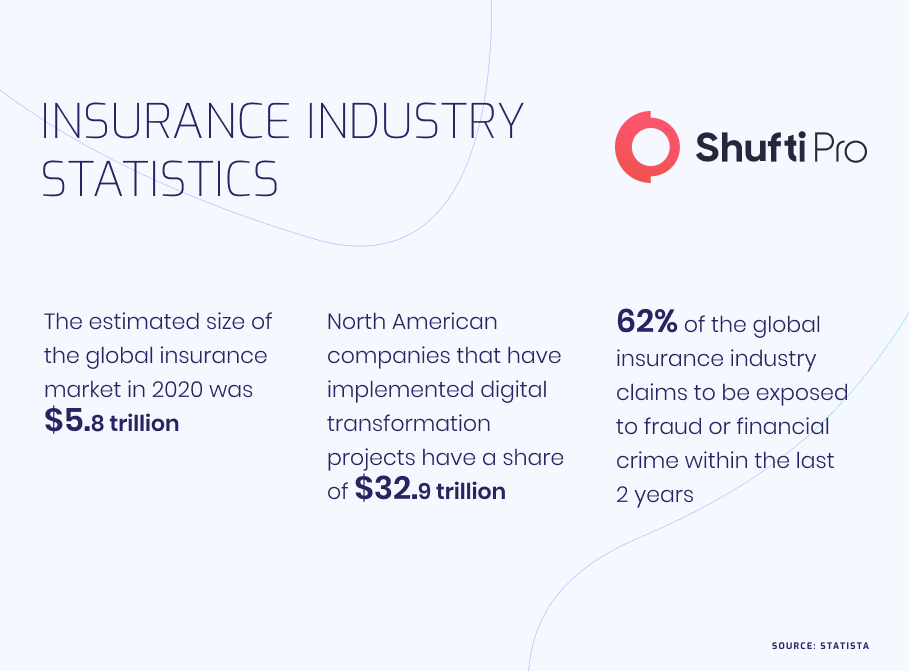
However, that’s not the case – as two-thirds of insurance companies faced fraud or financial crime in 2021. Insurance contracts usually involve the flow of larger amounts of money, which make the sector an easy target for fraudsters and financial criminals. Just like real estate, the art industry, and luxury vehicles, big investments allow money launderers to obscure the origins of their illegally obtained funds.
What Makes the Insurance Sector Vulnerable
The financial sector, including banks, FinTech firms, and insurance companies are equally at risk of getting their reputation stained due to instances of money laundering or terrorist financing. Statistics of financial crime go against the commonly believed notion that the insurance sector does not need stringent Anti-Money Laundering (AML) measures like other financial institutions. As a result, global regulators are seen taking action to ensure that insurance companies implement sufficient AML measures and penalize those involved in money laundering.
When corrupt politicians and business tycoons purchase high-value items using their dirty money, they can claim and get them reimbursed through insurance firms. As per regulations, the insurance firm must refund the paid insurance premium in case of cancellation within a specific time period. Moreover, policy loans do not require insurance firms to conduct due diligence in the same way as traditional banking institutions. In this way, financial criminals exploit insurance firms by capitalizing on the absence of AML compliance procedures.
That being said, regulatory watchdogs always keep an eye on the entire financial sector, including insurance companies. The increasing cases of money laundering in the sector have accounted for the tightening of AML regulations and practices for insurance firms.
Regulatory Efforts to Prevent Financial Crime
Insurance companies in the UK are not obliged to comply with AML regimes, but they are required to report suspicious activities under the Proceeds of Crime Act. As a result, insurance firms and related businesses that do not incorporate strategic AML controls are increasingly vulnerable to the risks of money laundering and terrorist financing.
Global financial authorities have made efforts to prevent financial crimes in the insurance sector. For instance, the UK’s Financial Conduct Authority (FCA) has taken enforcement action against four intermediaries of insurance firms for AML failures. Paris-based Financial Action Task Force (FATF) has urged financial institutions throughout the world to adopt a risk-based approach and conduct due diligence on customers. Similarly, the EU’s 6AMLD (Anti-Money Laundering Directive) states that insurance companies and insurance intermediates are covered by the regulation and must comply.
The US Bank Secrecy Act is not much different. It states the requirement for strict transaction monitoring in insurance companies. Insurance companies in the US must perform transaction monitoring in the case of most permanent life insurance policies, annuity contracts, and other insurance products that have a cash value of investment features. The five basic components of a BSA/AML programme are:
- risk assessment
- internal controls review
- independent auditing
- the appointment of a BSA/AML compliance officer
- BSA/AML compliance training for employees
The regulatory situation in the Asia Pacific is similar, as the Monetary Authority of Singapore (MAS) has issued specific regulations for AML compliance for the insurance sector.
How Insurance Firms Can Combat Financial Crime
Insurance firms must take steps to ensure the prevention of financial crimes in the sector. The most important aspect is to identify the vulnerabilities in their system that allows money launderers to get away with their illicit motives. The pressure on insurance companies is obvious as they are stepping up their game to ensure that there are no loopholes left for financial criminals to launder their illicit funds.
With emerging technologies and methods of committing financial crime, the threat of money laundering for insurance firms is increasing. Insurance companies are now taking steps to perform identity verification to detect and mitigate the risk of fraudulent activities. However, verifying the identity of a customer is sometimes not enough, as legitimate customers can also be involved with external entities to collectively carry out illicit activities.
For this reason, insurance firms must implement enhanced due diligence measures to ensure that high-risk entities are eliminated from the system. With the help of enhanced due diligence, insurance firms can get detailed data and monitor a wide array of potential red flags that can lead to criminal activities like money laundering and terrorist financing.
The Need for Fraud Prevention Solutions
The future of the insurance industry, like the overall financial sector, is filled with challenges in terms of countering financial crimes. Internal misconduct, asset misappropriation, money laundering, and corruption will continue to have a negative effect on the sector. Given the rate at which these risks are increasing, especially after the Russian invasion of Ukraine, it is imperative that insurance firms will have to incorporate solutions to reduce the risks of financial crime.
One of the problems faced by insurance firms is the accurate verifications of customers’ personal information. The accuracy of the data itself, and the accuracy of the measures taken to verify the identities of customers are essential for the reputation of any insurance firm. In order to achieve this, they must incorporate effective Know Your Customer (KYC) solutions and improve their oversight of their customers.
What Shufti Offers
To steer clear of regulatory action, insurance firms must incorporate robust solutions to not only verify their customers’ identities but also monitor their transactions. Identifying and eliminating the risks of money laundering and adopting a risk-based approach must be the top priority for any financial firm.
Shufti’s Anti-Money Laundering (AML) screening allows insurance firms to stay compliant with regulatory standards as well as prevent money laundering. Powered by thousands of AI algorithms, Shufti’s AML screening solution also screens customers against 1700+ global watchlists in less than a second with 98.67% accuracy.
Want to learn more about our AML Screening solution for your insurance firm?