 Runs On Your Cloud
 No Data Sharing
 No Contract Required
 Explore Now
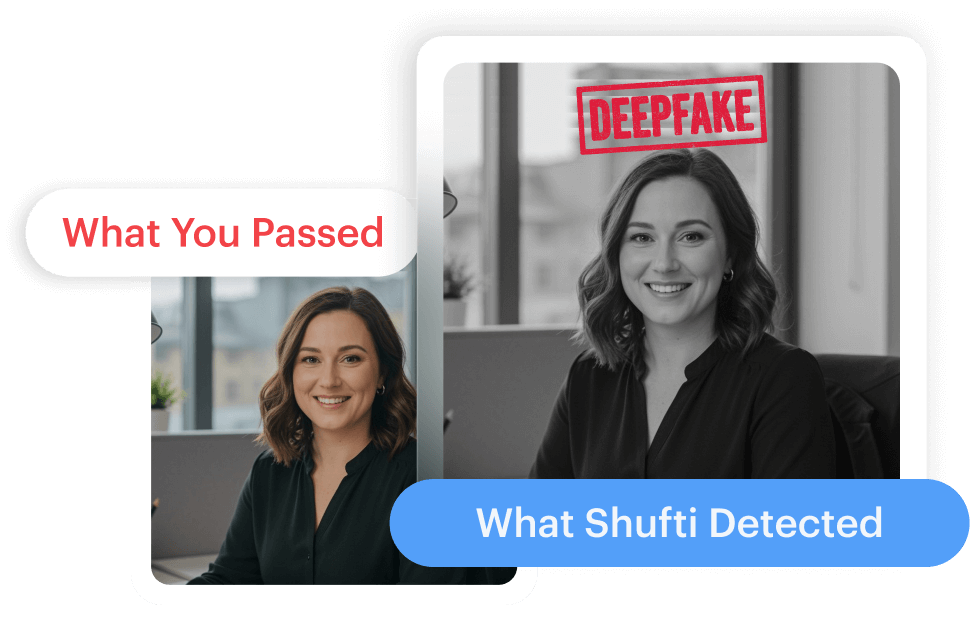

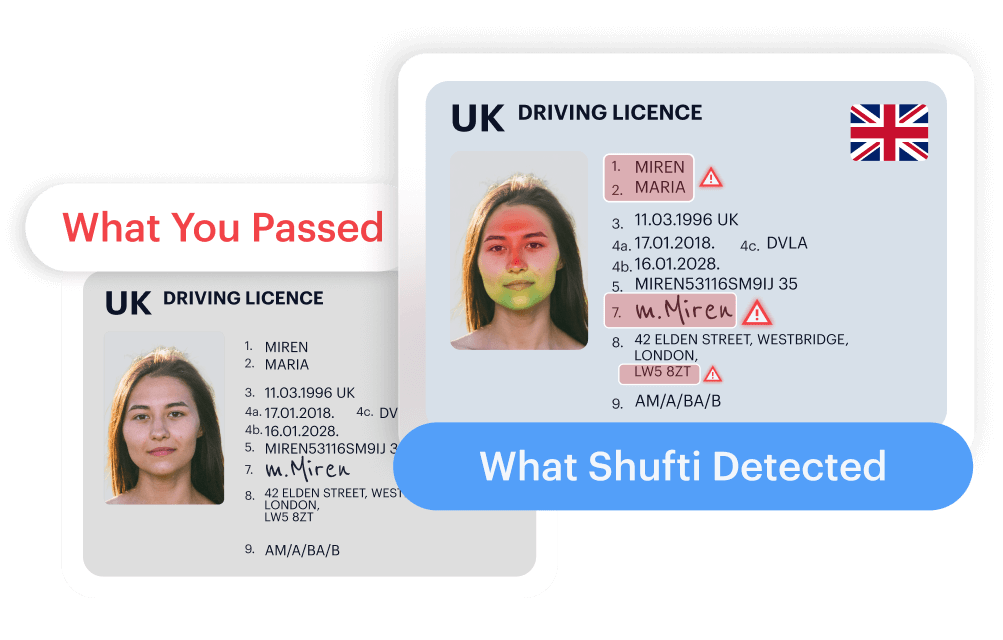
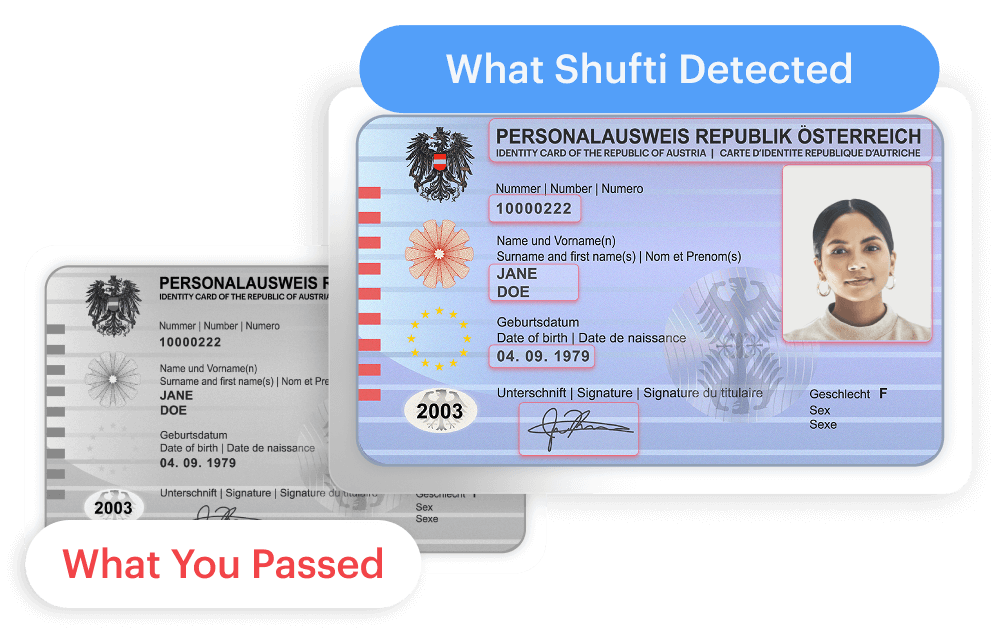





 Face Verification
 Address Verification
 Document Verification
 Age Verification
 VideoIdent
 Fast ID
 eIDV
eIDV
 NFC Verification
 Consent Verification
 Business Verification
 Due Diligence
 Investor Verification
 E-Signature
 Behavioural Biometrics
 Device Fingerprinting
 MFA
MFA
 AML Screening
 Business AML Screening
 User Risk Assessment
 Transaction Screening
 Adverse Media Screening
 Identity Verification
 KYC
KYC
 KYB
KYB
 KYI
KYI
 Bonus Abuse
 Fraud Prevention
 Deepfakes
 Banking
 Crypto
 Fintech
 Forex
Forex
 Gaming
 Gig Economy
 Marketplace
 Social Networks
 Product Managers
 Compliance Officers
 Fraud Analyst
 Global Trust Platform
 Journey Builder
 Vendor Comparison
 Content library
 Blogs
Blogs
 News
News
 Reports
 Insights
 Knowledgebase
 ROI calculator
 Blind Spot Audit
 Deepfake Detection
 Liveness Detection
 Document Originality
 Document Deepfake
 Events & Webinar
 Podcast Studio
 Spotlight Studio
 API Documentation
 Mobile SDKs
 Service Status
 Help Center
 Contact Us
 Technical Support
 Compliance
 Supported Document
 About
About
 Career
 Press Release
 Certifications
 Partnership
 Awards
Risks and Solutions for Bonus Abuse in iGaming & Gambling

- 01 What is Bonus Abuse?
- 02 Bonus Abuse in iGaming vs. Bonus Abuse in Online Gambling
- 03 Modern Bonus Abuse Fraud and Its Anatomy
- 04 The Mechanics Behind the Casino Bonus Abuse
- 05 Is Bonus Abuse a Legal Loophole or Crime?
- 06 The Ecosystem Impact of Online Gambling Abuse and Its Ripple Effects
- 07 How Operators Can Detect and Prevent Bonus Abuse?
- 08 How Shufti Empowers iGaming & Gambling Platforms to Prevent Bonus Abuse?
Online gaming is widely popular worldwide. Casino websites and betting applications attract players with attractive sign-up bonuses, which usually include free bets or even more playing credit.
The purpose is clearly to attract more players to sign up and play. However, bonuses or promotions also invite people who do not intend to continue playing after benefiting from these promotions. As a result, instead of gaining legitimate users, the business loses money spent on promotions. Such practices kill the whole idea of offering bonuses and promotions for expansion.
According to the SalesPlay report, hidden revenue gaps account for an average of 23% in lost revenue potential, with over 79% of organizations consistently missing their revenue targets. The figure is not constant; however, it’s going to escalate alongside platform expansion.
The profile of the “bonus hunter” has transformed dramatically, from occasional opportunists to organized entities operating automated Fraud-as-a-Service (FaaS) frameworks. These actors will use the systemic loopholes with precision, bypass conventional measures for risk mitigation, and require monitoring and verification systems. It is essential for operators who want to grow while keeping their revenue safe.
What is Bonus Abuse?
Bonus abuse happens when players exploit gaming promotions unfairly, and that too often at scale. It includes creating multiple accounts, reusing offers, or employing fake identities, stolen IDs, or automated programs. Terms like “bonus abuse fraud,” “casino bonus abuse,” and “promotion misuse” describe similar activities.
Fundamentally, it constitutes a type of cheating that damages honest participants, the reputations of operators, and operator income. Gaming platforms provide bonuses to attract new users. This is to encourage them to play and to create loyalty with the platform, however, under the condition of adherence to the rules.
Widespread abuse forces operators to tighten offers. It also reduces benefits for the players who are legitimate and harms the entire community.
Bonus Abuse in iGaming vs. Bonus Abuse in Online Gambling
Bonus abuse seems different across gambling and gaming platforms, as it is shaped by intent and sophistication.
In recreational gaming, exploitation often begins with players “gaming the system,” capitalizing on referral programs, eSports incentives, or tactics that trick people into giving away private information. While seemingly sporadic, these behaviors aggregate into measurable revenue deterioration.
On the other side, bonus abuse within gambling is increasingly systematic. Techniques such as Matched and Arbitrage Betting, which are not illegal in themselves, exploit mathematical loopholes in wagering requirements, often executed by organized rings with precise operational discipline.
The rise of account manipulation has further strengthened the threat. Once limited to
“Gnoming,” which involved creating several accounts at the same time to exploit bonuses, has changed. Now, synthetic identities allow people to mix real and made-up information to avoid detection while verification is in process.
Understanding the tactics, risk levels, and technology-based countermeasures is essential. These elements can vary widely, so operators should adopt careful and informed strategies. This approach helps to distinguish between casual exploitation and deliberate criminal actions.
Modern Bonus Abuse Fraud and Its Anatomy
The contemporary fraud of bonus abuse has become very complex and multi-layered. Fraudsters have gained access to a technology stack that they can use to bypass the standard security measures. Anti-detect browsers, residential proxies, and device emulators help mimic real user behavior in great detail. This makes it harder for traditional detection methods to work effectively.
In addition to technology imitations, synthetic identity fraud has become an urgent threat. “Frankenstein” profiles, constructed from leaked personal data fused with AI-generated metadata, allow players to operate multiple accounts while evading the systems specifically designed to verify identities. Collusion further increases the level of risk.
Tactics such as Chip Dumping and Opposite Betting exploit multi-platform coordination, effectively “cleaning” bonus funds and converting them into withdrawable assets.
This is a combination of technology-focused schemes, which shows that operators need to use newer monitoring systems, integrate behavioral analysis with efficient identity checks, and be diligent throughout the life cycle of the customer to defend earnings and platform security.
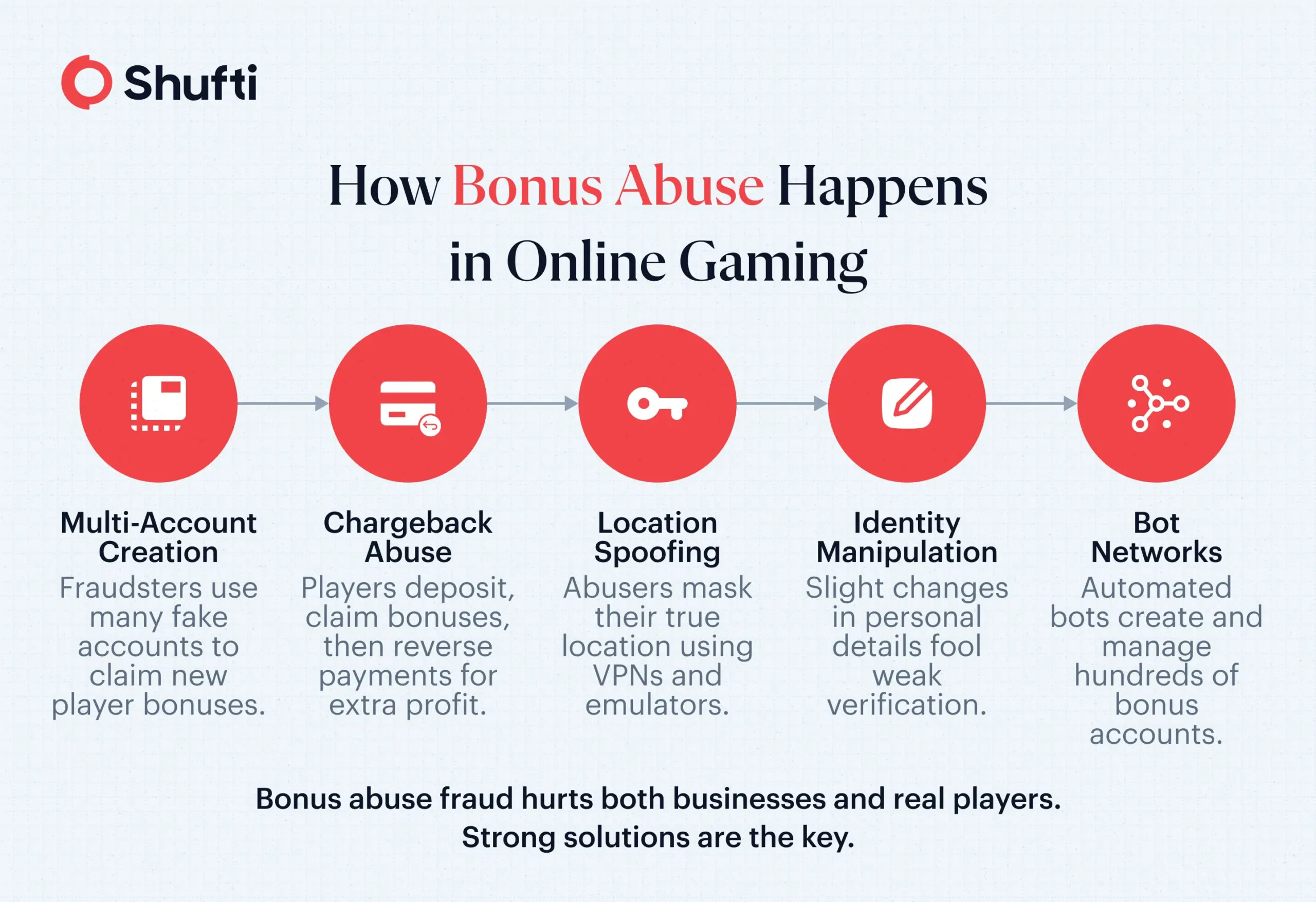
The Mechanics Behind the Casino Bonus Abuse
Casino bonus abuse exploits both technical loopholes and behavioral blind spots. Here are the main ways in which bonus abuse actually occurs:
- Weighted Game Exploits: Fraudsters target low-volatility games, executing betting patterns that are designed to meet betting requirements while reducing actual risk, effectively bypassing T&C restrictions.
- Free Spin Harvesting: Fraudsters sometimes automate the creation of fake accounts to repeatedly claim “sign‑up” and “no‑deposit” bonuses, which is essentially the same mechanism behind what’s described as “free spin harvesting.
- Gateway to Money Laundering: The bad actors use bonus systems to transfer money, mixing dirty money with legitimate wins in promotions to cover up their origins.
Operators need to implement strong measures to manage risks. This includes using real-time behavior monitoring, thorough identity checks, and sharing information across platforms. These steps help protect revenue and meet anti-money laundering requirements.
Is Bonus Abuse a Legal Loophole or Crime?
The question “Is bonus abuse illegal?” comes up often. Bonus abuse fraud usually breaks the rules set out in a site’s terms and conditions. The majority of the cases are handled as violations of Terms of Service and can be resolved with the help of civil sanctions, not criminal charges. The jurisdictional distinctions also make enforcement challenging: the UK Gambling Commission can consider intentional manipulation of financial gain differently from some of the states in the USA, and criminal responsibility has different limits.
In the cases where the abuse consists of fabricated identities, automated scripts, or cross-border transfer of funds, it may evolve into wire fraud or identity theft, exceeding the contractual violation and becoming a criminal act.
To operators, the inability to prevent or report abuse carries significant regulatory risk, including fines, licence suspension, and reputational harm, and UK regulators are explicit on this point. For example, the UK Gambling Commission has made clear that if the industry cannot appropriately manage the criminal risks posed by bonus and promotional offers, it may intervene through licence conditions that restrict or reshape how bonuses and promotions can be issued under Section 81 of the Gambling Act 2005.
The Ecosystem Impact of Online Gambling Abuse and Its Ripple Effects
Online gambling abuse extends far beyond immediate financial loss, eroding the broader ecosystem. Product degradation emerges as operators impose stricter wagering requirements, penalizing genuine players and diminishing the overall user experience. Marketing budget cannibalization produces a “phantom ROI,” in which acquisition spend fuels fake accounts rather than true lifetime value.
In the meantime, data integrity is compromised: the use of fraudulent profiles alters behavioral analytics and AI-driven game balance and decision-making. All these impacts reduce operational efficiency, player trust, and strategic development.
How Operators Can Detect and Prevent Bonus Abuse?
To prevent bonus abuse, we need a stronger approach than standard Know Your Customer measures alone. Effective solutions incorporate:
- Advanced Identity Verification: Platforms analyze more than names, flagging fake, reused, or suspicious identities by assessing patterns across accounts.
- Biometric Authentication and Liveness Detection: Photos and videos cannot impersonate a real user since this data is checked by a biometric device, which ensures that a person is actually who they say they are.
- Device Fingerprinting and Behavioral Analytics: Minor device and interaction patterns, mouse movement, typing rhythms, and similar indicate that an activity is repeated or automated, which is an indicator of abuse.
- IP and Geo-Location Intelligence: The use of VPN or unusual locations should be monitored to indicate possible fraud.
- Real-Time Fraud Data Sharing: Collaborative networks help to alert operators about abusers known quickly.
- AML Screening and Identity Graphs: Mapping financial connections between accounts exposes coordinated fraud.
These tools combined form a powerful security layer, which protects fair players and is always ready to counter changing attacks.
How Shufti Empowers iGaming & Gambling Platforms to Prevent Bonus Abuse?
Bonus abuse often scales when repeat sign-ups and lookalike accounts slip through basic checks, which reduces the value of promotional spend.
Shufti supports iGaming operators with identity verification, liveness checks, and device intelligence to help detect duplicate and higher-risk registrations. For returning users, Shufti Fast ID supports quick re-verification using a selfie that can be matched against an existing verified profile, which helps reduce repeat document checks while improving confidence in promotion eligibility.
Request a demo to see how Shufti’s bonus abuse prevention supports across onboarding and repeat sessions.