 Runs On Your Cloud
 No Data Sharing
 No Contract Required
 Explore Now







 Face Verification
 Address Verification
 Document Verification
 Age Verification
 VideoIdent
 Fast ID
 eIDV
eIDV
 NFC Verification
 Consent Verification
 Business Verification
 Due Diligence
 Investor Verification
 E-Signature
 Behavioural Biometrics
 Device Fingerprinting
 MFA
MFA
 AML Screening
 Business AML Screening
 User Risk Assessment
 Transaction Screening
 Adverse Media Screening
 Identity Verification
 KYC
KYC
 KYB
KYB
 KYI
KYI
 Bonus Abuse
 Fraud Prevention
 Deepfakes
 Banking
 Crypto
 Fintech
 Forex
Forex
 Gaming
 Gig Economy
 Marketplace
 Social Networks
 Product Managers
 Compliance Officers
 Fraud Analyst
 Global Trust Platform
 Journey Builder
 Vendor Comparison
 Content library
 Blogs
Blogs
 News
News
 Reports
 Insights
 Knowledgebase
 ROI calculator
 Blind Spot Audit
 Deepfake Detection
 Liveness Detection
 Document Originality
 Document Deepfake
 Events & Webinar
 Podcast Studio
 Spotlight Studio
 API Documentation
 Mobile SDKs
 Service Status
 Help Center
 Contact Us
 Technical Support
 Compliance
 Supported Document
 About
About
 Career
 Press Release
 Certifications
 Partnership
 Awards
Shufti Recognised As A Top Performer in DHS RIVR 2025

- 01 Why DHS RIVR Matters to the Identity Verification Market?
- 02 Understanding the Selfie Match to Document Track
- 03 Shufti’s Overall Performance in RIVR 2025
- 04 Consistency In Results Irrespective of the Device, Document, and Demographic
- 05 Why These Results Matter for Real Business Use Cases?
- 06 Strengthening Market Trust Through Independent Validation
- 07 Operate At Scale with Shufti’s Low-Risk Identity Verification
Shufti has delivered one of the strongest performances in the U.S. Department of Homeland Security’s 2025 Remote Identity Verification Rally. This independent evaluation tests how well commercial systems match live selfies with government-issued identity documents under real-world conditions.
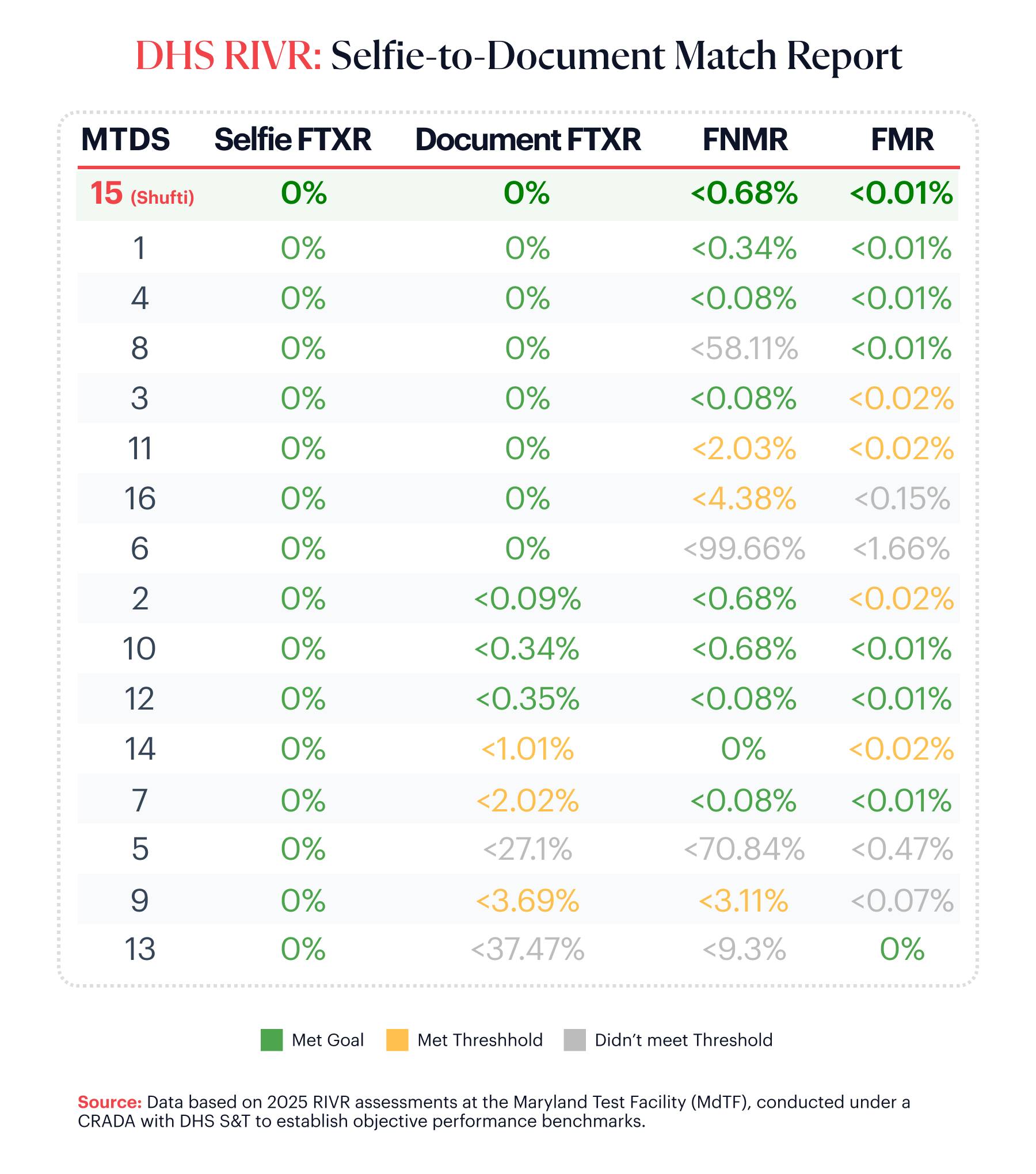
Shufti was one of the few vendors to show a false match rate below 0.01 percent and a false non-match rate below 0.68 percent.
These results demonstrate Shufti’s strength in delivering reliable identity verification while maintaining high assurance and low friction for legitimate users.
Accurate selfie-to-document matching empowers banks, fintechs, and other regulated sectors to confirm that applicants are genuine and that documents belong to the people presenting them.
Independent evaluation of identity verification systems is important as it validates how systems perform in real-life conditions. Without this, system failures can lead to higher rejection rates, onboarding friction, and weak controls that increase exposure to fraud.
The U.S. Department of Homeland Security’s Science and Technology Directorate’s Remote Identity Verification Rally helps identity verification providers substantiate their accuracy and performance claims.
Shufti, assessed under the alias MTDS 15, was one of the top performers, demonstrating excellence across all evaluated benchmarks.
Why DHS RIVR Matters to the Identity Verification Market?
It is common for identity verification vendors to make accuracy claims. Ye, very few of them are independently tested by independent bodies such as government organizations that use standardised biometric metrics, mixed demographics, and multiple devices to evaluate performance.
DHS RIVR uses industry-informed benchmarks for remote identity validation technologies and to assess whether systems are suitable for operational use.
For businesses requiring remote identity verification for AML Compliance or ensuring digital trust, RIVR shows how identity verification vendors deliver results under stress, scale, and demographic variation.
Understanding the Selfie Match to Document Track
The Selfie Match to Document (SMTD) track evaluates whether a system can accurately determine if a selfie belongs to the same person pictured on a genuine U.S. state-issued identity document.
DHS measured performance using ISO-aligned biometric metrics, including:
- Failure to Extract Rate for selfies and documents
- False Non-Match Rate (FNMR), where genuine users are incorrectly rejected
- False Match Rate (FMR), where impostors are incorrectly accepted
Systems were tested across three smartphones and two issuing states, with additional analysis across age, sex, race, and skin tone. Overall performance was judged using the worst-case result, reflecting real-world deployment risk rather than best-case scenarios.
Shufti’s Overall Performance in RIVR 2025
According to the official RIVR results summary, only 31 percent of tested systems met RIVR goals for all metrics. Shufti, identified as MTDS 15, was one of these systems.
Many systems met some thresholds but failed others. Shufti’s performance has demonstrated the balance across accuracy, reliability, and robustness rather than optimization around a single metric.
-
Zero Failure to Extract (No Single Customer Drops)
One of the most operationally relevant metrics in RIVR is Failure to Extract Rate (FTXR). This metric tells how many times a system failed to generate a biometric template from a selfie or document image.
For Shufti, the results show:
- 0 percent selfie extraction failures across all smartphones
- 0 percent document extraction failures across all smartphones and document states
Evaluating Identity Verification Systems on these outcomes matters for the businesses, because extraction failures translate directly into abandoned onboarding journeys, manual reviews, or reattempts. In regulated onboarding flows, each failed attempt adds cost and friction while increasing drop-off rates.
For banks and fintech firms operating at scale, consistent extraction success supports higher verification completion rates, lower operational costs, and more predictable customer acquisition funnels.
-
Low False Non-Match Rates (Improved Customer Experience)
The False Non-Match Rate (FNMR) measures how many times real users are incorrectly rejected. High FNMR values create friction, customer dissatisfaction, and increased support workloads.
In the RIVR evaluation, Shufti’s worst-case FNMR across all tested device and document combinations was 0.67 percent. This worst-case scenario occurred under the most challenging combination of device and document state and still remained well below the RIVR threshold of 5 percent and close to the 1 percent goal benchmark.
From a business perspective, this indicates that legitimate customers are rarely blocked during identity verification. For financial institutions, this supports smoother account opening while still maintaining strong identity assurance. For digital platforms, it reduces false declines, which causes customers to switch to other platforms or reputational damage.
-
Strong False Match Performance (Fraud Risk Reduction)
False matches represent a critical risk area in identity verification. A false match means an impostor is incorrectly accepted as a legitimate user, which can lead to account takeover, fraud losses, and regulatory breaches.
RIVR evaluates false match performance using millions of non-mated comparisons and includes a more challenging category known as demographically similar impostors, for example, individuals with similar age, sex, and race characteristics.
Shufti’s results show:
- 146 false matches out of approximately 7.9 million non-mated comparisons, resulting in an extremely low overall false match rate
- 50 false matches out of approximately 250,000 demographically similar comparisons, which remains within RIVR threshold and goal expectations
These figures demonstrate that Shufti maintains strong impostor resistance even under more realistic attack scenarios, where fraud attempts are rarely random and often involve look-alike characteristics.
For AML and fraud teams, this means minimized risk of synthetic identity fraud, account misuse, and regulatory scrutiny.
Consistency In Results Irrespective of the Device, Document, and Demographic
Another important aspect of RIVR is that it also tests resilience. Systems were tested for their performance on different smartphones, document states, and demographic groups.
The RIVR conclusions indicate that high-performing systems show consistent behaviour across race, sex, age, and skin tone categories. Shufti’s inclusion among the systems meeting all performance goals reflects its ability to deliver stable outcomes even when the user base is diverse (based on both demographics and device use), rather than performing well only under narrow conditions.
This consistency is a basic need of businesses that operate in multiple regions and demographics, particularly in markets where fairness, accessibility, and biasness are regulatory and public concerns.
Why These Results Matter for Real Business Use Cases?
Independent validation strengthens Shufti’s positioning across several high-impact business scenarios.
For financial services onboarding, low false matches and low false rejections support both fraud prevention and customer experience. Institutions can meet KYC requirements without causing undue friction.
For digital wallets and fintech platforms, zero extraction failures help maintain fast, mobile-first onboarding flows that scale across devices.
For regulated digital services and marketplaces, strong impostor resistance supports compliance with identity assurance requirements as well as preventing account abuse.
Across all use cases, DHS-backed benchmarking provides decision-makers with confidence that identity verification performance is not based on internal claims but on independent, standardised evaluation.
Strengthening Market Trust Through Independent Validation
The RIVR programme highlights an important industry reality. Technical maturity varies widely across vendors, and not all solutions are suitable for operational deployment. The fact that only a small proportion of systems met all high-performance goals tells the value of independent testing.
Shufti’s performance as MTDS 15, meeting RIVR goals across every evaluated metric, reinforces its role as a reliable identity verification provider for regulated environments.
Operate At Scale with Shufti’s Low-Risk Identity Verification
Businesses that operate in regulated sectors like finance, crypto, gambling, and marketplaces are under pressure from both ends because, for them, user experience is as important as compliance and fraud prevention.
Independent benchmarks such as DHS RIVR provide rare transparency into how identity verification technologies perform in real-life conditions and scenarios.
The 2025 RIVR results show that Shufti’s selfie match to document technology delivers consistent accuracy, low friction, and strong fraud resistance across devices, documents, and demographics. Therefore, organisations seeking evidence-backed identity verification can view these results as a meaningful indicator of operational readiness.
Identity fraud continues to evolve, and so do regulatory expectations. To address these challenges, businesses require solutions that perform not only in controlled demos but also under independent scrutiny. Shufti’s participation and results in DHS RIVR 2025 reflect that commitment.
Request a demo to see how Shufti supports secure and compliant digital identity journeys.