 Runs On Your Cloud
 No Data Sharing
 No Contract Required
 Explore Now





 Face Verification
 Address Verification
 Document Verification
 Age Verification
 VideoIdent
 Fast ID
 eIDV
eIDV
 NFC Verification
 Consent Verification
 Business Verification
 Due Diligence
 Investor Verification
 E-Signature
 Behavioural Biometrics
 Device Fingerprinting
 MFA
MFA
 AML Screening
 Business AML Screening
 User Risk Assessment
 Transaction Screening
 Adverse Media Screening
 Identity Verification
 KYC
KYC
 KYB
KYB
 KYI
KYI
 Bonus Abuse
 Fraud Prevention
 Deepfakes
 Banking
 Crypto
 Fintech
 Forex
Forex
 Gaming
 Gig Economy
 Marketplace
 Social Networks
 Product Managers
 Compliance Officers
 Fraud Analyst
 Global Trust Platform
 Journey Builder
 Vendor Comparison
 Content library
 Blogs
Blogs
 News
News
 Reports
 Insights
 Knowledgebase
 ROI calculator
 Blind Spot Audit
 Deepfake Detection
 Liveness Detection
 Document Originality
 Document Deepfake
 Events & Webinar
 Podcast Studio
 Spotlight Studio
 API Documentation
 Mobile SDKs
 Service Status
 Help Center
 Contact Us
 Technical Support
 Compliance
 Supported Document
 About
About
 Career
 Press Release
 Certifications
 Partnership
 Awards
Video KYC Verification Guide for Faster, Fraud-Resistant Onboarding

Every weak identity check is an open invitation to fraud. Every extra step is a reason for a real customer to leave. KYC has to balance both. The dynamic of verifying a customer’s identity has always been shifting. From assessing high-risk profiles to verifying ages, KYC keeps evolving to uphold regulatory standards while protecting customer convenience.
A verification system should be crafted not only to meet compliance standards but also to prioritize user convenience. In today’s digital-first marketplace, effectively verifying a customer’s identity is essential for maintaining security and fostering trust.
What is Video KYC Verification?
Video KYC is a verification method that helps businesses verify a customer’s identity through a live video call with a KYC expert. During the call, the customer shows their documents, which mostly include an ID card or passport. The expert checks these documents and uses facial recognition to ensure the customer’s face matches the ID. Additionally, the process is usually augmented with advanced technologies like OCR, document authenticity, deepfake & liveness detection, etc., to watch out for any signs of fraud, forgery and impersonation.
Why Does Video KYC Matter?
More businesses are moving their operations online. At the same time, fraudsters are finding ways to exploit weaknesses in digital systems. For this, they employ common tactics like fake identities, identity theft, and manipulation to steal important customer information. This is a major problem for businesses, especially in high-risk areas like finance, fintech, and digital wallets.
Automation is necessary for speed and scale in business operations. However, certain cases still require human oversight, especially when document quality is poor, biometric signals are uncertain, or higher-risk cases require additional scrutiny.
Video KYC helps close this gap between technology and human oversight. Real-time video verification makes it difficult for fraudsters to exploit others’ identities or alter documents.
According to a study by PwC, banks spend nearly 3% of their total operational budget on Know Your Customer procedures. And not only this, but process-heavy steps require 18.5 hours for a simple customer verification.
How Video KYC Works?
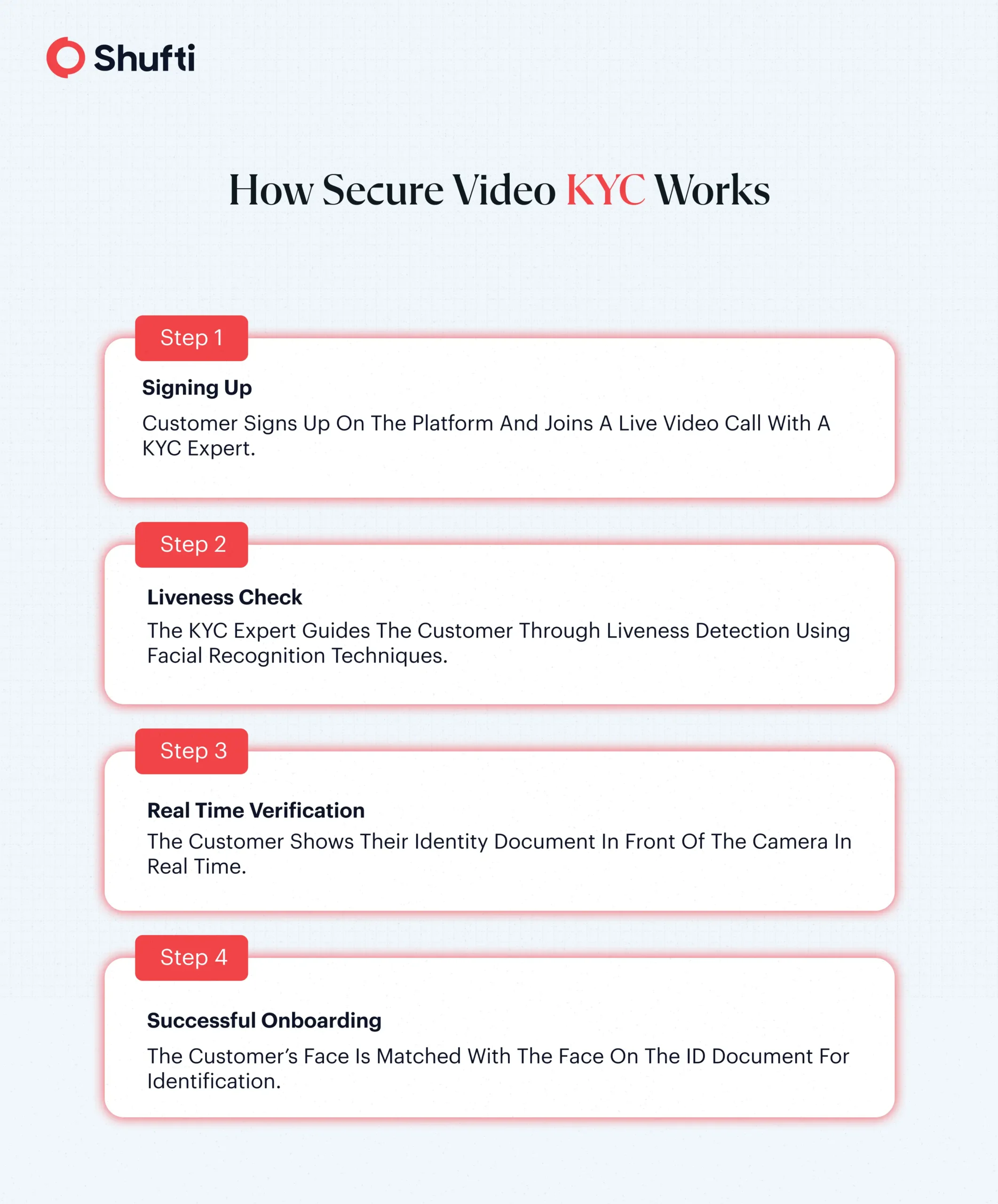
The process of customer verification through live video call is an effective method that has the following essential steps:
-
Signing up for a Video KYC
The customer books a live session by providing some necessary details like name, DOB and email address. Customers are usually invited to join a video call through a secure link leading to a necessary app or platform’s built-in video call feature.
-
Facial and Document Verification
Through the call, the customer shows their government-issued ID document, such as a passport, ID card, or driver’s license. The KYC expert uses facial recognition techniques to compare the customer’s face with the image on the presented document.
-
Liveness Detection
To avoid the risk of spoofing, the system uses liveness detection technology. During this, the customer may be asked to perform specific actions, such as blinking or turning their head, for confirmation that they are physically present.
-
Successful Completion and onboarding
The customer’s face matched the face on the ID document, including the online database, if present. If the checks go well, the customer gets onboarded successfully. The KYC expert may ask follow-up questions to confirm additional details or clear up if there may be any confusion in the documents.
Video KYC looks complicated, but it helps businesses safely onboard customers and prevents fraud. It adds an extra layer of safety and reduces the chances of mistakes that manual systems might overlook.
Video KYC Regulations by Country
Regulatory bodies around the world have become aware of the increasing risk of fraud in online onboarding. Many have made specific rules for verifying identities. In some regions, businesses that must follow strict Anti-Money Laundering (AML) and Countering Financing of Terrorism (CFT) regulations are required to conduct Video KYC for remote onboarding of clients in certain situations.
Video KYC regulations may differ from country to country, but typically revolve around requirements for user consent, recording of the session, trained reviewers, document quality, and auditability.
Businesses across all sectors are vulnerable to various risks of fraud. The problem with traditional KYC is that the systems can be easily exploited due to their weaknesses. For example, Verification systems that rely solely on document uploading are likely to be exploited more, as there is a chance that fraudsters can use forged or completely fake documents and bypass the KYC system.
Germany (BaFin)
In Germany, the Federal Financial Supervisory Authority (BaFin) provides guidelines for banks and financial companies on how to verify identities. Since 2017, Bafin has introduced updated video KYC interview requirements for businesses in remote settings.
BaFin sets these minimum requirements for video identification procedures in Germany, which are as follows:
- Video verification should be done by trained employees of the organization or a trusted third party.
- The person being verified must clearly agree to the video KYC process.
- Video KYC should happen in real time.
- Video KYC sessions must be recorded and kept for future reference.
Switzerland (FINMA)
In Switzerland, video KYC is accepted as an equivalent to in-person customer onboarding. Provided that, it must be:
- Monitored by a trained KYC expert who should identify the customer.
- Conducted in real time.
- Audio recorded end-to-end, with evidence archived alongside captured images of the ID and the contracting party
- Only government-issued identity documents with a machine-readable zone (and an optical security feature).
Additionally, FINMA also states that banks/FIs using video KYC should have:
- liveness detection capabilities.
- Technical capabilities to compensate for the poor lighting conditions and check the authenticity of the document.
- Technical capabilities to read MRZ and optical security features.
Spain
SEPBLAC, the Spanish financial authority, allows companies to use video KYC for customer identification. However, for this, firms must follow specific rules. For example, they need to clearly document their video identification process. Companies must also assess the risks involved to ensure safe practices. Finally, they must record the entire verification session to maintain accurate records and compliance with regulations.
What are the Benefits of Video KYC?
Stronger assurance than document upload-only checks
Video KYC gives financial institutions a lot more than just a simple document verification, which is mostly done through uploading. In live video checks, experts can base their decision on additional risk signals such as how a user speaks, their real-time movements, and what’s happening in their surroundings during the live call.
Better protection against impersonation
A live session makes impersonation harder because the applicant must respond in real time to analyst queries, present the document in the moment, and complete liveness prompts.
More resilient than mere selfie checks
Selfie verification is a helpful step. If the selfie doesn’t match the photo on the ID, the case can be checked more closely. However, a determined fraudster might still use AI or deepfake tools to create a selfie that looks similar enough to pass.
Helps spot coaching and coercion
Video KYC can capture the customer’s surroundings. This includes background voices, strange pauses, or someone whispering instructions, which may show when someone is being coached or pressured to open an account for someone else.
More verification signals in one decision
With live video checks, there are multiple data points that are assessed during verification. For example, an expert can review the document, match the face, and do liveness checks, and the overall behavior during the call as one combined picture. This collective mix of signals provides a better chance to stop suspicious activities before they turn into real losses.
Automate Video KYC with Shufti
Remote onboarding usually fails when automation cannot resolve edge cases. This can increase drop-off rates or push large volumes into manual queues. A blended model helps address both problems because automation covers repeatable checks while trained reviewers handle complex outcomes.
Shufti Video KYC supports this approach by combining trained KYC experts and AI in real time, so businesses can:
- Increase enrollment rates when users struggle with fully automated onboarding, since Shufti combines liveness detection, facial verification, and document verification to help genuine users complete signup.
- Meet regulatory requirements in countries that expect live video sessions with trained experts, supported through expert-led calls, session recordings, identity document verification, and high-quality video standards.
- Choose an operational model that fits business and regional needs, including dedicated or shared experts, international experts for language and regional coverage, AI-supported chat, and OCR document scanning.
- Scale across markets with flexibility to operate in one country or expand to several jurisdictions where Video KYC is required or preferred.
- Run a guided verification flow that follows a clear sequence: customer joins a live call, liveness is checked, the document is shown on camera, and the face is matched with the ID for final confirmation.
Request a demo to evaluate Video KYC workflows for compliance and fraud risk reduction.