 Runs On Your Cloud
 No Data Sharing
 No Contract Required
 Explore Now







 Face Verification
 Address Verification
 Document Verification
 Age Verification
 VideoIdent
 Fast ID
 eIDV
eIDV
 NFC Verification
 Consent Verification
 Business Verification
 Due Diligence
 Investor Verification
 E-Signature
 Behavioural Biometrics
 Device Fingerprinting
 MFA
MFA
 AML Screening
 Business AML Screening
 User Risk Assessment
 Transaction Screening
 Adverse Media Screening
 Identity Verification
 KYC
KYC
 KYB
KYB
 KYI
KYI
 Bonus Abuse
 Fraud Prevention
 Deepfakes
 Banking
 Crypto
 Fintech
 Forex
Forex
 Gaming
 Gig Economy
 Marketplace
 Social Networks
 Product Managers
 Compliance Officers
 Fraud Analyst
 Global Trust Platform
 Journey Builder
 Vendor Comparison
 Content library
 Blogs
Blogs
 News
News
 Reports
 Insights
 Knowledgebase
 ROI calculator
 Blind Spot Audit
 Deepfake Detection
 Liveness Detection
 Document Originality
 Document Deepfake
 Events & Webinar
 Podcast Studio
 Spotlight Studio
 API Documentation
 Mobile SDKs
 Service Status
 Help Center
 Contact Us
 Technical Support
 Compliance
 Supported Document
 About
About
 Career
 Press Release
 Certifications
 Partnership
 Awards
What is Customer Identity Verification in 2026

- 01 What is Customer Identity Verification
- 02 Why Customer Identity Verification is Necessary
- 03 Key Customer Identity Verification Methods in 2026
- 04 How Regulatory Updates are Impacting Customer Identity Verification in 2026
- 05 Industries That Rely on High Assurance Customer Identity Verification
- 06 How Technology is Reshaping Customer Identity Verification in 2026
- 07 Strengthen Your Trust Framework with Shufti
Identity fraud has emerged as a significant business risk, prompting companies to reconsider their approach to trust evaluation and risk management. The growing losses from identity theft, synthetic identities, and AI-based impersonation schemes are exposing underlying weaknesses in digital platforms. The urgency for prompt action is evident:
- According to the FTC (2024), around 1.13 million identity theft cases were reported in the U.S. alone. The same report highlighted that consumer losses from fraud exceeded $12 billion.
- A report from TransUnion highlights that exposure to synthetic identities reached $3.3 billion among U.S. lenders for the year ending 2024
- Furthermore, data from TransUnion Global (H1 2024) shows that 6.5% of digital account creation attempts were flagged as potential fraud.
- Meanwhile, a survey by Experian in 2024 revealed that 84% of consumers identified identity theft as their main concern regarding digital security.
Identity checks are vital in the expanding digital economies of finance, healthcare, e-commerce, and cryptocurrency. Customer identity verification has moved from manual, branch-based checks to automated online workflows. It is now heading towards applying artificial intelligence so that it will make smarter and risk-based decisions that will combat more sophisticated threats.
What is Customer Identity Verification
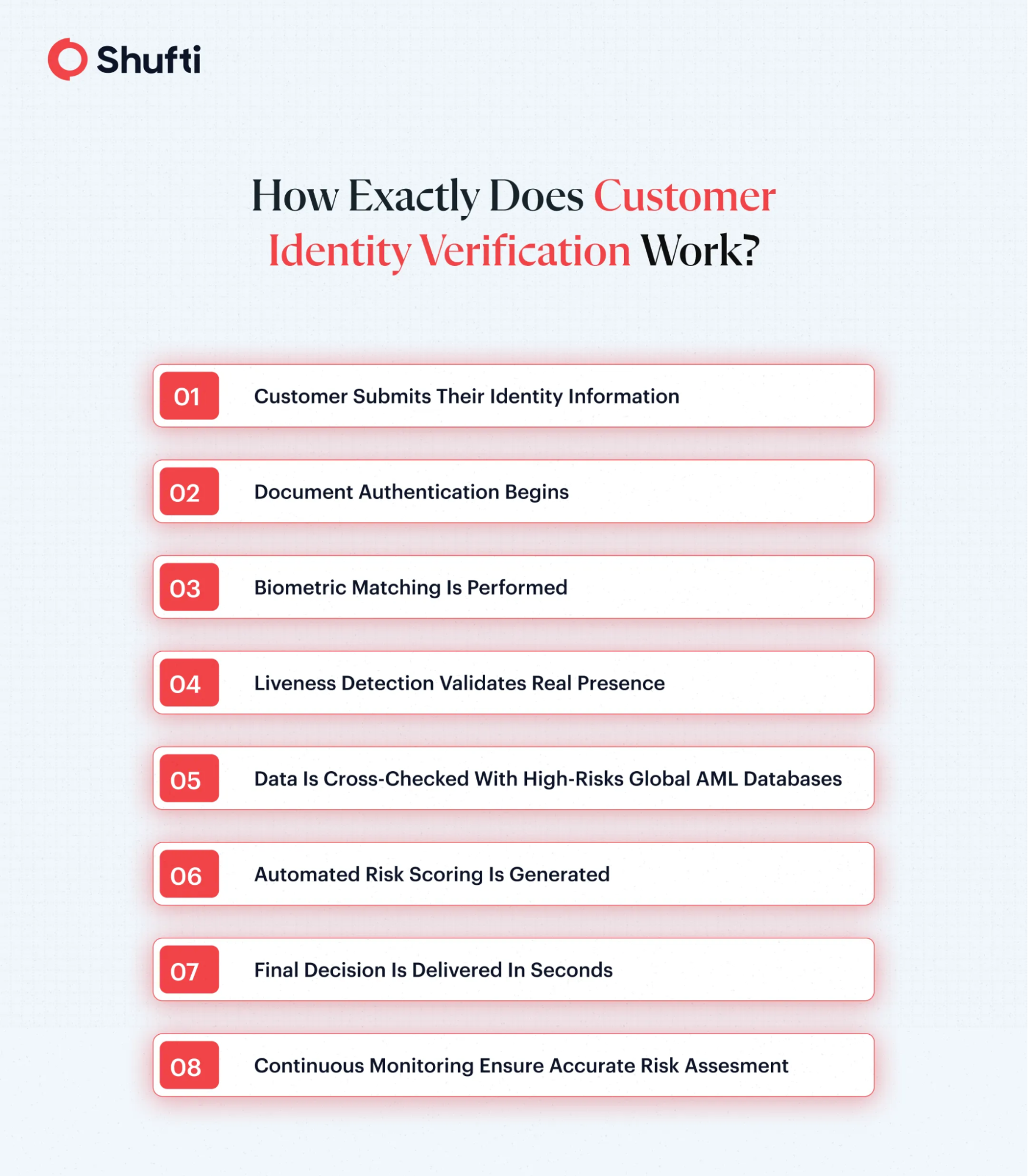
Customer identity verification refers to the process of confirming that an individual is who they claim to be before granting access, services, or financial privileges. It involves the process of document verification, the analysis of biometrics, and data validation in order to make sure that it is all real. In the case of regulated industries, it is one of the main control processes that creates trust and stops fraud, and helps meet legal requirements. The identity checks are critical to securely onboarding new customers as companies expand their services on digital channels.
However, identity verification has its own vulnerabilities and challenges. Problems can include fake documents, inconsistent data, unclear uploads, spoofing from devices, and delays from manual reviews. These issues can cause frustration, lower accuracy, and add pressure to operations.
Why Customer Identity Verification is Necessary
Businesses that involve high-value transactions, operate in regulated sectors, and handle large volumes of sensitive information need to verify customer identity. It helps companies to comply with the laws, reduces the fraud risk, and provides secure growth. Most importantly, it builds confidence between the businesses and their customers. When they know that their information is being processed with care, customers are most likely to have confidence in a business.
Customer Due Diligence
Customer Identity Verification is a core pillar of Customer Due Diligence (CDD). It enables businesses to assess customer risk, validate identities at onboarding, and conduct ongoing monitoring to meet KYC and AML obligations throughout the customer lifecycle.
Supporting Market Expansion
As companies expand into new regions, they face varying identity and compliance requirements. Electronic Identity Verification (eIDV) and identity document verification enable businesses to validate government-issued IDs, biometrics, and local credentials, ensuring customers meet regional regulations and allowing compliant, scalable international growth.
Reducing Identity Fraud
Effective verification procedures reduce the risks of identity theft. Businesses can minimize account takeovers, fake identities, and fraudulent transactions by verifying the identities of individuals who use them. This minimizes losses of money and the reputation of the company.
Meeting Legal Requirements
Compliance is a critical factor in the business sectors that conform to the Know Your Customer (KYC) and Anti-Money Laundering (AML) requirements. The inability to use the verification standards can result in penalties and legal issues. A robust identity verification system will help companies avoid such problems and demonstrate their responsibility.
Protecting Personal Data
Strong authentication maintains that confidential information is accessible to only authorized personnel, reducing the risks of data breaches. Biometrics and multi-factor authentication are some of the measures that enhance security against data breaches and secure the personal data of customers.
Building Customer Trust
Customers respond by realizing that the organization is serious about security when they observe that the checking procedures are not intrusive. This trust creates loyalty and promotes lasting relations.
Ensuring Smooth Digital Experiences
An effective verification system enhances the customer experience. The process of onboarding and transactions becomes smooth with quick checks that enable legitimate users to proceed with speed and identify high-risk behavior.
Key Customer Identity Verification Methods in 2026
The rise of digital interactions requires organizations to make decisions regarding the verification methods that would provide a balance between security, compliance, and user experiences. Various strategies offer a range of accuracy, fraud protection, regulatory support, and convenience in the onboarding process.
- To authenticate IDs, document verification employs a number of technologies such as OCR, MRZ parsing, and hologram checking, among others. In many scenarios, this method will work. However, in the event of document tampering or alteration by AI, it may not always be effective.
- Biometric verification relies on the recognition of faces, fingerprints, and iris scans, combined with liveness checks to determine if the person is present. This method can be resilient, but remains exposed to deepfake images, masks, or physical impersonations.
- Database and government checks involve API connections to national registries, which, depending on the region, may not always be reliable; there could also be questions regarding how fresh and complete the data is.
- Knowledge-based authentication (KBA) is less used nowadays since it may easily be targeted with social engineering and relies on publicly available information.
- While Multi-Factor Authentication (MFA) improves access security, it is susceptible to SIM swaps and may eventually lead to user overwhelm or fatigue.
- Behavioral biometrics monitors various parameters such as typing patterns and device motion for continuous authentication. However, its reliability may vary under environmental changes.
- Device and network intelligence leverages IP addresses and device information to detect bots, emulators, and VPN abuse.
How Regulatory Updates are Impacting Customer Identity Verification in 2026
Identity verification has always been important in the prevention of identity fraud and in the protection of any country’s financial system. Thus, a set of international rules and industry-specific requirements governs it. Organizations must follow these rules to stay compliant, reduce risk, and keep customer trust.
International standards establish the baseline for identity verification. FATF recommendations require reliable customer identification and verification using independent, trustworthy sources as part of KYC and CDD. The EU’s 2024 AML package strengthens obligations around identity verification, beneficial ownership checks, and ongoing monitoring, with key AMLD6 requirements taking effect by July 10, 2026.
In the U.S., FinCEN rules mandate financial institutions to verify customer identities at onboarding and maintain verified records to prevent AML and CTF risks. eIDAS 2.0 establishes a pan-European digital identity framework, enabling qualified electronic identification, trust services, and EU Digital Identity Wallets to support secure, cross-border identity verification across public and private sectors.
The Industry-Specific Rules add extra amounts of scrutiny. The bank needs to comply with FFIEC expectations and PSD2. The Travel Rule applies to cryptocurrency companies, as they are required to monitor transactions and verify their recipients. Healthcare providers must comply with both HIPAA and GDPR requirements, which require high levels of protection of sensitive and personal, and medical information.
Verification is also impacted by requirements related to Data Privacy. GDPR imposes an obligation on organizations to collect only necessary data, stating clear legal grounds for processing such information and specifying the rules regarding data storage. Moreover, CCPA and other similar laws in different regions amplify individual rights along with the requirement for consent. Organizations shall plan the collection of information securely. Further, to process and store identity data without losing transparency with customers.
To meet legal and ethical requirements, institutions need a smart and careful approach to identity verification, especially with increasing regulations. This approach should combine technology, clear policies, and strong operational practices.
Industries That Rely on High Assurance Customer Identity Verification
The nature of identity verification requirements across industries is diverse, depending on the risks, regulations, and requirements in the industry. As an illustration, in finance and financial technology, strong controls can be used to fulfill anti-money laundering (AML) requirements. In finance and fintech, effective identity verification reduces the risk of account opening fraud and helps prevent account takeover attempts.
Moreover, strict verification is necessary to comply with transaction regulations and reduce crimes that exploit anonymity in the crypto and digital assets sector. Furthermore, identity checks are also used by E-commerce websites and gig-economy services to avoid fake seller accounts, along with courier impersonation and payment fraud.
Telecommunications companies must verify identities to prevent SIM card-related fraud and number transfers. Identity checking is also a feature of the travel and hospitality sector, which utilizes traveler identity verification to curb booking fraud and streamline and enhance safety in the check-in procedure.
How Technology is Reshaping Customer Identity Verification in 2026
The process of identity verification is taking a new turn towards a more distributed control, a more refined authentication system, and more autonomous security systems. Decentralized identity models and digital wallets via verifiable credentials will enable individuals to take control of the sharing of their data.
Simultaneously, the introduction of state-provided digital identity and mobile driver licenses will create consistent high-assurance identity models in multiple areas. The AI-first approach of verification will enhance accuracy in scale without having to manually review them.
Moreover, self-driven fraud detection engines will be on the lookout continuously to detect anomalies in order to deal with matters before they go out of control. The combination of these developments is an indication of a new era of identity systems that are more secure, stable, and user-centric.
Strengthen Your Trust Framework with Shufti
Fraud patterns entering 2026 include deepfake-led impersonation, synthetic identities, and document manipulation that weaken trust at the point of onboarding and account recovery.
Shufti helps financial institutions and regulated businesses address these risks through AI-powered identity verification that combines document verification, face verification with liveness, and fraud detection to support risk-based decisions and compliance workflows.
Request a demo to see how Shufti can strengthen digital trust across customer journeys.