 Runs On Your Cloud
 No Data Sharing
 No Contract Required
 Explore Now







 Face Verification
 Address Verification
 Document Verification
 Age Verification
 VideoIdent
 Fast ID
 eIDV
eIDV
 NFC Verification
 Consent Verification
 Business Verification
 Due Diligence
 Investor Verification
 E-Signature
 Behavioural Biometrics
 Device Fingerprinting
 MFA
MFA
 AML Screening
 Business AML Screening
 User Risk Assessment
 Transaction Screening
 Adverse Media Screening
 Identity Verification
 KYC
KYC
 KYB
KYB
 KYI
KYI
 Bonus Abuse
 Fraud Prevention
 Deepfakes
 Banking
 Crypto
 Fintech
 Forex
Forex
 Gaming
 Gig Economy
 Marketplace
 Social Networks
 Product Managers
 Compliance Officers
 Fraud Analyst
 Global Trust Platform
 Journey Builder
 Vendor Comparison
 Content library
 Blogs
Blogs
 News
News
 Reports
 Insights
 Knowledgebase
 ROI calculator
 Blind Spot Audit
 Deepfake Detection
 Liveness Detection
 Document Originality
 Document Deepfake
 Events & Webinar
 Podcast Studio
 Spotlight Studio
 API Documentation
 Mobile SDKs
 Service Status
 Help Center
 Contact Us
 Technical Support
 Compliance
 Supported Document
 About
About
 Career
 Press Release
 Certifications
 Partnership
 Awards
Which Countries Issue Biometric ID Documents Worldwide
- 01 What is a Biometric ID?
- 02 Which countries issue Biometric ID documents?
- 03 How Do Biometric IDs Work for Cross-Border Travel?
- 04 Where Biometric IDs Are Used Beyond Passports?
- 05 Why Biometric IDs Alone Can’t Stop Fraud?
- 06 How FATF Addresses Biometric Verification in Digital Identity Systems?
- 07 What’s Next for Biometric Identity?
- 08 Empowering Secure Digital Identity Verification with Shufti
Government-issued identity credentials have evolved from paper-based documents into biometric ID systems, which are designed for digital-first environments. Today, many countries issue biometric passports and national ID cards together with mobile digital IDs that use fingerprints, facial recognition, and iris scans to improve identity security while decreasing fraud and providing easier access to public services.
Adoption, however, shows different patterns. Some countries use biometric identification throughout their banking system and telecom onboarding and government portals, while other countries limit its use to border control and specialized programs. The use of conventional identity documents without biometric security measures continues to be widespread in various regions, which creates digital trust gaps and increases the possibility of identity theft.
The World Bank ID4D initiative estimates that more than 1.1 billion people worldwide still lack an officially recognized ID. It also notes that several countries have introduced some form of biometric ID, though the maturity of these systems differs by region.
Identity systems now require more than just issuing identification because digital services are growing. The systems require reliable verification methods that authenticate the ID holder as the actual owner of the identification.
What is a Biometric ID?
A biometric ID ties a credential to a uniquely human trait, which includes fingerprinting, facial mapping, and iris scanning, because these traits cannot be easily copied or distributed. The World Bank ID4D initiative states that biometric recognition prevents duplicate registrations while allowing users to verify their identity and access services.
Biometric verification differs from basic ID checks by performing a one-to-one match between a live biometric capture and a stored reference. The system verifies ID ownership through the process of matching the presented ID with its actual owner. Biometric systems require strong privacy safeguards and governance controls, and lawful usage frameworks to achieve both effectiveness and trustworthiness.
Which countries issue Biometric ID documents?
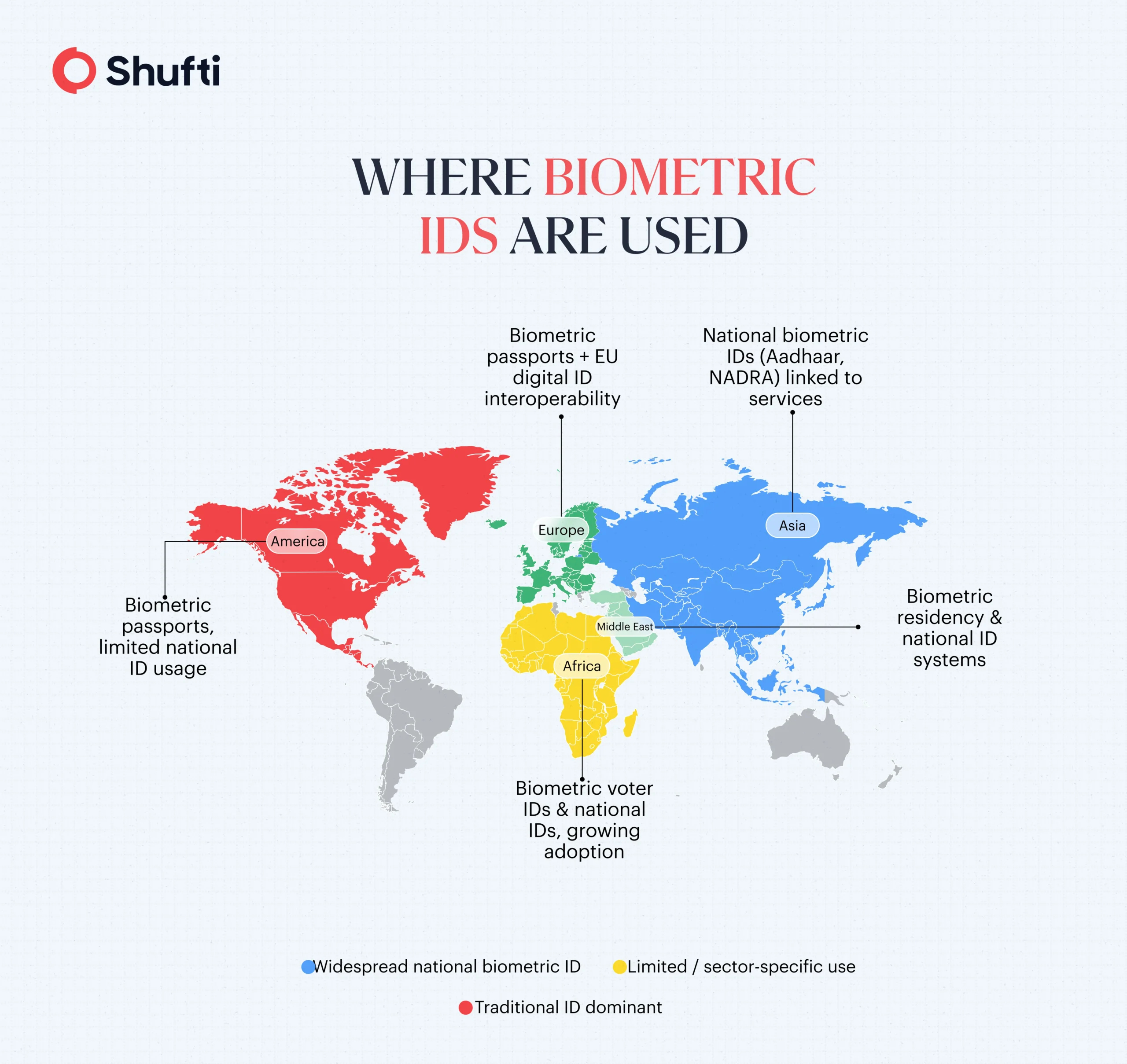
Instead of listing every country, we can look at global adoption trends, which reveal how countries implement biometric ID systems and integrate their data across different services.
-
Asia
Multiple Asian nations operate extensive biometric identification systems. India’s Aadhaar program links biometric identity to public services, banking, and mobile access. Pakistan, Bangladesh, and Indonesia issue biometric national identification documents. East Asian countries use biometric passports and facial recognition technology for their travel and border control operations.
-
Europe
Most European countries issue biometric passports and national ID cards, which contain facial images and fingerprints. The EU digital identity framework enables member states to develop interoperable digital identification systems that use biometric data to provide advanced authentication for international services.
-
Africa
Many African countries issue biometric voter IDs, passports, or national identity cards. The integration of biometric systems into digital services is progressing through increased adoption, but existing infrastructure and governance systems present obstacles to that integration.
-
Americas
North and Latin American countries issue biometric passports as standard travel documents. Some countries use biometrics for their national ID systems and election processes, but they do not implement this technology across all citizens.
-
Middle East
Several Middle Eastern countries, especially those in the Gulf region, provide biometric national identification cards that connect to residency permits, immigration documents, and government services.
Although international development has advanced, numerous nations, particularly those with insufficient registration systems, continue to use standard identification methods, which do not incorporate biometric information. World Bank research estimates that over 1.1 billion people worldwide lack official identity documents, highlighting persistent gaps.
How Do Biometric IDs Work for Cross-Border Travel?
e-Passports have been globally recognized and validated since the ICAO standardized them in 2003. These standards define how biometric passports and ID documents are formatted so that machines can read them worldwide.
However, countries implement these standards differently. Some embed multiple biometrics in secure chips linked to national registries, while others store only a single biometric trait or rely solely on facial images. These variations can occasionally create interoperability challenges, as some systems may have limited capability to verify documents from other nations.
The European Union’s eIDAS framework requires all notified eIDs to be mutually recognized across its different assurance levels, enabling users to access services across state borders.
Despite these advancements, some biometric systems still face security gaps. Without real-time liveness verification and anti-spoofing measures, unauthorized access remains a potential risk. Independent verification tools that confirm a biometric match to a live person at the point of entry help enhance security and maintain trust in cross-border identity verification.
Where Biometric IDs Are Used Beyond Passports?
Biometric IDs extend their applications beyond their use in travel.
- Banking and finance industries use biometric identity systems for their digital onboarding processes and to reduce fraud. The 2024 industry survey shows that facial recognition technology now achieves accuracy rates above 98% while more than 70% of enterprises worldwide use cloud-based identity verification systems.
- Healthcare: Biometric controls ensure precise patient medical records and minimize fraud in healthcare.
- Telecom & SIM registration: Biometric linking to national databases helps prevent identity misuse.
- Elections: Biometric voter registration is implemented in over 50 countries to increase the integrity of voter rolls and the election process.
These examples indicate that biometric identity is no niche, but is, instead, crucial to securing and scaling access across sectors.
Why Biometric IDs Alone Can’t Stop Fraud?
Biometric identification methods create more security because their design makes them harder to fake than traditional identification methods. Research demonstrates that identity theft has increased among banking and online service sectors despite the implementation of biometric identification systems.
Systems need real-time liveness detection with anti-spoofing measures to protect against replay and spoofing attacks. Businesses need Identity Verification as a Service (IDaaS) solutions that combine document liveness verification with checks and artificial intelligence-based risk assessment to enhance their identity verification procedures beyond the security offered by national identification systems.
How FATF Addresses Biometric Verification in Digital Identity Systems?
The Financial Action Task Force (FATF) guidance on digital identity systems demonstrates that reliable digital identity systems perform necessary customer due diligence for anti-money laundering (AML) compliance by providing accurate methods to verify users during online transactions.
The FATF references NIST-defined Identity Assurance Levels (IAL) as benchmarks, providing guidance on how users should present biometric data and complete either in-person or supervised remote verification to confirm their identity.
Its 2025 guidance highlights the importance of combining biometric registers, robust verification methods, and advanced fraud prevention systems to strengthen digital identity reliability and support financial inclusion.
By referencing NIST’s assurance levels, FATF ensures that biometric identity systems meet internationally recognized benchmarks for security and reliability while providing practical guidance for real-world implementation in banking, finance, and other regulated sectors.
What’s Next for Biometric Identity?
Emerging trends show where biometric identity is headed:
- Multi‑modal verification: Combining fingerprints, face, and iris data for stronger assurance.
- Mobile biometric IDs: Secure credentials on smartphones for everyday access.
- AI‑driven fraud detection: Real‑time anomaly detection with biometric checks ensures the system resists deepfakes, presentation attacks, and injection attacks, confirming that only the legitimate user can authenticate and maintain verification integrity.
- Standardization & interoperability: Efforts to harmonize systems for seamless global verification.
These trends emphasize that biometric identity must evolve with usability, privacy, and fraud resistance at the center.
Empowering Secure Digital Identity Verification with Shufti
As digital services and global connectivity continue to grow, the challenges surrounding identity verification, fraud prevention, and regulatory compliance remain significant. Traditional methods are no longer enough to meet the increasing demands for security, scalability, and seamless user experiences.
Shufti addresses these challenges with its AI-powered verification solutions that combine cutting-edge technologies like biometric identification, document verification, and liveness detection. By ensuring fast, secure, and accurate identity validation, Shufti helps businesses combat fraud, comply with global regulations, and enhance user trust in a digital-first world.
Whether it’s AML/KYC compliance, anti-fraud measures, or cross-border authentication, Shufti’s comprehensive suite of services offers businesses a reliable, scalable, and future-proof solution.
Book a Demo today to see how Shufti can strengthen your identity verification process and protect against fraud.
Frequently Asked Questions
Which countries have mandatory biometric IDs?
Over 120 countries use biometric ID systems, with nations like India, Pakistan, and several Gulf countries mandating biometric IDs for public services and financial access. Many others restrict biometric use to passports, elections, or border control.
How will biometric IDs change international security?
Biometric IDs strengthen international security by enabling accurate identity verification at borders and reducing identity fraud. Global standards and interoperable systems are key to making cross-border biometric checks effective.
How do governments protect biometric database privacy?
Governments secure biometric databases using encryption, strict access controls, and data protection regulations. One-to-one biometric matching and governance frameworks help prevent misuse and unauthorized access.