





 AMLR Solutions
  AMLR Consultation
 EUDI Wallet
 Onboarding
 Ongoing Monitoring
 FRAML
FRAML KYC
KYC KYB
KYB KYI
KYI Age Assurance
 Workforce IAM
 Candidate Verification
 Account Takeover
 Bonus/ Promotion Abuse
 Chargeback Fraud
 Deepfake
 Document Fraud
 Fraud Networks
 Impersonation Fraud
 Money Mule Activity
 Multi-Accounting
 Party Fraud
 Regulatory & Compliance Risks
 Synthetic Identity Fraud
 Adult Content
 Banking
 Crypto
 Fintech
 Forex
Forex Compliance
 Fraud prevention
 Trust & safety
 Global expansion
 Compliance Officers
 Developers
 Fraud Analysts
 Product Managers
 Journey Builder
  Global Trust Platform
 Customer Profiles
 Vendor Comparison
 IDV Case Management
 AML Case Management
 Regulatory Reporting
 Agentic Rule Builder
  AI Compliance Co-Pilot
  Fraud Analytics
 Fraud Hub
  OCR
OCR Shufti AI
 Bank Account Verification
  Biometric Duplication
 Database Checks
 Document Intelligence
 Government ID
 Mobile Driver's License
 NFC
NFC Selfie Liveness
 Brand Personalisation
 Deployment Options
 Identity Methods
 IDV Modes
 Multi-tenancy
 On-Premise IDV
 Secure Capture
 Shufti MCP


- Australia
- Austria
- Bangladesh
- Belgium
- Brazil
- Bulgaria
- Canada
- China
- Cyprus
- Egypt
- Estonia
- Eswatini
- Ethiopia
- France
- Germany
- Greece
- Haiti
- Hong Kong
- India
- Iraq
- Ireland
- Indonesia
- Italy
- Japan
- Jordan
- Kazakhstan
- Kenya
- Kosovo
- Kuwait
- Latvia
- Luxembourg
- Malaysia
- Malta
- Mauritius
- Mexico
- Micronesia
- Moldova
- Montenegro
- Morocco
- Mozambique
- Myanmar
- Namibia
- Nauru
- Nepal
- Nigeria
- Nicaragua
- Niue
- Norway
- Netherlands
- New Zealand
- Oman
- Pakistan
- Palau
- Palestine
- Panama
- Papua New Guinea
- Paraguay
- Peru
- Puerto Rico
- Philippines
- Portugal
- Portugal
- Qatar
- Republic of Congo
- Romania
- Russia
- Rwanda
- Samoa
- San Marino
- Senegal
- Serbia
- Seychelles
- Sierra Leone
- Singapore
- Slovakia
- Slovenia
- Somalia
- South Africa
- South Korea
- South Sudan
- Spain
- Sri Lanka
- St Kitts and Nevis
- St Maarten
- St Lucia
- Sweden
- Switzerland `
- Syria
- Taiwan
- Tajikistan
- Tanzania
- Thailand
- Timor Leste
- Togo
- Tonga
- Trinidad and Tobago
- Turkey
- Turks and Caicos
- Turkmenistan
- Tunisia
- Tuvalu
- Uganda
- Ukraine
- UK
- Uruguay
- USA
- Uzbekistan
- Vatican City
- Vietnam
- Venezuela
- Vanuatu
Australia
Identity Verification & KYC For Australia
Unify KYC, KYB, and AML screening in a single platform aligned with Australia’s regulatory ecosystem. Built to support AUSTRAC AML/CTF obligations and Australia’s identity verification framework, including DVS and Privacy Act requirements in a single compliance workflow.
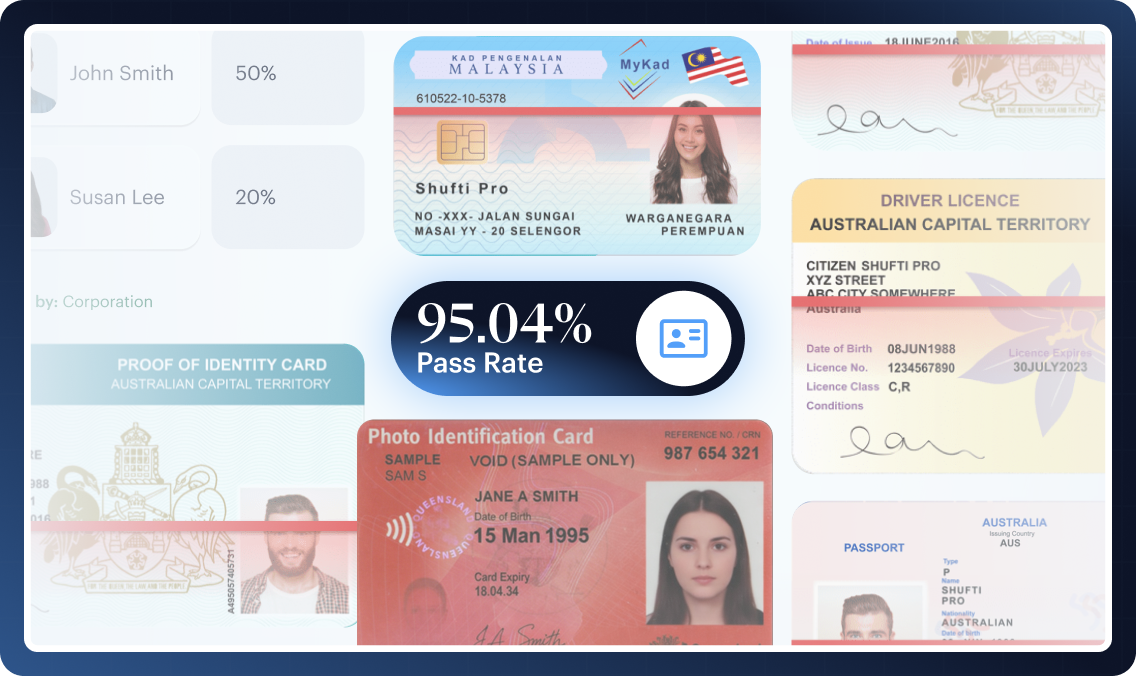
Operational performance for Australia KYC
Our Numbers Speak Volumes
95.04%
Pass Rate
99%
EIDV
Coverage
<15s
Average Document
Verification
Evidence-Ready Checks Across People & Businesses
Individual Documents we Verify
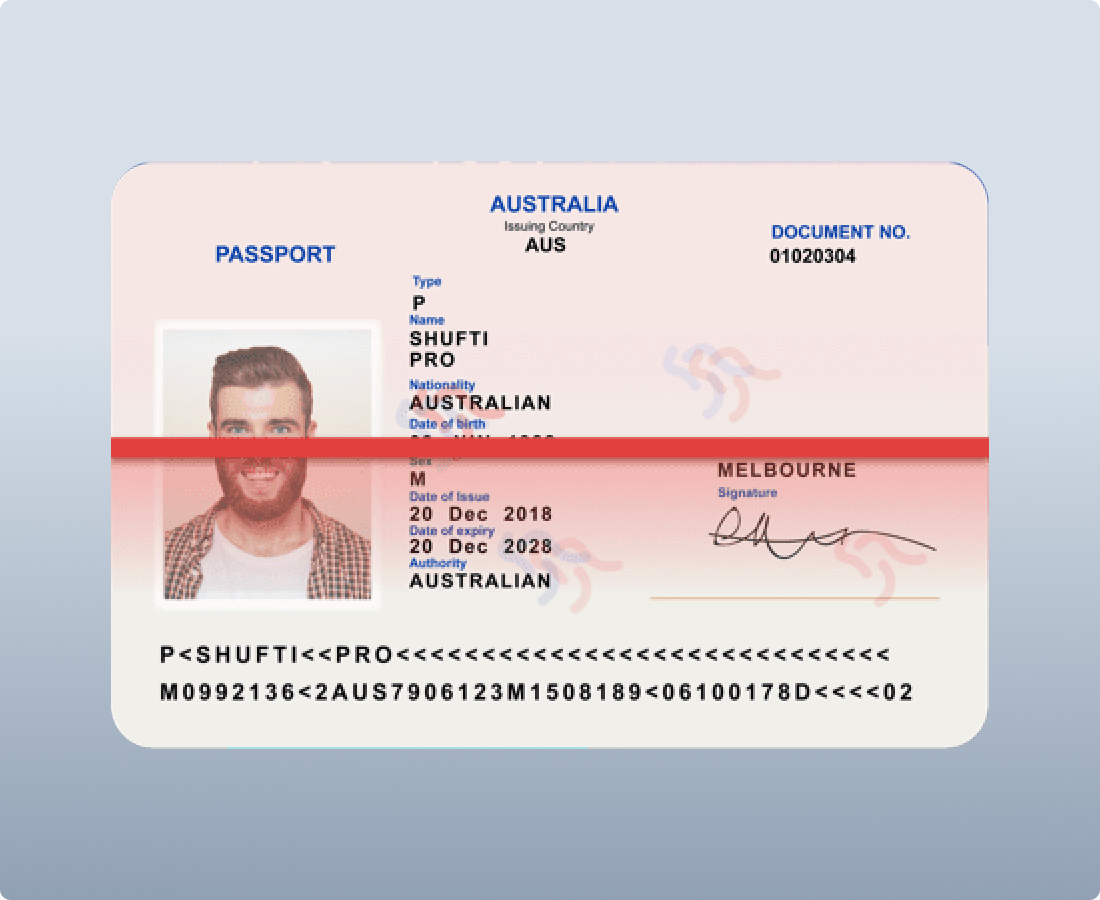
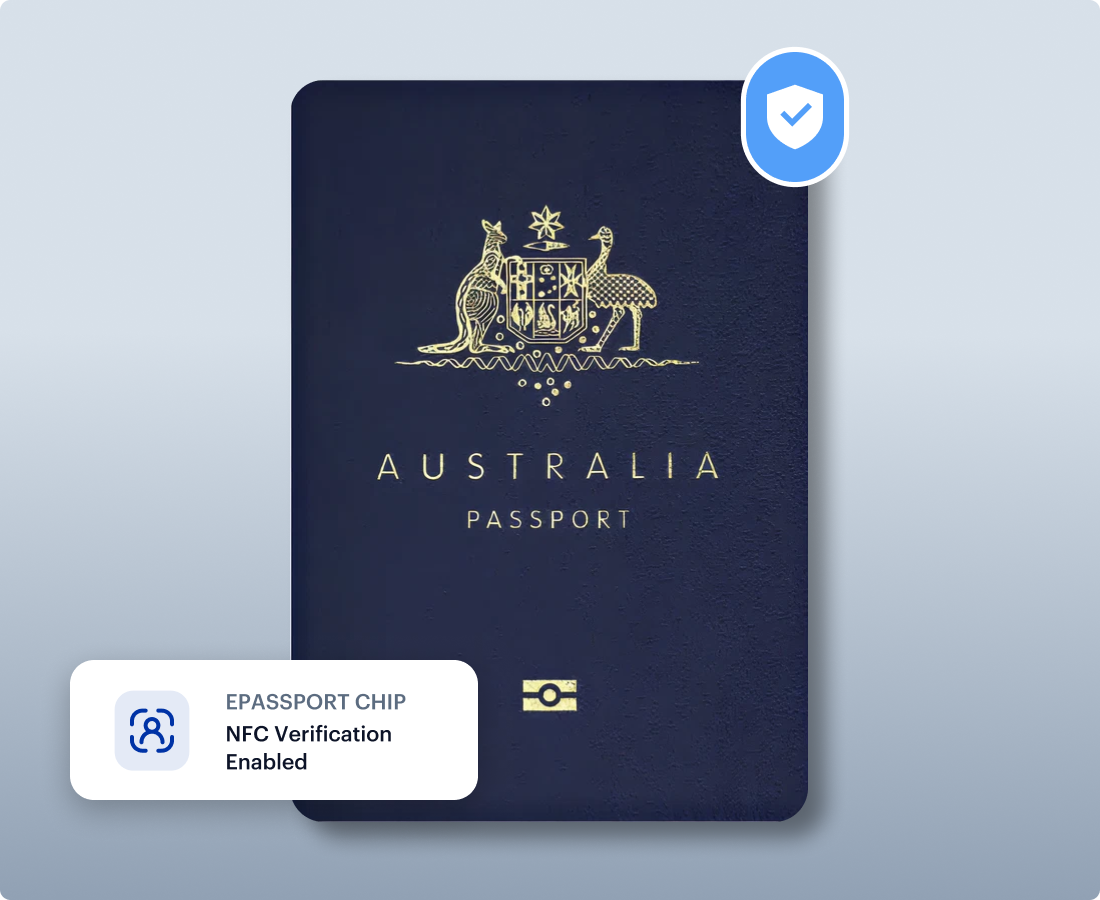
Shufti verifies 40+ official Australian ID document types.
View All Supported DocumentsAustralian Passport (ePassport)
Primary government-issued identity document used for remote and high-assurance onboarding.
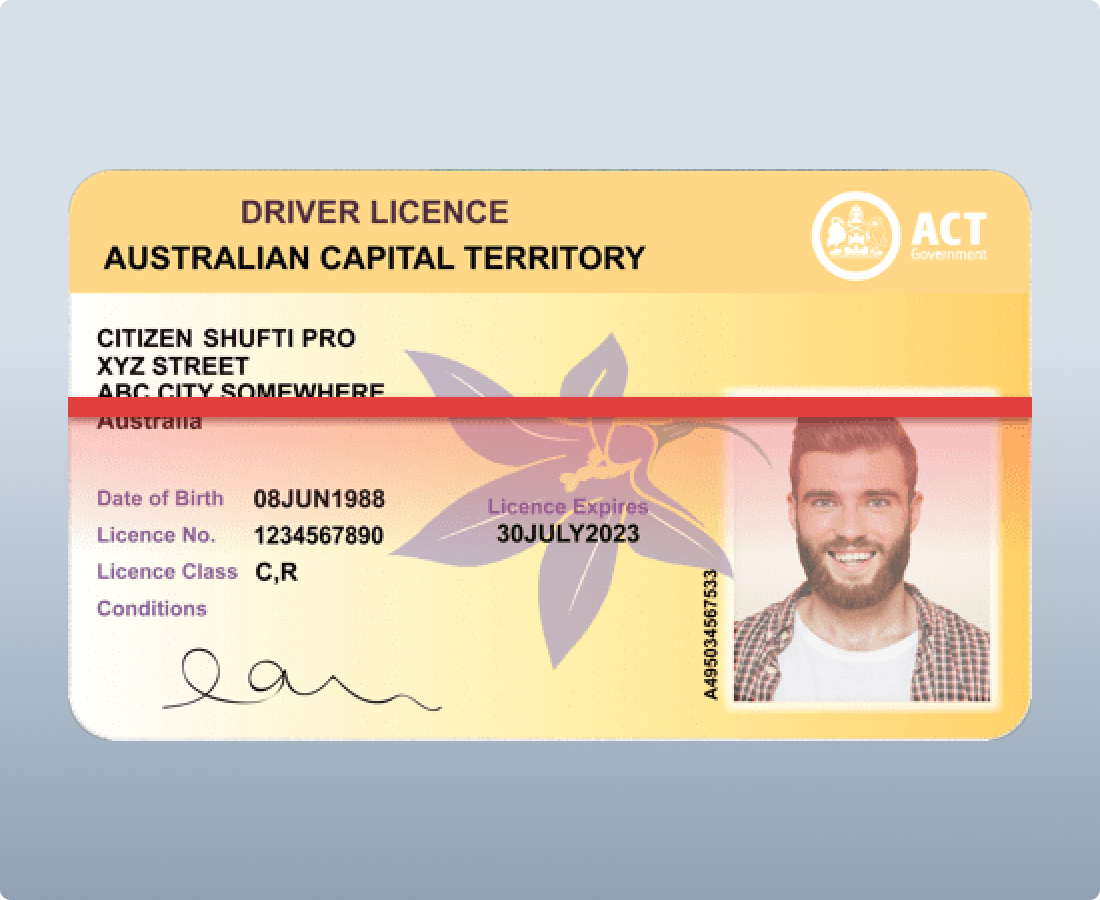
State and Territory Driver’s Licence
Most commonly used domestic photo ID, issued across eight jurisdictions with differing layouts.
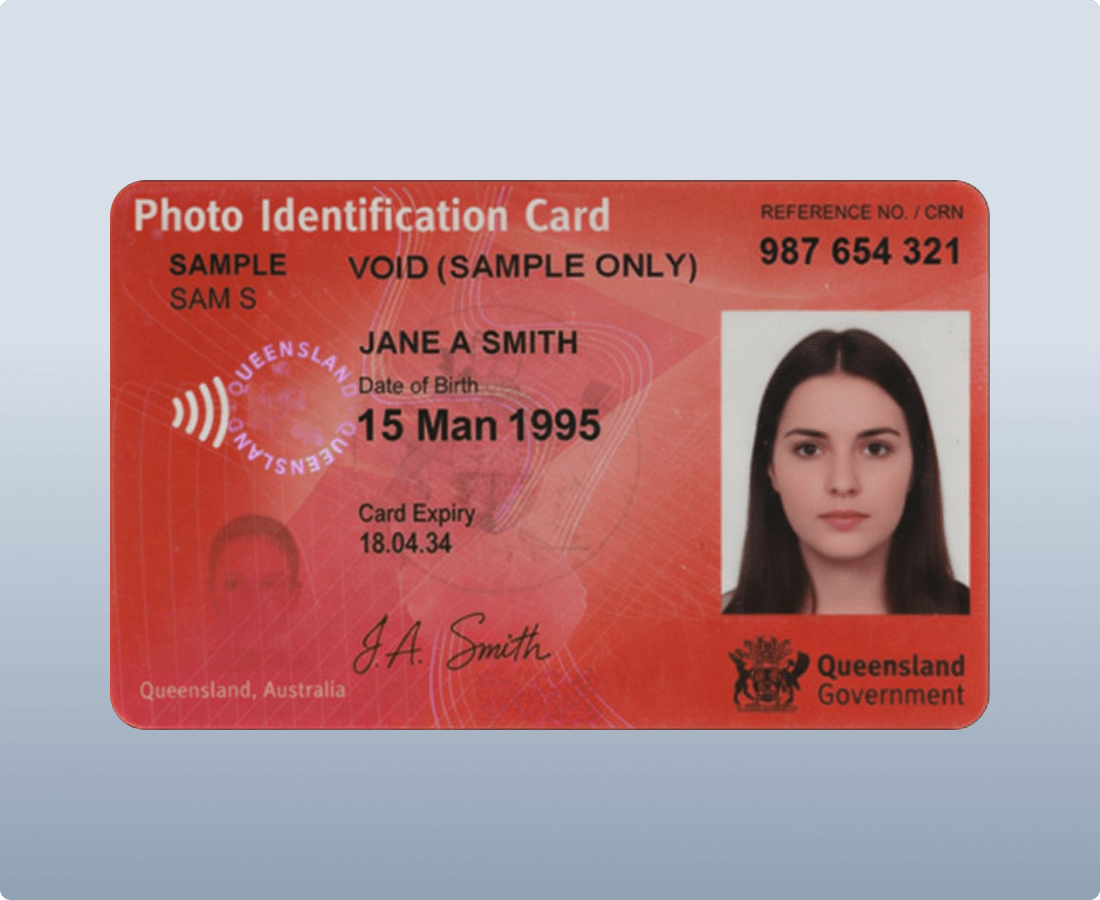
State or Territory Photo Card
Government-issued alternative for non-drivers, widely accepted for standard KYC checks.
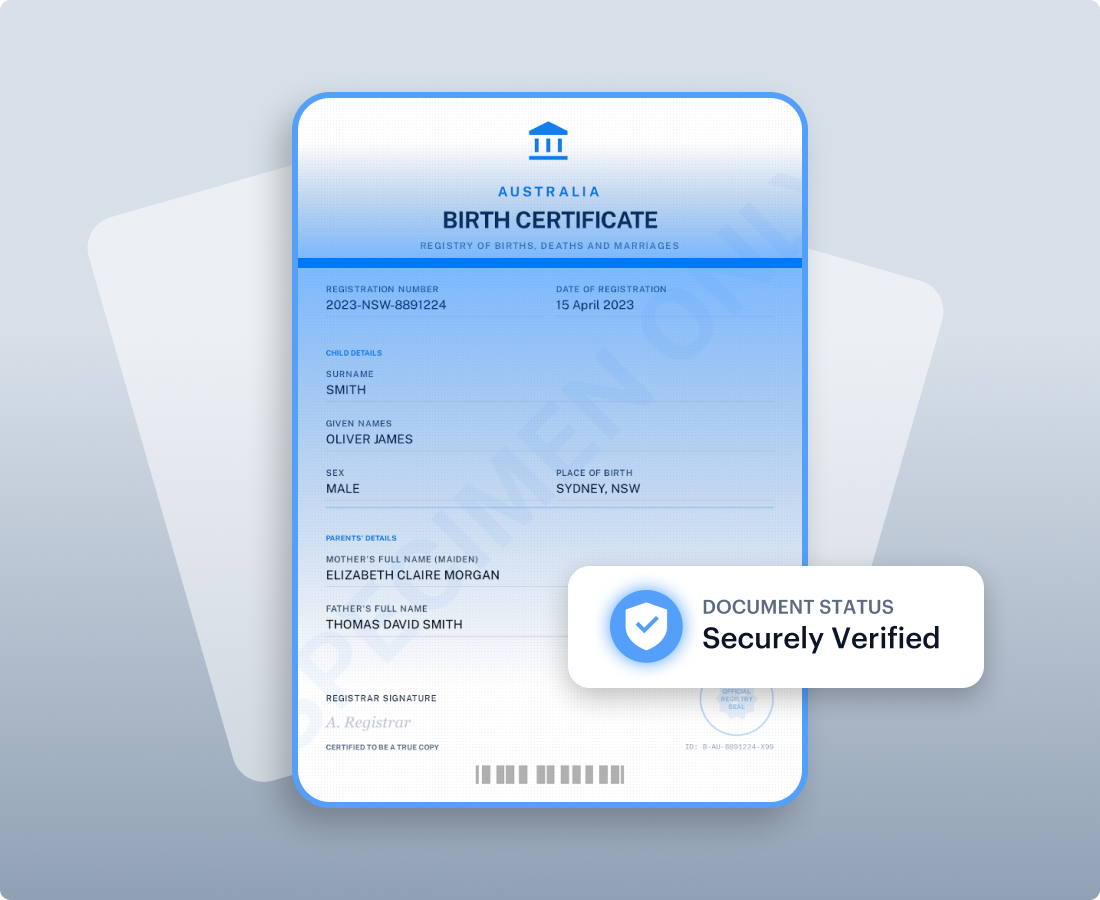
Birth Certificate
Foundational identity document used when users lack photo ID or need to prove legal identity history.
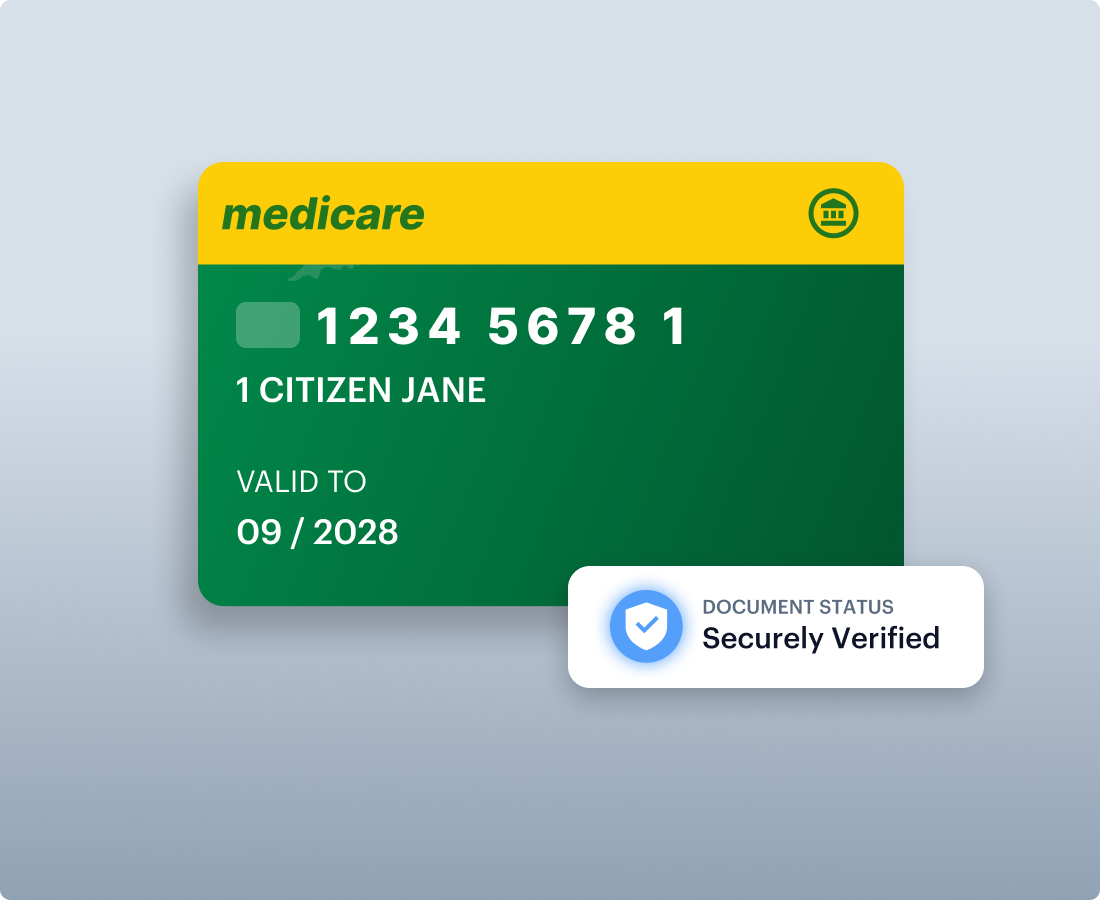
Medicare Card (supporting evidence)
Used as secondary identity evidence under multi-source verification methods.
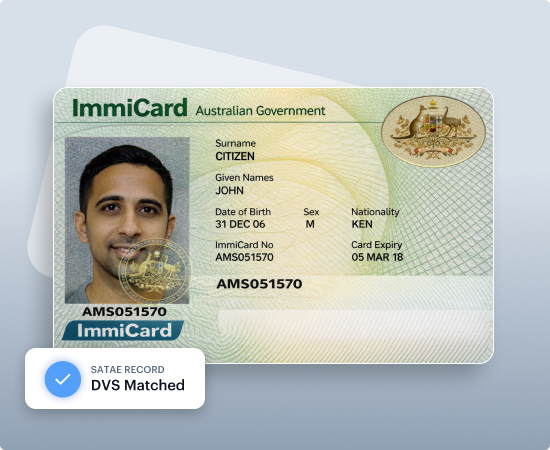
ImmiCard / Visa Status (VEVO) Evidence
Used to confirm immigration status for non-citizens during regulated onboarding.
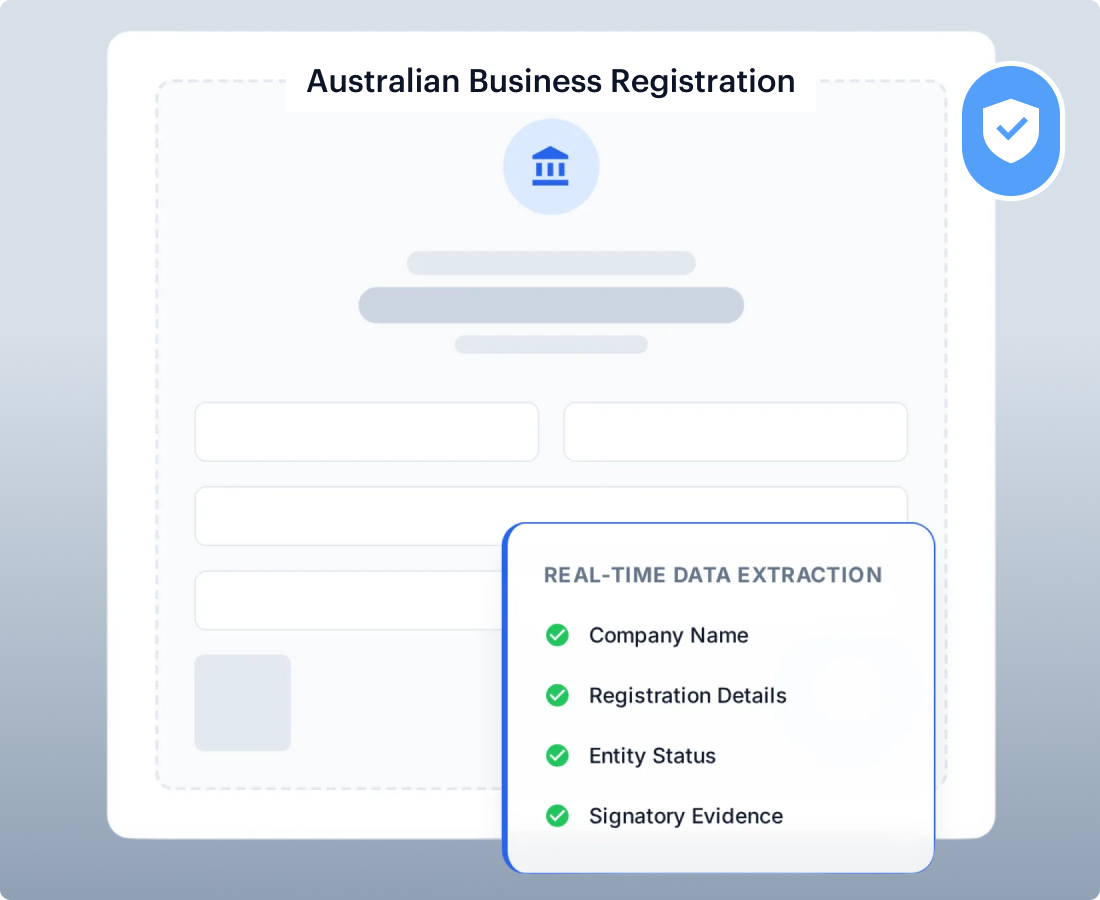
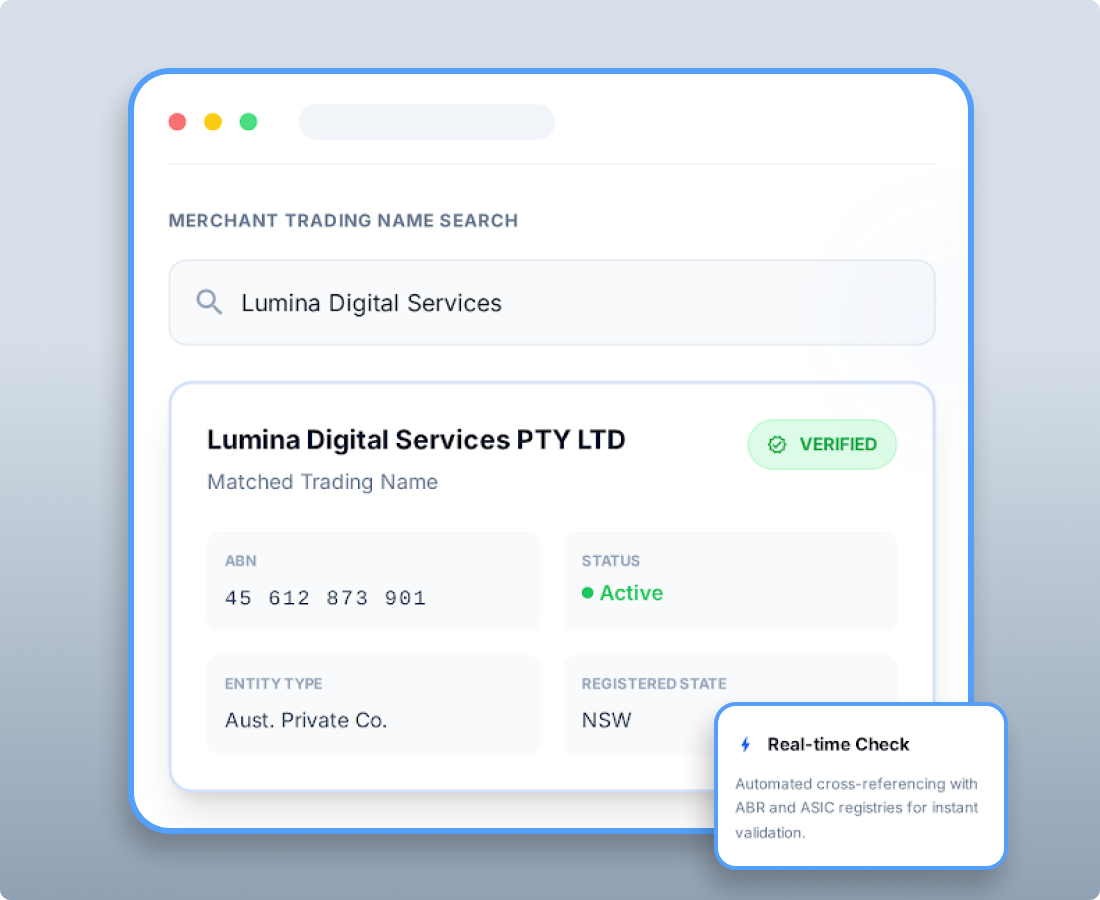
Entity Identity
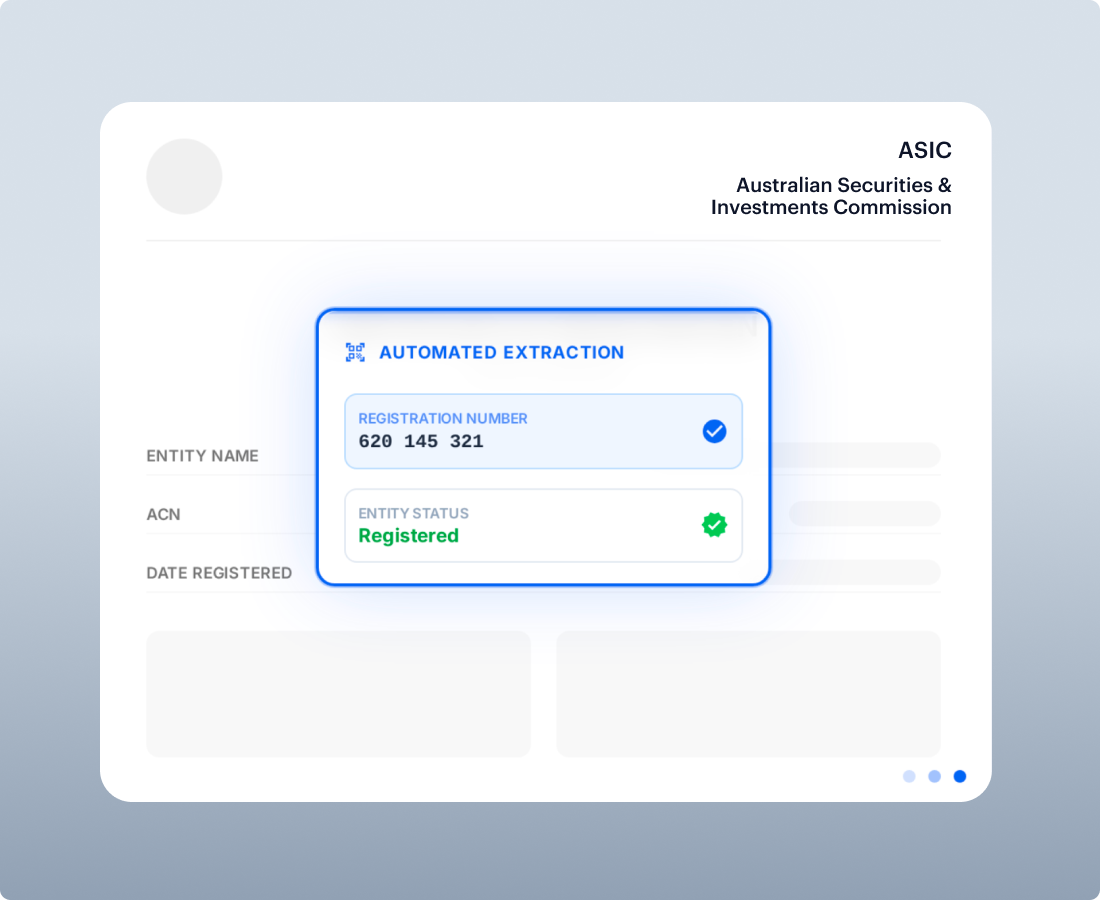
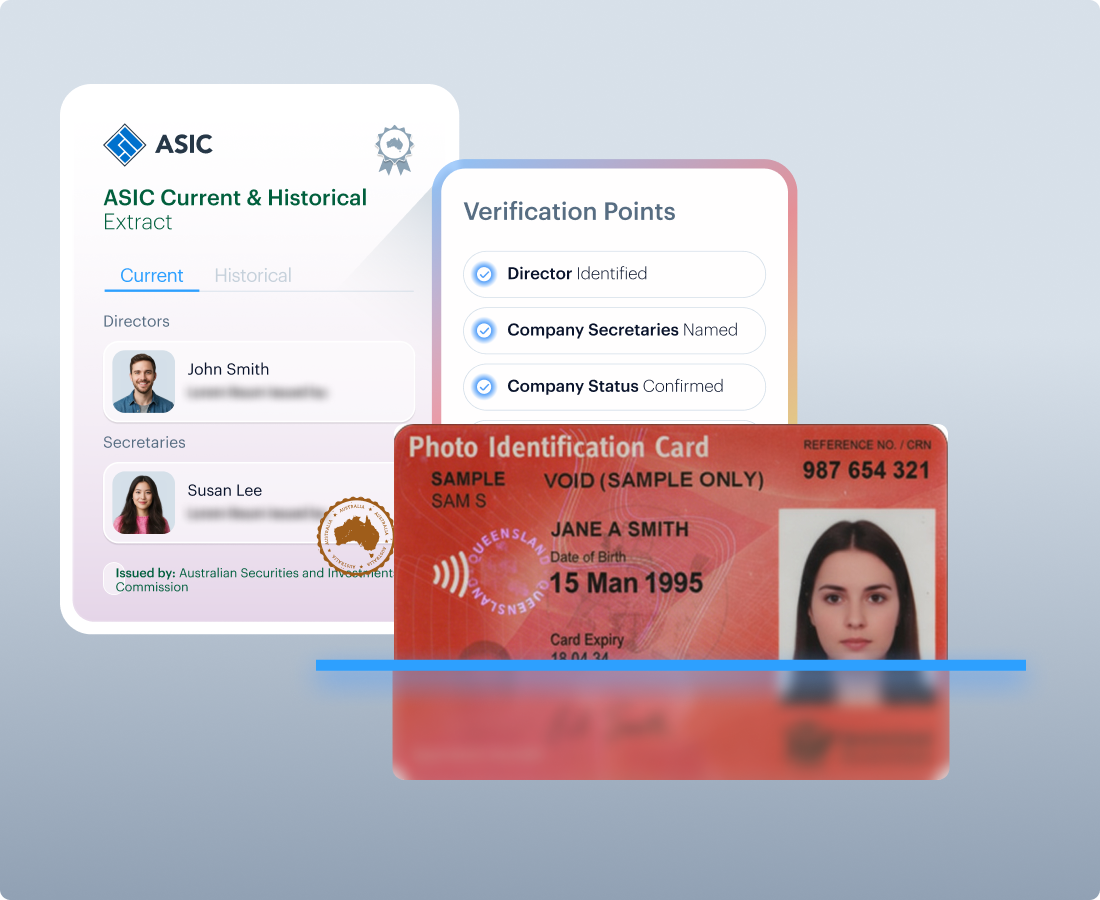
Australian Company Number (ACN) & ASIC Company Extract
Confirms company registration, status, and officeholders.
Australian Business Number (ABN) & ABR Record
Validates business identity and operational registration.
Registered Business Name Extract
Confirms trading names linked to an ABN.
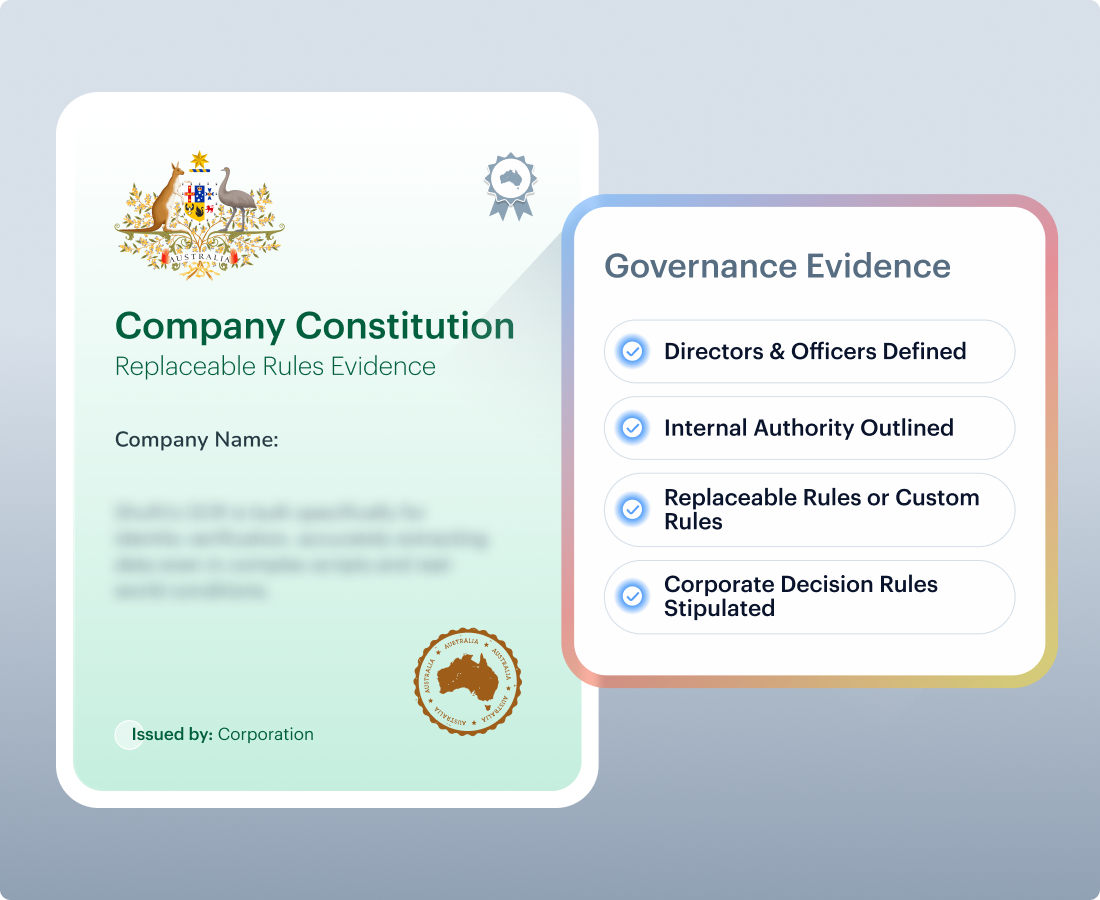
Company Constitution / Replaceable Rules Evidence
Establishes governance structure and internal authority.
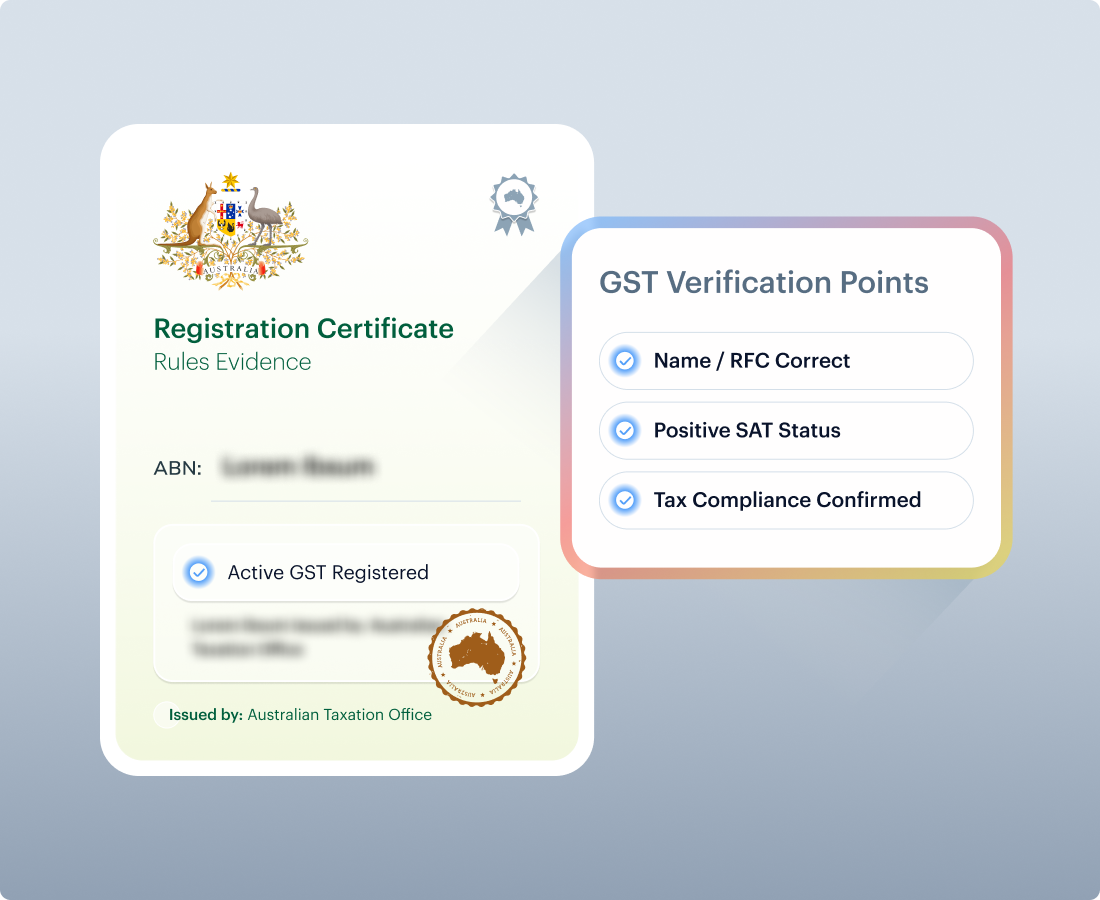
Tax Identity
ABN-linked GST Registration
Confirms Goods and Services Tax registration status.
Ownership & Control (UBO)
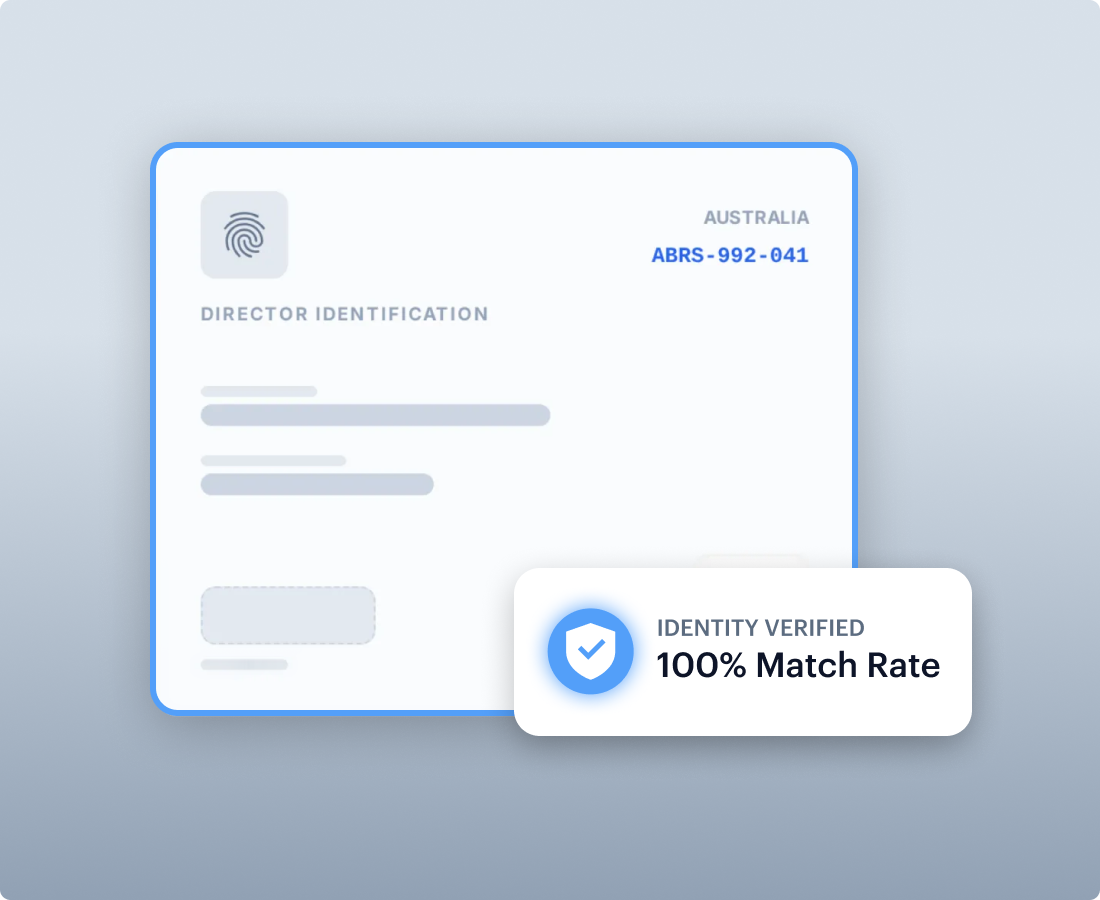
Director Identification Number (Director ID)
Confirms the director's identity under the Australian Business Registry Services.
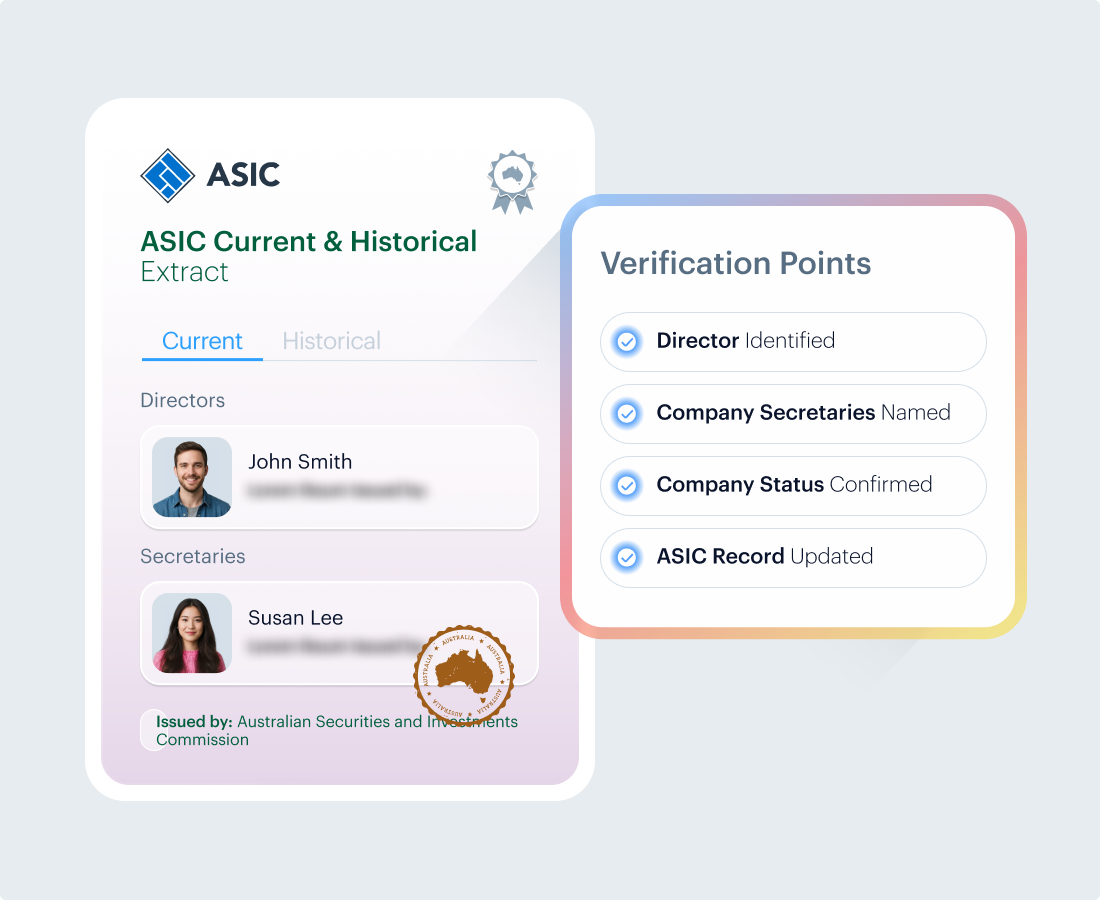
ASIC Current & Historical Company Extracts
Used to identify directors and secretaries.
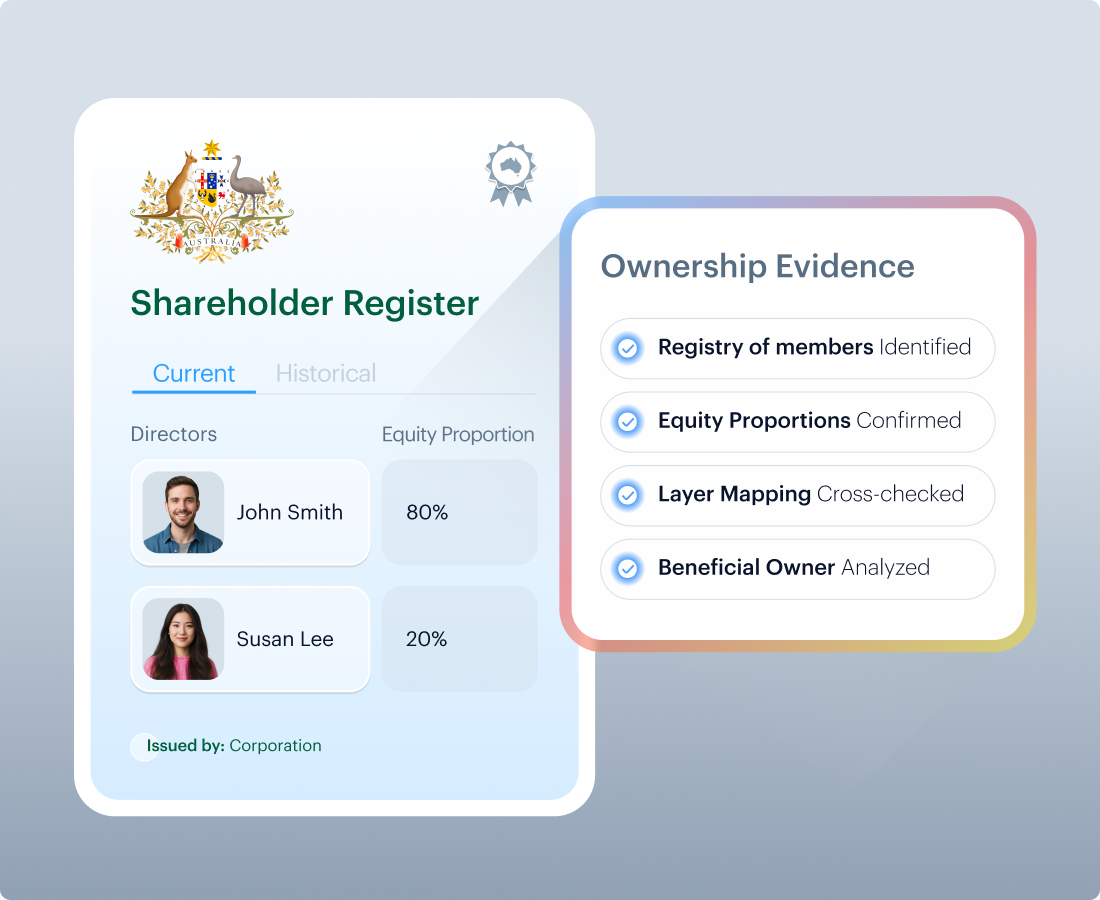
Shareholder Register / Company Register of Members
Supports beneficial ownership mapping across corporate layers.
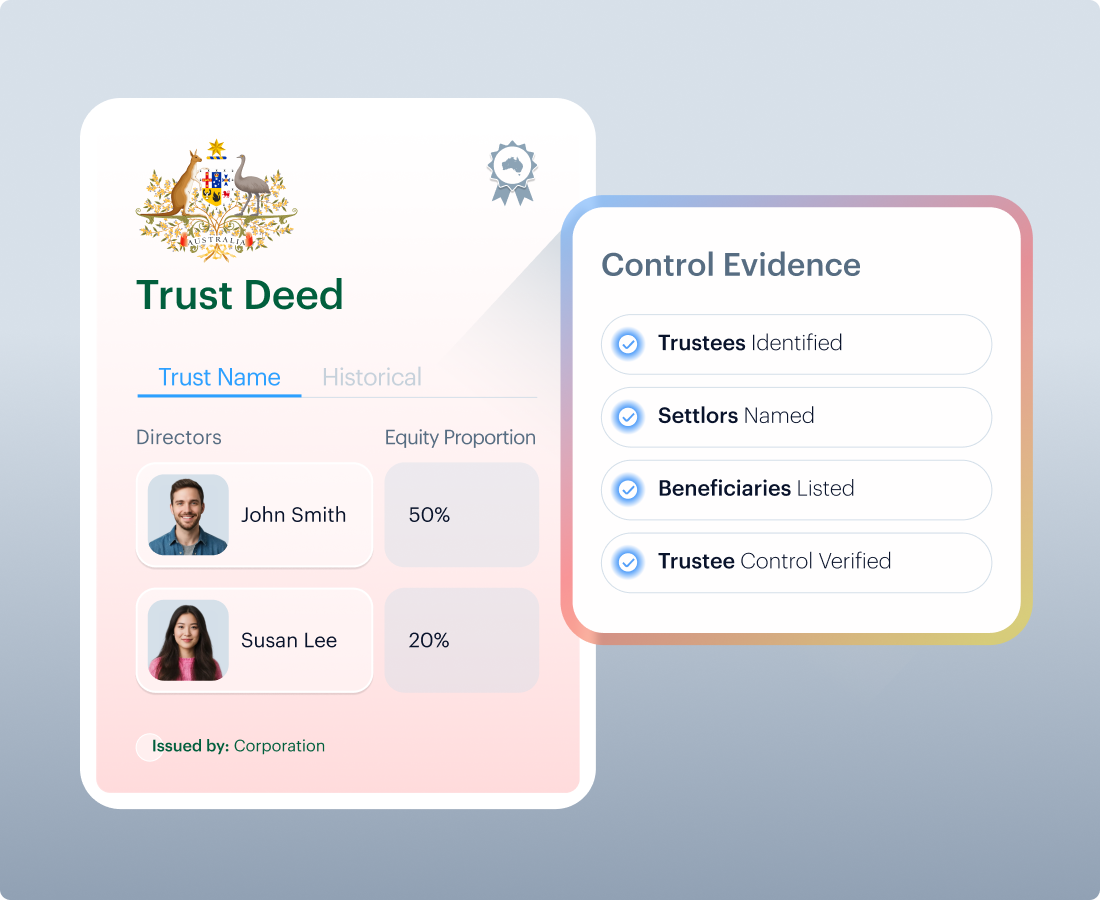
Trust Deed (for Trust-Controlled Entities)
Identifies trustees, settlors, and beneficiaries where control sits via trust.
Languages We Cover
English document handling
Australian identity and registry documents are issued in English; Shufti extracts structured fields across varying state formats.
Name matching across formatting variations
Handles apostrophes, hyphenation, and multiple given names (e.g., O’Connor vs OConnor; Anne-Marie vs Anne Marie).
Consistency across onboarding evidence
Aligns document data, selfie verification, and registry records where formatting inconsistencies create exceptions.
GOVERNANCE & CONTROLS
Audit-Ready Decisions, Lower Operational Drag
Fewer avoidable re-submissions
Shufti’s capture and validation logic reduces retries due to differences in state-based ID formats.
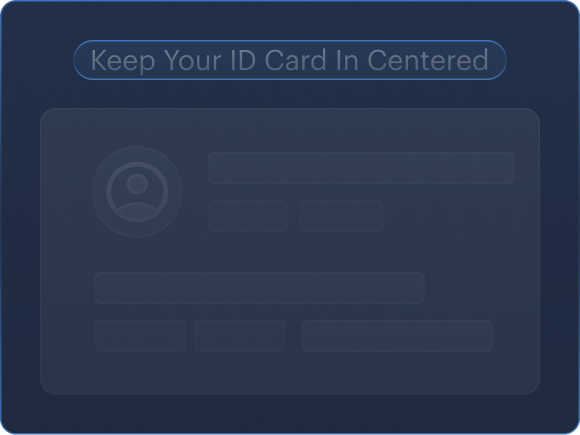
Cleaner audit
trails
Structured verification logs support AUSTRAC recordkeeping and regulatory review.
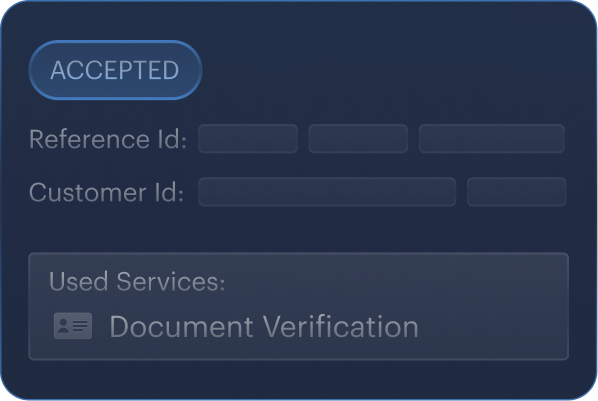
Better name matching outcomes
Normalises apostrophes, hyphenation, and multi-part names common in Australian records.
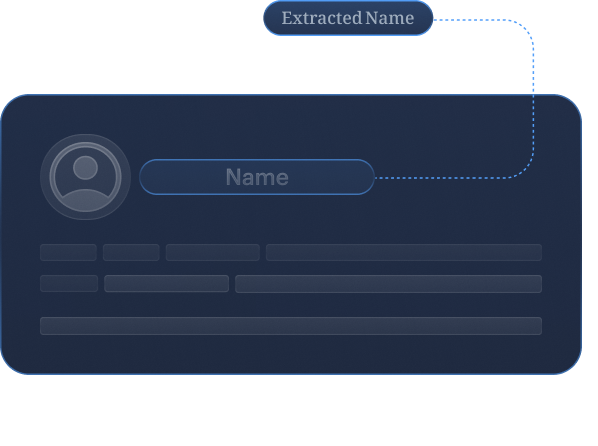
One workflow,
one back office
KYC, KYB, and AML screening managed in a single operational interface.

Primary ID-first flow design
Prioritises Australian passport and driver’s licence verification workflows most commonly used in regulated onboarding.
Australia IDV/KYC Challenges

State ID Format Variations
Driver’s licences differ across states and territories, leading to increased capture errors and longer manual review queues.

Non-Face-to-Face Verification Controls
Remote onboarding must meet AUSTRAC identity standards, increasing compliance friction.

Complex Beneficial Ownership Structures
Layered corporate and trust arrangements increase manual UBO verification workload.

Sanctions & PEP False Positives
Common names and limited unique identifiers increase the number of screening exceptions.
Shufti’s IDV/KYC Solutions for Australia
KYC Solutions

Face Verification
Detects impersonation and presentation attacks in Australia’s remote onboarding environment, supporting non-face-to-face compliance controls.
.
Age Verification
Combines selfie-based age estimation with document verification when required for regulated or age-restricted services.
.
Address Verification
Verifies any address-bearing document, including utility bills (AGL, Origin Energy, EnergyAustralia) and bank statements (Commonwealth Bank, Westpac, NAB, ANZ).
.
Document Verification
Supports passports, driver’s licences, and state-issued photo cards across all Australian jurisdictions, including layout and design differences.
.KYB Solutions


AML Screening


Built To Fit Australia's Compliance Landscape

AUSTRAC
Australia’s AML/CTF regulator and financial intelligence unit. Shufti supports risk-based customer identification, ongoing monitoring, structured recordkeeping, and audit-ready decision logs aligned to AML/CTF obligations.

Australian Securities and Investments Commission (ASIC)
Maintains company registration and director records. Shufti supports registry-based business verification and director validation.

Australian Business Registry Services (ABRS)
Administers Director ID requirements. Shufti supports identity verification of directors and control persons during KYB onboarding.

Australian Business Register (ABR)
Maintains ABN registration data. Shufti validates ABN records used in entity verification workflows. Shufti uses this data comprehensively and holistically to make decisions.

Office of the Australian Information Commissioner (OAIC)
Enforces the Privacy Act and Australian Privacy Principles. Shufti supports controlled processing, consent capture, and compliant retention practices.

Department of Foreign Affairs and Trade (DFAT) – Australian Sanctions Office
Administers Australian sanctions regimes. Shufti enables sanctions screening aligned to domestic and global list requirements.
Deployment Choice
Cloud or on-premise deployment options support local governance and enterprise requirements for controlling access to AML/KYC/KYB data while complying with supervisory expectations under AUSTRAC.
Regulatory Alignment
Aligned to Australia’s AML/CTF Act & Rules for AML/KYC obligations, and the Privacy Act 1988 Australian Privacy Principles (APPs)
Retention controls
Configurable retention and deletion policies aligned with AML/CTF record-keeping rules and Privacy Act requirements to minimise unnecessary retention
Encryption Posture
Strong encryption standards are applied to protect personal and financial data (including identity, source of funds/wealth and transaction data)
Data Controls & Privacy for Australia
Australia AML Sources that Strengthen Decisions

Department of Climate Change

Institute of Social Science Research

Civil Aviation Safety Authority (CASA)

AWB Limited (Australian Wheat Board)
Department of Foreign Affairs and Trade (DFAT)

Australian National Security

Australian Government AUSTRAC

Australian Transaction Reports and Analysis Centre
Australian National Security Website

Australian Securities and Investments Commission (ASIC)
Department of Climate Change
Institute of Social Science Research
Civil Aviation Safety Authority (CASA)
AWB Limited (Australian Wheat Board)
Department of Foreign Affairs and Trade (DFAT)
Australian National Security
Australian Government AUSTRAC
Australian Transaction Reports and Analysis Centre
Australian National Security Website
Australian Securities and Investments Commission (ASIC)
Department of Climate Change
Institute of Social Science Research
Civil Aviation Safety Authority (CASA)
AWB Limited (Australian Wheat Board)
Department of Foreign Affairs and Trade (DFAT)
Australian National Security
Australian Government AUSTRAC
Australian Transaction Reports and Analysis Centre
Australian National Security Website
Australian Securities and Investments Commission (ASIC)
Frequently Asked Questions
What is the primary ID used for KYC in Australia?
State or territory driver’s licences and Australian passports are most commonly used. Secondary documents may be required under multi-source methods.
Does Australia use DVS for identity checks?
Many organisations rely on the Document Verification Service framework for passport, licence and Medicare verification.
What is Australia’s AML reporting authority?
AUSTRAC supervises AML/CTF compliance and receives suspicious matter reports.
Are domestic sanctions screening requirements mandatory?
Yes. Screening should include Australian sanctions administered by DFAT, as well as global lists.
What evidence is required for beneficial ownership?
Entities must identify directors and shareholders and verify control structures under AML/CTF obligations.
How does Shufti handle name variations?
The platform normalises hyphenation, apostrophes, and multi-part names to reduce false mismatches.
Does Australia require local data residency?
Many organisations adopt in-country processing policies due to regulatory and privacy risk appetite. Australia hosts multiple hyperscaler regions.
What happens if document capture fails?
Configurable retry logic and assisted workflows reduce drop-off while preserving structured audit evidence.
Build a Australia-ready KYC, KYB & AML programme with Shufti
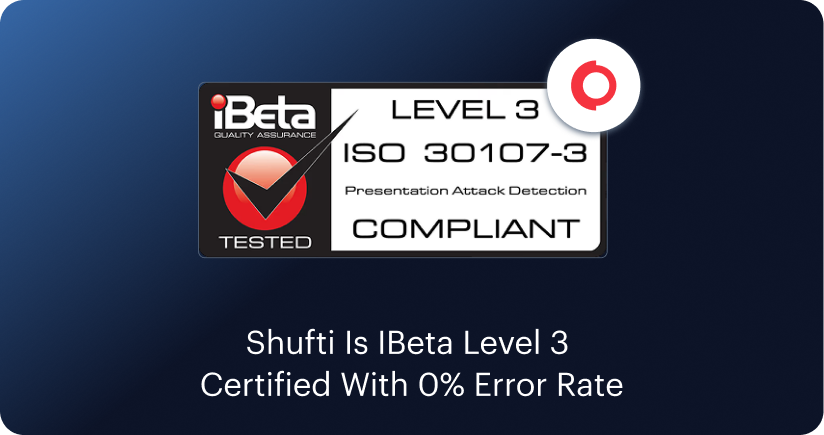
INDEPENDENTLY AUDITED. GLOBALLY CERTIFIED.
Certified to Global Standards






PROVEN WORKFLOWS
Use Cases for Regulated Growth in Australia
Accelerate Growth, Eliminate Friction
Onboard users in seconds, not days. Deploy tiered address verification flows that maximise completion rates for genuine users while filtering out synthetic fraud.


Onboard Global Traders in Real-Time
Verify investors across 240+ countries & territories. Ensure compliance with international financial regulations while preventing identity theft and high-risk chargebacks.



Secure Trust at Every Transaction
Automate KYC and AML workflows to reduce manual onboarding costs. Strengthen residency checks while delivering the frictionless digital experience modern customers expect.



Power a Fair & Secure Player Experience
Reduce bonus abuse and multi-accounting rings at the door. Enforce location rules and trigger step-up checks without disrupting the player journey.



Build a Trusted, Verified Workforce
Screen freelancers and drivers at scale. Verify residency and reduce onboarding friction while maintaining trust between users.



Scale Your Exchange with Confidence
Balance anonymity with compliance. Instantly verify user jurisdiction to meet Travel Rule obligations and help stop abuse without slowing down legitimate trading volume.



Reduce fraud without blocking growth
Shufti supports marketplace integrity by verifying seller and buyer identities, enabling age-gated journeys where needed, and preserving evidence to support investigations, disputes and risk-led enforcement actions.




Accelerate Growth, Eliminate Friction
Onboard users in seconds, not days. Deploy tiered address verification flows that maximise completion rates for genuine users while filtering out synthetic fraud.
Onboard Global Traders in Real-Time
Verify investors across 240+ countries & territories. Ensure compliance with international financial regulations while preventing identity theft and high-risk chargebacks.
Secure Trust at Every Transaction
Automate KYC and AML workflows to reduce manual onboarding costs. Strengthen residency checks while delivering the frictionless digital experience modern customers expect.
Power a Fair & Secure Player Experience
Reduce bonus abuse and multi-accounting rings at the door. Enforce location rules and trigger step-up checks without disrupting the player journey.
Build a Trusted, Verified Workforce
Screen freelancers and drivers at scale. Verify residency and reduce onboarding friction while maintaining trust between users.
Scale Your Exchange with Confidence
Balance anonymity with compliance. Instantly verify user jurisdiction to meet Travel Rule obligations and help stop abuse without slowing down legitimate trading volume.
Reduce fraud without blocking growth
Shufti supports marketplace integrity by verifying seller and buyer identities, enabling age-gated journeys where needed, and preserving evidence to support investigations, disputes and risk-led enforcement actions.
Accelerate Growth, Eliminate Friction
Onboard users in seconds, not days. Deploy tiered address verification flows that maximise completion rates for genuine users while filtering out synthetic fraud.
Onboard Global Traders in Real-Time
Verify investors across 240+ countries & territories. Ensure compliance with international financial regulations while preventing identity theft and high-risk chargebacks.
Secure Trust at Every Transaction
Automate KYC and AML workflows to reduce manual onboarding costs. Strengthen residency checks while delivering the frictionless digital experience modern customers expect.
Power a Fair & Secure Player Experience
Reduce bonus abuse and multi-accounting rings at the door. Enforce location rules and trigger step-up checks without disrupting the player journey.
Build a Trusted, Verified Workforce
Screen freelancers and drivers at scale. Verify residency and reduce onboarding friction while maintaining trust between users.
Scale Your Exchange with Confidence
Balance anonymity with compliance. Instantly verify user jurisdiction to meet Travel Rule obligations and help stop abuse without slowing down legitimate trading volume.
Reduce fraud without blocking growth
Shufti supports marketplace integrity by verifying seller and buyer identities, enabling age-gated journeys where needed, and preserving evidence to support investigations, disputes and risk-led enforcement actions.
Let’s Tailor your journey
Just a few quick questions to guide your Shufti experience.

Shufti
Market Positioning and Commercial Assessment

Industry stands at 1.7rating

Best ID Verification Innovator

TOP 10 KYC Solution Provider
Best Client Onboarding Solution

Samer Al Tamimi@CEO of Safwa Bank
We take our client's privacy very seriously and always look for new innovative solutions to ensure a safe banking experience. Working with Shufti feels like a breath of fresh air, as their 100% in-house tech keeps our customer's data free from vulnerabilities and fully safe and protected.




PROVEN PLAYBOOKS
Explore Practical KYC & AML Resources
16 August, 2025
5 minutes read
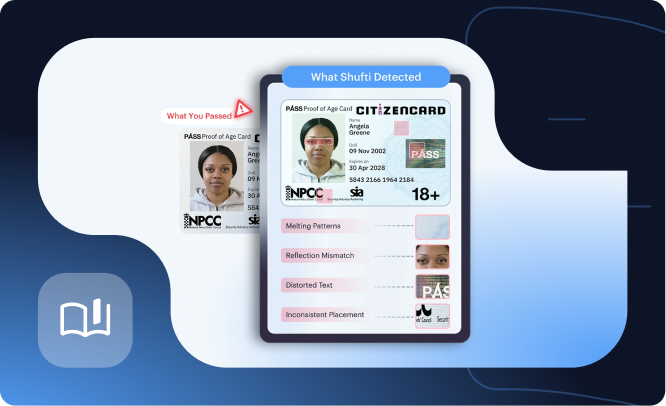
How Much of What You’ve Verified Is Actually Real?
Shufti’s Deepfake Blindspot Audit now runs fully inside your AWS environment, auditing historic KYC for manipulation signals without moving sensitive data off-prem.
whitepapers